


Why Medical Malpractice Ads Are the Hardest to Get Right
- Corey Larson

- May 14
- 7 min read
Understanding the High Stakes of ER Malpractice Birth Injury Claims

ER malpractice birth injury cases are among the most legally complex — and most emotionally charged — claims in personal injury law. When an emergency room fails a pregnant patient, the consequences can be permanent: cerebral palsy, Hypoxic-Ischemic Encephalopathy (HIE), Erb's palsy, or worse.
Here is a quick overview of what these cases involve:
What it is: Negligence by ER staff during a pregnancy emergency that causes harm to the baby or mother
Common errors: Delayed C-sections, triage failures, medication mistakes, failure to monitor fetal distress
Who is liable: Attending physicians, nurses, hospitals (including for independent contractor doctors under apparent authority)
Key law: EMTALA requires federally funded ERs to screen and stabilize pregnant patients regardless of ability to pay
Injuries linked to ER errors: Cerebral palsy, HIE, brachial plexus injuries, Erb's palsy
Compensation: Medical costs, lifelong care, special education, lost wages
Time limits: Most states toll the statute of limitations for minors until age 18
For law firms, advertising these cases is a different challenge entirely. The medical malpractice ad space is one of the most competitive — and expensive — in all of legal marketing. Cost-per-lead can reach $1,000 or more, and the 19% success rate for medical malpractice payouts means conversion from lead to signed client is brutal. Getting the messaging right for something as sensitive as an er malpractice birth injury requires more than a big ad budget. It requires deep trust-building, clinical credibility, and airtight compliance with bar association advertising rules.
Most firms get at least one of those wrong.
I'm Corey Larson, and at Outlier Creative Agency I've spent years helping law firms craft high-performance content and campaigns specifically for high-stakes practice areas like er malpractice birth injury claims. In the sections ahead, I'll break down exactly why these ads are so hard to get right — and what the best-performing firms do differently.
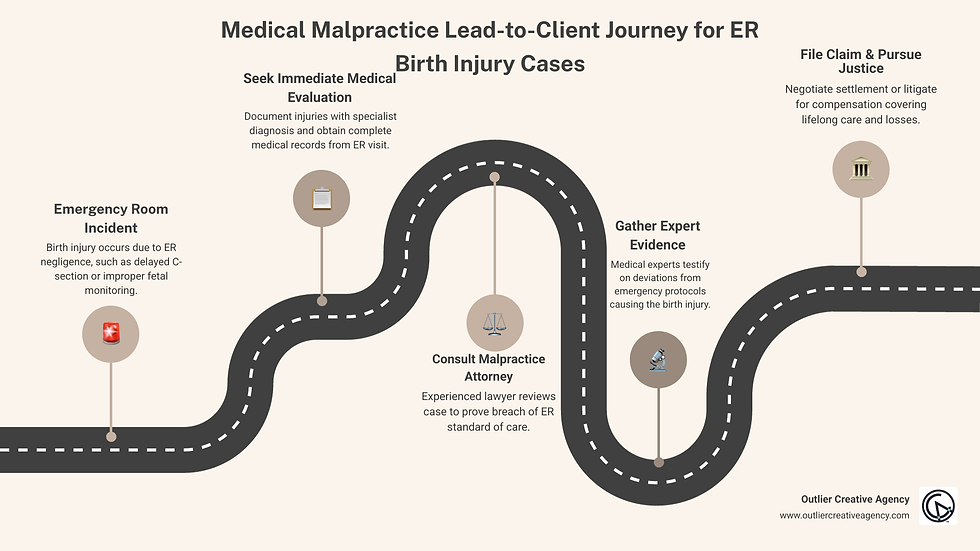
When we talk about an er malpractice birth injury, we aren't just discussing a medical complication; we are looking at a failure of the safety net. In places like Los Angeles and Austin, emergency rooms are the front lines of healthcare. However, they are often overcrowded and understaffed. Research shows that in 2009, the average ER wait time was six hours, with over 400,000 patients waiting 24 hours or more. By April 2026, these pressures haven't disappeared; they’ve evolved.
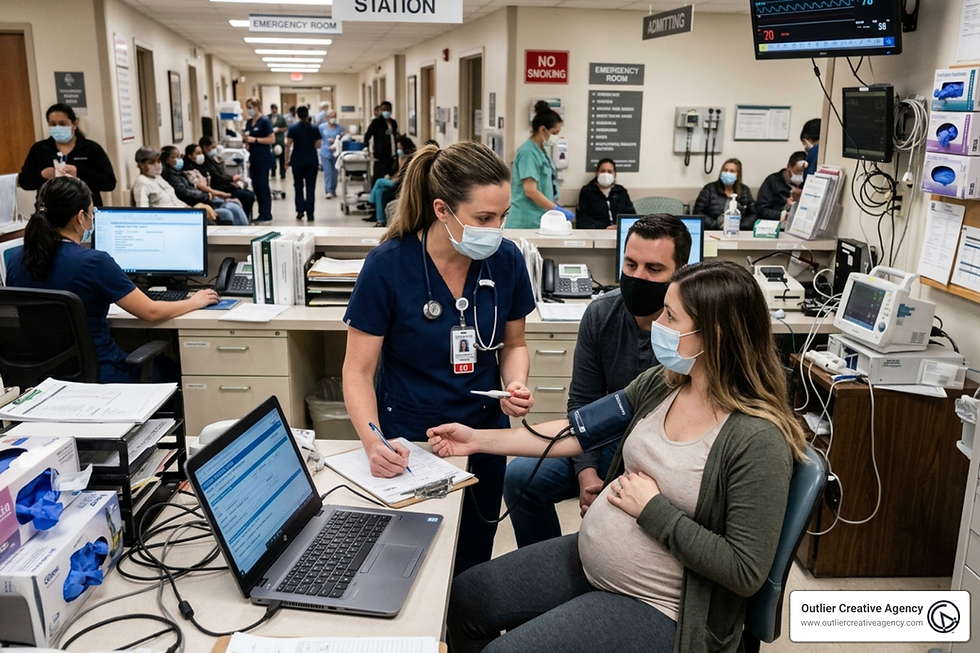
A critical component of these cases is the Emergency Medical Treatment and Labor Act (EMTALA). This federal law dictates that any hospital receiving federal funds must provide a medical screening exam to determine if an emergency medical condition exists. For a pregnant patient, this includes evaluating the health of both the mother and the unborn child. If an emergency is found, the hospital must stabilize the patient before any transfer can occur. Negligence often begins at the triage desk—where a pregnant woman's symptoms are dismissed or she is "forgotten" in a waiting room while fetal distress escalates.
Common errors leading to these injuries include:
Triage Failures: Failing to recognize signs of preeclampsia or placental abruption.
Delayed Diagnosis: Missing the symptoms of fetal hypoxia.
Improper Monitoring: Failing to send a pregnant patient to an obstetrical unit after a trauma, such as a car accident.
Identifying Common Errors in ER Malpractice Birth Injury Cases
The window for preventing a permanent brain injury is often measured in minutes, not hours. One of the most common benchmarks used in litigation is the ACOG "decision-to-incision" interval. For an emergency C-section, the standard is generally 30 minutes. If an ER team takes 60 or 90 minutes to move a patient to surgery because of administrative delays or lack of available staff, that delay can be the direct cause of a child's cerebral palsy.
Common Medical Errors Causing Birth Injuries | Erin Marshall highlights that errors aren't always about what was done, but what was not done. This includes failing to monitor fetal heart rate tracings correctly or failing to recognize that a baby is in a breech position. Medication errors also plague the ER environment, where poor communication or rushed orders can lead to the administration of drugs that are contraindicated for pregnancy.
Proving Causation in an ER Malpractice Birth Injury Lawsuit
Proving that an ER mistake caused a specific injury is the highest hurdle in these cases. We often see children diagnosed with Hypoxic-Ischemic Encephalopathy (HIE), which is a brain injury caused by a lack of oxygen and blood flow. According to Birth Injury Medical Malpractice Claims | Medical Malpractice Authority, establishing causation requires linking the "sentinel event" (the ER error) to the physical outcome.
For instance, Erb’s palsy and other brachial plexus injuries are often linked to excessive force during delivery—specifically, pulling on the baby's head during shoulder dystocia. Statistics show that approximately 50% of Erb's palsy injuries affect the C5, C6, and C7 nerve roots. To win these cases, your firm needs expert neurological and obstetric testimony to prove that the injury wasn't a natural complication, but a result of a provider's deviation from the standard of care.
Proving the Standard of Care in Emergency Settings
In a typical medical malpractice case, the "reasonable person" standard applies, but it is viewed through the lens of a similarly trained professional in similar circumstances. In an ER context, the chaos of the environment is often used as a defense. However, "we were busy" is not a legal excuse for negligence.
To succeed, a plaintiff must prove their case by a preponderance of the evidence, meaning it is more likely than not (a 51% burden) that the negligence caused the harm.
Feature | ER Negligence | Standard Labor & Delivery Malpractice |
Primary Regulation | EMTALA & State Tort Law | State Tort Law |
Staffing | General ER Physicians/Nurses | OB/GYNs & Labor/Delivery Nurses |
Initial Contact | Triage (often non-specialized) | Scheduled or Direct Admit to OB |
Liability Focus | Failure to screen/stabilize | Failure to manage labor/delivery |
One nuance we often emphasize in Law Firm SEO in 2024: Top 8 Tactics to Increase Online Visibility and Client Leads is the importance of educating potential clients on vicarious liability. In many ERs, the doctors are independent contractors, not hospital employees. However, under the doctrine of "apparent authority," a hospital can still be held liable if they didn't clearly tell the patient the doctor wasn't an employee. Since most patients in labor don't stop to read the fine print on a clipboard, the hospital often remains on the hook for the doctor's mistakes.
Why Medical Malpractice Keywords Command Premium Prices
If you've looked at your Google Ads dashboard lately, you know that keywords related to er malpractice birth injury are eye-wateringly expensive. By 2026, the U.S. personal injury market is projected to surpass $63 billion in revenue. In competitive hubs like Los Angeles and Austin, the cost-per-lead (CPL) for medical malpractice can easily exceed $1,000.
Why is the price so high? It comes down to the "High-Severity" impact. While the success rate for medical malpractice claims resulting in payouts is only about 19% (compared to 61% for car accidents), the value of a win is astronomical. A single birth injury settlement can reach into the millions to cover lifelong care, making the high acquisition cost a calculated risk for many firms.
We help firms navigate this by focusing on Local SEO Checklist for Law Firms: Geo-Targeted Strategies That Drive Consultations. If you are paying $100 per click, you cannot afford to waste traffic on people looking for "free medical advice." Your digital strategy must be surgical, targeting high-intent users who are specifically searching for legal recourse after an ER error.
Compliance and Conversion: Building a Trustworthy Digital Front Door
Your website is often the first point of contact for a grieving or stressed parent. At Outlier Creative Agency, we call this The Digital Front Door: Why Law Firms Need High-Performance Web Design. For er malpractice birth injury cases, the design must balance professional authority with deep empathy.
However, you have to play by the rules. Bar association advertising rules in California and Texas are strict regarding "guarantees" or "promises" of results. To build a trustworthy presence while staying compliant, focus on:
E-E-A-T Signals: Showcase your experience, expertise, authoritativeness, and trustworthiness. This means highlighting your years in practice and your specific focus on birth trauma.
HIPAA Considerations: Ensure any contact forms or intake processes are secure and respect patient privacy.
Trust-Based Copywriting: Instead of "We win big," use "We help families secure the resources their children need for a lifetime of care."
Client Testimonials: Use them wisely. Ensure they are verified and comply with local ethics rules regarding "past results."
Frequently Asked Questions about ER Birth Injury Malpractice
What is the role of EMTALA in ER birth injury cases?
EMTALA (Emergency Medical Treatment and Labor Act) requires all federally funded hospitals to provide a medical screening exam to any pregnant patient who comes to the ER. If she is in labor or experiencing an emergency, the hospital must stabilize her and the baby. They cannot refuse treatment or transfer her just because she lacks insurance or the ability to pay. A violation of EMTALA can be a powerful component of a malpractice claim.
How long do families have to file an ER birth injury claim?
Statutes of limitations vary by state. In many jurisdictions, while the parents may have a shorter window (often 2 years), the deadline for the minor child is "tolled." This means the clock doesn't start ticking until the child reaches age 18. However, we always advise families to act quickly. Evidence like fetal monitor strips and hospital logs can disappear over time, and witnesses' memories fade.
What compensation is available for lifelong birth injuries?
Compensation in an er malpractice birth injury case is designed to cover the "economic" and "non-economic" damages. This includes:
Immediate and future medical costs (surgeries, therapies).
Lifelong caregiving expenses.
Specialized education and housing modifications.
Loss of future earning capacity for the child.
Pain and suffering for the child and, in some cases, the parents.
Can a hospital be held liable for an independent contractor doctor?
Yes, under the legal doctrine of apparent authority. If a hospital holds itself out as a provider of emergency services and does not clearly disclose to the patient that the ER doctors are independent contractors, the hospital can be held vicariously liable for that doctor's negligence. This is a common strategy in birth injury litigation to ensure there is adequate insurance coverage for the child's lifetime needs.
Conclusion
Marketing for er malpractice birth injury cases is a marathon, not a sprint. It requires a sophisticated blend of data-driven PPC, high-authority SEO, and a website that acts as a compassionate "digital front door." Because these cases are so high-stakes, your marketing needs to reflect the same level of precision that you bring to the courtroom.
At Outlier Creative Agency, we specialize in helping law firms nationwide—from Los Angeles to Austin—increase their caseloads through integrated marketing strategies. We understand the nuances of medical malpractice advertising and the strict compliance standards required by state bars. If you are ready to build an authoritative online presence and attract the right leads for your firm, we are here to help.
Stop burning your budget on generic leads. Let’s build a strategy that works. Contact Outlier Creative Agency today to schedule your consultation, or learn more about our PPC Advertising for Law Firms.


Comments