

Master law firms digital marketing in 2026 with proven SEO, PPC, and compliance strategies that drive client growth and measurable ROI.
Is Your Law Firm Invisible Online? Here's What You Need to Know
Law firms digital marketing is the practice of using online channels — SEO, paid ads, social media, content, and web design — to attract and convert potential clients searching for legal help.
Quick answer for law firm owners and marketing directors:
- 96% of people use search engines when looking for legal services, and nearly 90% use Google specifically
- Your website is your most important marketing asset — it's often the first impression a potential client gets
- Core channels include SEO, Google Ads (PPC), Local Services Ads, social media, and content marketing
- Budget benchmark: invest between 2% and 12% of gross revenue on marketing, depending on your practice area and market
- Target ROI: a 5:1 revenue-to-cost ratio is the widely accepted benchmark for legal marketing spend
- Speed matters: 66% of potential clients expect a response from an attorney within one day — and many hire within hours
Most law firms still rely heavily on referrals. That worked well for decades. But today's clients don't ask a friend first — they Google it.
If your firm isn't showing up where people are searching, you're handing cases to competitors who are. The good news? A smart digital strategy doesn't require a massive budget or a full marketing department. It requires the right approach.
I'm Corey Larson, founder of Outlier Creative Agency, where we've spent years helping law firms cut through the noise with high-quality content, video production, and targeted digital strategies built specifically for the legal industry — because law firms digital marketing demands a different level of precision than most industries. Let's break down exactly what works, what doesn't, and how to build a strategy your firm can actually execute.
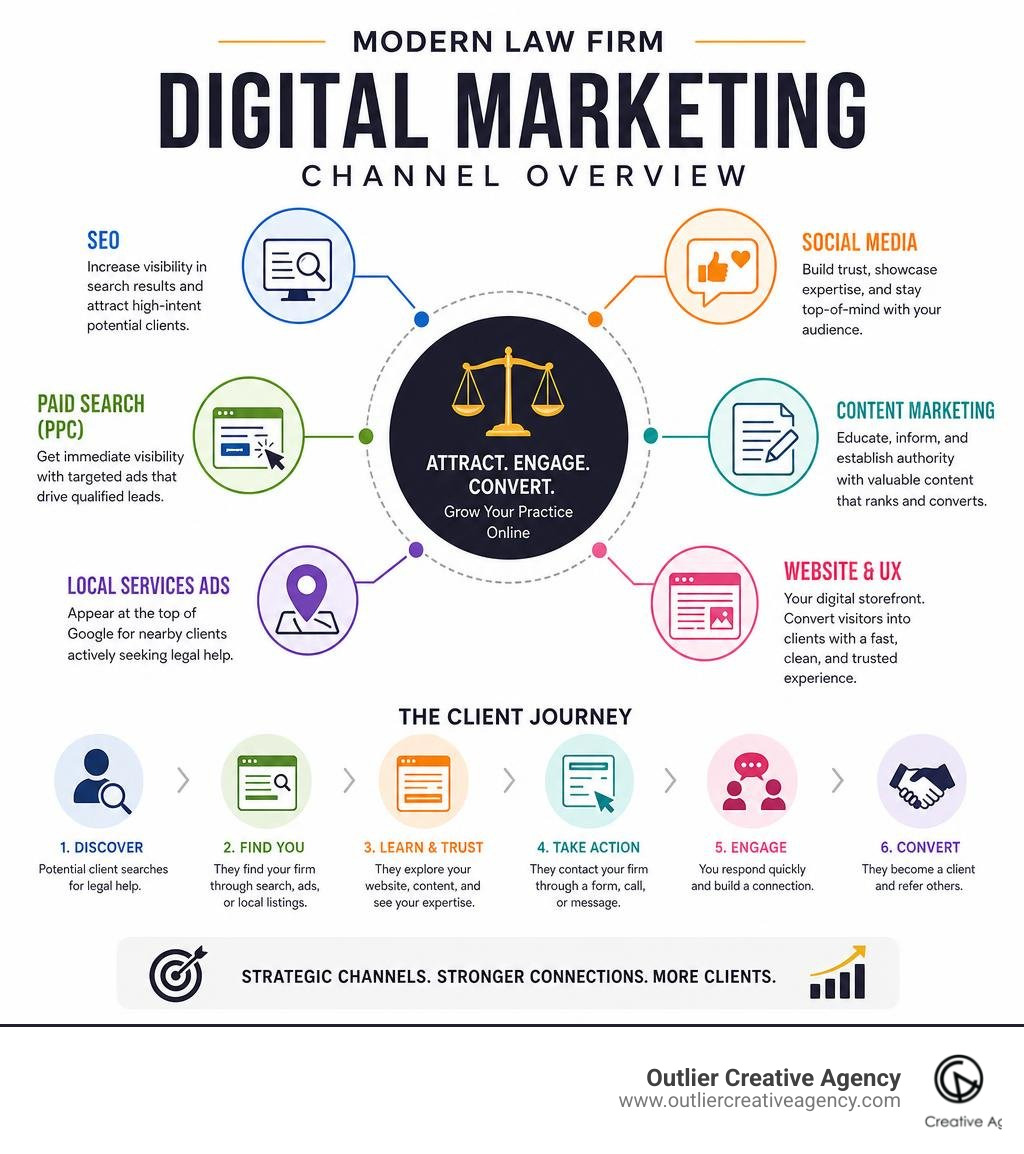
Why Law Firms Digital Marketing is Essential in 2026
Relying entirely on courthouse handshakes and passive word-of-mouth referrals is a risky way to run a business in July 2026. While reputation will always be the bedrock of any legal practice, the way consumers find and choose their legal counsel has fundamentally shifted.
Today, 96% of consumers turn to search engines when seeking legal services. When someone is in a car accident in Los Angeles or facing a complex business dispute in Austin, they do not wait to bump into a friend who knows a lawyer. They pull out their phone and type their problem into Google.
If your firm does not have a highly visible online presence, you simply do not exist to the vast majority of your market. In fact, Google's local map pack now appears in 93% of local searches and captures a staggering 44% of all clicks. If your local SEO is lacking, you are missing out on nearly half of the immediate lead volume in your geographic area.
Beyond sheer visibility, digital marketing is a sustainable, long-term asset. Unlike traditional billboards or print ads that stop generating leads the second you stop paying for them, a solid digital ecosystem builds compounding authority over time. By executing a strategy focused on Digital Marketing for Attorneys, you create an on-demand client acquisition system that works around the clock, positioning your firm as the obvious choice the moment a legal crisis strikes.
Core Channels of Law Firm Digital Marketing
To build a marketing engine that consistently signs qualified cases, you must understand how different digital channels work together. It all starts with your website, which acts as the digital front door to your practice.

Website Design and the User Experience
Many law firms treat their website like a glorified online brochure. In reality, your website is your ultimate conversion tool.
Consider this: up to 76% of consumers look at a company's online profiles and website before making a decision, yet 88% of people will abandon a website entirely after a single bad user experience. Furthermore, modern browsers like Google Chrome and Safari will warn users or refuse to load your site entirely if you do not have an active SSL certificate.
To convert high-value visitors into signed cases, your website must:
- Load in under 3 seconds: In legal marketing, you have a three-second elevator pitch. If your site is slow, users will hit the back button and click a competitor.
- Be fully mobile-responsive: Most emergency legal searches (criminal defense, personal injury) happen on mobile devices.
- Feature clear, prominent Calls to Action (CTAs): Make it incredibly easy for a user to call you, text you, or fill out a secure intake form. 66% of people expect a response from an attorney within a day, and many will hire the first firm that answers.
Expanding Beyond the Written Word: Video, Social, and Email
While text is vital, modern legal consumers crave human connection. This is where multi-channel strategies come into play.
- Video Marketing: Legal issues are highly personal. Utilizing authentic, non-stuffy video content allows prospective clients to see the human beings behind the bar results.
- Social Media: Platforms like LinkedIn are fantastic for attorney thought leadership and professional referral networks, while Instagram and Facebook can humanize your firm for consumer-facing practice areas (family law, personal injury).
- Email Marketing: Keeping in touch with past clients and referral partners through structured, non-promotional email campaigns ensures your firm stays top-of-mind.
To master these channels, we recommend reviewing our guides on How to Market a Law Firm, exploring our Email Marketing Guide for Lawyers, and investing in professional Media Production for Law Firms to create high-impact visual assets.
Search Engine Optimization and Law Firms Digital Marketing
Search Engine Optimization (SEO) is the process of optimizing your online presence so search engines rank your firm at the top of organic search results. For law firms, SEO is classified under Google’s "Your Money or Your Life" (YMYL) guidelines, meaning search engines demand incredibly high standards of E-A-T (Expertise, Authoritativeness, and Trustworthiness).
To win at organic search, you must execute on three fronts:
- Technical & On-Page SEO: Ensuring your site is easily crawlable, secure, fast, and structured logically by practice area.
- Local SEO: Optimizing your Google Business Profile, earning local citations, and building localized links in competitive hubs like Los Angeles and Austin. Because the local map pack drives 44% of clicks, local optimization is non-negotiable.
- Problem-Based Content Marketing: Most law firms optimize only for transactional keywords like "personal injury lawyer in Austin." However, prospective clients often search for their problems first (e.g., "what to do if your back hurts after a car accident" or "how is marital property divided in Texas"). By writing helpful, jargon-free content that answers these questions, you capture leads much earlier in their decision-making journey.
To find the exact terms your prospective clients are using, read our guide on Keyword Research for Law Firms.
For firms in hyper-competitive markets, partnering with localized specialists who understand regional search behavior can make all the difference. If you are operating in Southern California or Texas, tailoring your SEO and digital campaigns to the specific nuances of the Los Angeles or Austin markets will give you a distinct edge over firms relying on generic, nationwide strategies.
Paid Advertising and Law Firms Digital Marketing Strategies
If organic SEO is a marathon, paid advertising is a sprint. Pay-Per-Click (PPC) advertising through Google Ads and Local Services Ads (LSAs) allows your law firm to bypass the organic queue and appear at the very top of search results instantly.
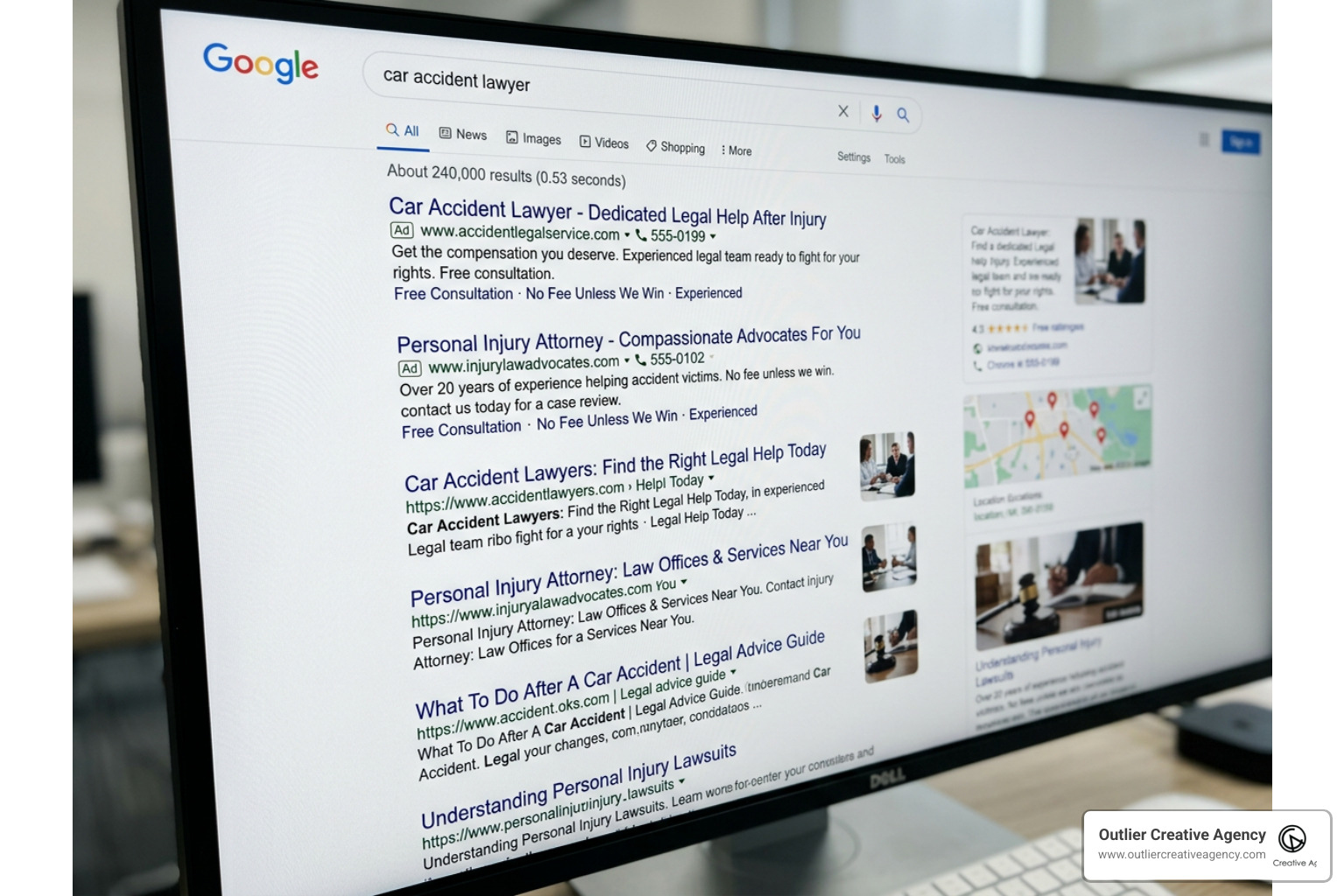
However, legal PPC is one of the most competitive and expensive digital ad markets in the world. High-intent keywords like "car accident lawyer" or "mesothelioma attorney" can cost hundreds of dollars per single click.
To run a profitable paid campaign without burning through your budget, you must:
- Utilize Local Services Ads (LSAs): These are the "Google Screened" ads at the very top of the page. You pay per qualified lead (call or message) rather than per click, which significantly reduces wasted spend.
- Target exact-match keywords & negative keywords: Prevent your ads from showing up for irrelevant searches (like "free legal aid" or "law school courses").
- Build conversion-optimized landing pages: Never send paid traffic to your homepage. Send them to a dedicated, fast-loading landing page designed to do one thing: get them to contact your firm immediately.
For a deeper dive into managing your ad spend effectively, check out our PPC Marketing Guide for Lawyers.
Budgeting, ROI, and Compliance in Legal Marketing
How much should you actually invest in law firms digital marketing, and what should you expect in return?
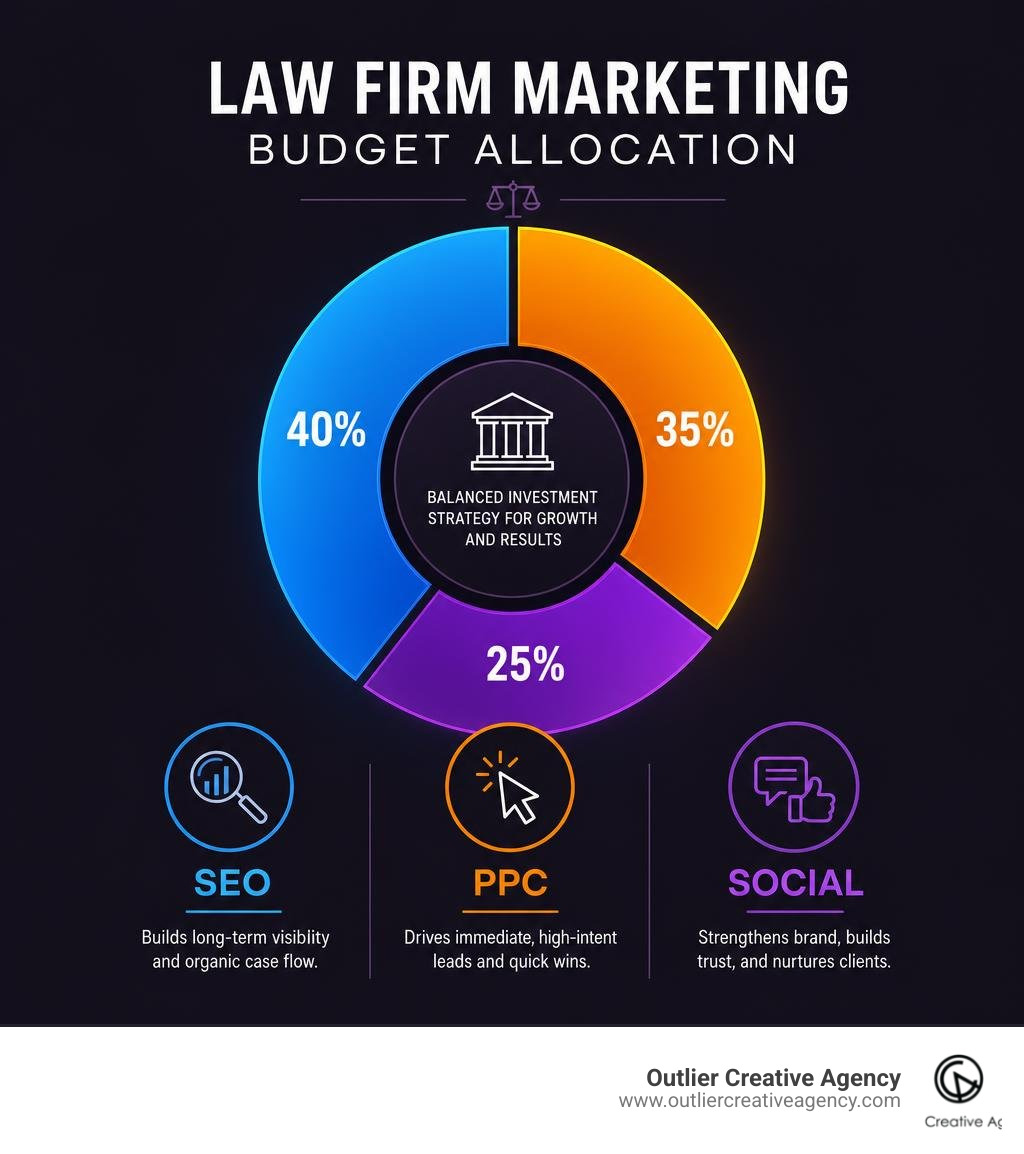
According to data from the American Bar Association, 85% of law firms with a marketing budget invest in online channels. Generally, legal marketing experts recommend allocating between 2% and 12% of your firm's gross revenue to marketing. If you are a solo practitioner or a boutique firm looking to maintain your current caseload, 2% to 5% is standard. If you are an aggressive personal injury or family law firm in Los Angeles or Austin looking to scale rapidly, you should expect to invest 10% to 12% (or more) to remain competitive.
When it comes to return on investment (ROI), a 5:1 revenue-to-cost ratio is the industry gold standard. This means that for every $1,000 you spend on marketing, you should generate $5,000 in fee revenue.
Compliance and Legal Ethics
You cannot market a law firm the way you market a retail brand. Every digital campaign must be meticulously designed to comply with your state's Bar Association advertising rules.
In California and Texas, rules regarding attorney advertising are strict. Key compliance areas include:
- Misleading Claims: You must never guarantee specific legal outcomes or refer to your firm as "the best" or "specialists" unless certified as such by the board.
- Client Confidentiality: Never discuss specific case details or post client reviews that reveal sensitive, unapproved information.
- Digital Disclosures: Ensure clear "Attorney Advertising" disclosures are visible on your website, landing pages, and social media profiles where required.
- Digital Media & Tech Compliance: As digital platforms evolve, staying compliant with data privacy laws and digital copyright is critical. For complex digital compliance issues, consulting with specialized Digital Media Attorneys - Jackson Walker can protect your firm from costly ethical missteps.
To help you visualize how to balance your marketing efforts, here is a breakdown of the primary digital channels:
| Marketing Channel | Average Cost | Expected ROI | Compliance Risk Level | Best For |
|---|---|---|---|---|
| Local SEO & GBP | Moderate | High (Long-term) | Low | Local visibility, map pack clicks, steady organic leads |
| Google PPC Ads | High | Immediate (Variable) | Medium | Immediate lead generation, high-intent cases |
| Social Media | Low to Moderate | Moderate | High (Monitoring comments/claims) | Brand awareness, humanizing the firm, referral networking |
| Email Marketing | Low | High | Low | Client retention, nurturing professional referrals |
Frequently Asked Questions about Law Firm Marketing
Should my firm use an agency or hire an in-house marketing team?
For most solo, small, and mid-sized firms, hiring a specialized legal marketing agency is far more cost-effective and scalable than building an in-house team. An agency provides immediate access to a full suite of experts — web designers, SEO strategists, PPC managers, and copywriters — for a fraction of the cost of hiring those full-time roles individually. Large, multi-location firms with highly stable, massive budgets may benefit from a hybrid model, but smaller firms typically find that agencies offer better agility and fresh, data-driven perspectives.
How much should law firms budget for digital marketing?
As a rule of thumb, law firms should budget between 2% and 12% of their gross annual revenue for marketing. Your exact percentage depends heavily on your practice area and market competitiveness. For example, a personal injury firm competing in Los Angeles or Austin will need to budget on the higher end of that spectrum to outpace aggressive competitors, whereas an estate planning firm in a quiet suburb can operate highly successfully on the lower end.
How do AI-powered marketing tools impact legal marketing strategies?
AI is shifting the digital landscape rapidly in 2026. Tools like ChatGPT, Gemini, and Perplexity mean that many consumers are asking AI assistants for lawyer recommendations rather than scrolling through search results. This has given rise to Generative Engine Optimization (GEO) — structuring your website's data and content so AI models can easily read, cite, and recommend your firm. However, human oversight remains absolutely essential. AI tools do not understand State Bar compliance rules, and relying on fully automated AI content can lead to severe ethical violations and search engine penalties.
Conclusion
Building a dominant online presence doesn't happen overnight, but continuing to rely solely on word-of-mouth in 2026 is a recipe for stagnation. By building a fast, mobile-friendly website, optimizing for local search, and carefully deploying paid ads, your firm can establish a highly profitable, ethical client acquisition system.
At Outlier Creative Agency, we specialize in helping law firms nationwide build integrated, compliant, and highly profitable digital marketing systems. We don't believe in generic marketing fluff — we focus strictly on the metrics that matter: signed cases and measurable ROI.
Ready to stop guessing if your marketing is making you money? Book a complimentary growth consultation with Outlier Creative Agency today and let's design a custom growth plan for your firm.