

Master San Francisco law firm SEO strategies from probate to securities fraud and dominate Bay Area search rankings.
The Real Cost of Being Invisible: San Francisco Law Firm SEO Explained
San Francisco law firm SEO is the practice of optimizing your firm's website and online presence so potential clients find you — not your competitors — when they search for legal help in the Bay Area.
Here's what that means in practice:
| What It Covers | Why It Matters |
|---|---|
| Google search rankings | 96% of people seeking legal help start online |
| Google Maps / Local Pack | Drives calls and consultations directly |
| Practice area content | Matches what clients are actually searching |
| Technical site health | Ensures Google can crawl and trust your site |
| E-E-A-T signals | Required for legal (YMYL) content to rank |
| Link authority | Builds credibility over competing firms |
The Bay Area legal market is unlike anywhere else in California. California has over 225,000 licensed attorneys, and a disproportionate number are concentrated right here in San Francisco. The city hosts more than 70 AmLaw 100 firms — each with dedicated marketing teams and significant budgets. And yet, most potential clients never walk past a billboard or open a directory. They open Google.
That gap between where clients search and where most firms invest is exactly where the opportunity lives.
San Francisco and Silicon Valley law firms saw revenue grow 7.2% in recent years. But that growth isn't distributed evenly. The firms showing up on page one are capturing the majority of it. The first position on Google earns roughly 10 times more clicks than position 10. Page two might as well not exist.
This guide covers everything you need to compete — from technical SEO and Google Business Profile optimization to practice-area content strategy and California Bar compliance.
I'm Corey Larson, and at Outlier Creative Agency I've spent years helping law firms cut through the noise with content and digital strategy built specifically for the legal industry — including San Francisco law firm SEO campaigns that connect the right clients with the right attorneys. The sections ahead give you a clear, actionable roadmap for doing the same.
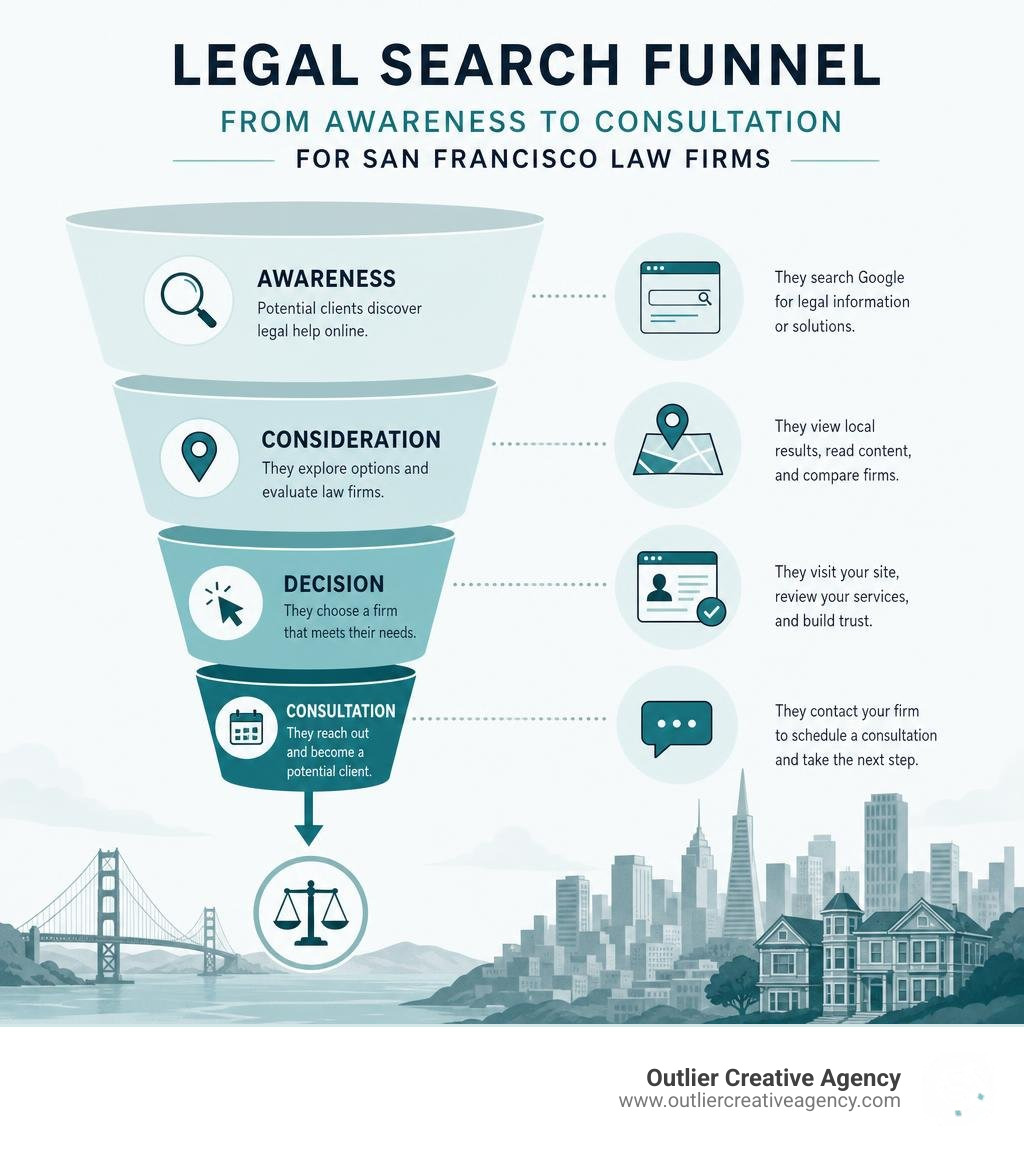
Why San Francisco Law Firm SEO is a High-Stakes Battleground
If you are practicing law in the Bay Area, you already know that the market is incredibly crowded. What you might not realize is just how intense the digital battleground has become. San Francisco is recognized as one of the three most competitive geographies in California for search engine optimization.
With over 70 AmLaw 100 firms anchoring the local market, smaller boutique firms and solo practitioners face a daunting task when trying to stand out. Large national firms pour massive budgets into local advertising, driving Pay-Per-Click (PPC) costs to eye-watering heights. In San Francisco, competitive keywords like "wrongful termination attorney San Francisco" or "corporate lawyer SF" routinely command Cost-Per-Click (CPC) rates between $150 and $500+.
Paying $300 for a single click that may or may not turn into a consultation is a fast way to burn through your marketing budget. This is why building long-term organic equity through San Francisco law firm SEO is not just a smart alternative; it is a business survival requirement.
Furthermore, search engines treat legal websites with an extraordinary level of scrutiny. Under Google’s Search Quality Rater Guidelines, legal queries fall under the "Your Money or Your Life" (YMYL) category. Because legal advice can fundamentally alter a person's financial status, freedom, or well-being, Google demands the highest standards of E-E-A-T:
- Experience: Demonstrating real-world, hands-on legal practice.
- Expertise: Showcasing deep knowledge of California and federal laws.
- Authoritativeness: Earning recognition from peers, legal associations, and authoritative publications.
- Trustworthiness: Maintaining a secure website, clear terms, and transparent attorney credentials.
To understand how these trust signals impact your firm's overall digital growth, it helps to look at California legal market dynamics. Competing against the giants requires a highly coordinated, multi-channel approach. To build a sustainable pipeline of high-value cases, firms must execute comprehensive legal search strategies that satisfy both Google's strict algorithms and the specific needs of Bay Area clients.
Navigating Practice-Area Specificity: From Probate to Securities Fraud
A common mistake many general practice firms make is trying to rank for broad, generic search terms. In a hyper-competitive market like San Francisco, ranking for "San Francisco lawyer" is both incredibly difficult and highly inefficient. The person searching that term could need help with anything from a minor traffic ticket to a complex intellectual property dispute.
Instead, successful SEO campaigns tailor practice area pages to distinct user intents. This means mapping content to the exact emotional and professional state of your target client.

Probate and Estate Administration
Probate clients are often grieving, overwhelmed, and looking for immediate, compassionate guidance. They search for terms like "how to file probate in San Francisco County" or "executor of estate duties Bay Area." The intent is highly emotional and informational. Your content must offer clear, jargon-free answers, step-by-step guides, and a calming, reassuring tone that builds immediate trust.
Securities Fraud and Corporate Litigation
On the opposite end of the spectrum is securities fraud. The target audience here consists of institutional investors, corporate executives, or high-net-worth individuals. They are searching for terms like "securities class action defense SF" or "FINRA arbitration attorneys." The search intent is highly transactional, analytical, and risk-averse. Your content needs to project absolute authority, featuring detailed case studies, regulatory insights, and a sophisticated, professional tone.
Tech-Sector Disputes
San Francisco's unique tech-driven economy creates highly specialized legal needs. We routinely build strategies around distinct, lower-competition keyword clusters that national firms overlook. These include:
- AB 5 Compliance: Independent contractor misclassification disputes.
- RSU & Equity Litigation: Disputes over stock options, restricted stock units, and founder equity splits during tech layoffs or acquisitions.
- Founder Disputes: Early-stage startup partnership breakups in SoMa or the Financial District.
By executing precise intent-driven keyword mapping, you can bypass the generic, high-cost keywords and capture high-value clients at the exact moment they need your specialized expertise.
How Do We Target Hyperlocal Intent in San Francisco?
San Francisco is a city of distinct neighborhoods, and search behavior reflects this geography. A commuter working in the Financial District wants a different experience than a resident living in Noe Valley. To win the local search battle, we must target hyperlocal intent.
Instead of only targeting "San Francisco employment lawyer," we optimize for neighborhood-specific terms:
- "Employment attorney near Union Square"
- "Business contract lawyer SoMa"
- "Estate planning attorney Noe Valley"
- "Personal injury lawyer Mission District"
This hyperlocal approach helps smaller firms bypass massive directory sites like Avvo or FindLaw, which tend to dominate broad, city-wide search terms. By focusing on the specific neighborhoods where your prospective clients live and work, you can implement highly effective local search optimization tactics that yield immediate, qualified leads.
Dominating the Local Map Pack and Google Business Profile
For brick-and-mortar law firms, the Google Local Map Pack (the top three map results that appear for local searches) is the single most valuable piece of digital real estate. When someone searches "probate lawyer near me" while standing in Pacific Heights, Google displays the Map Pack before the organic search results.
To dominate this space, your Google Business Profile (GBP) must be meticulously optimized. This involves several critical steps:
- NAP Consistency: Your Name, Address, and Phone number must be identical across your website, GBP, and every online directory (such as Yelp, YellowPages, and legal-specific directories like Avvo, Justia, or Martindale-Hubbell). Even minor discrepancies like "Suite 400" vs. "Ste. 400" can confuse Google's crawlers.
- Local Citations: Building high-quality citations on trusted local and legal platforms. Working with recognized local authorities, such as the Bar Association of San Francisco, helps signal your active presence in the local community.
- Ethical Review Management: Reviews are a primary ranking factor for the Map Pack. You must actively encourage satisfied clients to leave detailed, keyword-rich reviews, and you should respond to every review professionally. However, in California, you must do this while strictly adhering to ethical standards (which we will cover below).
- Satellite Offices: If you have multiple physical offices in the Bay Area, you need separate, optimized GBP listings and dedicated location pages on your website to prevent internal keyword competition.
| Optimization Element | Local Map Pack | Organic Search Results |
|---|---|---|
| Primary Driver | Proximity, GBP completeness, reviews | Content depth, backlinks, technical SEO |
| User Intent | Immediate contact, "near me" searches | Researching, comparing, informational |
| Click-Through Rate | Extremely high for mobile users | High for desktop researchers |
| Key Asset | Google Business Profile | Practice area landing pages |
Implementing a structured local SEO checklist ensures that your firm remains visible to nearby prospects, turning local searchers into signed cases.
Technical SEO, E-E-A-T, and AI Search Readiness in 2026
As we navigate June 2026, search technology is evolving rapidly. Traditional search engine optimization is no longer enough; firms must prepare for Generative Engine Optimization (GEO). Users are increasingly using AI-driven search engines like ChatGPT, Perplexity, and Google's AI Overviews to find legal advice and recommend attorneys.

To ensure your firm is recommended by both traditional algorithms and AI models, your website must maintain flawless technical health and clear structured data:
- Core Web Vitals & Page Speed: Bay Area clients are tech-savvy and impatient. If your website takes longer than two seconds to load on a mobile device, they will bounce. Google actively penalizes slow, unresponsive sites.
- Mobile-First Indexing: Over 70% of legal searches originate on mobile devices. Your website must be fully responsive, easy to navigate, and optimized for quick conversions on small screens.
- Schema Markup: You must implement advanced schema markup (specifically
Attorney,LegalService, andFAQPageschemas). This structured code acts as a direct translator, helping AI search engines understand your practice areas, location, credentials, and answers to common legal questions. - AI Search Optimization: AI engines synthesize information from multiple authoritative web sources to answer user queries. To be cited by these engines, your site must publish highly structured, authoritative, and direct answers to complex legal questions.
To stay ahead of these technological shifts, firms should conduct regular technical SEO audits and align their content with AI search engine optimization standards to ensure they remain highly visible in this next era of search.
Ethical Compliance and California Bar Advertising Rules
In legal marketing, visibility should never come at the expense of your professional license. The State Bar of California enforces strict rules regarding attorney advertising, and your SEO strategy must comply with them completely. Before publishing new practice-area pages, review the official California Rules of Professional Conduct and confirm that your claims, testimonials, and calls to action are accurate, supportable, and not misleading.
When optimizing your website, pay close attention to the following California Rules of Professional Conduct:
- Rule 7.1 (Communication Concerning a Lawyer's Services): All statements on your website must be truthful and non-misleading. You cannot state or imply that you can achieve a specific outcome based on past results. Avoid subjective claims like "the best personal injury lawyer in San Francisco" unless they are backed by verifiable, third-party awards (and even then, use caution).
- Rule 7.2 (Advertising): Any paid promotion, directory listing, or backlink acquisition must be clearly identifiable as advertising where required. When building backlinks, avoid low-quality, spammy link-building schemes that could violate professional standards or trigger Google search penalties.
- Rule 7.3 (Solicitation of Clients): While SEO is generally considered a form of passive, permissible advertising because the user initiates the search, any live chat features, automated pop-ups, or direct email outreach triggered by site behavior must not cross the line into coercive solicitation.
Additionally, when displaying client testimonials or case results, you must include clear, conspicuous disclosures stating that "past results do not guarantee, warrant, or predict future outcomes."
By partnering with an agency that understands these strict legal boundaries, you can build an authoritative online presence without risking disciplinary action. Integrating ethical marketing practices into your digital strategy protects your firm's reputation while steadily growing your caseload.
Frequently Asked Questions about San Francisco Law Firm SEO
How long does it take to see measurable results from San Francisco law firm SEO?
SEO is a long-term investment, not an overnight switch. For a new website or a firm starting in a highly competitive practice area (like personal injury or employment law in San Francisco proper), it typically takes 3 to 6 months to see initial movement in keyword rankings and local Map Pack visibility.
By months 6 to 12, as your technical foundation, content pipeline, and backlink authority compound, you can expect to see a consistent, measurable increase in organic leads and signed cases. Niche practice areas with lower competition (such as specialized probate or boutique business litigation) often see faster results, sometimes within 90 days.
What is the typical budget required for a competitive San Francisco law firm SEO campaign?
Because San Francisco is one of the most competitive legal markets in the country, effective SEO requires a significant commitment of resources, expertise, and time. A comprehensive, competitive SEO campaign for a San Francisco law firm typically ranges from $2,500 to $10,000+ per month, depending on the size of your firm, your practice areas, and your growth goals.
While this may seem like a significant investment, it is highly cost-effective when compared to PPC. A single personal injury or high-stakes corporate litigation case can easily generate tens of thousands of dollars in fees, delivering an exceptional return on investment (ROI) that compounds over time.
How do we measure the ROI of our San Francisco law firm SEO campaign?
We believe in measuring success by signed cases and revenue, not just vanity metrics like traffic or keyword rankings. To track the true ROI of your campaign, we implement a robust tracking system using Google Analytics 4 (GA4), call-tracking software, and CRM integration:
- Conversion Tracking: We track every phone call, contact form submission, and live chat engagement back to its specific organic search source.
- Cost Per Lead (CPL): We calculate how much you are spending to acquire each qualified lead through organic search.
- Revenue Attribution: We connect your signed cases directly to the organic keywords and landing pages that brought those clients to your website.
For a deeper dive into establishing these tracking systems, read our guide on tracking legal marketing ROI.
Conclusion
Navigating the competitive waters of San Francisco law firm SEO requires a partner who understands both the technical nuances of modern search algorithms and the strict ethical standards of the legal profession.
At Outlier Creative Agency, we specialize in delivering award-winning, data-driven digital marketing strategies designed exclusively for law firms. From optimizing your Google Business Profile to crafting compliant, high-performing practice area pages, we help you build an authoritative online presence that turns local searchers into signed cases.
Ready to outrank your competition and grow your Bay Area practice? Schedule a consultation with Outlier Creative Agency today, and let's discuss how we can elevate your firm's visibility.