

Boost law firm visibility with SEO optimized lawyer videos that improve rankings, engagement, and client conversions.
Why Most Law Firms Are Invisible Online (And How Video Changes That)
SEO optimized lawyer videos are one of the fastest ways for law firms to climb Google's search results and convert more visitors into paying clients. Here's a quick breakdown of what that actually means in practice:
How to create SEO optimized lawyer videos:
- Research keywords your potential clients are already searching for
- Optimize your title and description with those keywords naturally included
- Add a full transcript so search engines can read your video's content
- Implement video schema markup so Google understands what your video is about
- Host on YouTube and your website to maximize reach across both platforms
- Keep videos concise — under 2 minutes for brand/social content, 5–10 minutes for educational deep-dives
- Include a clear call to action directing viewers to contact your firm
Legal marketing is brutally competitive. Attorneys are spending $50–$200 per click on Google Ads, and most law firm websites look identical to each other — walls of text, stock photos, and generic practice area descriptions.
Here's the problem: potential clients aren't just looking for a lawyer. They're scared, stressed, and asking three basic questions before they pick up the phone:
- Do I trust this person?
- Do they actually know what they're doing?
- Are they going to judge me?
Text alone can't answer those questions. Video can.
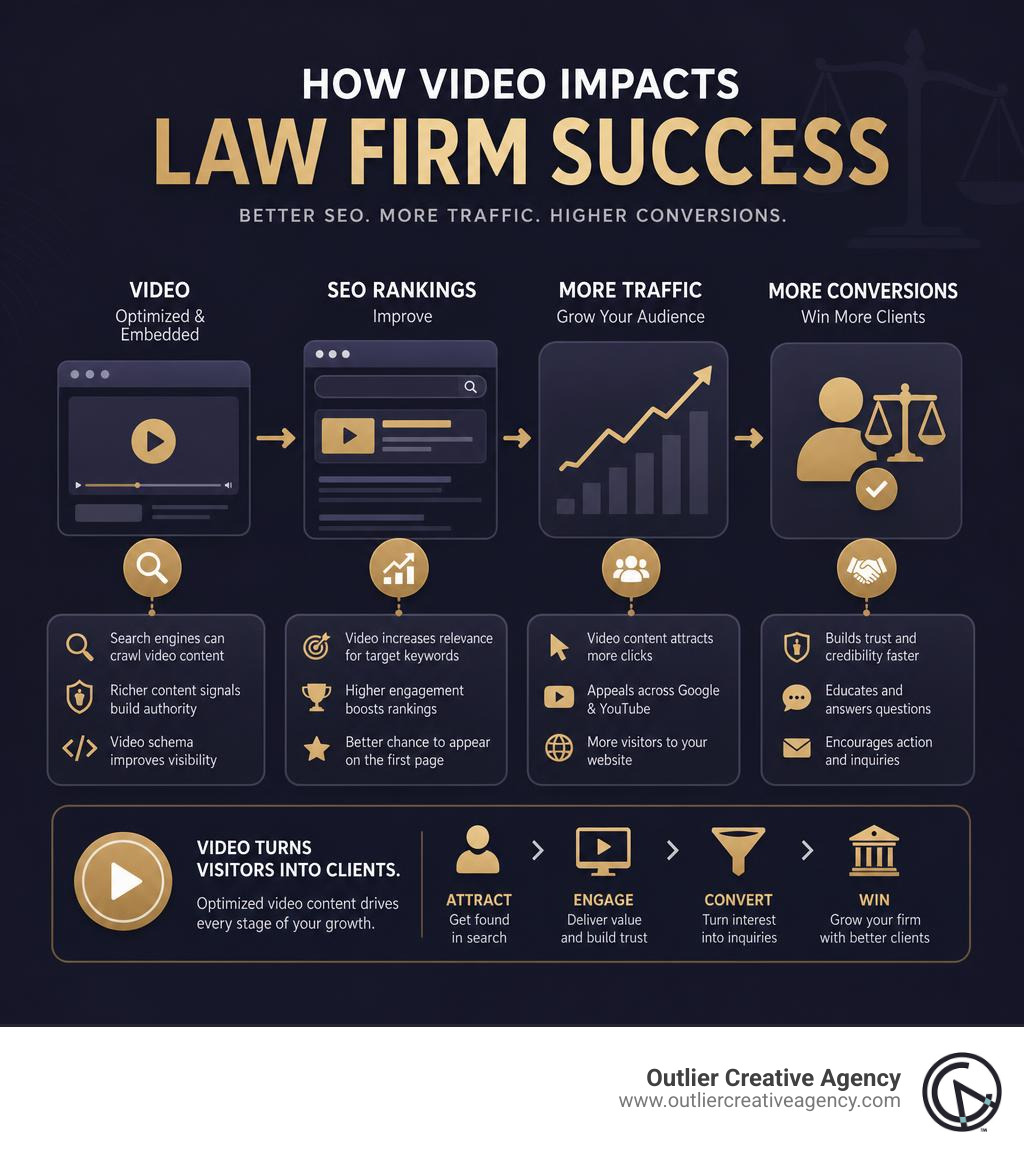
Pages with embedded video are 53% more likely to appear on the first page of Google search results, and law firms that use video marketing see a 41% increase in web traffic compared to those that don't. Video content is also 50 times more likely to rank organically in Google than plain text alone.
Yet most law firms either skip video entirely or produce it without any SEO strategy behind it — which means the videos sit on a server somewhere, unseen, doing nothing.
This guide will walk you through exactly how to fix that.
I'm Corey Larson, founder of Outlier Creative Agency, where we specialize in producing high-quality media for law firms — from SEO optimized lawyer videos to full website builds — built specifically to drive leads and grow your brand. Everything in this guide comes from real experience working inside the legal industry.
Why Video SEO is Crucial for Modern Law Firms
To survive in the digital landscape of May 2026, relying solely on written blog posts is no longer enough. Traditional written content has heavily saturated online search results. If you want your firm to stand out in competitive markets like Los Angeles or Austin, you need to capture organic visibility where your clients are actually looking.
Search engine algorithms have evolved to prioritize user experience and diverse media formats. When Google crawls a webpage, it doesn't just look for keyword density; it measures user engagement signals. One of the most critical signals is "dwell time"—the amount of time a visitor spends on your page before clicking back to the search results. If a user lands on your site and immediately leaves (a high bounce rate), Google assumes your content is unhelpful.
However, when you embed a compelling video, visitors stay on your page significantly longer. A visitor watching a two-minute video signals to Google that your website provides high-value answers, boosting your organic rankings. For a deeper dive into why this visual shift is happening, read our guide on Content Marketing for Law Firms: Why Video Can Help.

How Video Content Impacts Search Engine Rankings and Client Engagement
When done correctly, video is the ultimate conversion tool. It bridges the gap between cold search results and a signed retainer. In the legal industry, clients are often shopping for an attorney during some of the most stressful moments of their lives—whether they are dealing with a severe personal injury, navigating a complex divorce, or facing commercial litigation. They are looking for empathy, authority, and clarity.
By using high-quality video, you humanize your firm. A prospective client in Austin searching at 2 AM for child custody guidelines can watch an educational video, connect with your tone, and feel an immediate sense of relief. This emotional connection directly drives conversion rates. In fact, including a video on a landing page can increase conversion rates by up to 80%.
Furthermore, search engines prioritize multi-format search results. Modern search engine result pages (SERPs) frequently feature video carousels and rich snippets. By optimizing your video content, you increase the likelihood of your firm appearing in these prominent visual spots, capturing clicks before users even scroll down to the standard blue links. This is particularly true for highly competitive practice areas; you can see real-world examples of how visual storytelling drives engagement in our breakdown of Modern Law Firm SEO | How Personal Injury and Divorce ....
How to Choose Keywords and Topics for SEO Optimized Lawyer Videos
The foundation of any successful video campaign is thorough keyword research. You cannot simply turn on a camera and talk about general legal concepts; you must target the exact phrases and questions your future clients are typing into search engines.
When mapping out your content, focus on search intent. Legal searches generally fall into three categories:
- Informational: "What happens during a deposition?"
- Investigational: "How to choose a business litigation attorney in Austin."
- Transactional: "Hire personal injury lawyer in Los Angeles."
To capture the highest-value leads, target conversational, long-tail keywords. Instead of trying to rank for a broad, hyper-competitive term like "car accident lawyer," focus on topic clusters built around specific questions, such as "Who pays my medical bills after a commercial truck accident in Texas?" For a comprehensive roadmap on structuring these campaigns, check out our guide on Boost Law Firm Visibility: 7 Proven Video Marketing Strategies for More Leads & Clients.
Identifying High-Value Practice Area Topics for SEO Optimized Lawyer Videos
To find the best topics, start by auditing your own intake process. What are the most common questions your clients ask during their initial consultations? These real-world pain points represent immediate video opportunities.
Additionally, you can use SEO tools like Ahrefs, SEMrush, or Google Keyword Planner to analyze search volume and find competitor gaps. Look at what other firms in your market are doing, and identify where they are failing to provide clear, comprehensive video answers. For example, if you practice corporate law, you might find a high volume of searches around partnership disputes but very little video content explaining the resolution process. In this case, creating a series of Business Litigation Lawyer Videos can position you as the leading authority.
The goal is to address the emotional concerns behind the search. For practical techniques on drafting educational legal content that ranks, explore the insights provided in SEO for Lawyers: Content Creation Tips and Tricks.
Technical Optimization: Metadata, Transcripts, and Advanced Schema
Once your video is recorded, the technical optimization process begins. Search engines are incredibly smart, but they still rely heavily on text-based metadata to understand, index, and rank video assets.

To ensure your videos rank on both Google and YouTube (the world's second-largest search engine), you must optimize the following key metadata elements:
- Video Title: Keep it under 60 characters. Place your primary long-tail keyword near the front and phrase it as a compelling question or clear benefit (e.g., "How to File a Car Accident Claim in Los Angeles | Step-by-Step").
- Video Description: Write a detailed, natural description of at least 150–250 words. Explain exactly what the video covers, naturally incorporate primary and secondary keywords, and include a clear call to action (CTA) with a link to your website's relevant landing page.
- Tags: Use a mix of broad terms (e.g., "personal injury attorney"), specific terms (e.g., "rear-end collision settlement"), and location-specific tags (e.g., "Austin car accident lawyer").
- Custom Thumbnail: Upload a high-contrast, professional image with clear text overlay. Keep your branding, fonts, and colors consistent across all thumbnails to build brand recognition.
The Role of Transcripts and Captions in SEO Optimized Lawyer Videos
Search engines cannot listen to the audio inside your video files. Therefore, providing accurate, clean transcripts is one of the most powerful things you can do for video SEO.
While auto-generated captions on platforms like YouTube have improved, they frequently misspell complex legal terminology, medical terms, and local geographic names. A messy transcript can confuse search crawlers and harm your E-E-A-T (Experience, Expertise, Authoritativeness, and Trustworthiness) signals.
Always upload custom, professionally formatted SubRip Subtitle (.srt) files or paste the full transcript directly into your video's webpage description. This provides search engines with several hundred words of crawlable, keyword-rich text, allowing you to naturally capture long-tail search traffic. To learn more about how strategic YouTube optimization drives organic case acquisition, review the strategies outlined in #89 - Let Jeff Show You How to Do YouTube for Law Firms.
Implementing Schema Markup and Video Sitemaps
To truly dominate search results and earn rich snippets on Google, you must implement video schema markup on your website. Schema markup is a structured data vocabulary (written in JSON-LD) that you add to your page’s HTML code. It tells search engines exactly what your video is, who is speaking, how long it lasts, and where the thumbnail is hosted.
{
  "@context": "https://schema.org",
  "@type": "VideoObject",
  "name": "How to Choose a Business Litigation Lawyer in Austin",
  "description": "Learn the key factors to consider when hiring a business litigation attorney in Austin, Texas.",
  "thumbnailUrl": "https://www.outliercreativeagency.com/wp-content/uploads/2026/05/business-litigation-video-thumbnail.jpg",
  "uploadDate": "2026-05-15",
  "duration": "PT5M12S",
  "contentUrl": "https://www.outliercreativeagency.com/wp-content/uploads/2026/05/business-litigation-lawyer-austin.mp4",
  "embedUrl": "https://www.youtube.com/embed/dQw4w9WgXcQ"
}
In addition to schema, you should submit a dedicated video sitemap to Google Search Console. This metadata-rich document helps search engines find and index all the video assets across your site, ensuring no valuable content is overlooked.
Finally, never upload poorly named files. A file named xyg315-John.mp4 communicates nothing to Google. Instead, rename your raw files to match your keywords, such as austin-personal-injury-lawyer-tips.mp4, before uploading them. For a deeper look at how technical production and structured data work together, read our guide on Media Production for Law Firms.
Production Best Practices: Ideal Length, Format, and Testimonials
The technical side of SEO gets people to your page, but the production quality and structure of your video keep them there. If your video is poorly lit, has echoey audio, or takes too long to get to the point, viewers will click away instantly, destroying your user retention metrics.
Maximizing Viewer Retention with Optimal Length and Format
Different platforms and goals require different video lengths and formats:
- Brand/Homepage Videos (under 90 seconds): These should be cinematic, emotional "heartbeat" videos focused on your firm's core values, mission, and how you help clients find peace of mind.
- Educational/Practice Area Videos (5 to 10 minutes): These are deep-dives designed to thoroughly answer specific legal questions. YouTube's algorithm favors longer videos that maintain high watch-time metrics, provided they remain engaging throughout.
- Short-Form Social Content (30 to 60 seconds): Ideal for TikTok, Instagram Reels, and YouTube Shorts. These must start with an immediate, high-impact hook in the first 3 seconds to prevent users from scrolling past.
When filming, avoid rigid scripts or teleprompters, which can make you appear stiff and unapproachable. Instead, use a conversational, interview-style format. To discover how high-end production elements can elevate your brand on individual bio pages, read our insights on Attorney Bio Video Creation.
Leveraging Video Testimonials for Trust and AI Visibility
In the era of AI-powered search engines and Google AI Overviews, traditional text reviews are no longer enough. Consumers are increasingly skeptical of written testimonials, which can easily be fabricated. Authentic video testimonials, however, show real faces, real voices, and genuine emotion.
To make your testimonials highly effective for both conversions and AI search engines, guide your clients to follow a simple "story arc" framework:
- The Tension: What was their situation, and what doubts or fears did they have before hiring your firm?
- The Truth: How did your team communicate and support them during their case?
- The Transformation: How did their life change after you resolved their legal issue?
Ensure your clients naturally mention your firm's name and the specific practice area (e.g., "Outlier Creative Agency helped me resolve my business litigation dispute in Austin"). When you upload the full transcript of this testimonial to YouTube and embed it on your website with schema markup, AI engines like Gemini and ChatGPT can easily crawl and cite your video as a trusted source for local legal recommendations. For an in-depth look at this process, listen to the podcast episode S03E145 Video Testimonials for AI Search Visibility with Jonathan Schüßler.
Distribution and ROI: Hosting, Embedding, and Measuring Success
Creating an incredible video is only half the battle; you must distribute it strategically to maximize your return on investment (ROI).
Best Practices for Hosting and Embedding Legal Videos
A common mistake is uploading raw video files directly to your website’s media library. Large video files will slow down your page load speed, leading to poor mobile performance and lower search rankings. Instead, use a reliable third-party hosting strategy.
| Hosting Method | Pros | Cons | Best Use Case |
|---|---|---|---|
| YouTube (Embedded) | Free, massive built-in audience, excellent for broad SEO, zero hosting costs, boosts channel metrics. | Displays competitor ads, can distract users away from your site. | Educational videos, practice area guides, and broad marketing. |
| Premium Third-Party (Wistia/Vimeo) | Clean, ad-free player, customizable branding, advanced conversion tools, strict control over user journey. | Requires paid subscription, no built-in organic search audience. | Homepage brand videos, landing page explainers, and high-end bios. |
To get the absolute best results, we recommend a hybrid approach: host your broad educational videos on YouTube to capture search traffic, and host your conversion-focused homepage videos on a premium player like Wistia. For customized regional advice, explore our dedicated services for Video Production Services in Los Angeles and Video Production Services in Austin.
Tracking Key Performance Indicators and Video ROI
To justify your marketing spend, you must track performance metrics that go beyond simple "view counts." A video with 10,000 views that generates zero phone calls is far less valuable than a video with 100 views that generates five qualified leads.
Focus on these key performance indicators (KPIs):
- Dwell Time: Are users spending more time on your landing pages after you embedded the video?
- Play Rate: What percentage of page visitors actually click play? (If it's low, try changing the thumbnail or placement).
- Watch Time / Retention: At what point do viewers stop watching? Use this data to refine your video pacing.
- Conversion Rate: Are visitors who watch your videos converting into consultation requests at a higher rate than those who don't?
By monitoring these metrics, you can continually refine your strategy, ensuring your video production efforts translate directly into increased caseloads. For a deeper analysis of how high-end production drives real business results, read our detailed guide on The ROI of High-End Video Production for Los Angeles Real Estate & Hospitality.
Frequently Asked Questions about Legal Video SEO
What is the ideal length for a legal marketing video?
For educational and practice area videos, aim for 5 to 10 minutes. This length allows you to provide comprehensive, high-value answers that keep viewers engaged, which search engines favor. For homepage brand videos and social media content, keep them concise—ideally under 90 seconds—to capture quick attention and drive immediate conversions.
How does video schema markup help my law firm rank on Google?
Video schema markup provides search engines with structured data (like the video's title, description, duration, and thumbnail URL) in a format they can easily read. This reduces Google's crawl budget and increases your chances of earning rich snippets, video carousels, and visual placements in search results.
Can video testimonials improve my visibility in AI search engines?
Yes. AI search engines and LLMs heavily rely on crawlable text to generate their answers. By uploading full transcripts of your client testimonials and using schema markup, you make it easy for AI tools to understand, index, and cite your firm as a highly recommended local option.
Conclusion
Creating SEO optimized lawyer videos is no longer an optional marketing tactic; it is a fundamental requirement for any law firm that wants to remain visible and competitive in 2026. By combining technical SEO precision—such as schema markup, transcripts, and keyword research—with high-end, authentic storytelling, you can build a digital asset library that consistently drives qualified leads to your firm.
At Outlier Creative Agency, we understand that managing a successful law practice leaves very little time for video production and technical SEO optimization. As an award-winning legal marketing agency, we specialize in handling the entire process for you—from script compliance and professional filming to advanced SEO implementation.
If you are ready to elevate your firm's online authority, increase your caseload, and dominate your local market, explore our specialized Video Production for Legal Services or book a consultation with our team today.