

Master will probate lawyer ads with 3 key insights: compliance, targeting, and ROAS benchmarks from $25 CPC to 6x returns.
How Will Probate Lawyer Ads Turn Searchers Into Qualified Consultations
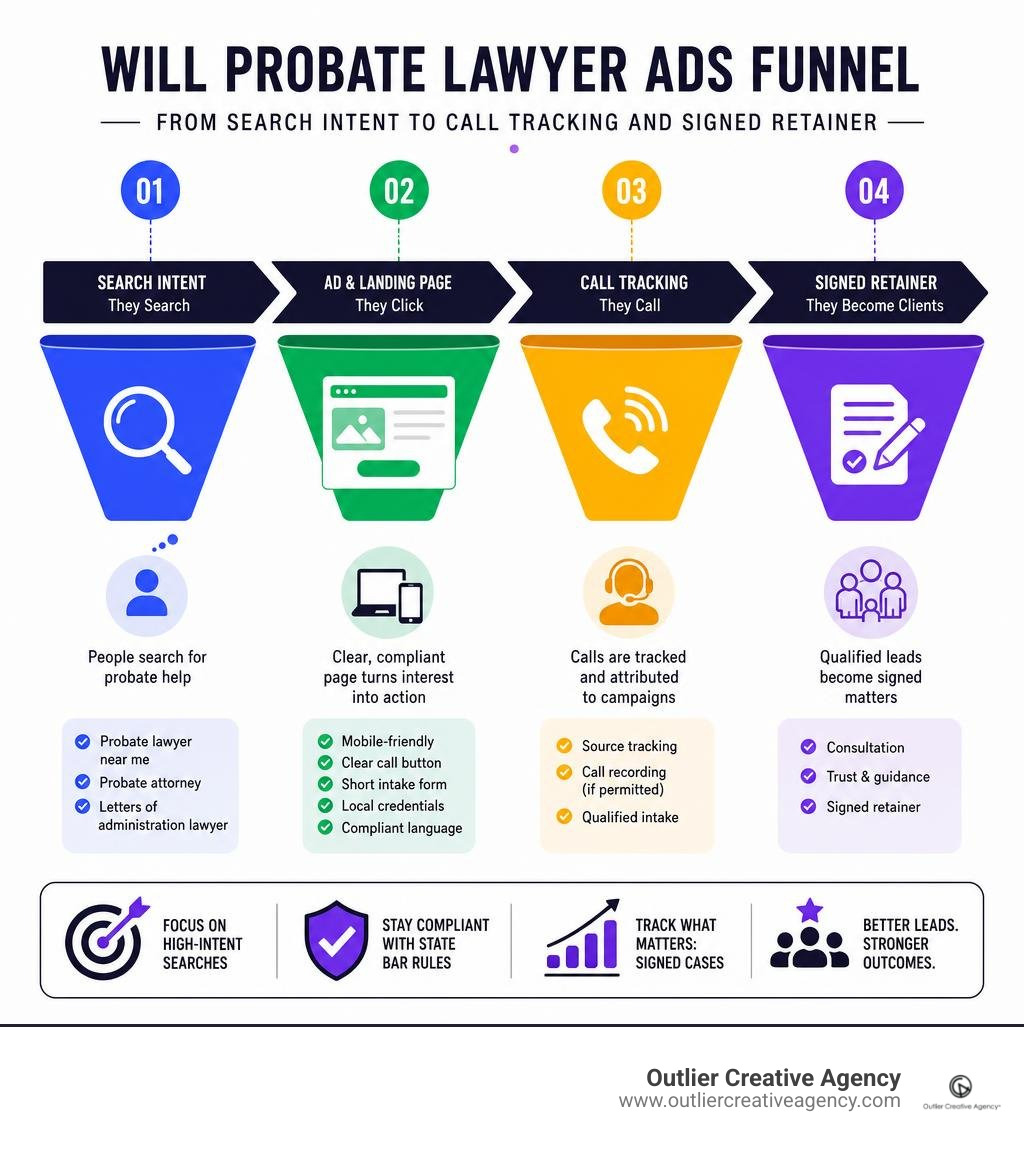
Effective will probate lawyer ads do three things: follow the advertising rules in every state where the firm markets, separate urgent "I need a lawyer" searches from early research queries, and track which calls become signed matters.
For most firms, that means:
- Run dedicated Google Search campaigns for urgent terms such as "probate lawyer near me," "probate attorney," and "letters of administration lawyer."
- Send each searcher to a focused, mobile-friendly page with a clear call option, short intake form, local credentials, and compliant language.
- Use lower-cost educational campaigns for searches about executor duties, probate timelines, wills, and trusts. Offer a useful checklist or guide, then nurture those leads.
- Measure signed-case revenue, not just clicks. Competitive metro-area estate and probate terms can cost roughly $25 to $60 per click, while high-intent landing pages may convert around 8% to 15% of visitors into leads.
Compliance is not an afterthought. State rules vary, but ads generally cannot be false or misleading, promise results, or misstate attorney credentials. Some jurisdictions also require ad filing, disclaimers, or disclosures for actors, testimonials, and paid media. A campaign that creates leads but triggers an ethics issue is not a win.
Probate is also a trust-heavy service. Families may be handling a recent death, a court deadline, or conflict among heirs. Clear, calm messaging and fast intake matter as much as keyword bids. Firms that distinguish probate administration, will contests, estate planning, and trust work can match the right message to the right need.
I am Corey Larson, and through Outlier Creative Agency, I create legal-focused content, websites, video, and campaigns designed to help firms communicate clearly and generate stronger leads. In this guide to will probate lawyer ads, I will break down the terms, compliance choices, and performance measures that matter before you invest more in paid media.
1. Compliance and Ethics: Navigating State Bar Rules for Will Probate Lawyer Ads
Legal advertising carries strict ethical obligations that do not apply to standard commercial industries. When launching search or social campaigns, law firms must align their messaging with the American Bar Association (ABA) Model Rules of Professional Conduct—specifically Rules 7.1, 7.2, and 7.3—alongside state-specific bar requirements in jurisdictions such as California and Texas.
Firms must maintain public confidence through honest, transparent communication, especially as consumer attorneys warn on public trust in legal ads across competitive markets. Running will probate lawyer ads requires an approach grounded in clarity rather than sensational promises.
State Bar Review Processes and Filing Fees
State regulatory bodies oversee legal marketing through various compliance mechanisms. While some jurisdictions require post-dissemination submissions, others mandate advance reviews before ads go live:
- Mandatory Submission Deadlines: In several regulatory jurisdictions, paid advertisements across digital platforms, print, and broadcast must be filed with the state bar advertising committee within 15 days of first publication.
- Filing Fee Structures: Submission fees often range from $100 per ad for standard post-launch filings to $250 or more for formal advance advisory opinions.
- Exemptions for Law Firm Websites: Under rules modeled on Supreme Court Rule 7.2A, static law firm websites are generally exempt from mandatory ad filing requirements, whereas paid search ads, sponsored social media posts, and display banners qualify as regulated solicitations.
- Multi-Jurisdictional Alignment: Firms operating in multiple metropolitan areas—such as Austin and Los Angeles—must ensure cross-border digital campaigns satisfy the strictest governing jurisdiction.
Maintaining ethical digital marketing standards protects your law practice from disciplinary audits. Implementing ethical SEO and compliant ad management ensures long-term stability and protects your professional standing.
Avoiding Deceptive Claims in Will Probate Lawyer Ads
State bar regulations prohibit false, misleading, or unsubstantiated statements in paid media. Probate advertising requires careful attention to specific copy restrictions:
- No Outcome Guarantees: Phrases like "We guarantee your estate will avoid probate" or "We ensure maximum inheritance recovery" violate Rule 7.1. Use factual, service-oriented language instead, such as "Guiding families through probate court administration."
- Superlatives and Ranking Claims: Avoid describing your firm as "the best probate attorney" or "the top-rated trust lawyer" unless validated by verifiable, independent awards with required contextual disclosures.
- Actor and Dramatization Notices: If video campaigns or landing pages incorporate professional spokespersons, stock models, or simulated client scenarios, clear visual and audio notices (such as "Actor Portrayal" or "Simulated Legal Scenario") must be visible.
- Testimonials and Past Results: Disclaimers noting that "Past results do not guarantee future outcomes" must accompany case studies, settlements, or client reviews.
- Specialization Designations: Lawyers may not claim to be a "certified probate specialist" unless formally accredited by their state bar board of legal specialization.
Strategic attorney PPC advertising balances clear value propositions with full regulatory compliance.
2. Campaign Architecture: How to Target High-Intent vs. Research-Phase Clients
Probate clients arrive at search engines under distinctly different circumstances. A searcher whose parent passed away two weeks ago facing letters of administration deadlines requires immediate legal representation. In contrast, someone exploring estate preservation is conducting informational research.
To prevent budget waste, we structure PPC campaigns by separating high-intent, immediate hiring queries from top-of-funnel educational searches.
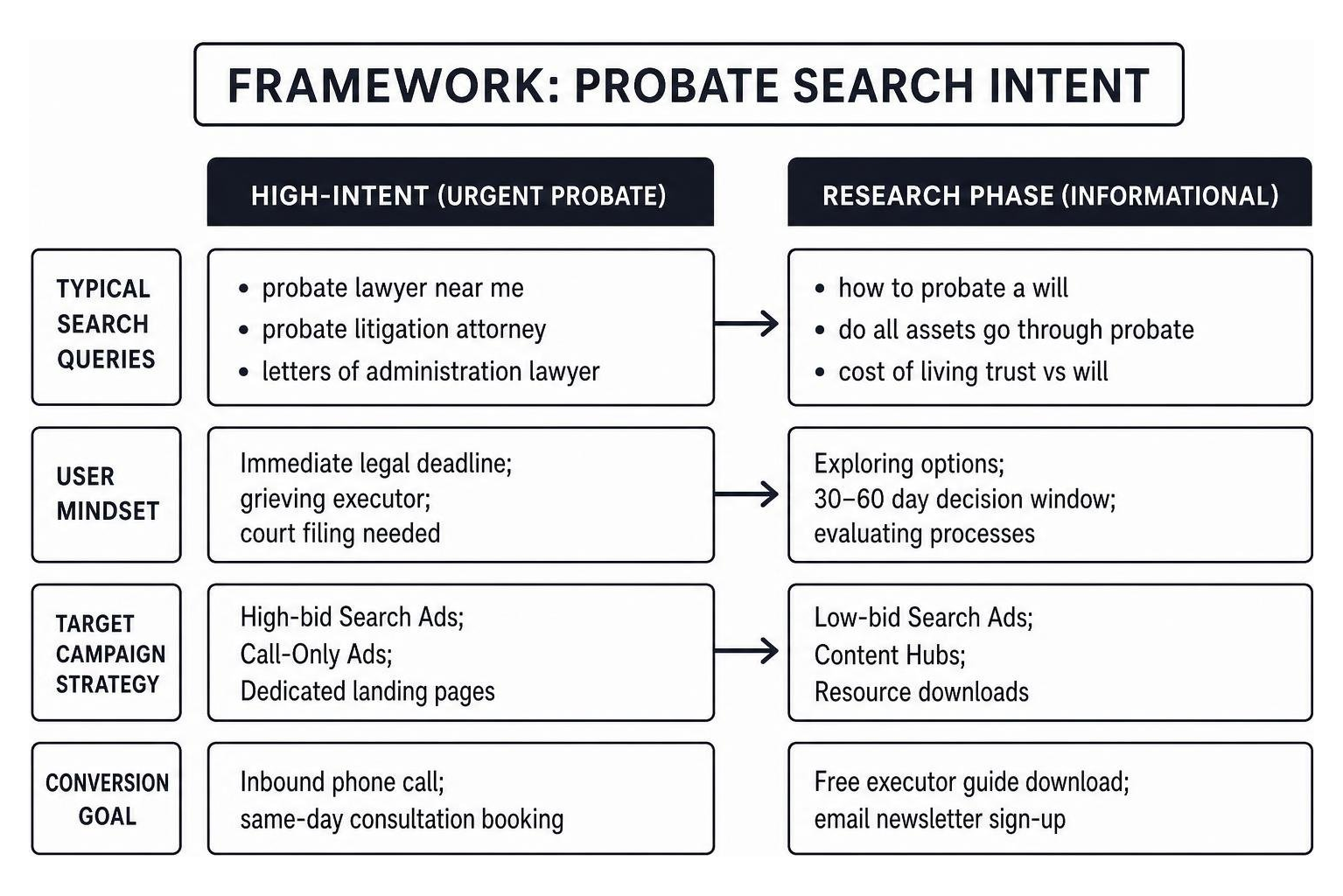
| Intent Category | Typical Search Queries | User Mindset | Target Campaign Strategy | Conversion Goal |
|---|---|---|---|---|
| Urgent Probate (High-Intent) | probate lawyer near me, probate litigation attorney, letters of administration lawyer | Immediate legal deadline; grieving executor; court filing needed | High-bid Search Ads; Call-Only Ads; Dedicated landing pages | Inbound phone call; same-day consultation booking |
| Informational Research (Mid/Top-Funnel) | how to probate a will, do all assets go through probate, cost of living trust vs will | Exploring options; 30–60 day decision window; evaluating processes | Low-bid Search Ads; Content Hubs; Resource downloads | Free executor guide download; email newsletter sign-up |
Navigating these dynamics effectively requires following a comprehensive PPC marketing guide for lawyers built around granular intent segmentation.
Structuring High-Intent Search Campaigns for Will Probate Lawyer Ads
Urgent probate queries demand immediate engagement. When an executor searches for a local probate litigator or estate administrator, mobile accessibility drives conversions.
- Local Search Query Optimization: Queries containing "near me" or municipal modifiers have expanded by over 150% in recent years. Most of these searches convert to a direct phone call within the first hour.
- Dedicated Ad Groups: Group tightly themed keywords into dedicated ad groups such as Probate Administration, Contested Wills, Estate Litigation, and Letters of Administration.
- Call-Only and Call-Asset Ads: For searchers on mobile devices, call-first formats bypass multi-step forms, connecting prospective clients directly with your legal intake team.
- Bid Strategy: High-intent estate and probate keywords routinely command $25 to $60 per click in competitive metro markets. Setting appropriate bid thresholds captures top positions during business hours when your staff is available.
Reviewing campaign search terms using a dedicated law firm PPC analytics guide 2026 allows firms to eliminate non-converting queries while prioritizing qualified calls.
Capturing Top-of-Funnel Estate Research and Lead Nurturing
Not all estate queries demand an immediate phone call. Prospective clients evaluating living trusts, powers of attorney, and estate preservation often research options for 4 to 8 weeks and compare 3 to 4 law firms before scheduling a consultation.
While direct self-service consumers frequently interact with online probate document tools for basic filings, complex estates require dedicated legal counsel. Law firms can capture these research-phase prospects affordably by:
- Offering Educational Assets: Promote downloadable resources like "The Texas & California Executor Checklist: 7 Costly Mistakes to Avoid."
- Implementing Lead Capture Forms: Collect names and email addresses in exchange for practical legal guides.
- Deploying Automated Email Workflows: Deliver automated follow-up sequences explaining estate tax triggers, fiduciary duties, and the advantages of professional legal administration using an email marketing guide for lawyers.
3. Conversion Economics: Tracking ROAS, CPC, and Landing Page Performance
Paid search marketing for probate and estate attorneys functions on clear unit economics. Unlike high-volume e-commerce advertising that targets 2x–3x returns, estate law campaigns generate high individual case values.
- Pacing Ad Budgets: Established estate planning and probate law practices typically invest $4,000 to $8,000 per month in paid search advertising, scaling ad budgets by 20% to 40% during seasonal surges in Q1 (New Year resolutions) and Q4 (year-end tax planning).
- Return on Ad Spend (ROAS): A well-optimized estate campaign generates a 3x to 6x ROAS across a 12-month period. For complex contested estate litigation matters, single retained cases frequently deliver a 14x to 100x return on the ad spend that generated the initial click.
- Case Revenue Value: Routine estate planning packages generally command $1,000 to $3,000 for standard wills and trusts, and $3,000 to $8,000+ for complex, multi-property estates and contested probate proceedings.
Understanding your firm's law firm PPC results ensures that marketing investments produce measurable caseload growth.
Landing Page Optimization and Dynamic Call Tracking
Sending paid search traffic to a general homepage lowers conversion rates and wastes advertising spend. Dedicated practice area landing pages convert high-intent traffic at 8% to 15%, compared to 2% to 4% for standard homepages.

High-converting legal landing pages include:
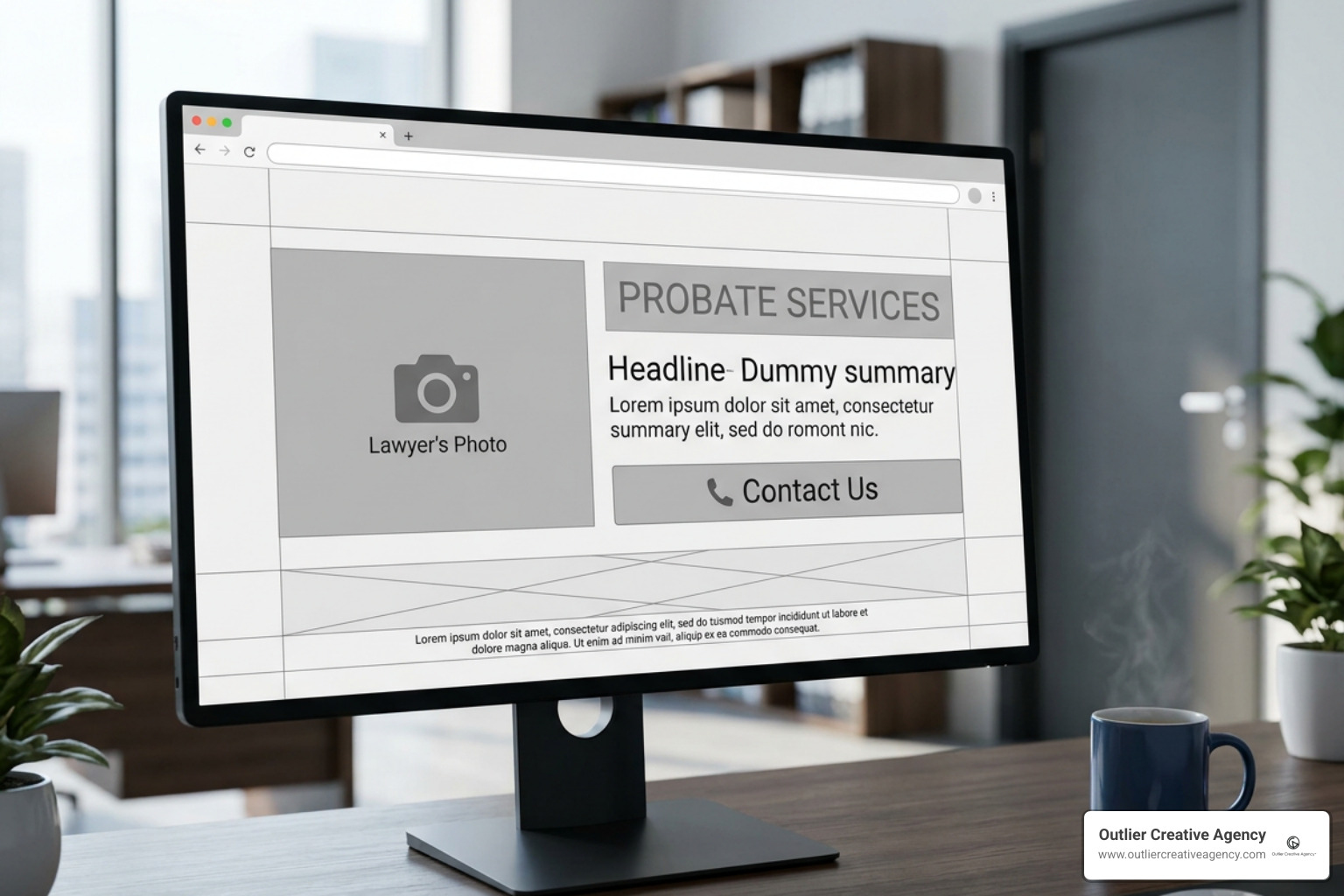
- Clear Headlines: Match the headline directly to the user's search query (e.g., "Austin Probate Administration Lawyer — Guiding Executors with Clarity").
- Prominent Click-to-Call Buttons: Keep contact numbers accessible with sticky headers on mobile screens.
- Dynamic Number Insertion (DNI): Deploy call tracking software to dynamically display unique phone numbers based on the user's keyword and campaign source.
- Trust and Validation Signals: Display state bar badges, certified specialist credentials, AV Preeminent ratings, and verified client testimonials.
- Intake Response Speed: High-intent legal leads drop in conversion value after five minutes. Ensure phone calls connect within three rings and web forms trigger immediate outreach.
Partnering with the best PPC for lawyers helps streamline your firm's technical infrastructure from keyword click to consultation booking.
A/B Testing, Negative Keywords, and Budget Optimization
Refining ad campaigns requires routine performance testing and negative keyword maintenance.
- Search Query Filtering: Exclude low-intent and irrelevant terms by adding negative keywords such as free probate legal aid, forms for DIY wills, legal aid pro bono, probate salary, and definitions of probate.
- Bidding Strategy Transitions: Start new campaigns with Manual CPC bidding to establish clean conversion data. Once the account records 30 to 50 conversions over a 30-day baseline, test Smart Bidding strategies like Target CPA (Cost Per Acquisition) or Maximize Conversions.
- Copy Testing: A/B test ad variations comparing empathy-focused messaging ("Compassionate Guidance for Deceased Estates") against efficiency-led messaging ("Fast, Reliable Probate Administration Counsel").
Conducting routine reviews using our law firm PPC audit guide 2026 keeps cost-per-click metrics low while maximizing case quality.
Frequently Asked Questions About Will and Probate Legal Advertising
What is the average cost per click for probate lawyer Google Ads?
In competitive metropolitan markets such as Los Angeles and Austin, high-intent probate and estate planning keywords range from $25 to $60 per click. Informational research keywords (such as executor guide searches) are less competitive, typically costing between $4 and $12 per click.
How long does it take to generate qualified leads from probate PPC campaigns?
A structured Google Ads campaign generally produces initial lead generation within 7 to 14 days, with consistent, qualified consultation bookings establishing within 2 to 4 weeks. This provides immediate lead flow while long-term organic SEO strategies build momentum over 4 to 6 months.
Do law firm websites count as advertisements under state bar filing rules?
In most jurisdictions, static law firm websites are exempt from mandatory state bar advertising filings under rules modeled after Supreme Court Rule 7.2A. However, paid search advertisements, video ads, direct sponsored placements, and unsolicited digital communications remain subject to state bar advertising filing deadlines, compliance reviews, and record-retention requirements.
What return on ad spend (ROAS) should an estate law firm expect?
Firms running optimized search campaigns target a 3x to 6x ROAS over a 12-month period. Because probate matters and complex estate disputes generate flat fees or retainers ranging from $3,000 to $8,000+, signing one or two contested estate matters can yield a 14x to 100x return on individual campaign ad spend.
Conclusion: Maximizing Caseloads with Data-Driven Probate Advertising
Running successful legal advertising requires balancing strict ethical compliance with strategic campaign architecture. By separating high-intent estate administration searches from early-stage research queries, building dedicated landing pages, and tracking inbound phone consultations, estate law firms can consistently attract qualified clients.
At Outlier Creative Agency, we design, manage, and scale data-driven digital campaigns built specifically for the legal industry. If your practice is looking to increase qualified consultations and expand its caseload, discover how our specialized PPC advertising for law firms delivers predictable, high-value client acquisition.