
What Is CRISP Data Science and Why Does It Matter for Law Firms?
CRISP data science—based on the Cross-Industry Standard Process for Data Mining (CRISP-DM)—is an open standard process model that structures analytics projects into six structured, cyclical phases: Business Understanding, Data Understanding, Data Preparation, Modeling, Evaluation, and Deployment. For law firms, it provides a standardized, vendor-neutral methodology to guide analytical projects from raw intake records to operational deployment, replacing guesswork and ad-hoc spreadsheets with empirical modeling.
In modern legal practice management, law firm managing partners and marketing directors constantly ask critical operational questions: Which intake channels yield the highest-value retainers? Why are qualified personal injury leads abandoning the intake funnel before signing an engagement letter? How can a mass tort practice forecast settlement timelines based on historical litigation trends?
To answer these questions reliably and avoid wasted marketing spend, firms rely on CRISP-DM. Independent industry tracking highlights its enduring dominance across commercial analytics:
- In historical polls conducted by KDnuggets across 2002, 2004, 2007, and 2014, CRISP-DM consistently ranked as the leading analytics methodology, holding steady at approximately 43% adoption among practitioners.
- In a focused 2020 industry poll conducted by Data Science PM, CRISP-DM emerged as the clear winner, capturing nearly half of all votes among competing frameworks.
- Alternative methodologies have seen sharp declines; for example, SEMMA secured only 1% of the vote in the same 2020 study.
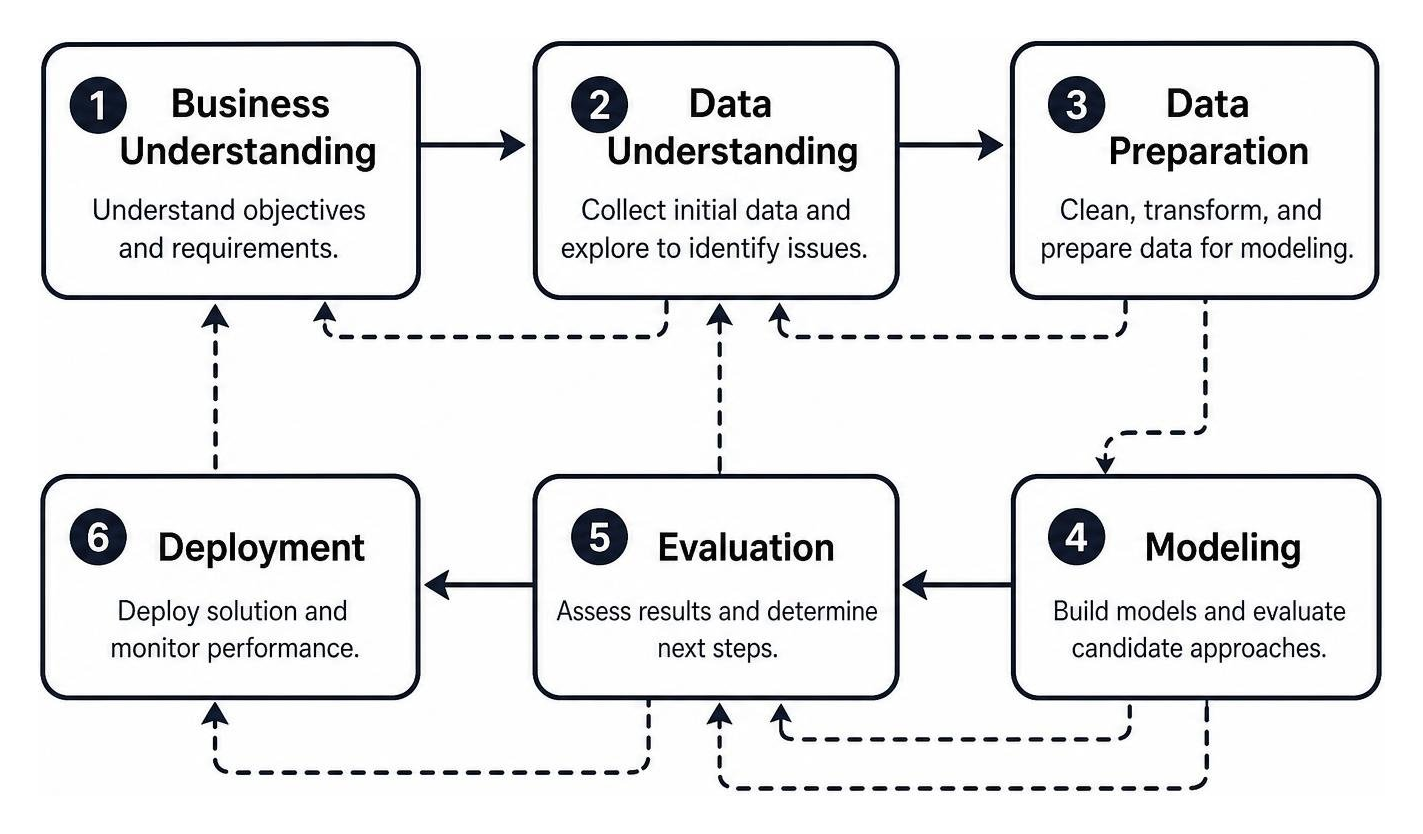
A comprehensive crisp data science lifecycle guide shows that the enduring power of this framework lies in its process neutrality. It does not dictate whether you use Python, R, SQL, or specialized BI platforms; rather, it governs how you conceptualize, clean, model, and deploy your data solutions.
The Evolution of CRISP Data Science Methodologies
Conceived in 1996 under the European Union’s ESPRIT funding initiative and officially published in 1999 following industry consortium workshops in Brussels, CRISP-DM was designed to solve a fundamental problem: data mining projects were failing because teams jumped straight into algorithmic modeling without understanding the underlying business problem.
For legal practices, this historical lesson is directly relevant today. Whether your firm operates in Los Angeles, California, or Austin, Texas, legal operations generate massive volumes of complex data. However, jumping directly into machine learning or predictive lead scoring without a structured framework often results in models that fail to account for legal ethics, state bar advertising rules, or operational intake realities.
How Legal Marketers Leverage Structured Data Models
When applied to legal marketing, structured data frameworks help firms build robust systems for:
- Intake Funnel Attribution: Moving beyond basic last-click attribution to understand every touchpoint across paid search, organic SEO, and video marketing.
- Caseload and Revenue Forecasting: Projecting case settlement values and litigation durations based on historical case-type parameters and judicial trends.
- Client Lifetime Value (LTV) Modeling: Identifying the demographic, geographic, and case-type characteristics that correlate with high-value referrals and recurring corporate legal work.
Applying Marketing Automation and Big Data allows managing partners to systematically clean CRM records, track campaign efficacy, and forecast growth with statistical confidence rather than guesswork.
The 6 Core Phases of the CRISP-DM Lifecycle Explained
The strength of CRISP-DM is its iterative lifecycle. The output of one phase routinely circles back to inform and refine the previous step.

- Business Understanding: Deconstruct high-level firm goals into measurable data science problem statements. Assess project constraints, budget, personnel, legal advertising compliance rules, and client confidentiality standards (such as ABA Model Rule 1.6).
- Data Understanding: Collect initial datasets from practice management software (e.g., Clio, Filevine), web analytics, and intake call logs. Conduct exploratory data analysis (EDA) using distribution charts and summary statistics to evaluate data completeness.
- Data Preparation: Clean raw datasets, handle missing values, resolve duplicate client records, encode categorical variables, and engineer new predictive features.
- Modeling: Select appropriate machine learning algorithms or statistical models (e.g., logistic regression for lead qualification, random forests for settlement value estimation), calibrate hyperparameters, and establish baseline performance benchmarks.
- Evaluation: Test model results against original business objectives rather than relying purely on technical metrics. Determine whether the model meets practical operational thresholds before investing in software integration.
- Deployment: Operationalize the model into daily firm workflows—such as automated intake scoring within your CRM, real-time executive dashboards, or alert systems for high-priority leads.
Applying CRISP Data Science to Law Firm Case Acquisition
Let's examine how a personal injury firm targeting motor vehicle accident cases in competitive urban markets applies these six phases:
- Business Understanding: The firm wants to reduce its cost-per-signed-case while identifying high-value catastrophic injury claims faster. The concrete data objective is defined: Predict the likelihood of an incoming web inquiry converting into a signed retainer within 2 hours of submission.
- Data Understanding: The analytics team extracts 24 months of historical intake records, including timestamp data, initial contact channel, geographic ZIP code, incident description length, and final case disposition.
- Data Preparation: Unstructured intake notes are processed to extract relevant keyword tags (e.g., "commercial vehicle," "surgery required"). Missing phone numbers and spam form submissions are filtered out.
- Modeling: The team trains a classification model to score leads on a scale from 1 to 100 based on conversion propensity and estimated claim severity.
- Evaluation: The model is evaluated not just on statistical accuracy, but on whether it correctly surfaces 95% of catastrophic injury cases to senior intake specialists.
- Deployment: The scoring engine is connected to the firm's CRM, enabling Marketing Automation and Lead Generation workflows that instantly route tier-one leads directly to senior intake attorneys via SMS alerts.
Why Data Preparation Consumes 80% of Analytics Projects
A common rule of thumb across the data science industry is that 80% of a project's total effort is consumed by data preparation.
In the legal vertical, this reality is even more pronounced. Law firm data is notoriously messy:
- Intake specialists record notes in free-text fields with inconsistent abbreviations.
- Marketing platforms report conversions under varying naming conventions.
- Prospective clients frequently submit incomplete or duplicate web forms across multiple campaigns.
Without rigorous data hygiene, schema standardization, and outlier correction, even the most sophisticated predictive algorithms will produce misleading conclusions.
How Does CRISP-DM Compare to Alternative Data Frameworks?
While CRISP-DM remains the predominant industry framework, understanding alternative process models helps firms evaluate which workflow best suits their internal capabilities.
| Feature / Dimension | CRISP-DM | SEMMA (SAS) | KDD (Knowledge Discovery in Databases) | ASUM-DM (IBM) |
|---|---|---|---|---|
| Origin & Backing | Industry Consortium (1999) | SAS Institute | Academic / Research Community | IBM |
| Primary Focus | End-to-end business & data lifecycle | Technical modeling within SAS toolsets | Theoretical data pattern extraction | Enterprise-scale deployment & governance |
| Business Phase | Dedicated upfront stage | Minimal / Assumed | Minimal / Academic | Comprehensive upfront alignment |
| Deployment Phase | Integrated core phase | Excluded (stops at assessment) | Excluded (stops at evaluation) | Extensive operational governance |
| Process Neutrality | 100% Tool-Agnostic | Tied primarily to SAS tools | Tool-Agnostic | Tool-Agnostic |
| Industry Adoption | Leading framework (~43%) | Declining (~1% in 2020 polls) | Academic reference standard | Enterprise niche |
Traditional alternatives like SEMMA (Sample, Explore, Modify, Model, Assess) and KDD focus almost entirely on the technical mechanics of data mining. They frequently skip the upfront business understanding phase and omit post-deployment monitoring.
For law firms, where marketing investments must tie directly to caseload growth and ethical compliance, CRISP-DM and its modernized extensions (such as ASUM-DM) provide the necessary safeguards to ensure analytics initiatives solve actual operational challenges.
Agile Slicing vs. Waterfall Execution in Legal Analytics
A frequent point of confusion among project managers is whether CRISP-DM is an agile or waterfall framework. The answer depends on how your team executes its phases:
- Horizontal Slicing (Waterfall): Executing every phase across the entire organization simultaneously—spending six months gathering all historical firm data, four months cleaning it, three months modeling, and attempting deployment a year later. This approach carries high risk; by the time the model is built, firm priorities and advertising algorithms have shifted.
- Vertical Slicing (Agile): Delivering thin, end-to-end analytical slices in rapid sprints. For instance, a firm might run a two-week sprint focused solely on predicting intake drop-offs from paid search mobile landing pages.
By pairing the structured phases of CRISP-DM with team coordination frameworks like Kanban, Scrum, or Data-Driven Scrum, legal marketing teams can test hypotheses quickly, iterate on baseline models, and demonstrate immediate ROI to managing partners.
Modern AI and LLM Adaptation in Data Science
With the rapid emergence of Large Language Models (LLMs) and agentic workflows, structured process models are more essential than ever. Exploring exploratory data science methodologies demonstrates how CRISP-DM adapts seamlessly to Generative AI projects:
Modern Marketing Automation Software Tools allow law firms to embed these AI workflows directly into client intake, automatically parsing inquiry context while maintaining strict compliance boundaries.
Best Practices for Deploying and Evaluating Data Models
Deploying a model without proper evaluation and monitoring is one of the most common points of failure in legal analytics. A model that performs with 90% accuracy in a controlled development environment can quickly fail in real-world conditions if consumer search behavior shifts or advertising platforms update their tracking rules.
When establishing evaluation standards, legal marketers must separate technical validation metrics from business KPIs:
- Classification Precision vs. Recall: In personal injury intake, recall is often far more important than raw accuracy. If a lead scoring model rejects three spam forms but accidentally filters out one six-figure commercial trucking injury lead, the financial loss far outweighs the operational time saved.
- R-Squared and Variance in Settlement Valuation: When building regression models to forecast case settlement values, an R² score between 0.35 and 0.50 can provide substantial directional value for managing partner resource planning, even if it cannot predict exact trial verdicts.
Bridging Algorithmic Accuracy with Real-World ROI
To ensure data science initiatives deliver lasting business value, firms should adhere to three core operational practices:
- Establish a Baseline Model Early: Never spend months engineering complex neural networks before deploying a simple linear regression or decision tree benchmark. A baseline model lets you measure incremental improvements and delivers fast feedback.
- Implement Continuous Drift Monitoring: Datasets are dynamic. Monitor your systems for data drift (e.g., changes in incoming lead demographics) and concept drift (e.g., statutory changes that alter case viability) to prevent accuracy degradation over time.
- Automate Executive Reporting: Present findings in clear, operational terms. Managing partners need to see cost-per-acquisition (CPA), qualified case volume, and intake velocity—not raw confusion matrices or loss curves.
Frequently Asked Questions About CRISP Data Science
Is CRISP-DM an agile or waterfall methodology?
CRISP-DM is methodology-neutral. It defines the necessary phases of an analytics project rather than the project management cadence. When teams execute the phases linearly over many months, it behaves like Waterfall. When teams cycle through the six phases rapidly in 1- to 2-week iterations using vertical slicing, it functions as an Agile framework.
What are the biggest pitfalls when implementing CRISP-DM?
The most frequent pitfalls include:
- Vague problem statements during Business Understanding.
- Underestimating data cleansing requirements (skipping the 80% preparation rule).
- Neglecting the Deployment phase by building models that cannot easily integrate into existing CRM or intake software.
- Failing to establish continuous monitoring for model drift after launch.
How do modern AI agents and LLMs fit into CRISP-DM?
CRISP-DM maps cleanly to Generative AI lifecycles. Business Understanding establishes the operational use case and ethical boundaries; Data Preparation handles document chunking, prompt structuring, and vector embedding; Modeling covers model selection, fine-tuning, or RAG architecture; and Evaluation tests for hallucinations, bias, and compliance before deployment.
Why is the business understanding phase critical for law firms?
Without a clear business objective tied to revenue, caseload capacity, or advertising compliance, data science projects often solve the wrong problem. A technically accurate model that fails to account for state bar advertising rules, attorney contingency fee structures, or specific practice-area dynamics provides zero real-world value to a firm.
Conclusion: Mastering Structured Data Science for Law Firm Growth
Data science is no longer reserved for Fortune 500 tech companies; it is a vital competitive differentiator for growing law firms. By adopting the structured, battle-tested phases of the CRISP-DM lifecycle, managing partners and legal marketing directors can eliminate guesswork, protect their marketing investments, and systematically transform raw client data into profitable caseload growth.
At Outlier Creative Agency, we combine deep legal marketing specialization with rigorous, data-driven execution. Whether you are scaling an integrated multi-channel acquisition strategy or elevating your practice through high-impact law firm video production and data-driven marketing, our team ensures every campaign is engineered for measurable ROI and strict regulatory compliance. Build an authoritative digital presence backed by sound data strategy today.