

Learn how marketing automation big data boosts email click rates by 119% and drives 18x revenue with AI-powered personalization and compliance.
What Is Marketing Automation Big Data Architecture?
At its core, marketing automation big data relies on a modern data architecture designed to break down information silos and turn chaotic, high-volume data streams into organized, actionable marketing workflows. For law firms and enterprise businesses alike, raw data lives in many places: Google Ads accounts, organic search sessions, CRM systems, offline phone logs, and intake questionnaires. Without a cohesive underlying structure, this data remains fragmented and unusable.
A robust big data architecture relies on three primary components:
- Data Ingestion and Pipelines: Ingesting data requires extract, transform, load (ETL) or extract, load, transform (ELT) pipelines that continuously gather interaction signals from web pages, social platforms, and digital ads.
- Centralized Data Warehouses: Modern cloud data warehouses act as the single source of truth, storing structured and unstructured data at scale.
- Operational Activation Layers: Utilizing tools like Reverse ETL, the architecture pushes enriched insights from cloud storage directly back into operational tools.
When your tech stack integrates smoothly, the performance improvements are undeniable. Automated emails backed by rich behavioral data achieve 119% higher click rates than standard broadcast emails, according to industry benchmarks. Furthermore, personalized content triggered by automated data signals drives up to 18x more revenue than generic broadcast blasts.
Implementing the right Marketing Automation Software Tools ensures that incoming client signals translate into immediate, structured nurture sequences rather than lost opportunities.
How Big Data Pipelines Power Automated Workflows
The mechanics of marketing automation big data rely on automated, end-to-end data pipelines. In the past, data engineers had to write custom scripts to move lead information from landing pages into databases, a slow process prone to errors. Today, automated pipeline generation handles data ingestion, cleansing, and orchestration in real time.
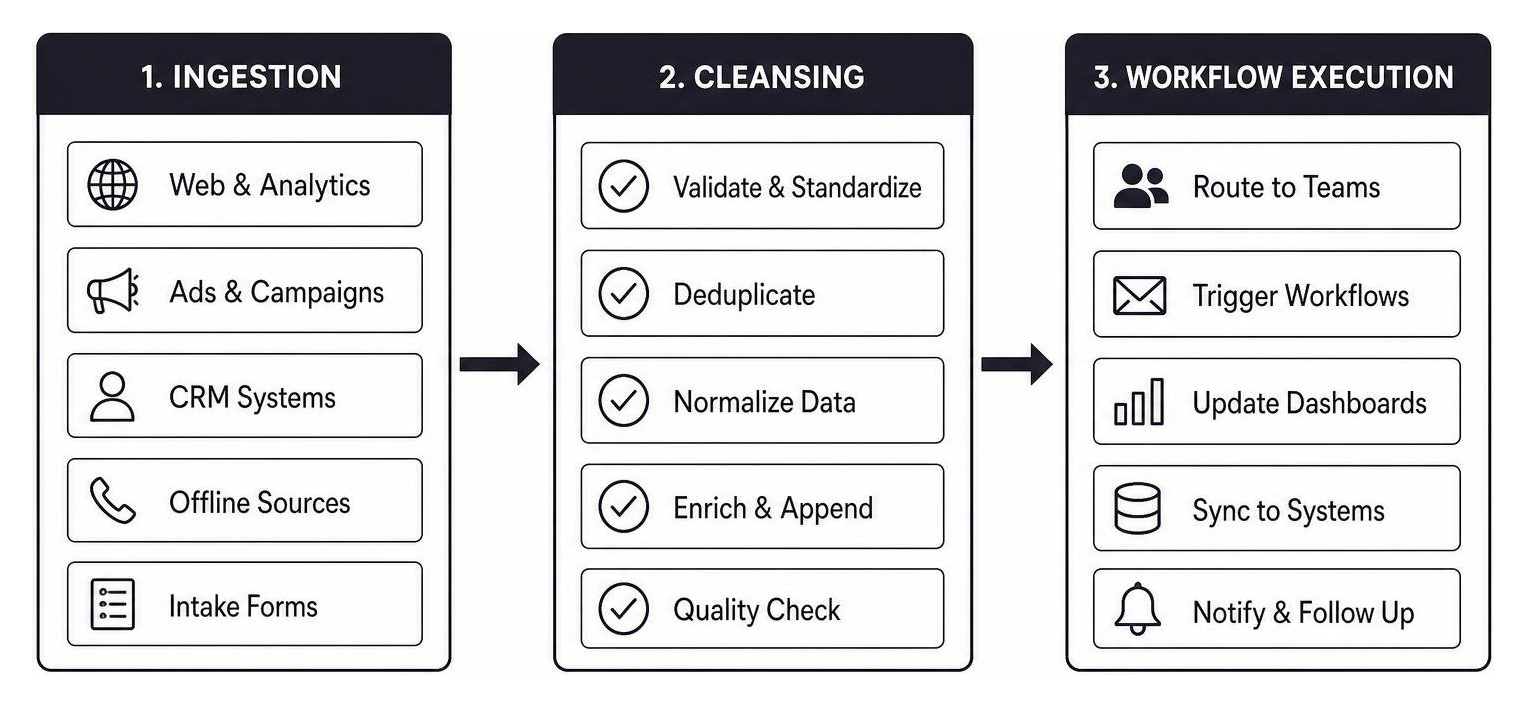
When a prospective client fills out an intake form for a personal injury or commercial litigation consultation, the data pipeline instantly normalizes phone numbers, checks for duplicate entries, enriches the profile with historical site behavior, and pushes the clean record directly to the intake team’s dashboard. This seamless automation eliminates manual data entry, guarantees high data hygiene, and allows marketing teams to focus on high-level campaign strategy.
Key Features of Marketing Automation Big Data Platforms
Modern enterprise automation tools have evolved far beyond basic email drip tools. To leverage massive datasets effectively, your platform architecture requires several critical capabilities:
- Bidirectional Data Synchronization: Ensures two-way communication between your CRM and cloud data platforms so that status updates (e.g., a lead converting into a retained client) instantly update marketing suppression lists.
- Reverse ETL Engine: Ships computed data points (like lead scores or churn risk metrics) directly out of data storage into front-line execution tools.
- Zero-Copy Data Architecture: Allows software systems to query centralized enterprise warehouses directly without replicating raw datasets across multiple vendor servers, enhancing privacy and security.
- Continuous Identity Resolution: Resolves individual user profiles across multiple devices, browser sessions, and offline touchpoints, creating a unified client identity.
How Big Data Enables Personalization at Scale and Advanced Segmentation
Generic marketing blasts no longer work. Modern legal clients expect tailored communication that directly addresses their specific legal challenges. By combining big data analytics with intelligent automation, firms can achieve hyper-personalization at scale without manually crafting individual messages.
When prospective clients visit a law firm’s website, big data tracking captures their exact navigation path—whether they are reviewing premises liability articles, checking attorney bios, or reading estate planning FAQs. Connecting this granular behavioral tracking with automated marketing systems allows firms to deliver tailored follow-up communications that reflect each prospect's unique interests.
Pairing dynamic content delivery with robust Marketing Automation and Lead Generation strategies turns high website traffic into qualified, highly engaged consults.
Dynamic Customer Profiling and Lead Scoring
Not every inbound inquiry is a good fit for your firm. Big data automation streamlines lead qualification by evaluating prospective clients using sophisticated lead scoring and lead grading models.
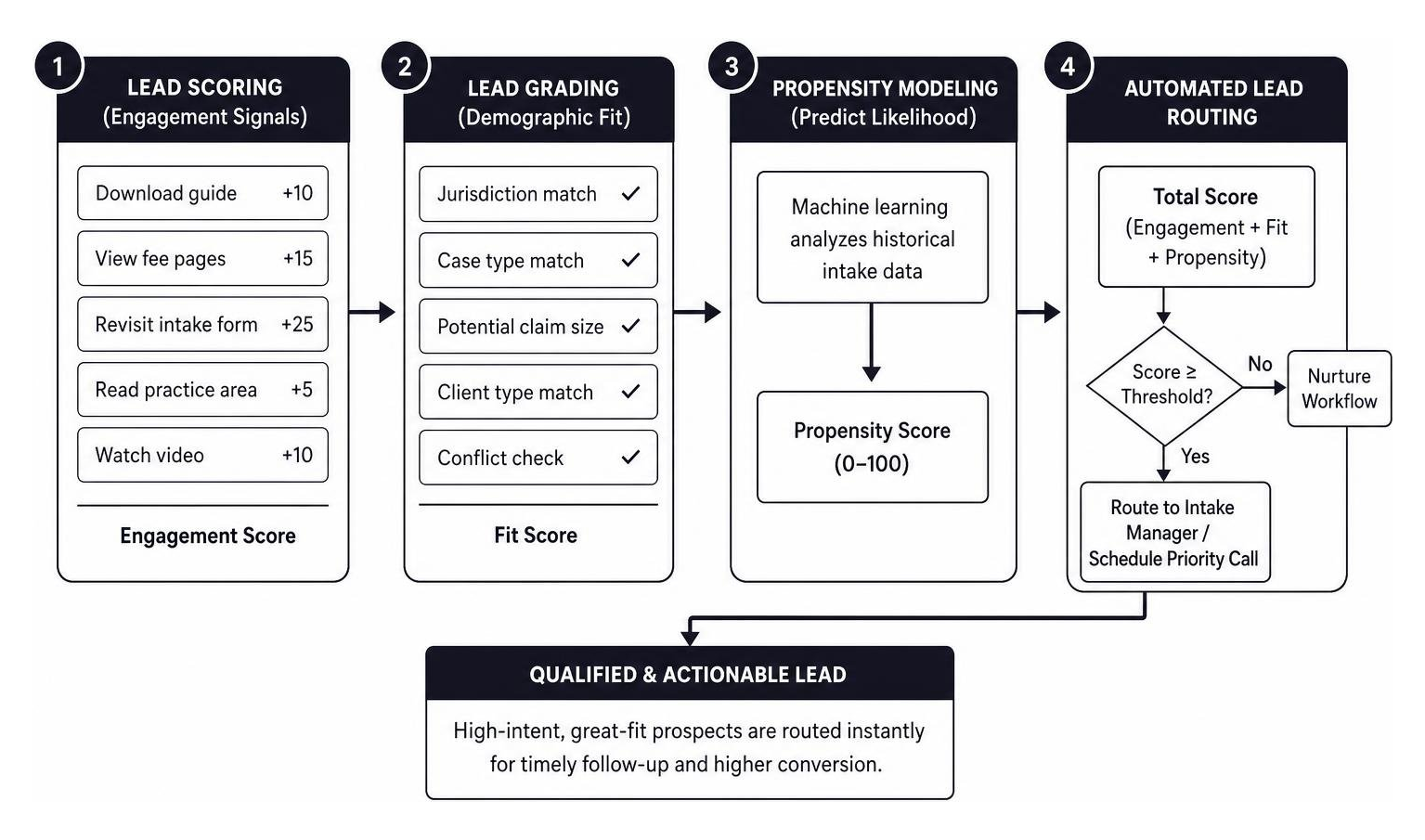
- Lead Scoring (Behavioral Signals): Assigns point values to real-time interactions. For example, downloading a litigation guide (+10), viewing fee structure pages (+15), or revisiting an intake form (+25) increases a prospect's engagement score.
- Lead Grading (Demographic and Firmographic Fit): Evaluates whether the lead meets your target criteria, such as jurisdiction, case type, or potential claim size.
- Propensity Modeling: Machine learning models analyze historical intake trends to predict which prospective clients are most likely to retain your firm.
- Automated Lead Routing: When a prospect's score crosses a designated threshold, the system immediately routes the file to the intake manager or schedules an automated priority call.
Integrating Online and Offline Data for Legal Marketing
A major challenge in legal marketing is connecting digital engagement with offline outcomes. Prospective clients may discover a firm via a Google PPC ad, read several blog posts, but ultimately call the office directly or schedule an in-person consultation weeks later.
Without integrated data systems, offline touchpoints like call logs, paper intake questionnaires, and retainer signings remain disconnected from online ad spend, distorting performance metrics. By partnering with data onboarding services and deploying call-tracking integrations, firms can map offline phone calls and consultation logs back to the exact digital campaign that triggered the initial inquiry. This creates an end-to-end view of the buyer journey, ensuring accurate ad spend attribution and full compliance with state bar advertising regulations regarding client communication records.
The Role of AI, Predictive Analytics, and Customer Data Platforms
The fusion of artificial intelligence, machine learning, and centralized big data repositories is transforming marketing automation. While traditional marketing platforms rely on simple "if-this-then-that" rules, modern AI-driven systems analyze context, predict future behaviors, and make autonomous campaign decisions.
Data shows that 29% of surveyed marketers plan to add automation to their social media and paid advertising management, while 28% are automating their email marketing workflows. Integrating AI models into these efforts shifts marketing from retroactive reporting to proactive engagement.
Leveraging CDPs to Unify Disparate Marketing Data
Customer Data Platforms (CDPs) serve as the primary engine unifying fragmented marketing data. Unlike standard CRMs, which mainly log direct customer touchpoints, a CDP continuously aggregates structured and unstructured event data from websites, mobile applications, ad networks, and offline management software.
By establishing a universal identity framework—moving beyond basic "Golden Records" to real-time, self-updating "Diamond Records"—an intelligent CDP provides a single source of truth. Advanced CDP setups deploy AI-driven marketing data lakehouses to run complex audience segmentation prompts without requiring manual SQL queries from your IT team.
How AI and Real-Time Decision Engines Drive Campaigns
Once big data is unified inside a CDP or lakehouse infrastructure, real-time decision engines step in to determine the optimal next action for every user.
Rather than sending pre-scheduled campaign blasts, AI-powered arbitration algorithms evaluate multiple factors in milliseconds:
- Propensity Scores: How likely is this prospect to book a consultation today?
- Business Value Calculations: What is the projected value of this case type?
- Contact Rules & Policies: Has this individual received an email within the last 48 hours?
Through real-time interaction management, the engine automatically selects the next best message—whether that means serving a retargeting ad on social media, sending an educational SMS, or holding back ads if the client has an active, open case with the firm.
Navigating Data Privacy Regulations and Measuring Campaign ROI
As marketing platforms become more data-intensive, staying compliant with evolving data privacy legislation is mandatory. Regulations like the General Data Protection Regulation (GDPR) and the California Consumer Privacy Act (CCPA) grant consumers strict rights over how their personal information is collected, stored, and used.
For law firms operating in major markets like Los Angeles or Austin, respecting user privacy is not only a regulatory obligation under state law—it is an ethical mandate governed by strict bar association rules regarding client confidentiality and solicitation.
| Dimension | First-Party Data Strategy | Third-Party Data Reliance |
|---|---|---|
| Data Ownership | 100% owned directly by your firm/business | Owned by external vendors and data brokers |
| Privacy Compliance | High; obtained via explicit user opt-in/consent | Low; subject to cookie deprecation and regulatory fines |
| Data Accuracy | High; verified directly through user interactions | Moderate to Low; aggregated and often outdated |
| Long-Term Viability | Future-proof against browser cookie blocks | Declining due to privacy laws and cookieless tracking |
Achieving GDPR and CCPA Compliance in Automation
Operating big data workflows responsibly requires building privacy controls directly into your technology stack:
- Explicit Opt-In Mechanisms: Clear, unambiguous consent forms must capture explicit authorization before tracking user behavior or triggering marketing workflows.
- Automated Data Deletion Protocols: Systems must support automated "Right to be Forgotten" workflows that purge user records across all linked databases upon request.
- Privacy-First Tracking Infrastructures: Transitioning away from third-party tracking cookies toward server-side tracking, hashed identifier matching, and first-party data collection.
- Legal Ethics & Compliance Shielding: Ensuring that automated SMS, email, and ad campaigns comply with local legal advertising ethics rules (e.g., proper disclaimer language and strict anti-solicitation guidelines).
Measuring ROI with Marketing Automation Big Data Metrics
Deploying advanced marketing automation big data strategies requires significant capital and operational focus. Demonstrating clear return on investment (ROI) relies on looking beyond vanity metrics like impression counts or open rates.

To measure true performance, enterprise marketing teams evaluate:
- Net Profitability per Acquisition: Calculating total legal fees generated by a campaign minus ad spend, software fees, and intake operational costs.
- Multi-Touch Attribution (MTA): Distributing conversion credit across all digital and offline touchpoints along the prospective client's path.
- Closed-Loop Reporting: Connecting signed retainer agreements back to the exact initial organic landing page visit or paid keyword query.
Understanding these detailed performance metrics makes it easier to evaluate marketing investments and balance tech spend against long-term growth targets, as outlined in our breakdown of Attorney Marketing Automation Pricing.
Frequently Asked Questions About Marketing Automation Big Data
How does big data automation transform legal intake and client acquisition?
Big data automation speeds up legal intake by instantly processing incoming lead forms, validating contact details, and executing real-time lead scoring. High-priority case inquiries automatically trigger immediate SMS or email follow-ups, while routing intake alerts directly to on-call staff. This rapid response prevents lost leads, improves conversion rates, and delivers a professional first impression for prospective clients.
What are the primary challenges of unifying online and offline marketing data?
The main challenge stems from data fragmentation across disconnected platforms, such as online ad accounts, website analytics, offline phone systems, and legal practice management CRMs. Resolving duplicate contacts, establishing accurate offline call attribution, and keeping data hygienic across platforms require automated data pipelines, Reverse ETL connectors, and secure onboarding partners.
How do privacy regulations like GDPR and CCPA affect automated marketing analytics?
Privacy regulations require explicit consumer consent for data collection, enforce strict data access and deletion requests, and limit reliance on third-party tracking cookies. Marketers must deploy consent management platforms, transition to first-party data strategies, and adopt server-side data processing to ensure analytics and campaign triggers remain compliant.
Scaling Your Practice with Data-Driven Automation
Navigating the intersection of high-volume data analytics, predictive AI, and automated campaign execution requires technical skill, strategic planning, and deep industry focus. For law firms competing in crowded legal markets across California and Texas, building a data-driven marketing system is essential for capturing market share, streamlining intake operations, and maintaining legal compliance.
At Outlier Creative Agency, we build tailored, high-performing marketing strategies designed specifically for attorneys and legal practices nationwide. From managing integrated PPC campaigns and local SEO to implementing automated nurture workflows that respect bar compliance standards, our team helps law firms scale predictable client pipelines.
Ready to transform your law firm's growth trajectory with data-driven workflows? Explore our comprehensive Email Marketing Guide for Lawyers or connect with our agency team directly to audit your current martech stack and unlock the power of modern legal email marketing and automation services.