
Reduce bankruptcy cost-per-lead from $229 to $20 with smart debt relief bankruptcy PPC strategies for high-converting attorney campaigns.
Turn Debt Searches Into Qualified Bankruptcy Consultations
Debt relief bankruptcy PPC works best when you separate Chapter 7, Chapter 13, and urgent debt searches; send each search to a matching local landing page; and measure qualified calls and booked consultations, not just form fills. Start with high-intent terms such as "bankruptcy attorney near me," chapter-specific terms, and urgent searches related to garnishments or creditor calls. Then block DIY, legal-aid, job, court-address, and out-of-service-area searches.
For most competitive markets, a meaningful Google Ads test needs roughly $2,000 to $4,000 per month in media spend. Early campaigns may see CPLs of $150 to $250, while mature, closely managed bankruptcy campaigns can target $20 to $50 per lead and conversion rates near 19% to 26%.
The important distinction is quality. A low-cost inquiry is not useful if the person is outside your jurisdiction, wants free filing forms, or cannot book a consultation. Build privacy and empathy into every step, use bar-compliant tracking, and let search-term data guide weekly improvements.
I am Corey Larson of Outlier Creative Agency. Our team creates legal content, websites, and lead-focused media for law firms, and this guide draws on that experience with debt relief bankruptcy PPC to help firms build a more reliable intake pipeline.
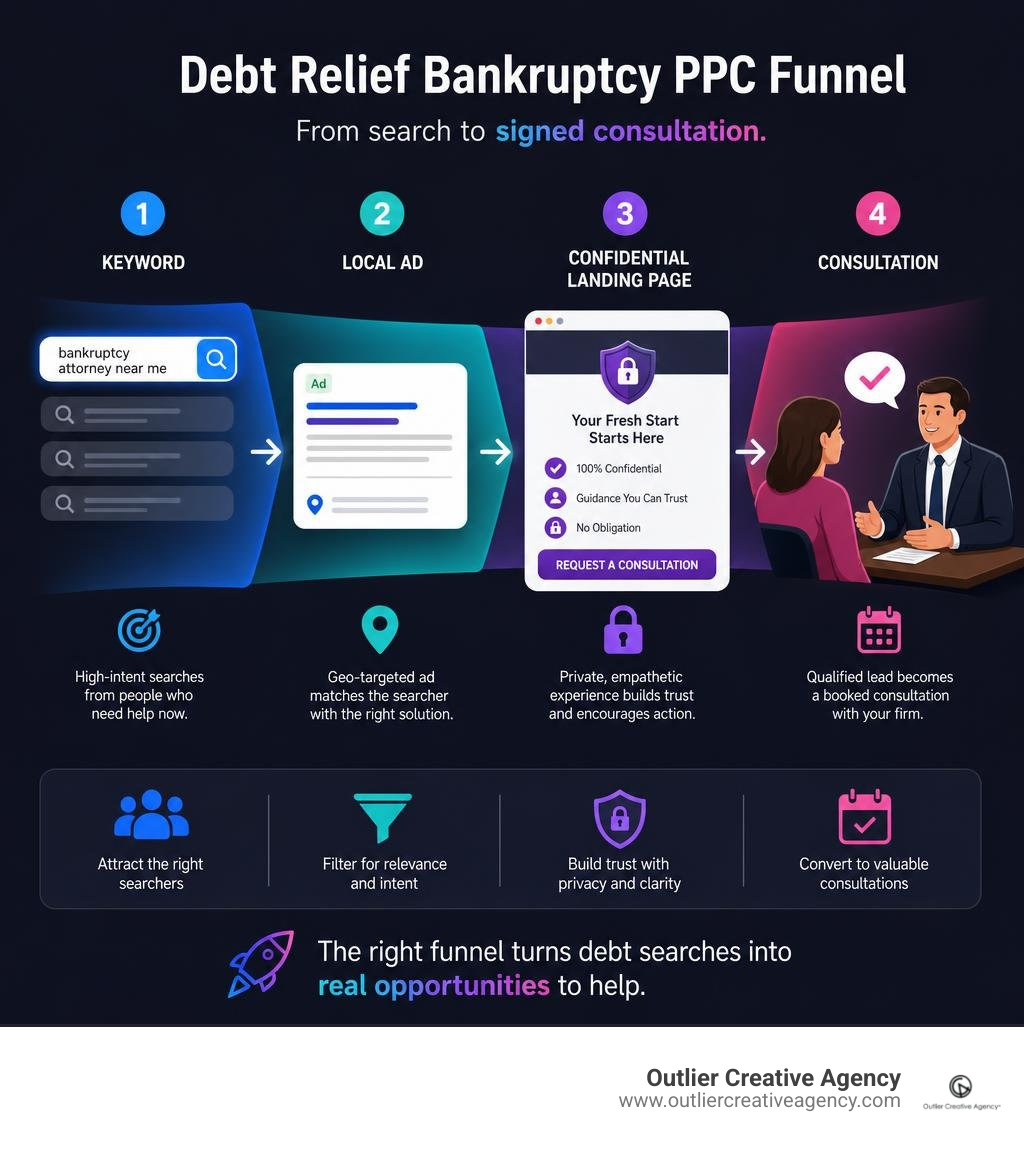
Structuring a High-Converting Debt Relief Bankruptcy PPC Campaign
A successful legal pay-per-click campaign does not happen by accident. When prospective clients face severe financial distress, their search queries mirror their immediate panic, legal eligibility, or desire to wipe the slate clean. Lumping every debt-related query into a single ad group drains your budget on irrelevant clicks and depresses your Quality Score.
To build an efficient acquisition engine, your campaign architecture must reflect user intent. At Outlier Creative Agency, we structure accounts into tightly focused campaigns divided by legal chapters and urgency triggers. We then apply precise geographic parameters to ensure every click comes from a jurisdiction where your attorneys are licensed to practice, such as the Central District of California for Los Angeles bankruptcy lawyers or the Western District of Texas for an Austin, TX bankruptcy attorney office.
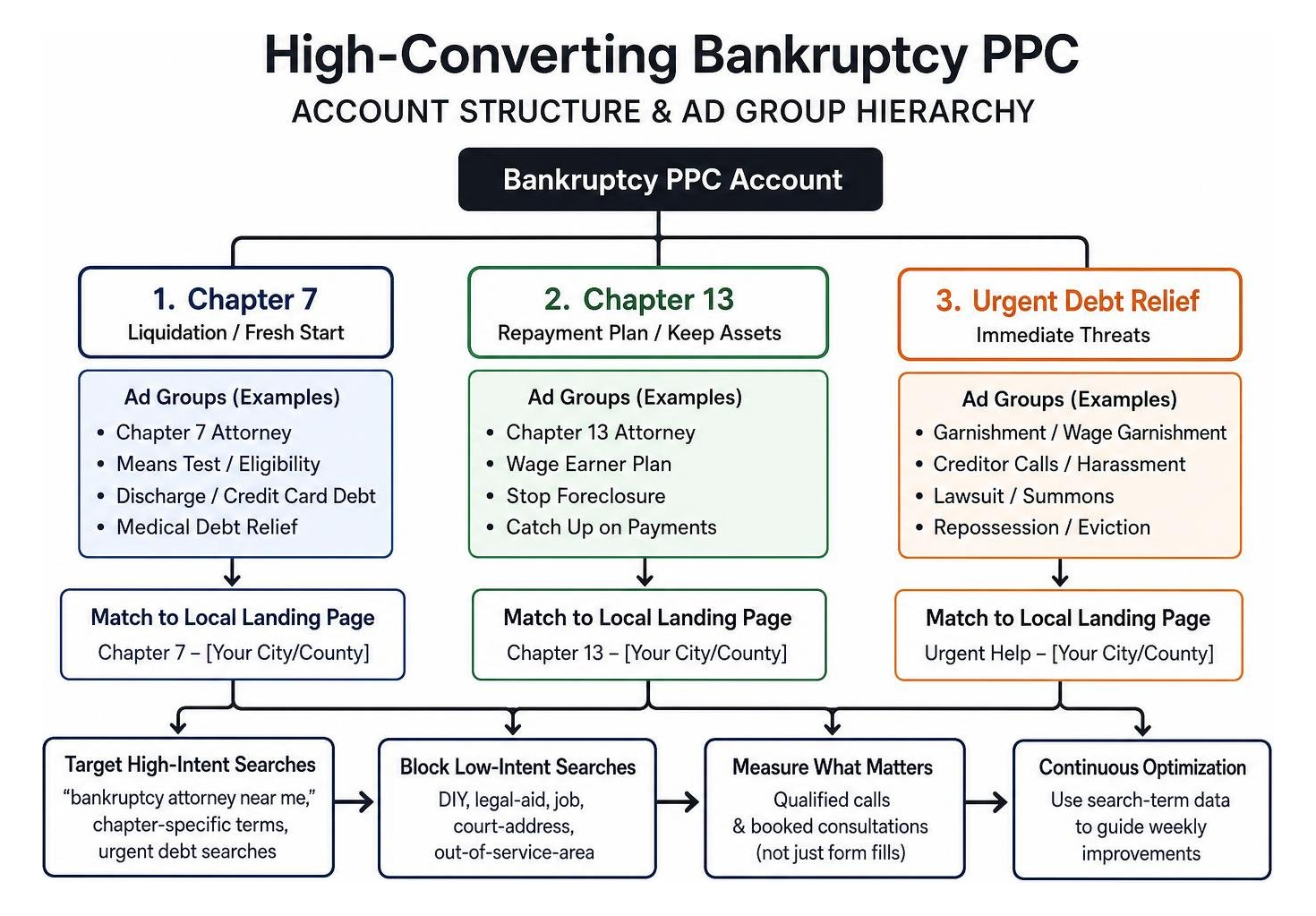
Differentiating Chapter 7 vs Chapter 13 Search Intent
Searchers looking for Chapter 7 liquidation have entirely different financial realities and motivations than those researching Chapter 13 wage-earner reorganization plans.
- Chapter 7 Search Intent: These searchers are typically looking for speed, total debt elimination, and an immediate fresh start. They often search terms related to credit card balances, medical debt, and the means test.
- Chapter 13 Search Intent: These prospects often own assets they want to protect, such as a home facing foreclosure or a vehicle at risk of repossession. They have steady income and are researching manageable repayment schedules.
| Campaign Dimension | Chapter 7 Targeting | Chapter 13 Targeting |
|---|---|---|
| Primary Consumer Goal | Complete unsecured debt discharge | Asset protection & repayment restructuring |
| Top Keywords | "Chapter 7 lawyer," "liquidate credit card debt" | "Stop foreclosure attorney," "Chapter 13 payment plan" |
| Primary Value Trigger | Fast relief, clean financial slate, means test help | Save the family home, halt vehicle repossession |
| Intake Qualifier | Low-to-moderate income vs. state median | Regular, verifiable income stream |
When implementing comprehensive PPC for attorneys, tailoring ad copy and dedicated landing pages to these distinct legal remedies ensures your conversion rate stays high while lowering your cost per acquisition.
Core Fundamentals of Debt Relief Bankruptcy PPC Keyword Strategy
Your keyword portfolio forms the foundation of your campaign. Broad, generic terms like "debt help" or "money problems" will quickly exhaust your ad spend on clicks from users seeking credit counseling, personal loans, or basic budgeting tips.
Instead, structure your bids around three proven keyword categories:
- High-Intent Direct Keywords: Search queries from users who already know they need legal counsel (e.g.,
bankruptcy lawyer near me,local Chapter 7 attorney). - Urgency & Enforcement Triggers: Searches driven by active creditor collections (e.g.,
stop wage garnishment lawyer,emergency bankruptcy filing to stop auction). - Chapter-Specific Terms: Queries indicating legal research into specific remedies (e.g.,
Chapter 13 lawyer Austin,Chapter 7 means test qualification).
Mastering these keyword themes requires a deep understanding of bankruptcy lawyer PPC ads and how exact and phrase match types prevent Google from matching your ads to unqualified informational queries.
Eliminating Wasted Spend with Aggressive Negative Keywords
What you exclude from your campaigns is just as critical as what you target. Search engines frequently match legal keywords to DIY filers, people seeking free legal aid, or job seekers looking for court clerk positions.
To protect your budget, add comprehensive negative keyword lists across your account, including:
- Free & Legal Aid Terms:
pro bono,free legal aid,free bankruptcy lawyer,community legal clinic. (Direct users seeking charitable assistance to resources like pro bono debtor assistance programs or local court clinics such as Central District of California pro bono opportunities). - DIY & Document Queries:
forms,PDF download,free template,file bankruptcy myself,software,pacer login. - Employment & Academic:
jobs,paralegal salary,law school,internships,clerkship. - Government & Court Queries:
court address,trustee phone number,docket lookup,341 meeting location.
Reviewing your search term reports weekly allows you to continuously identify negative keywords, keeping ad spend focused on clients who can retain your firm.
High-Impact Ad Copy and Landing Pages Built for Conversion
Securing the click is only half the battle. If your landing page is cluttered, slow to load, or intimidating, distressed visitors will bounce back to the search results. Designing campaigns in accordance with modern standards—like those detailed in our PPC advertising lawyers guide for 2026—ensures your firm turns clicks into retained cases.
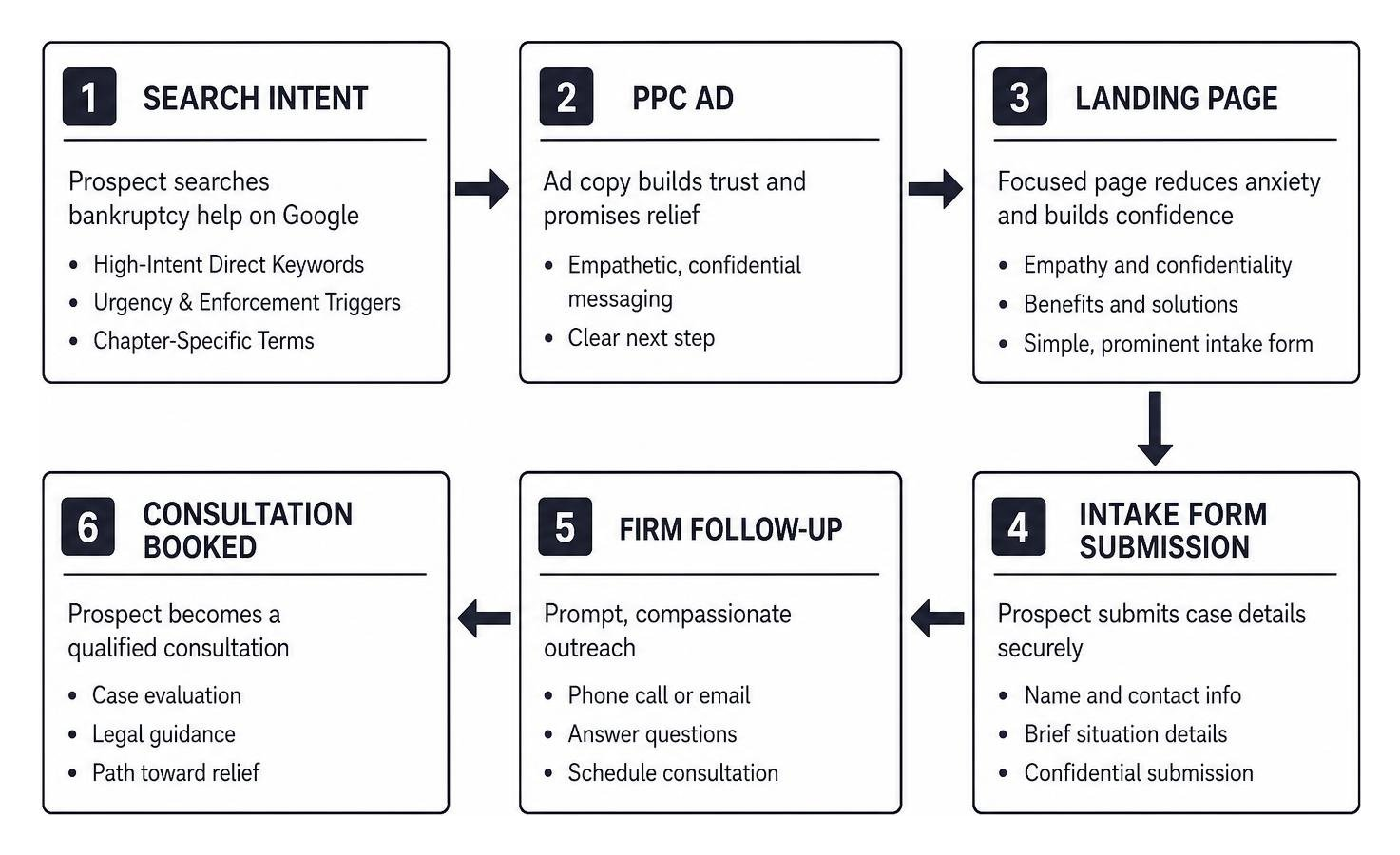
Empathy, Confidentiality, and Emotional Urgency Triggers
People searching for bankruptcy relief are often experiencing severe stress, fear, and embarrassment. Aggressive, clinical, or boastful ad copy fails because it ignores the prospective client's emotional state.
Effective ad messaging combines three critical elements:
- Empathy and Relief: Acknowledge their situation without judgment (e.g., "Struggling with overwhelming debt? Get the fresh start and peace of mind you deserve.").
- Clear Confidentiality Signals: Reassure users that their inquiry is safe (e.g., "100% Confidential Consultation • No Judgment").
- Immediate Action on Urgency: Provide clear next steps to halt creditor action (e.g., "Stop Creditor Calls & Wage Garnishments Today. Speak with an Attorney.").
Highlighting credentials matters, but leading with empathy and discretion generates significantly higher click-through and conversion rates.
Landing Page Architecture and Bar-Compliant Call Tracking
To convert high-intent legal traffic, landing pages must be clean, mobile-optimized, and free of distracting navigation menus.
Key landing page elements include:
- Clear, Reassuring Headline: Match the exact search query and promise immediate relief (e.g., "Put an End to Creditor Harassment and Wipe Out Unsecured Debt").
- Simplified Contact Form: Keep fields to a minimum—Name, Phone, Email, and Debt Amount. Extended questionnaires increase drop-offs.
- Click-to-Call Buttons: Over 65% of bankruptcy PPC conversions occur via mobile phone calls. Ensure your phone number is prominently clickable across the screen.
- State Bar-Compliant Disclaimers: Display necessary attorney advertising disclaimers, physical office locations, and attorney responsible designations to comply with state bar rules.
- Privacy Assurance: Prominently state that all submitted information is privileged and confidential.
For call tracking, implement Dynamic Number Insertion (DNI) using privacy-compliant tools. Ensure call recordings are disabled or strictly restricted to administrative intake staff to uphold attorney-client privilege and state bar ethics guidelines.
Bidding Strategies, Budgets, and Economic Seasonality
Managing a legal PPC campaign requires balancing your bidding strategy with broader economic factors. Knowing when to rely on automated bidding versus manual control helps maintain consistent caseload growth without overpaying for clicks.
Budgeting and Bidding Models in Debt Relief Bankruptcy PPC
Achieving top-tier performance from your ad spend takes patience and iterative optimization. In competitive metro areas, law firms should expect early-stage campaigns to produce a cost per lead (CPL) between $150 and $250 while Google gathers initial conversion data.
As negative keywords, geographic bid adjustments, and quality scores improve over time, a mature campaign can achieve a $20 to $50 CPL, with conversion rates reaching 19% to 26%. In fact, multi-year optimization case studies show that firms consistently refining their search queries can reduce their CPL from over $220 down to below $20.
To navigate this progression efficiently, align your bidding strategies with account maturity:
- Phase 1 (Launch - First 30 Conversions): Utilize Manual CPC or Enhanced CPC. This gives you direct control over keyword bids and prevents automated algorithms from overspending before search-term quality is established.
- Phase 2 (Growth - 30 to 60 Monthly Conversions): Transition to Target CPA (Cost Per Acquisition) once conversion volume is stable.
- Phase 3 (Mature Account - 60+ Monthly Conversions): Deploy Maximize Conversions with a Target CPA cap to capture high-value search queries across your geographic market.
Reviewing overall firm performance with resources like our best PPC for lawyers breakdown will help you benchmark your cost per signed case against industry standards.
Navigating Market Seasonality and Economic Surges
Bankruptcy search volume fluctuates throughout the year based on consumer spending and tax cycles:
- Q1 (Tax Season Dip): January through April often sees a temporary dip in Chapter 7 filings as consumers use tax refunds or earned income credits to pay down pressing balances or delay filing.
- Q2 & Q3 (Post-Tax Surge): Search volume typically rises in late spring and summer as tax refund cash reserves deplete and creditor collection activities resume.
- Q4 (Holiday Lull): Filings tend to slow slightly during November and December as consumers focus on the holidays, followed by a sharp spike in January as credit card statements arrive.
Broader macroeconomic shifts—such as interest rate changes, inflation, or the expiration of government relief programs—also drive sudden increases in debt-relief searches. Keeping campaigns active during slower months preserves your Quality Score and ad rank, positioning your firm to capture market share when search volume surges.
Evaluating Lead Generation Vendors vs. Managed PPC Campaigns
Attorneys looking to scale their bankruptcy caseload often debate between hiring a specialized agency to manage proprietary PPC campaigns or buying leads directly from third-party lead generation vendors.

Third-party lead brokers typically offer tiered pricing packages (e.g., $2,500 to $7,500 per month for batches of 20 to 60 pre-screened leads, plus a per-lead processing fee). While this model offers short-term volume, it comes with distinct trade-offs:
- Shared Lead Distribution: Many lead vendors sell the same inquiry to three or four competing law firms, creating a race to call the prospect first.
- Brand Dilution: Prospects fill out generic web forms (e.g., "National Debt Relief Network") and have no idea which law firm is calling them, leading to confusion and mistrust.
- Lack of Long-Term Equity: When you stop paying a lead broker, your lead flow drops to zero immediately. In contrast, managing your own Google Ads builds proprietary account data, high quality scores, and localized brand authority that you own permanently.
For sustainable growth, pairing direct PPC campaigns with organic search visibility through law firm SEO services builds a reliable pipeline of exclusive leads who specifically sought out your law firm.
Lead Quality Guarantees, Pricing Tiers, and Red Flags
If you do evaluate third-party lead providers, look out for common industry red flags:
- Guaranteed Outcome Claims: Any vendor using ad copy that guarantees debt elimination or specific legal outcomes violates legal advertising ethics (such as ABA Model Rule 7.1).
- Hidden Attorney Identity: Ads that fail to state that legal services are provided by independent licensed attorneys can trigger regulatory scrutiny.
- Lack of Real-Time Delivery: Leads delivered via spreadsheet hours or days after submission convert at a fraction of the rate of real-time call transfers or instant CRM push notifications.
When leads come in, using automated SMS and email appointment reminders can reduce consultation no-shows by as much as 80%, ensuring your marketing budget turns into scheduled appointments.
Frequently Asked Questions About Bankruptcy PPC
What is a realistic cost per lead for bankruptcy Google Ads?
In competitive metro markets, early-stage Google Ads campaigns generally yield a cost per lead (CPL) between $150 and $250. As the campaign matures—through the addition of negative keywords, ad relevance optimization, and landing page refinement—firms typically see CPL drop to $20 to $50 per lead, with conversion rates reaching 19% to 26%.
How much monthly ad spend is required to generate consistent bankruptcy cases?
For a bankruptcy law firm operating in a mid-to-large metropolitan market, a competitive ad spend is typically $2,000 to $4,000 per month. This budget provides enough click volume to generate steady weekly consultations, supply the bidding algorithms with conversion data, and build predictable caseload growth.
How do automated appointment reminders improve bankruptcy consultation show rates?
Bankruptcy leads are often under intense emotional stress and may feel overwhelmed by their financial situation. Automated, multi-channel appointment reminders (sent via SMS and email 24 hours and 2 hours before the consultation) help overcome avoidance behavior and can reduce no-shows by up to 80%.
Can bankruptcy attorneys track calls without violating state bar confidentiality rules?
Yes. Bankruptcy law firms can safely track calls by deploying Dynamic Number Insertion (DNI) that monitors campaign-level and keyword-level attribution without recording client conversations. If calls are recorded for quality assurance, firms must provide clear two-party consent disclosures and ensure access is strictly limited to authorized intake staff to protect confidentiality and attorney-client privilege.
Conclusion
Building a predictable, profitable bankruptcy practice requires moving past generic marketing tactics. By structuring distinct campaigns for Chapter 7, Chapter 13, and urgent collection matters, crafting empathetic ad copy, and strictly tracking conversion data, your firm can generate qualified leads while lowering client acquisition costs.
At Outlier Creative Agency, we build and manage data-driven marketing systems designed specifically for the legal industry. Whether you want to overhaul an underperforming Google Ads account or build an automated lead generation engine from the ground up, explore our dedicated PPC advertising for law firms to discover how we can help you scale your firm.