
How to Generate Bankruptcy Leads without Going Broke - Learn about bankruptcy lawyer ppc ads
What Are Bankruptcy Lawyer PPC Ads and How Do They Work?
Bankruptcy lawyer PPC ads are paid search campaigns that place your law firm at the top of Google the moment someone searches for debt relief help — and that moment matters more than almost any other in legal marketing.
Here's a quick breakdown of what they are and why they work:
- What they are: Paid ads on Google (and Bing) that appear above organic results when someone searches terms like "bankruptcy attorney near me" or "Chapter 7 lawyer."
- How they work: You bid on keywords. When someone clicks your ad, you pay. When they call or fill out a form, you have a lead.
- Why they convert: Bankruptcy searchers are in crisis — facing wage garnishment, foreclosure, or creditor calls. They are not browsing. They are ready to hire today.
- What they cost: Average cost-per-click ranges from $20 to $80+ in competitive markets. Average cost-per-lead runs around $82. A well-run campaign returns roughly $2–$4 for every dollar spent.
- Who should run them: Any bankruptcy firm that needs leads now, not six months from now.
Think about the person sitting at their kitchen table at 11pm, staring at a wage garnishment notice. They open Google and type "bankruptcy lawyer near me." The first result they click is either your firm — or your competitor's.
That single search is the entire business case for bankruptcy PPC.
I'm Corey Larson, and at Outlier Creative Agency I've spent years helping law firms cut through the noise with high-converting digital campaigns, including bankruptcy lawyer PPC ads that generate real, qualified leads without blowing the budget. In the guide below, I'll walk you through exactly how to build, run, and optimize a campaign that actually closes cases.
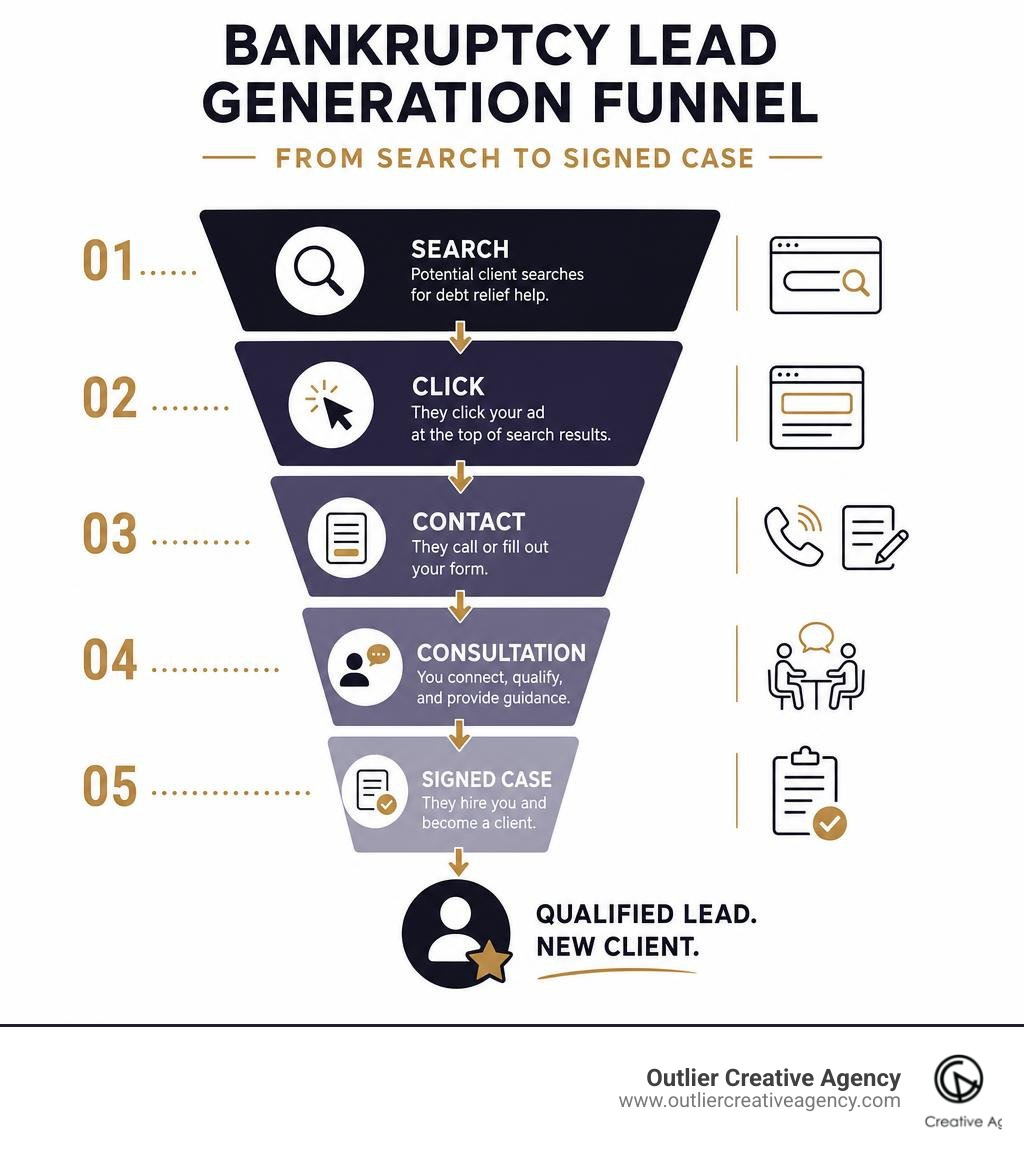
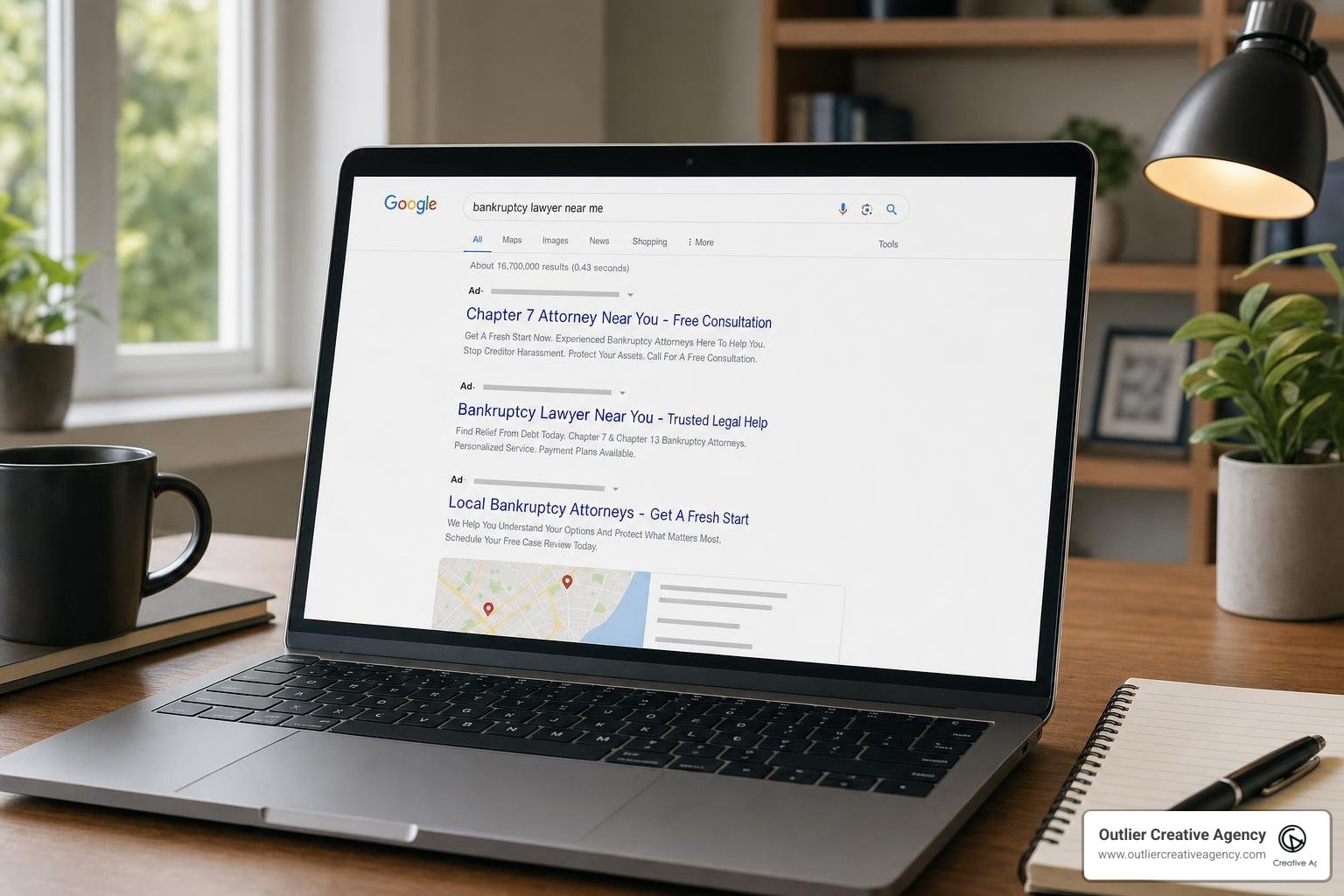
At its core, Pay-Per-Click (PPC) advertising is a search engine marketing auction. When someone searches for legal assistance, Google determines which ads to display at the very top of the Search Engine Results Page (SERP).
Unlike traditional advertising, where you pay a flat fee regardless of performance, PPC operates on a "pay-to-play" basis where you only incur charges when a user actually clicks your ad.
However, Google’s auction system is not a simple "highest bidder wins" scenario. Instead, Google calculates an Ad Rank for every participant in the auction using a formula driven by two main factors:
- Your Maximum Bid: The highest amount you are willing to pay for a single click.
- Your Quality Score: A 1-to-10 rating determined by your ad's relevance to the search query, your expected click-through rate (CTR), and the quality of your post-click landing page.
If your ad copy is highly relevant and your landing page provides an exceptional user experience, you can achieve a high Quality Score. This allows you to outrank competitors who are bidding significantly more money but running poorly optimized campaigns.
For a detailed look at how we structure these high-performance campaigns, check out our specialized PPC Services.
Why Google Ads is the Premier Platform for Bankruptcy Lawyer PPC Ads
When someone is facing an immediate financial emergency, they do not casually browse social media looking for solutions. They go straight to a search engine. This is why Google Ads is the absolute premier platform for bankruptcy lawyer PPC ads.
It targets high-intent, bottom-of-funnel searches at the exact moment of crisis.
Furthermore, mobile search has completely dominated the legal vertical. A massive portion of bankruptcy searches occur on smartphones, often late at night when financial anxiety peaks. Google Ads allows you to leverage call-only ad formats and prominent call extensions, enabling stressed users to click a single button and speak directly with your intake team.
By utilizing targeted search campaigns, you place your firm directly in front of motivated prospects actively seeking debt relief solutions. To learn more about tailoring these strategies to your practice, read our guide on PPC for Attorneys.
The Real Cost of Bankruptcy PPC: Budgets, CPC, and CPL Benchmarks
To run a profitable campaign, you must understand the unit economics of bankruptcy marketing. While legal keywords are notoriously competitive, bankruptcy remains one of the most cost-effective and highest-converting niches in the entire legal sector.
Below is a realistic projection of what you can expect to spend and return in competitive metropolitan areas like Los Angeles and Austin:
| Marketing Metric | Bankruptcy PPC Benchmark | Personal Injury PPC | Family Law PPC |
|---|---|---|---|
| Average Cost-Per-Click (CPC) | $11.70 (National Avg.) / $20 – $80+ (Metro) | $150 – $300+ | $70 – $150 |
| Average Cost-Per-Lead (CPL) | $82.27 – $112.00 | $200 – $400+ | $120 – $250 |
| Lead-to-Sign Conversion Rate | 13% – 22%+ | 5% – 10% | 8% – 12% |
| Average Cost Per Signed Case | ~$630.00 | $1,500 – $3,000+ | $800 – $1,500 |
| Typical Legal Fees Collected | $1,500 – $5,000+ | Contingency (Variable) | $3,000 – $10,000+ |
As the data shows, a well-optimized campaign managed by an experienced Law Firm PPC Agency can easily secure signed cases for roughly $630.
Given that a standard Chapter 7 flat fee ranges from $1,500 to $3,000, and a Chapter 13 case typically commands $3,000 to $5,000, the return on investment math is exceptionally strong. For real-world proof of how these metrics translate into actual cases, explore our breakdown of Law Firm PPC Results.
Setting a Realistic Monthly Budget and Timeline for ROI
To give Google's machine-learning algorithms enough data to optimize your bids, you must establish a minimum viable budget. In competitive markets like Los Angeles or Austin, we recommend a starting monthly budget of $3,000 to $5,000. For established firms looking to dominate their local market, a steady-state monthly spend of $5,000 to $10,000 is typical.
While you can see your very first phone call within 24 to 48 hours of launching, a new campaign requires a stabilization period. Expect the campaign to reach full maturity and peak efficiency around the 90-to-120-day mark.
During this initial phase, budget is allocated to testing ad copy, building out robust negative keyword lists, and refining bid strategies. For a deeper dive into managing your marketing spend efficiently, read our Affordable PPC for Lawyers Guide.
Structuring Your Campaigns: Chapter 7 vs. Chapter 13 and Keyword Strategy
A common mistake that drains ad budgets is dumping all bankruptcy-related keywords into a single, generic campaign. To maximize your Quality Score and conversion rates, you must design a highly structured campaign architecture.

By segmenting your campaigns, you can ensure that a user searching for a specific solution is met with an ad and a landing page that directly address their exact situation. To build a solid foundation for this structure, utilize our expert insights on Keyword Research Law Firms.
High-Intent Keywords and Negative Keyword Filtering
To protect your ad spend, you must bid aggressively on transactional, bottom-of-funnel keywords while ruthlessly filtering out informational search queries.
- High-Intent Keywords to Target: "Chapter 7 bankruptcy lawyer near me," "emergency bankruptcy attorney Austin," "hire a bankruptcy lawyer in Los Angeles," "stop foreclosure attorney."
- Negative Keywords to Exclude: "free bankruptcy forms," "do it yourself bankruptcy," "pro se filing," "bankruptcy court jobs," "how to file bankruptcy for free."
Without a robust, continuously updated negative keyword list, your ads will display for users who have zero intention of hiring an attorney. By implementing these exclusions, you ensure your budget is spent strictly on high-value, fee-paying clients.
Segmenting Chapter 7 Liquidation vs. Chapter 13 Repayment Campaigns
Chapter 7 and Chapter 13 prospects have entirely different financial profiles, pain points, and psychological triggers. Your campaign messaging must reflect these differences:
- Chapter 7 Campaigns (Liquidation): Stressed searchers are often overwhelmed by credit card debt, medical bills, or wage garnishment. They want immediate relief, a fresh start, and a fast, affordable filing process. Your ad copy should lead with emotional relief, speed, and affordability.
- Chapter 13 Campaigns (Repayment/Reorganization): These searchers typically have higher incomes and valuable assets they want to protect, such as a home facing foreclosure or a vehicle facing repossession. They are looking for strategic restructuring and asset protection. Your ad copy and adjacent foreclosure defense campaigns should focus heavily on "keeping your home" and "stopping creditor harassment."
By tailoring your creative assets to these specific scenarios, you dramatically increase your click-through and conversion rates.
Designing High-Converting Landing Pages and Ensuring Legal Compliance
Sending paid traffic to your law firm's homepage is one of the fastest ways to lose money. A homepage contains too many distractions, generic information, and links that lead users away from the conversion path. Instead, every ad group must direct traffic to a dedicated, conversion-focused landing page.
To maximize conversions, your landing page must load in under 4 seconds, be fully optimized for mobile devices, and feature:
- Pricing Transparency: Because bankruptcy clients are highly fee-sensitive, publishing clear, transparent flat-fee pricing or flexible payment options can convert traffic at 2 to 3 times the rate of competitors who hide their fees.
- Immediate Contact Options: Prominent click-to-call buttons, a simple 3-field contact form, and a 24/7 live chat option.
- Trust and Credibility Signals: Real client testimonials, industry badges, and localized trust signals. For example, an Austin-based landing page might reference the Western District of Texas, while a Los Angeles page would highlight the Central District of California.
For advanced landing page layouts, check out our guide on the Best PPC for Lawyers.
Compliance and Ethical Rules for Bankruptcy Lawyer PPC Ads
Because bankruptcy is governed by strict federal and state regulations, your advertising must remain completely compliant to avoid costly bar association penalties:
- ABA Model Rules 7.1 & 7.2: You must never make false, misleading, or unsubstantiated claims. Review the ABA Model Rules of Professional Conduct and your state bar's advertising rules before launching campaigns. Avoid calling yourself an "expert" or "specialist" unless you hold an official, certified board specialty in consumer bankruptcy.
- The Federal Debt Relief Agency Disclaimer (11 U.S.C. § 528): By federal law, bankruptcy attorneys are classified as debt relief agencies. You must include the mandatory disclosure on all public ads and landing pages: "We are a debt relief agency. We help people file for bankruptcy relief under the Bankruptcy Code." You can review the statutory language through 11 U.S.C. § 528.
At Outlier Creative Agency, we specialize in building high-performing campaigns that seamlessly integrate these mandatory legal disclaimers without hurting your conversion rates. To learn more about maintaining compliance across all digital channels, read our guide on Ethical SEO.
Advanced Tactics: LSAs, Tracking Success, and Competing with Big Budgets
To truly scale your firm's intake, you should combine standard Google Search Ads with Google Local Service Ads (LSAs).
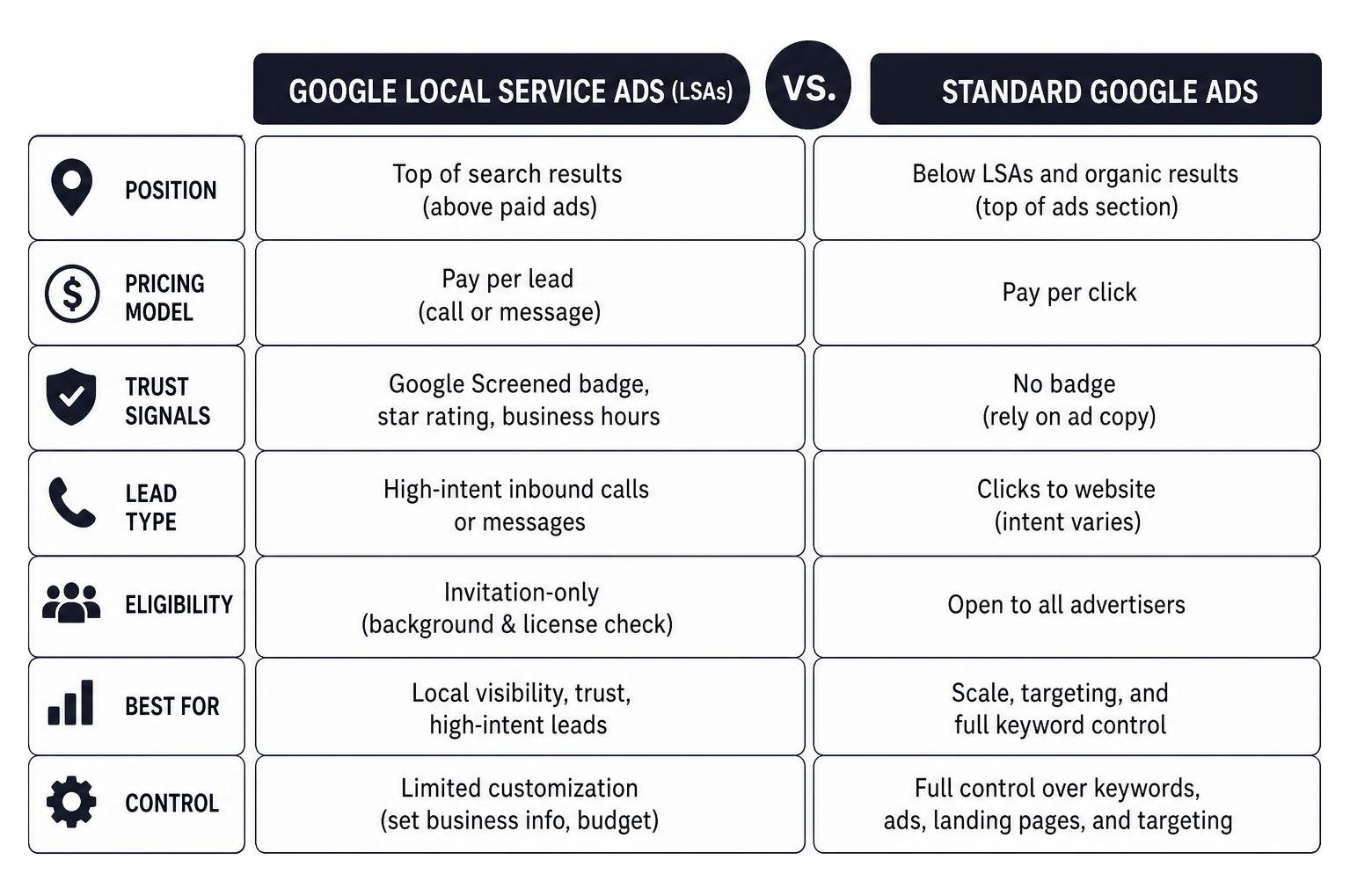
Google Local Service Ads (LSAs) vs. Standard Google Ads
While standard Google Ads charge you per click, LSAs operate on a pay-per-lead model, meaning you only pay when a prospect calls or messages your firm directly. LSAs appear at the absolute top of the Google search results page, displaying a green "Google Screened" badge, your star rating, and your business hours.
Because LSAs build immediate trust, they are an incredibly cost-effective complementary channel to run alongside your standard bankruptcy lawyer PPC ads. For a deeper comparison of these paid search channels, read our article on Attorney PPC Advertising.
How Small Firms Can Outsmart Competitors and Track Success
You do not need a massive corporate marketing budget to compete with national lead-generation mills. Small-to-midsize firms can win local auctions by executing highly disciplined, localized campaigns:
- Geographic Radius Targeting: Limit your ads strictly to the zip codes or court districts where you actually practice (e.g., targeting Travis County for an Austin office, or Los Angeles County for an LA office).
- Ad Scheduling: Only run your high-intent, call-centric ads during the hours when your intake staff is actively available to answer the phone. If a stressed prospect calls and gets sent to voicemail, they will immediately hang up and click the next competitor's ad.
- Single Keyword Ad Groups (SKAGs): Build hyper-targeted ad groups around your highest-performing keywords to maximize your Quality Score and lower your average cost-per-click.
To ensure every dollar is accounted for, you must implement robust conversion tracking. This includes dynamic call tracking to tie every inbound phone call back to the exact keyword that generated it, and full integration with your law firm's CRM.
For step-by-step instructions on auditing and analyzing your campaign metrics, consult our Law Firm PPC Analytics Guide 2026 and the Law Firm PPC Audit Guide 2026.
Frequently Asked Questions About Bankruptcy PPC
Should bankruptcy lawyers prioritize PPC or SEO for lead generation?
Ideally, you should run both. PPC delivers immediate, high-intent leads within days, making it perfect for filling your pipeline quickly. Search Engine Optimization (SEO) takes 6 to 12 months to mature, but it builds long-term organic authority and a sustainable stream of free leads.
Combining both strategies ensures you capture prospects at every stage of the funnel. Learn more about balancing these channels in our guide on Digital Marketing for Attorneys.
What are the most common mistakes bankruptcy lawyers make with PPC ads?
The most common mistakes include:
- Sending paid traffic to a generic homepage instead of a dedicated landing page.
- Failing to build and update a robust negative keyword list, resulting in wasted spend on "free" or "DIY" searches.
- Using broad-match keywords that attract completely irrelevant search queries.
- Broken conversion tracking, which leaves you blind to which keywords actually generate signed cases.
How long does it take to see results from a bankruptcy lawyer PPC campaign?
You can start receiving phone calls and form submissions within 24 to 48 hours of your campaigns going live. However, it typically takes 30 to 90 days of continuous optimization to stabilize your cost-per-lead and find the perfect bidding sweet spot in your local market.
For more foundational tips on managing your paid campaigns, review our PPC Marketing Guide for Lawyers.
Conclusion
Running profitable bankruptcy lawyer PPC ads requires a delicate balance of precise keyword targeting, disciplined budget management, high-converting landing page design, and strict ethical compliance. When executed correctly, paid search is the single fastest, most predictable way to scale your law firm's caseload.
At Outlier Creative Agency, we build data-driven, fully compliant marketing engines that help bankruptcy attorneys in Los Angeles, Austin, and nationwide dominate their local markets.
Ready to stop wasting money on empty clicks and start signing more high-value bankruptcy cases? Book a strategic consultation with our legal marketing experts today to get a customized market analysis for your firm.