

Compare the best law firm internet marketing strategies: SEO, PPC, and web design. Learn key metrics and budget allocation for maximum ROI.
Core Strategies in the Best Law Firm Internet Marketing Programs
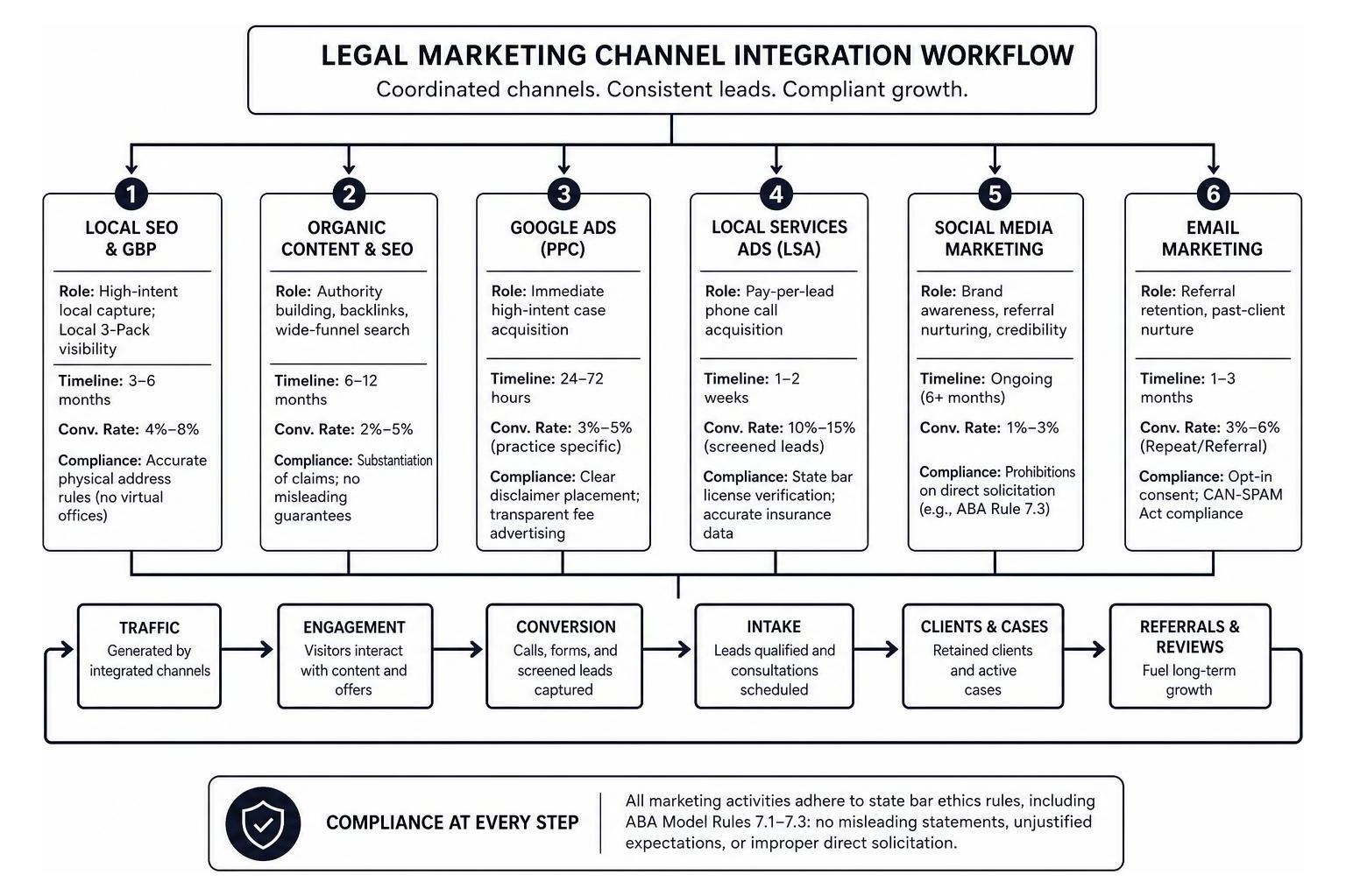
Achieving consistent caseload growth requires an integrated digital strategy rather than disconnected tactics. For law firm owners and managing partners in competitive legal hubs like Los Angeles, California, and Austin, Texas, marketing performance hinges on understanding how different channels complement each other across short- and long-term timelines.
| Legal Marketing Channel | Primary Strategic Role | Typical Timeline to ROI | Average Conversion Rate Benchmark | Key Legal Compliance Focus |
|---|---|---|---|---|
| Local SEO & GBP | High-intent local capture; Local 3-Pack visibility | 3 to 6 months | 4% – 8% (Calls/Form Fills) | Accurate physical address rules (no virtual offices) |
| Organic Content & SEO | Authority building, backlinks, wide-funnel search | 6 to 12 months | 2% – 5% | Substantiation of claims; no misleading guarantees |
| Google Ads (PPC) | Immediate high-intent case acquisition | 24 to 72 hours | 3% – 5% (Practice specific) | Clear disclaimer placement; transparent fee advertising |
| Local Services Ads (LSA) | Pay-per-lead phone call acquisition | 1 to 2 weeks | 10% – 15% (Screened leads) | State bar license verification; accurate insurance data |
| Social Media Marketing | Brand awareness, referral nurturing, credibility | Ongoing (6+ months) | 1% – 3% | Prohibitions on direct solicitation (e.g., ABA Rule 7.3) |
| Email Marketing | Referral retention, past-client nurture | 1 to 3 months | 3% – 6% (Repeat/Referral) | Opt-in consent; CAN-SPAM Act compliance |
When building an internet marketing program, modern firms allocate budgets based on cash flow needs and operational goals. Paid search delivers immediate lead flow, while search engine optimization builds enterprise value that reduces reliance on ad spend over time. Every strategy must remain compliant with state bar ethics rules, including American Bar Association (ABA) Model Rules 7.1 through 7.3, ensuring all claims avoid misleading statements, unjustified expectations, or improper direct solicitation.
Components of the Best Law Firm Internet Marketing for Organic Search
Organic visibility remains the foundation of sustainable online authority. Because 75% of people never scroll past the first page of search results, securing top organic positioning directly impacts your firm's intake volume.
A comprehensive organic strategy combines three pillars:
- Technical SEO: Optimizing site architecture, mobile responsiveness, and Core Web Vitals to ensure search engines crawl, render, and index your practice pages efficiently.
- Local 3-Pack Optimization: Local SEO leads to an average 50% increase in website traffic for law firms targeting specific geographic areas. Optimizing your Google Business Profile (GBP) with precise primary categories, local geo-citations, and authentic client reviews allows you to dominate local map packs.
- High-Authority Link Acquisition: Law firms that blog regularly receive 97% more inbound links to their website, signaling relevance and domain trust to search algorithms.
To maintain sustainable rankings, firms must leverage professional SEO Services rooted in Ethical SEO best practices, strictly avoiding manipulative backlink schemes that risk severe search penalties or bar disciplinary scrutiny.
High-Intent Paid Advertising and Lead Capture
Pay-per-click (PPC) advertising provides an immediate mechanism to place your firm in front of individuals experiencing urgent legal crises. In personal injury, criminal defense, and family law, high-intent keywords command significant commercial value. Industry data shows that law firms investing in PPC advertising achieve an average conversion rate of 3% to 5% for personal injury keywords when campaigns are strategically managed.
To prevent ad spend waste, high-performing legal ad campaigns rely on rigorous structural controls:
- Exhaustive Negative Keyword Lists: Filtering out irrelevant queries such as "pro bono," "legal aid," "salary," or "forms" preserves budget for fee-paying matters.
- Dedicated Practice-Area Landing Pages: Directing ad traffic to targeted, high-speed landing pages rather than a generic homepage significantly increases conversion velocity.
- Comprehensive Call and Conversion Tracking: Dynamic number insertion (DNI) and server-side tracking trace every signed retainer directly back to the specific search query and campaign.
Firms seeking to scale lead acquisition without budget inefficiencies benefit from specialized PPC Services engineered around legal market economics.
Multi-Channel Authority and Client Retention
Relying solely on single-channel search leaves a practice vulnerable to algorithm updates and rising ad costs. Building a multi-channel presence creates multiple touchpoints that reinforce credibility throughout the prospective client's decision-making process.
Active social engagement allows firms to humanize their partners, highlight community involvement, and present complex legal concepts through digestible video formats. Implementing structured Social Media Services keeps your firm top-of-mind for prospective clients and professional referral networks alike.
Simultaneously, regular newsletter campaigns and structured Email Marketing Services nurture relationships with past clients, co-counsel, and industry contacts. By circulating quarterly legal updates and firm milestones, your practice consistently drives high-margin referral cases without incremental ad acquisition costs.
Evaluating High-Converting Legal Web Design and Content Marketing
A law firm's website serves as the central hub for all digital marketing investments. Since over 70% of potential clients research a law firm online before making initial contact, an outdated, slow, or confusing website directly diminishes conversion rates.
High-converting legal websites integrate specific structural and design principles:
- Mobile-First User Experience: Over 60% of legal searches occur on mobile devices. Fast load times, sticky click-to-call buttons, and simplified intake forms are essential for capturing mobile traffic.
- Clear Practice-Area Silos: Structuring practice areas into logical hierarchies allows both search engines and prospective clients to navigate complex service offerings effortlessly.
- Prominent Trust Signals: Displaying bar admissions, professional accolades, accreditations, and verified client testimonials builds immediate trust.
Firms upgrading their online presence often implement comprehensive Web Design Services informed by targeted Keyword Research for Law Firms to ensure technical architecture supports organic search objectives.
Content Marketing and Thought Leadership
Content marketing establishes a law firm's E-E-A-T (Experience, Expertise, Authoritativeness, and Trustworthiness). Prospective clients frequently begin their journey with informational searches regarding their legal rights, statutory deadlines, or procedural options.
Developing comprehensive practice-area guides, statutory breakdowns, and answers to common legal questions positions your firm as the definitive local authority. When drafting content, incorporating behavioral framing—such as outlining tangible financial risks avoided or step-by-step procedural protections—resonates strongly with individuals navigating stressful legal circumstances. All educational content must include standard disclaimers stating that articles do not constitute formal legal advice or create an attorney-client relationship.
Reputation Management and Client Review Acquisition
Online reviews are a primary conversion factor for prospective legal clients. A robust review profile enhances local map rankings while establishing immediate credibility.
Key elements of an effective reputation management protocol include:
- Systematized Review Generation: Implementing automated SMS and email review prompts at positive case milestones (e.g., successful settlement, case dismissal, or estate plan completion).
- Compliant Response Protocols: Responding professionally to all reviews while strictly adhering to client confidentiality rules. Even when addressing an unfavorable review, attorneys must never disclose confidential case facts or confirm that an individual was a client without explicit consent.
- Multi-Platform Profiles: Maintaining active review presences across Google Business Profile, Avvo, Martindale-Hubbell, and local directories ensures balanced online sentiment.
Key Metrics and Budget Allocation for Maximum Return on Investment
Evaluating digital marketing success requires moving beyond vanity metrics like impressions, total clicks, and raw traffic. Managing partners must evaluate marketing through firm-level financial performance metrics.

The essential metrics for measuring legal marketing performance include:
- Cost Per Lead (CPL): Total marketing spend divided by the number of qualified inquiries (phone calls, form submissions, live chats).
- Cost Per Acquisition (CPA): Total spend divided by the number of signed, paying clients.
- Lead-to-Consultation Conversion Rate: The percentage of inbound inquiries that schedule and attend a formal intake consultation.
- Consultation-to-Retained Rate: The percentage of evaluated consultations that result in an executed retainer agreement.
- Client Lifetime Value (LTV) to CPA Ratio: The average revenue generated per case compared to the total cost to acquire that case (a healthy legal benchmark is 4:1 or higher).
Establishing closed-loop attribution allows firm leadership to allocate capital toward the specific keywords, channels, and campaigns generating the highest return on investment.
How to Select the Best Law Firm Internet Marketing Solutions
Selecting an agency partner requires rigorous evaluation of their legal industry expertise, data transparency, and technical execution.
When vetting potential providers, managing partners should prioritize:
- Exclusivity and Market Protection: Ensuring the agency does not manage direct competitors within the same practice area and geographic radius.
- Transparent Data Ownership: Requiring that your firm retains full ownership of all ad accounts, analytics properties, website assets, and domain registrations.
- Demonstrated Legal Compliance: Confirming the agency understands state-specific legal advertising ethics rules, mandatory disclaimer requirements, and solicitation boundaries.
- Custom Growth Roadmaps: Avoiding one-size-fits-all packages in favor of data-backed strategies tailored to your firm's specific practice margins and local market density.
Frequently Asked Questions About Law Firm Internet Marketing
How do law firms optimize for local SEO in competitive markets?
Optimizing for local SEO requires establishing prominence, relevance, and geographic proximity within search algorithms. Firms must claim and optimize their Google Business Profile with precise practice categories, upload real office photography, ensure uniform Name, Address, and Phone (NAP) citations across legal directories, and build location-specific landing pages. Consistently generating authentic client reviews with relevant keywords further strengthens local map pack placement.
What budget should a law practice allocate toward digital marketing?
Most established law firms allocate between 7% and 15% of their gross revenue toward digital marketing. Firms in aggressive growth stages or highly competitive practice areas (such as mass torts or urban personal injury) frequently invest 15% to 25% or more of anticipated revenue to capture substantial market share.
How quickly can attorneys expect measurable results from digital campaigns?
Timelines vary by marketing channel:
- Paid Search (Google Ads / LSAs): Inbound inquiries typically begin within 24 to 72 hours of campaign launch.
- Local SEO & Reputation Campaigns: Noticeable improvements in Local 3-Pack visibility generally emerge within 3 to 6 months.
- Organic SEO & Content Marketing: Comprehensive organic growth and authoritative rankings typically mature over 6 to 12 months, delivering compounding long-term returns.
What are the most common digital marketing mistakes attorneys make?
Common missteps include failing to track signed cases back to the lead source, neglecting mobile website usability, failing to respond to inbound leads within five minutes, using generic stock photography rather than authentic attorney media, and violating state bar advertising rules through unsubstantiated success claims or missing disclaimers.
Conclusion: Partnering with Legal Marketing Specialists
Scaling a modern law firm requires orchestrating search visibility, compelling website design, targeted advertising, and rapid intake execution into a unified growth engine. With 75% of users staying on page one and over 70% of potential clients researching firms online, maintaining a dominant digital presence is essential for consistent caseload expansion.
At Outlier Creative Agency, we deliver data-driven marketing strategies engineered specifically for the legal sector. By combining ethical search optimization, custom web development, and high-performance PPC advertising for law firms, we help attorneys across the country attract qualified leads, increase signed retainers, and build lasting market authority.