
Hire a pay per click consultant for lawyers to cut ad waste, boost lead quality by 30%, and hit 200% ROI with proven legal PPC strategies.
Why Hiring a Pay Per Click Consultant for Lawyers Outperforms In-House Management
Hiring a specialized pay per click consultant for lawyers allows legal practices to eliminate wasted ad budget, ensure strict state bar compliance, and turn high-intent search traffic into qualified retainers. Law firms should evaluate consultants based on their vertical experience, account transparency, negative keyword strategies, and ability to integrate paid traffic directly with firm intake systems.
While managing paid digital advertising internally often seems cost-effective initially, the legal sector remains one of the most fiercely contested verticals in online advertising. Across the United States, legal advertisers contribute heavily to the more than $1.5 billion spent annually on legal paid search. Navigating this landscape requires deep platform expertise, daily bid management, and continuous optimization that in-house staff rarely have the bandwidth to maintain.
Data shows that law firms partnering with a dedicated legal paid search specialist experience an average 30% increase in lead quality compared to firms running campaigns in-house. Because approximately 96% of law firms rely on Google Ads as their primary paid marketing channel, competing successfully requires more than just picking a list of keywords and writing basic text ads.
The difference in performance comes down to technical execution:
- Aggressive Waste Elimination: With the average legal cost-per-click (CPC) hovering around $6.75—and competitive terms in major metros climbing past $100 to $300 per click—every non-converting click drains your budget. Specialized consultants implement extensive negative keyword lists to filter out searches for free legal aid, pro bono services, forms, court clerk phone numbers, or unrelated jurisdictions.
- Quality Score Engineering: Google assigns Quality Scores based on expected click-through rate (CTR), ad relevance, and landing page experience. Higher Quality Scores reduce what you pay per click while securing higher ad positioning.
- Conversion Rate Optimization (CRO): Law firms running optimized paid campaigns achieve an average conversion rate of 3.5%, compared to the standard 1.5% seen across unoptimized organic traffic. A consultant builds dedicated landing pages tailored to the user's explicit search intent rather than directing expensive traffic to a generic homepage.
- Strategic Bid Adjustments: Managing bids involves dialing in dayparting (scheduling ads during peak intake hours), device bid modifications (prioritizing mobile click-to-call for immediate emergencies), and precise geographic fencing around specific counties or judicial districts.
Attorneys looking to deepen their paid search strategy can review our practical guide on PPC for Attorneys as well as industry insights in PPC for Lawyers: 10 Tips to Attract More Clients in 2026.
The Complete Checklist for Evaluating Legal PPC Specialists
Selecting the right partner requires a structured vetting process to separate generalist marketers from true legal advertising specialists.
When interviewing prospective candidates, law firm leadership should demand full transparency across account governance, reporting methodology, and historical campaign data. Conducting a comprehensive review using a structured framework like our Law Firm PPC Audit Guide 2026 will help you pinpoint operational gaps before signing a contract.
Use this checklist during your evaluation:
- Account Ownership: Does the law firm own the Google Ads account, data history, and conversion tracking assets directly?
- Legal Vertical Focus: Does the consultant demonstrate proven case studies across your specific practice areas?
- Intake Integration: Can they connect call tracking and form submissions directly into your legal CRM (such as Clio, Lawmatics, or Filevine)?
- Exclusivity Clauses: Does the consultant refrain from running identical campaigns for direct competitors within your exact geographic radius?
- Transparent Reporting: Are reports focused on cost-per-acquisition (CPA) and signed retainers rather than vanity metrics like impressions?
Vetting Strategy: Questions to Ask a Pay Per Click Consultant for Lawyers
During initial consultations, ask these targeted questions to evaluate the candidate's strategic depth:
- "How do you handle click fraud and competitor clicks in high-CPC legal auctions?"
- "Can you provide examples of negative keyword lists tailored specifically to our practice area?"
- "What is your protocol for setting up multi-channel conversion tracking, including dynamic number insertion (DNI) and offline conversion imports?"
- "How do you distinguish between informational search intent and high-intent commercial searches in ad copy?"
State Bar Compliance and Legal Advertising Ethics
Legal advertising is governed by strict ethical standards. A single non-compliant advertisement can trigger state bar inquiries, formal reprimands, or costly mandatory retractions.
An experienced legal PPC specialist understands how to navigate:
- ABA Model Rule 7.1 & State Equivalents: Prohibiting false or misleading communications about the lawyer or the lawyer's services. Ad copy must avoid unsubstantiated claims or creating unjustified expectations.
- Specialization Rules: In many jurisdictions, ads cannot refer to an attorney as an "expert" or "certified specialist" unless formally certified by an accredited state bar program.
- Mandatory Disclaimers: Ad extensions, landing pages, and banners must include required office addresses, responsible attorney names, and clear disclaimers stating that past results do not guarantee future outcomes.
- Confidentiality Safeguards: Ensuring live chat transcripts, contact forms, and intake data remain strictly secure and protected under attorney-client privilege expectations.
Practice Area Ad Strategies: Personal Injury, Family Law, and Defense
Search intent varies drastically across legal practice areas. An ad campaign built for an urgent criminal arrest requires an entirely different keyword, bidding, and ad-copy strategy than a campaign designed for a contested divorce or estate administration.

High-Stakes Personal Injury and High-Competition Litigation
Personal injury search terms regularly command some of the highest CPCs in paid search. In major metropolitan markets, competitive bids for auto accidents or commercial vehicle collisions can easily exceed standard industry averages.
Key strategies for managing high-stakes personal injury campaigns include:
- Aggressive Click Fraud Defense: Deploying real-time automated IP blocking tools to filter bot traffic, scraper clicks, and rival firm click spam.
- Granular Geo-Fencing: Concentrating ad dollars on specific corridors, medical center surroundings, and high-incident traffic areas while excluding low-converting zip codes.
- Case-Type Segmentation: Splitting motor vehicle accidents, slip-and-fall claims, and catastrophic injury terms into distinct ad groups with customized landing pages. For advanced tactical frameworks in this sector, explore our Personal Injury PPC Complete Guide 2026.
Family Law, Criminal Defense, and Local Estate Planning
For family law, estate administration, and criminal defense matters, user intent centers on local trust, discretion, and rapid response:
- Criminal & OWI Defense: Potential clients or their family members often search late at night or over weekends immediately following an arrest. Campaigns require 24/7 call tracking, dedicated night-owl ad scheduling, and primary click-to-call ad extensions.
- Family Law & Divorce: Searches often happen during private moments at home or during weekday lunch hours. Messaging must emphasize privacy, asset protection, child custody experience, and compassionate advocacy. Firms managing domestic relation campaigns can see specialized strategies in our guide to PPC for Family Lawyer marketing.
- Estate Planning & Probate: Prospective clients conduct extensive research before making contact. Ad campaigns perform best when paired with educational lead assets, detailed probate guides, and transparent consultation scheduling.
Fee Structures, Ad Spend Budgets, and Realistic ROI Benchmarks
Understanding how legal PPC consultants structure their fees ensures your firm maintains a predictable marketing budget while aligning incentives.
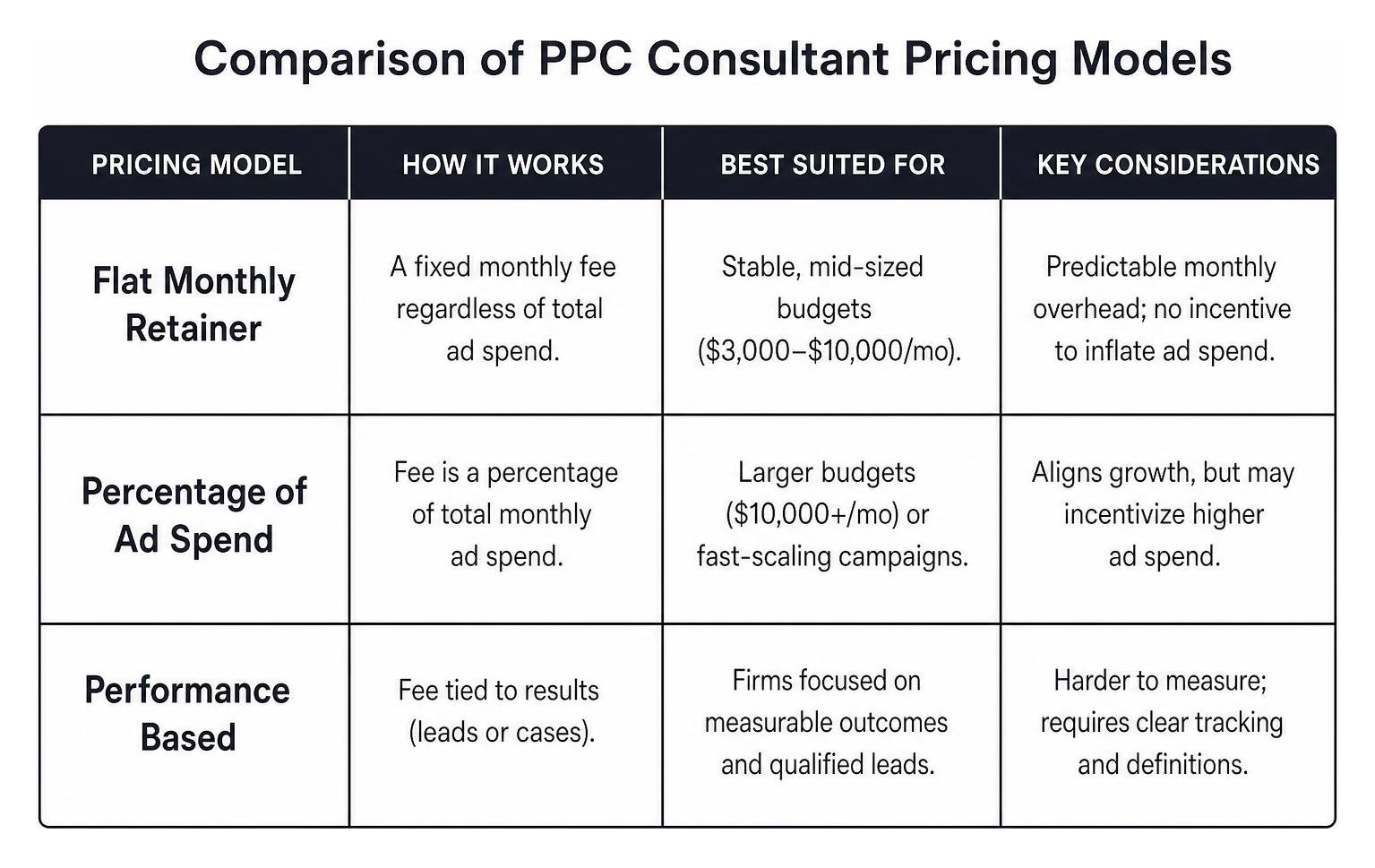
Common PPC Consultant Pricing Models
| Pricing Model | How It Works | Best Suited For | Key Considerations |
|---|---|---|---|
| Flat Monthly Retainer | A fixed monthly fee regardless of total ad spend. | Stable, mid-sized budgets ($3,000–$10,000/mo). | Predictable monthly overhead; no incentive to inflate ad spend. |
| Percentage of Ad Spend | Management fee calculated as a tier (typically 15%–25% of gross spend). | Large campaigns spending $15,000+/mo. | Scales with campaign size, but monitor to avoid unnecessary budget hikes. |
| Hybrid (Base + Performance) | Lower base retainer paired with a bonus per qualified lead or signed case. | High-volume consumer litigation firms. | Closely aligns consultant and law firm incentives, requires CRM tracking integration. |
Budget Allocation and Realistic ROI Benchmarks
Law firms typically invest between $2,000 and $10,000 per month on Google Ads, with firms in hyper-competitive markets budgeting upward of $20,000 to capture meaningful market share.
When managed by a qualified specialist, legal PPC campaigns can deliver an ROI of up to 200%, transforming ad spend into a highly predictable client acquisition engine. To assess how to structure your ad budgets effectively without overpaying, review our Affordable PPC for Lawyers Guide.
Analytics, Conversion Tracking, and Multi-Channel Marketing Integration
Generating clicks is meaningless if those clicks do not translate into consults and signed retainers. A qualified consultant implements closed-loop conversion tracking to follow prospective clients from their initial search query through intake.

Essential metrics law firms must monitor include:
- Cost-Per-Lead (CPL): The ad spend required to generate a legitimate phone call, contact form, or chat interaction.
- Cost-Per-Acquisition (CPA): Total ad spend divided by the number of formally signed retainers.
- Conversion Rate: The percentage of landing page visitors who take action. While legal ads average a 3.5% conversion rate, top-tier campaigns exceed 8% to 12% on dedicated landing pages.
- Click-Through Rate (CTR): High-performing legal ads regularly achieve a CTR of 5.5% or higher, reflecting precise search intent matching and strong ad copy relevance.
To explore analytics configurations, reference our Law Firm PPC Analytics Guide 2026.
How a Pay Per Click Consultant for Lawyers Integrates Paid Search with SEO
PPC should never operate in a marketing silo. The most successful legal practices integrate paid search with search engine optimization (SEO) and content marketing to create search engine dominance.

- Keyword Data Sharing: High-converting keyword data from Google Ads campaigns should directly inform your organic SEO and content marketing editorial calendar.
- Search Real Estate Dominance: Combining Google Local Services Ads (LSAs) at the top, traditional Google PPC ads in the next positions, and top-ranking organic map pack placements ensures your firm captures the majority of page-one visibility.
- Cross-Channel Retargeting: Non-converting organic and paid site visitors can be re-engaged through compliant display and social retargeting ads, keeping your firm top-of-mind as prospects evaluate their legal options.
Frequently Asked Questions About Legal PPC Management
What is the typical monthly cost of hiring a legal PPC consultant?
Most specialized legal PPC consultants charge a monthly management fee ranging between $1,500 and $5,000, or 15% to 25% of your total monthly ad spend. This fee is separate from your direct media spend paid to Google Ads.
How quickly can a law firm expect qualified leads from PPC?
Unlike SEO, which takes months to build momentum, PPC campaigns generate immediate visibility and can produce incoming calls within the first 48 to 72 hours of launch. However, full campaign optimization, bid calibration, and negative keyword refinement typically require a 30- to 90-day stabilization window.
Why are legal keywords more expensive than other industries?
Legal keywords are among the most expensive in paid advertising due to the high lifetime value of legal retainers. A single catastrophic injury or commercial litigation case can result in tens or hundreds of thousands of dollars in legal fees, driving up competitive bidding among firms vying for immediate case acquisition.
How do PPC consultants ensure compliance with state bar advertising rules?
Specialized consultants review all ad headlines, copy, extensions, and landing pages against applicable state bar ethics rules. This includes avoiding misleading guarantees, ensuring mandatory attorney disclaimers are present, and verifying that certifications comply with local jurisdictional guidelines.
Conclusion
Hiring the right PPC partner is one of the most critical growth decisions a law firm can make. By partnering with a consultant who understands legal ethics compliance, technical tracking architecture, and practice-area nuances, your firm can eliminate wasted spend and consistently generate high-value retainers.
At Outlier Creative Agency, we provide end-to-end digital marketing solutions built exclusively for the legal sector. If your practice is ready to optimize ad performance and attract higher-quality retainers, explore how our team can help you scale your firm with expert legal PPC management.