
Learn how a California class action lawsuit works, from filing to payout, and get key info on deadlines, claims, and settlements.
What Is a California Class Action Lawsuit and How Does It Operate?
A class action is a procedural mechanism that consolidates hundreds, thousands, or even millions of individual claims into a single representative lawsuit. Instead of every affected person hiring a lawyer and filing a distinct complaint, one or more lead plaintiffs (known as class representatives) sue on behalf of an entire group suffering from the same unlawful conduct.
In standard individual litigation, each plaintiff must independently shoulder the evidentiary burdens, court fees, and legal costs. For many everyday consumer injuries—such as an illegal $15 bank fee, a deceptive food label, or minor wage theft—the cost of hiring counsel far exceeds the potential individual recovery. Class actions level the playing field. By pooling claims, aggregate damages reach millions or billions of dollars, creating sufficient economic incentive for complex litigation while driving judicial efficiency.
For attorneys, the practical takeaway is to build an early case record that supports class treatment: preserve uniform policies, standardized contracts, and centralized decision-making evidence before filing. Lead counsel handles the day-to-day prosecution of the matter under strict judicial scrutiny. When addressing workplace misclassification or overtime disputes, law practices frequently combine strong legal strategy with tailored digital marketing for employment attorneys to identify representative plaintiffs and keep affected workforces informed within relevant legal ethics standards and bar association advertising rules.
What Types of Claims Drive a California Class Action Lawsuit?
California provides some of the nation's most robust statutory protections for consumers, employees, and businesses. High-profile representative litigation in the state commonly targets:
- Consumer Protection and False Advertising: The Unfair Competition Law (UCL, Cal. Bus. & Prof. Code § 17200), the False Advertising Law (FAL, Cal. Bus. & Prof. Code § 17500), and the Consumer Legal Remedies Act (CLRA, Cal. Civ. Code § 1750) penalize deceptive trade practices and hidden fees.
- Antitrust and Algorithmic Price-Fixing: Actions filed under the Cartwright Act address unlawful trusts and market manipulation. For instance, the 2026-06-22 Kalibrate Complaint details how centralized pricing algorithms allegedly inflated retail fuel costs for California drivers, where even a one-cent-per-gallon coordination costs drivers an estimated $134 million annually.
- AI Screening and Background Reporting Violations: As enterprises deploy automated evaluation software, candidates are challenging algorithmic opacity. The recent CLASS ACTION COMPLAINT FOR VIOLATIONS OF THE FAIR CREDIT REPORTING ACT, CALIFORNIA INVESTIGATIVE CONSUMER REPORTING AGENCIES ACT, AND UNFAIR COMPETITION LAW DEMAND FOR JURY TRIAL against Eightfold AI highlights how screening tools may operate as consumer reporting agencies under the California Investigative Consumer Reporting Agencies Act (ICRAA), requiring strict disclosures and candidate consent.
- Defective Products and Warranty Breaches: Cases seeking rescission, repair, and damages under the Song-Beverly Consumer Warranty Act when commercial equipment, smart home devices, or vehicles fail to meet safety and performance standards.
How Do Greenwashing and Chemical Contamination Claims Drive Class Actions?
Public scrutiny surrounding corporate sustainability has sparked significant environmental class actions. Recent surveys show that 93% of consumers are concerned about harmful chemicals like per- and polyfluoroalkyl substances (PFAS) in food, and 83% want companies to disclose chemical usage. Furthermore, consumers pay an average 9.7% premium for sustainably sourced items, while 77% state they would stop purchasing from a brand caught greenwashing.
These dynamics were highlighted in the Washington v. Driscoll’s, Inc. - 3:26-cv-06961 filing. Driscoll's, which commands at least one-third of the $9 billion U.S. berry market, faced allegations under the CLRA, UCL, and FAL regarding undisclosed PFAS contamination in conventional strawberries despite marketing emphasizing pure, environmentally responsible farming practices.
What Are the Legal Requirements for Class Certification in California Courts?
Filing a complaint does not automatically create a certified class. To proceed collectively, plaintiffs must file a formal motion for class certification.
Under Section 382 of the California Code of Civil Procedure, courts grant certification when the question is one of common or general interest to many persons, or when the parties are numerous and it is impracticable to bring them all before the court.
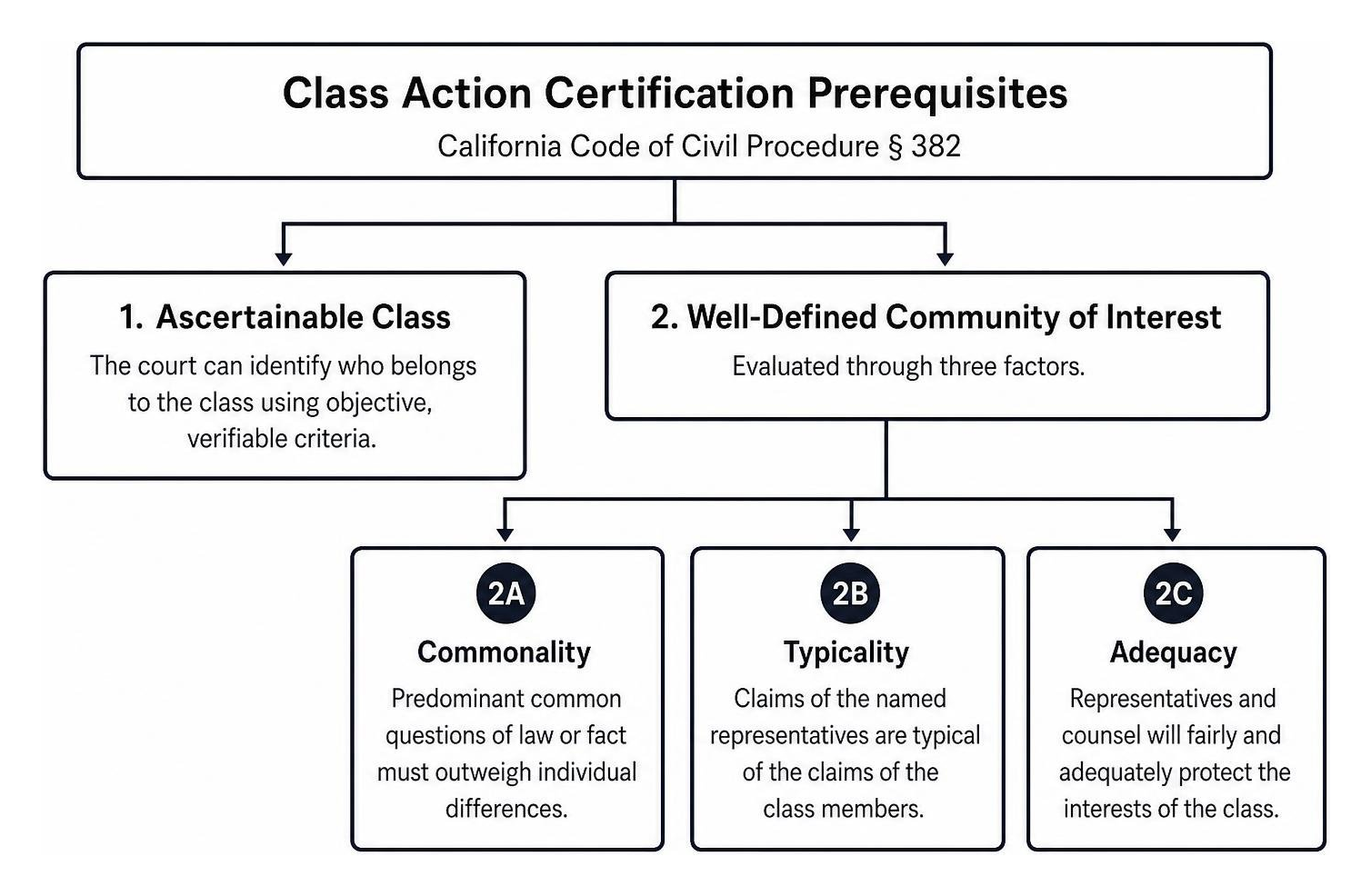
State judges evaluate two primary threshold tests:
- An Ascertainable Class: The court must be able to identify who belongs to the group using objective, verifiable criteria (such as transaction records, employee rosters, or subscriber logs) without conducting individualized mini-trials.
- A Well-Defined Community of Interest: This requirement breaks down into three key factors:
- Predominant Common Questions: Factual and legal issues common to the class must outweigh individual differences.
- Typicality of Claims: The injuries and legal claims of the class representative must mirror those of the absent class members.
- Adequacy of Representation: The representative plaintiffs and class counsel must be fully competent, free of conflicts of interest, and committed to vigorously protecting the entire class's interests.
For attorneys preparing a certification motion, a practical checklist can strengthen the record: identify objective class-member criteria from business records, isolate the uniform policy or contract language driving the common question, confirm the named plaintiff's claims track the class definition, and document counsel's experience and absence of conflicts. Plaintiffs' firms handling these complex procedural hurdles regularly use refined California attorney marketing campaigns to locate key witnesses and establish the widespread nature of corporate misconduct while strictly complying with State Bar of California advertising ethics.
What Procedural Standards Apply When Filing in State vs. Federal Court?
Class actions in California can proceed in either California Superior Court or the federal system (U.S. District Courts for the Northern, Central, Eastern, or Southern Districts of California) governed by Federal Rule of Civil Procedure 23.
Under the federal Class Action Fairness Act (CAFA), defendants often remove cases from state to federal court if:
- The proposed class includes 100 or more members;
- Minimal diversity exists (at least one plaintiff is a citizen of a different state than any defendant); and
- The aggregate amount in controversy exceeds $5,000,000.
Litigators navigating these venues match their caseload requirements with targeted California business litigation ads to reach corporate stakeholders and commercial claimants across relevant jurisdictions.
How Do Settlements Work Under California Law: Approval, Fees, and Payouts?
Unlike standard civil disputes, class action settlements cannot conclude through private dismissal. Because absent class members surrender their rights to sue individually, the judicial system provides active oversight under California Rules of Court, Rule 3.769.
What Is the Two-Stage Class Action Settlement Approval Process?
- Preliminary Approval: Counsel submits the proposed settlement agreement. The court reviews the financial terms, claims protocol, and proposed class notice plan to determine whether the proposal falls within the range of possible final approval.
- Notice and Objection Window: Direct mail, email, and publication campaigns notify class members. Potential claimants receive an administrative window (typically 60 to 90 days) to submit claim forms, opt out, or lodge formal objections.
- Final Fairness Hearing: The judge assesses the total recovery, review any filed objections, evaluates litigation risks, and determines whether the compromise is fair, reasonable, and adequate for all members.
- Enforcement and Residual Funds: The court enters a final judgment while retaining jurisdiction under Rule 3.769(h). Unclaimed residual funds are distributed via pro rata enhancements or allocated under the cy pres doctrine to non-profit entities supporting consumer protection or public interest legal aid.
For attorneys, a practical Rule 3.769 notice program should include a plain-language summary of the class definition, the release scope, the claim deadline, the opt-out deadline, and the date of the final fairness hearing. Drafting these materials with the claims administrator early can reduce objections and speed preliminary approval.
How Do Courts Scrutinize Attorneys' Fees in California Class Actions?
California courts require full transparency regarding legal fees. Agreements cannot include hidden collusive fee carve-outs. Judges review fee applications using either the percentage-of-the-fund approach (typically benchmarked around 25% to 33.3%, adjusted for results achieved) or the lodestar method (reasonable hours spent multiplied by hourly rates, modified by a multiplier reflecting risk and complexity).
Are California Class Action Settlement Payouts Taxable?
The taxability of settlement payouts depends on the underlying nature of the claim:
- Taxable Allocations: Payments replacing lost wages, statutory interest, emotional distress unaccompanied by physical injury, and punitive damages are taxable as gross income and reported via IRS Form 1099-MISC or W-2.
- Non-Taxable Allocations: Compensatory damages directly compensating physical illness, physical injury, or direct property damage reimbursements (up to the adjusted cost basis) are generally exempt from federal and California personal income taxes.
How Do Class Members Participate in an Open California Class Action Lawsuit?
To claim a portion of an open settlement, class members should follow this administrative process:
- Verify Eligibility: Read the class definition carefully to ensure your purchase date, employment period, or product ownership falls within the specified settlement parameters.
- Obtain Documentation: Check whether the claim form requires proof of purchase (receipts, serial numbers, account statements) or if simple self-certification under penalty of perjury is sufficient.
- Submit Before the Deadline: Complete the electronic form on the official court-approved settlement portal before the administrative deadline.
- Select Payment Preference: Modern administrators distribute funds through direct deposit, digital payment apps, prepaid cards, or physical paper checks.
- Monitor Status: Follow up if your address or contact information changes prior to the distribution date.
Class Action vs. Multidistrict Litigation (MDL): What Are the Key Differences?
When corporate conduct harms thousands of individuals nationwide, cases are typically coordinated as either a class action or Multidistrict Litigation (MDL). While both aggregate cases to streamline discovery, their structural mechanics differ significantly.
| Feature | Class Action | Multidistrict Litigation (MDL) |
|---|---|---|
| Case Structure | A single representative lawsuit covering an entire group | Hundreds or thousands of individual lawsuits consolidated for pretrial proceedings |
| Claim Identity | Individual claims merge into a single collective entity | Each plaintiff maintains their own distinct civil action and docket |
| Applicable Injuries | Uniform economic loss, consumer fraud, wage discrepancies | Catastrophic personal injury, severe medical device failure, toxic exposure |
| Pretrial Transfer | Resolved within one designated state or federal court | Transferred by the Judicial Panel on Multidistrict Litigation (JPML) |
| Trial Mechanism | A single trial determines liability for the entire class | Select individual cases proceed to "bellwether" trials to test arguments |
| Settlement Dynamic | Binding class-wide agreement covering all non-opt-outs | Global matrices where individual plaintiffs choose to accept or proceed to trial |
Should You Stay in the Class or Opt Out to File an Individual Lawsuit?
Remaining in a certified class action offers substantial convenience: you incur no upfront legal costs, take on minimal personal litigation exposure, and receive compensation automatically or by filing a simple claim form.
However, class participation binds you to the final judgment, extinguishing your right to bring independent lawsuits. If you experienced substantial, distinct damages—such as direct bodily harm or major business losses—opting out before the court-ordered exclusion deadline allows you to retain individual counsel and pursue a separate recovery.
Frequently Asked Questions About California Class Actions
How much does it cost to join a California class action?
There are no upfront costs for class members. Class action attorneys work on a contingency fee basis, funding all litigation expenses. Legal fees and expenses are paid out of the common settlement fund only if the court approves them after a successful outcome.
What happens if I miss the claim filing deadline for a settlement?
If you miss the deadline, you forfeit your right to receive a financial distribution from the settlement fund. However, because you did not opt out before the exclusion deadline, you remain bound by the class release and cannot sue the defendant separately for the same claims.
How are class action settlement funds distributed if money remains unclaimed?
Unclaimed funds are typically managed according to the approved settlement agreement. The court may authorize a secondary pro rata distribution to active claimants or direct the remaining balance to court-approved non-profit or public interest organizations through the cy pres doctrine.
Can non-residents participate in a California class action lawsuit?
Yes. Non-residents may participate if the class definition includes consumers nationwide, or if a significant portion of the defendant’s misconduct, operational decision-making, or corporate headquarters is based in California, establishing jurisdiction under California consumer protection statutes.
How Can Law Firms Build Strategic Support for High-Stakes Class Action Litigation?
Managing class actions and multidistrict litigation requires not only sophisticated legal strategy but also transparent, compliant communication with affected individuals. At Outlier Creative Agency, we design data-driven digital infrastructure, lead generation campaigns, and educational content that help law firms build authoritative caseloads within state and federal ethical standards, including bar association advertising rules and legal ethics compliance.
For practice groups handling consumer, employment, or antitrust class actions, a practical marketing workflow can support case development: publish plain-language explainers that mirror the questions potential class members actually search, use structured data to help those pages appear in search results, and route qualified inquiries through intake forms that capture the facts needed for class certification. To learn how integrated search engine marketing and strategic paid campaigns can elevate your practice's reach, explore our specialized PPC advertising for law firms or book a consultation with our team today.