

Learn digital marketing for employment attorneys: data-driven strategies, ROI benchmarks, and channel allocation to win high-value cases.
How Can Data-Driven Strategies Improve Digital Marketing for Employment Attorneys?
To maximize profitability while maintaining strict legal ethics compliance, employment law firms must shift away from evaluating marketing success based on total lead volume. Instead, sophisticated firms rely on data-driven strategies that measure return on investment (ROI) by specific matter type while adhering to state bar association advertising rules regarding outcome statements and client disclosures.
Executing a multi-channel campaign requires a clear view of how different subpractices function economically. A single wrongful termination retainer can yield significantly higher legal fees than an individual wage dispute. Without subpractice attribution, marketing managers risk allocating budget toward ad keywords that drive high call volumes but yield low retainer revenue.
To dive deeper into broad campaign mechanics, explore our comprehensive guide on Law Firms Digital Marketing.
Why Does Broad Digital Marketing Fail to Generate High-Value Employment Law Leads?
Broad keyword strategies, such as bidding heavily on general terms like "employment lawyer," frequently fail because they pull in mixed inquiry dockets. Raw lead volume is a vanity metric; what ultimately sustains a law practice is signed retainer value.
Consider the underlying economics of different employment claims:
- Government Regulatory Insights: According to data from the Department of Labor’s Wage and Hour Division, back-wage recoveries averaged roughly $1,465 per worker in FY 2025. While collective wage actions can be lucrative, individual wage claims often involve smaller recoveries.
- EEOC Merit Rates: The EEOC secured over $535 million in monetary relief in FY 2020, yet only 17.4% of total charges were determined to have merit. This means over 80% of incoming discrimination inquiries may lack the legal grounds needed to survive initial motions.
- The Pareto Principle (80/20 Rule): In most employment law practices, 80% of firm revenue is generated by 20% of high-value matters, such as executive severance negotiations, complex retaliation, or egregious wrongful termination claims.
When digital campaigns treat all leads identically, marketing dollars are wasted on low-value, unviable inquiries.
How Should Plaintiff and Defense Firms Tailor Their Digital Marketing Channels?
Plaintiff-side and employer defense-side practices require fundamentally different marketing strategies, touchpoints, and acquisition channels. All messaging must strictly comply with state bar rules governing legal advertising disclaimers and prohibitions on guaranteeing specific case outcomes.
Plaintiff-side clients are individuals experiencing immediate workplace crises—such as sudden termination or severe harassment. They rely heavily on high-intent search engine queries to find immediate legal representation. In contrast, corporate defense buyers (such as HR directors, general counsel, and C-suite executives) make calculated B2B hiring decisions. LinkedIn, which reaches over 310 million monthly active users, allows legal marketers to target defense decision-makers directly by corporate title, company size, and industry.
For practice-area examples, review Austin Employment Law Practice Areas to see how specific claims are categorized for target audiences.
How Should Employment Law Firms Allocate Marketing Budgets Across Channels?
Allocating a legal marketing budget requires balancing immediate lead generation with long-term brand equity while ensuring full compliance with state bar ethics rules. A balanced framework for digital marketing for employment attorneys follows a 40-25-20-15 budget allocation model:
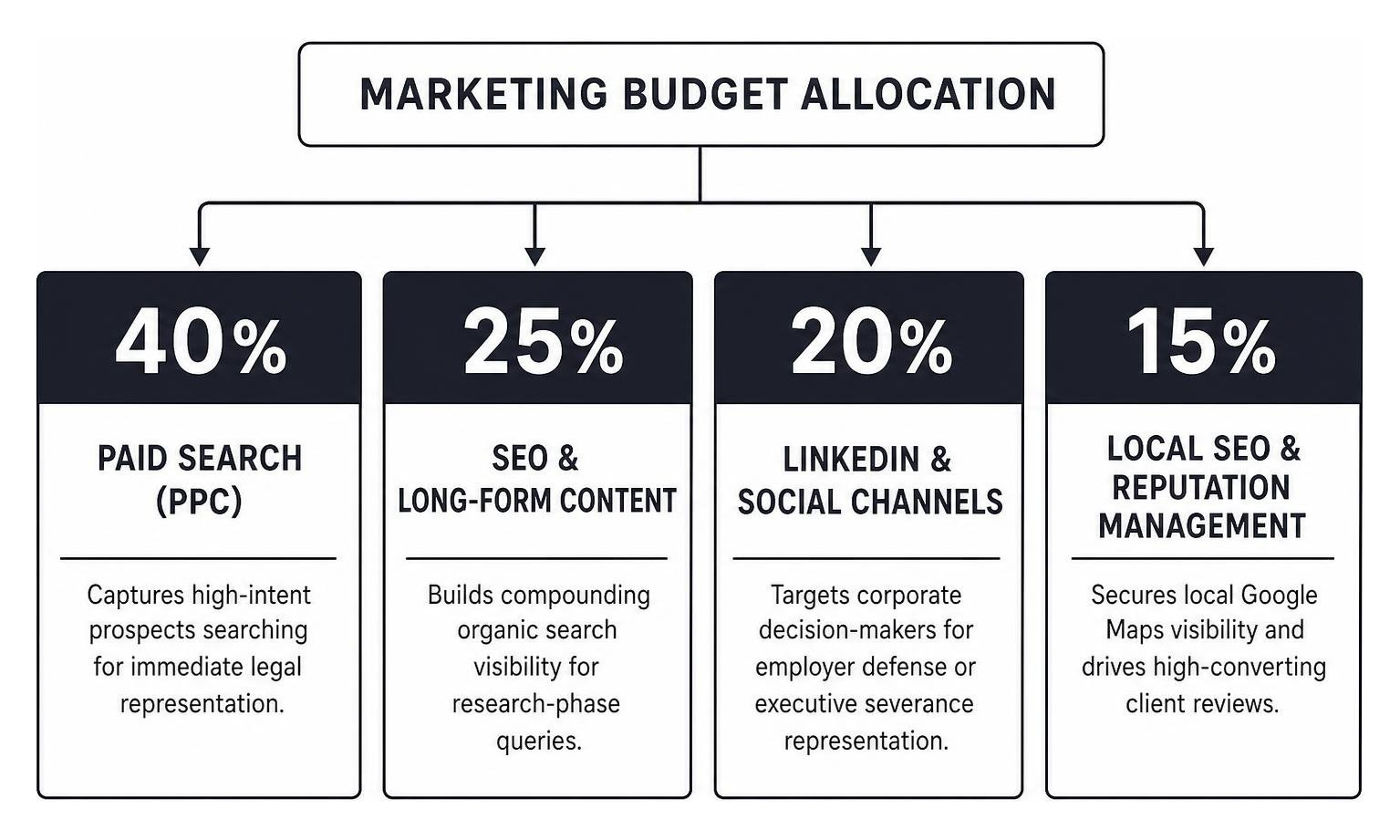
- 40% Paid Search (PPC): Captures high-intent prospects searching for immediate legal representation.
- 25% SEO & Long-Form Content: Builds compounding organic search visibility for research-phase queries.
- 20% LinkedIn & Social Channels: Targets corporate decision-makers for employer defense or executive severance representation.
- 15% Local SEO & Reputation Management: Secures local Google Maps visibility and drives high-converting client reviews.
For a broader perspective on multi-channel strategies, check out our insights on Internet Marketing for Attorneys.
How Can Employment Attorneys Optimize Paid Search for High-Yield Results?
Google Ads offers immediate search engine visibility, but competitive legal keywords can easily drain budgets if managed poorly. Ad copy must also align with bar association advertising rules, avoiding unsubstantiated comparative claims like "best employment lawyer" unless permitted by state ethics board guidelines.

To prevent wasteful spend, law firms must implement strict negative keyword lists (e.g., "unemployment benefits," "free legal advice," "labor union contact") to filter out unqualified traffic. Additionally, PPC campaigns must feature dedicated landing pages for specific claim types rather than directing traffic to a generic homepage.
High-converting employment law keywords include:
- Wrongful termination lawyer near me
- Executive severance agreement attorney
- Workplace sexual harassment lawyer
- FMLA retaliation attorney
To learn how Outlier Creative Agency builds high-yield ad campaigns, explore our services for PPC for Attorneys and Attorney PPC Advertising.
How Do SEO, Content, and Video Build Long-Term Brand Authority for Law Firms?
Organic search drives approximately 53% of all website traffic across industries. While paid ads capture immediate crisis searches, organic content catches potential clients during their early research phases.
When facing workplace discrimination or reviewing a severance offer, prospective clients frequently research their legal rights before contacting an attorney. This buyer behavior fits the 7-11-4 Trust Rule: a prospect typically needs to digest 7 hours of content, across 11 touchpoints, in 4 media formats before feeling confident enough to retain professional services. Content assets must maintain legal ethics compliance by providing educational insights without establishing an unsolicited attorney-client relationship.
Integrating short-form video into your content strategy accelerates trust. Videos featuring attorneys explaining severance packages or disability accommodation rights make firms far more approachable. Discover how we produce video assets by reviewing our resources on SEO Optimized Lawyer Videos and Lead Generation Lawyer Videos.
For examples of high-converting firm positioning, visit Laurel Employment Law.
How Can Local SEO and Google Business Profiles Drive Immediate-Need Cases?
When an employee is suddenly terminated, their immediate response is often a localized mobile search for nearby legal help.

To capture these immediate-need searches, firms must optimize their Google Business Profile (GBP) for local search results:
- Primary Category Selection: Ensure your main category is set to "Employment Attorney" or "Law Firm."
- Review Velocity: Systematically request reviews from satisfied clients, encouraging them to naturally mention specific services like "wrongful termination case" or "severance review," while adhering to state bar guidelines on ethical review solicitation and confidentiality.
- Local Landing Pages: Ensure your business address, local telephone number, and office hours match across all web directories.
How Do Attribution Systems and AI Intake Automation Track Real Case ROI?
Connecting a signed client back to their original ad click or search term requires closed-loop attribution. Modern legal CRMs and analytics platforms make it possible to monitor prospects from initial touchpoint through intake to retained matter while respecting client confidentiality and legal ethics regulations.
For detailed operational guidance on structuring law firm systems, read our article on How to Market Law Firm.
How Do You Build a Case-Level Closed-Loop Attribution System?
Standard web analytics only measure contact form submissions or call clicks, failing to reveal whether those interactions resulted in viable cases.
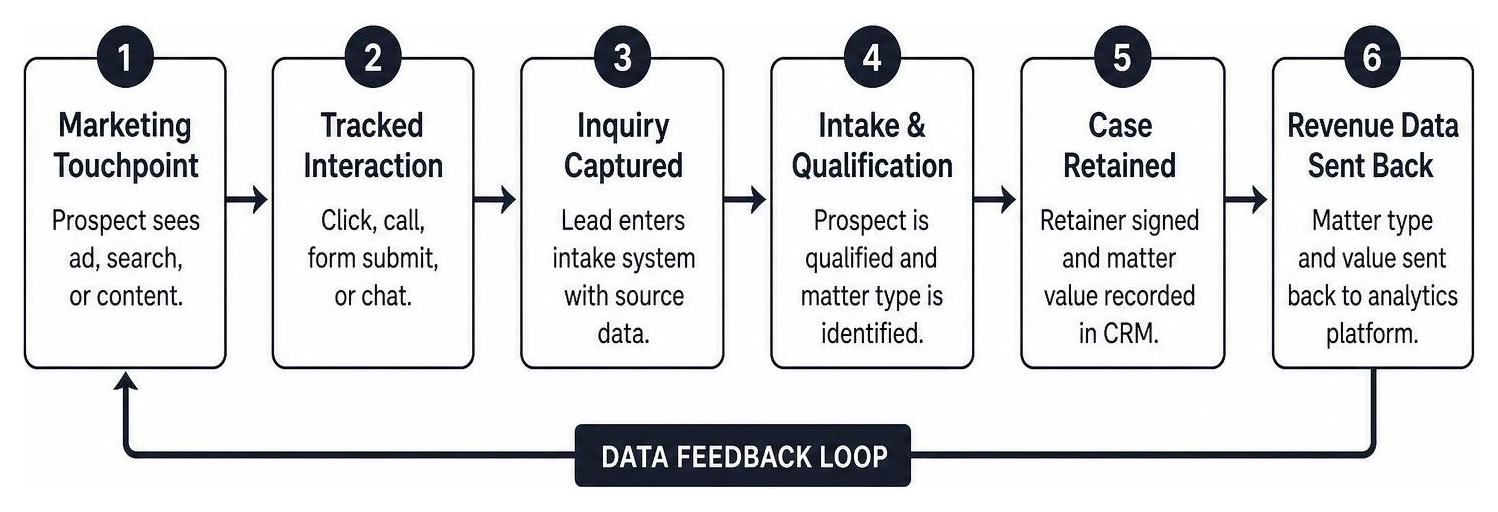
A case-level closed-loop system pairs web tracking parameters (UTM codes, dynamic call tracking numbers) with CRM data. When an inquiry signs a retainer, the CRM sends the matter type and contract value back to the analytics engine. This allows law firm managers to evaluate performance by Cost Per Retained Case by Subpractice rather than raw cost per lead.
How Can AI and Call Automation Filter Out Low-Value Legal Inquiries?
Intake efficiency is critical for law firm profitability. Data shows well-managed legal intake teams convert 30% to 50% of qualified inbound leads, while slow or disorganized intake drops conversion rates below 10%.

AI-powered call transcription tools automatically transcribe intake calls, analyze keyword patterns, and tag case types before an intake specialist manually enters data. For instance, if an incoming call mentions "unemployment check status," the system automatically flags it as a non-target inquiry, preserving staff bandwidth for high-value wrongful termination or retaliation claims.
What Are Realistic Client Acquisition Benchmarks and Cost Reduction Strategies?
Understanding industry benchmarks helps legal practices audit their marketing efficiency, satisfy state bar advertising rules on fee efficiency, and identify budget waste.
What Are Realistic Client Acquisition Cost Benchmarks for Employment Attorneys?
Client Acquisition Cost (CAC) varies drastically based on geography, practice specialization, and intake speed.
In competitive metro markets like Los Angeles or Austin, competitive PPC keywords can drive CAC for general employment inquiries into the $1,000–$2,500 range if campaigns lack rigorous filtering. However, firms using targeted keyword selection, localized SEO, and structured intake automation can achieve far greater efficiency. For example, in an attribution-driven marketing test across a 30-day window, an optimized strategy secured 13 signed clients at a $296 average acquisition cost.
What Are the Common Digital Marketing Mistakes That Drain Employment Law Budgets?
- Bidding on Broad Terms Without Negative Keywords: Paying for clicks on terms like "labor board telephone number" or "free employee handbook."
- Unsegmented Intake Forms: Using generic contact forms that fail to pre-qualify lead parameters (e.g., date of termination, company size, back wages owed).
- Ignoring Review Velocity: Allowing online review profiles to stall, which weakens local Google map rankings.
- Neglecting Email Nurturing: Failing to follow up with leads who were not ready to hire immediately during their initial consultation. Learn how to stay connected using our Email Marketing Guide for Lawyers.
Frequently Asked Questions About Employment Law Marketing
How long does it take to see ROI from employment law digital marketing?
Paid search campaigns (Google Ads) produce call volume and signed clients within 30 to 60 days. Organic SEO and content marketing strategies typically require 90 to 180 days to gain strong search engine traction, but they build compounding authority that lowers overall acquisition costs over time.
What is the average client acquisition cost for employment law cases?
CAC varies significantly based on practice subtype and intake efficiency. While broad campaigns can cost over $1,500 per signed client, firms utilizing closed-loop attribution, tight negative keyword lists, and fast AI intake workflows can reduce average acquisition costs below $500 per signed matter.
How can an employment law firm differentiate between high-value discrimination cases and lower-value wage claims?
Firms can differentiate lead types by deploying dedicated landing pages, running negative keyword lists, and utilizing pre-qualifying intake forms. Implementing AI-driven call analysis tools also helps automatically classify incoming inquiries based on spoken transcript patterns before routing them to intake staff.
Conclusion
Succeeding in digital marketing for employment attorneys requires moving beyond simple lead counts and tracking performance down to signed matter value. By pairing targeted search campaigns and LinkedIn outreach with AI-assisted intake automation and closed-loop attribution, your firm can reliably attract and sign high-value cases.
At Outlier Creative Agency, we build data-driven marketing systems designed specifically for legal practices. If you are ready to stop wasting budget on unqualified inquiries and start scaling your firm with high-value retainers, explore our specialized services for PPC Advertising for Law Firms or contact our expert team today to schedule a strategic consultation.