
Discover marketing automation for growth teams to boost ROI, cut manual work, and accelerate revenue with AI workflows.
Why Should Growth Teams Automate Manual Marketing Workflows?
Growth teams automate manual marketing workflows by connecting lead capture, behavioral scoring, and multi-channel messaging into a single always-on system. Instead of waiting for staff to copy-paste inquiries into spreadsheets or manually send follow-up emails, automated triggers respond to prospect actions within seconds, route high-intent leads to the right intake queue, and keep every consent record synchronized across the CRM. This approach lets law firms and other growth-focused organizations scale acquisition without adding administrative headcount.
Manual workflows create four core operational risks:
- Delayed response times: Inquiries left unaddressed for even an hour see sharp drops in conversion.
- Fragmented data silos: Customer touchpoints remain trapped across disparate ad platforms, email tools, and case management software.
- Inconsistent compliance logs: Proving explicit consent under strict industry standards becomes nearly impossible when communication is scattered across personal inboxes.
- High marketing overhead: Scaling outbound volume without automation requires linearly hiring more administrative personnel.
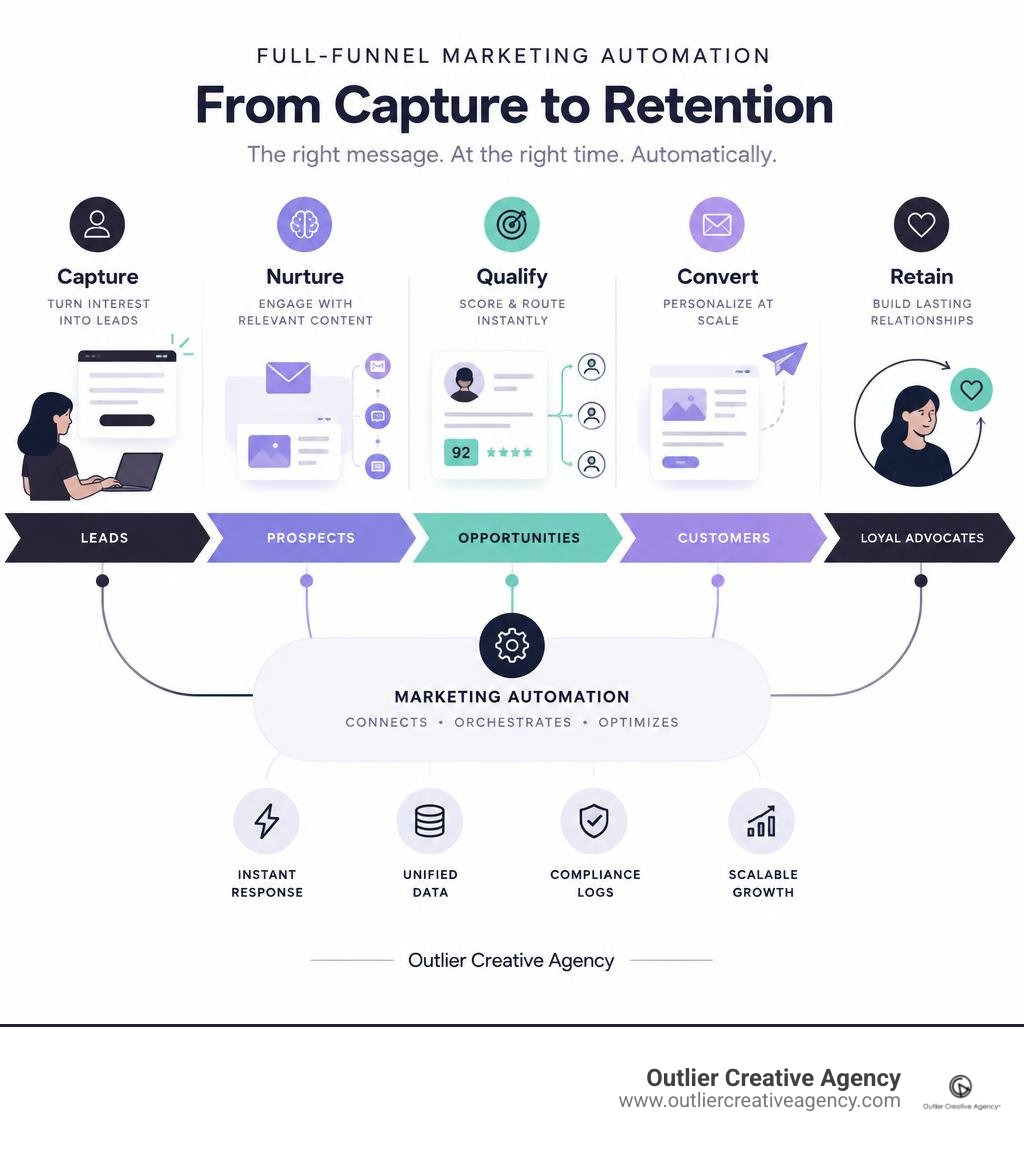
By establishing an end-to-end automated architecture, growth teams shift their focus from tactical execution to strategic experimentation. Modern engines capture prospect intent instantly, score engagement using machine learning, route data into centralized databases, and deliver tailored messages at scale.
Why Is Marketing Automation for Growth Teams Essential in 2026?
As of 2026, 88% of marketers report integrating artificial intelligence and automation into at least one core workflow—up dramatically from 55% in 2023. Relying on disconnected point solutions is no longer sustainable. Marketing automation acts as an always-on operating layer that orchestrates pipeline generation, lead qualification, and client retention.
Achieving sustainable marketing automation growth requires unifying audience data, brand voice, and lifecycle triggers. Instead of managing a patchwork of isolated tools, modern growth operators leverage continuous execution engines that operate around the clock.
How Does Full-Funnel Automation Accelerate Lead Generation?
Traditional marketing casts a wide net and leaves the heavy lifting of lead qualification to manual outreach. Full-funnel automation relies on behavioral triggers that respond instantly to prospect actions, such as visiting specific practice area pages, downloading educational guides, or clicking ad variants.
Implementing modern marketing automation and lead generation pipelines yields remarkable velocity:
- Organizations nurturing prospects through automated workflows see a 451% increase in qualified leads.
- Automated behavioral triggers deliver relevant answers at each stage of the consideration cycle, satisfying the 77% of buyers who demand tailored content during their research.
- Leads move smoothly through automated lifecycle stages without human intervention until they hit high-intent thresholds.
What Quantitative ROI and Productivity Gains Can Teams Expect?
Marketing automation consistently produces measurable efficiency gains and compounding revenue:
- Organizations achieve an average £5.44 return per £1 invested in marketing automation solutions while reclaiming 30 to 60 hours weekly from manual administration.
- Implementing automated nurture and sales alignment drives a 14.5% increase in sales productivity alongside a 12.2% reduction in marketing overhead.
- Nurtured leads complete purchases and retain services at 47% larger deal sizes than non-nurtured counterparts.
| Performance Dimension | Manual Marketing Execution | Automated Growth Funnel |
|---|---|---|
| Response Latency | 2 to 24 hours | Under 60 seconds (instant trigger) |
| Lead Qualification | Manual screening (30–40% accuracy) | AI predictive scoring (70–85% accuracy) |
| Campaign Deployment | Days to weeks per initiative | Hours via template flows and AI planning |
| Data Synchronization | Manual CSV imports/exports | Real-time bi-directional CRM syncing |
| Compliance Management | Decentralized, manual opt-out tracking | Universal automated consent and suppression |
How Should You Evaluate Platforms Beyond Standard Feature Checklists?
Choosing an automation platform based solely on vendor feature checklists often results in costly technical debt. Many platforms check every box on paper but fail under real-world conditions due to high trigger latency, rigid data schemas, or complicated deployment steps.
Growth teams must evaluate platforms across three critical operational pillars:
- Revenue Moment Execution: Can the platform trigger multi-channel actions within seconds of a high-intent event?
- Operational Independence: Can non-technical team members launch, test, and adapt complex branching workflows without filing engineering tickets?
- Data Unification and Tool Consolidation: Does the platform sync natively with your customer data layer and CRM, eliminating the need for complex middleware?
What Are the Core Evaluation Criteria of Marketing Automation for Growth Teams?
When evaluating marketing automation tools, verify these core capabilities:
- Sub-Second Trigger Latency: Behavioral events must trigger communications immediately, not in delayed hourly batches.
- Dynamic Behavioral Segmentation: Lists must update in real time based on combined data attributes (e.g., location, page engagement, case type, explicit consent status).
- Direct Data Warehouse and CRM Connectivity: The platform should integrate natively with your firm's core CRM or case management system without duplicate data storage fees.
- Predictive Optimization Engines: Built-in machine learning models should continuously test send times, creative variants, and channel mix.
How Can Teams Balance Developer-Grade Infrastructure With Marketer-Friendly Visual Builders?
High-velocity growth requires both developer flexibility and non-technical usability. Platforms that cater only to developers slow down campaign velocity, while overly basic tools restrict advanced conditional logic and custom API hooks.

The ideal architecture combines API-first infrastructure with visual drag-and-drop workflow canvases:
- Headless Orchestration: Developers integrate unified webhooks and APIs to track product/website events.
- Visual Branching Logic: Marketers design multi-step customer journeys using visual nodes (e.g., IF lead score > 75 AND practice area = "Corporate Litigation" THEN trigger consultation SMS, ELSE enter educational email sequence).
- Governance and Rollback Controls: Versioning systems allow teams to safely test journey updates before pushing them live to active prospect pipelines.
What High-Impact AI Automation Workflows Drive Maximum Revenue?
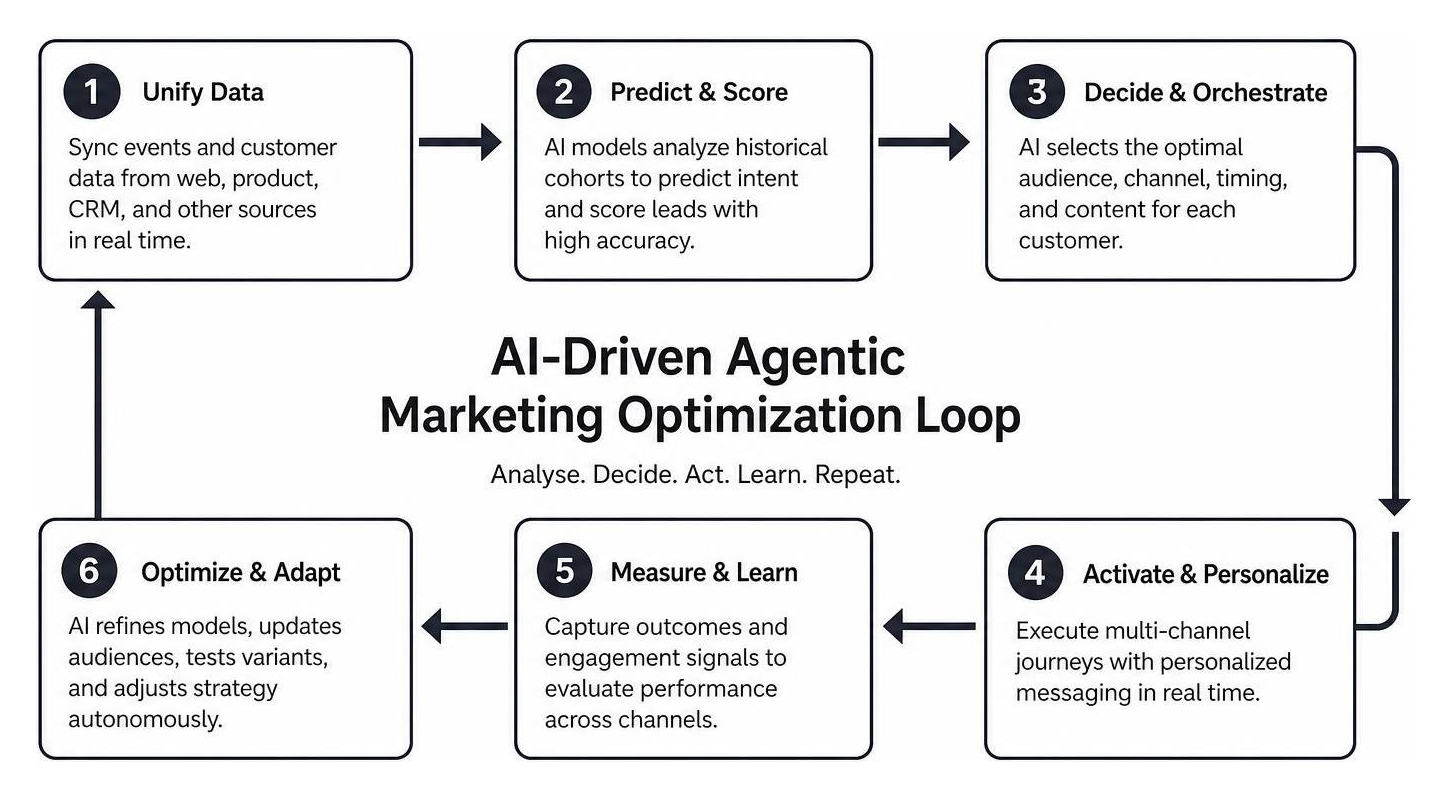
AI-driven marketing automation has advanced far beyond simple mail-merge tags. Modern growth operations deploy agentic workflows that analyze historical cohort performance, predict user intent, and autonomously refine campaign elements. Unified systems now orchestrate content generation, real-time audience assembly, and recursive optimization loops without requiring dedicated SQL developers.
How Can Predictive Lead Scoring Improve Dynamic Audience Segmentation?
Manual lead scoring typically relies on arbitrary point assignments that quickly become outdated. Modern AI lead scoring achieves 70% to 85% accuracy in predicting conversion likelihood, compared to just 30% to 40% for legacy rule-based setups.
By leveraging marketing automation big data, growth teams unlock substantial performance lifts:
- Companies adopting AI lead scoring report a 138% ROI compared to 78% for traditional static models, boosting overall conversion rates by 25%.
- Algorithmic models evaluate implicit behavioral signals—such as reading fee structure pages, downloading practice briefs, and opening specific case studies—to dynamically prioritize hot prospects.
- Predictive models flag disengagement early, routing at-risk prospects into automated re-engagement workflows before churn occurs.
How Can Teams Orchestrate Omnichannel Journeys Across Email, SMS, and Paid Channels?
Relying on a single communication channel limits audience reach. Growth funnels perform best when coordinating timely interactions across email, SMS, and targeted ad platforms. Teams can coordinate cross-channel messaging while maintaining unified consent records.

How Can Regulated Growth Teams Ensure Strict Compliance Across Automated Messaging?
For growth teams operating in highly regulated industries—such as legal services—marketing automation must incorporate ironclad compliance guardrails. A single non-compliant SMS or deceptive automated email can trigger regulatory fines, carrier blocks, and state bar disciplinary actions.
At Outlier Creative Agency, our work in legal advertising compliance emphasizes that every automated message must strictly conform to:
- State Bar Advertising Rules: Disclaimers, prohibition of misleading guarantees, and explicit attorney advertising labels.
- Legal Ethics Compliance: Avoiding unauthorized practice of law (UPL) within automated replies and preserving attorney-client privilege boundaries during automated intake.
- Telecommunications Frameworks: Strict adherence to TCPA, CTIA, and carrier SHAFT guidelines.
How Can Teams Navigate TCPA, GDPR, and SHAFT Regulatory Frameworks?
Automated messaging across SMS and email requires strict adherence to privacy and carrier regulations:
- **TCPA**: Requires express written consent prior to sending automated promotional SMS messages. All numbers must be checked against National and Internal Do Not Call (DNC) registries.
- SHAFT (Sex, Hate, Alcohol, Firearms, Tobacco) Regulations: Strict carrier filtering rules that block uncertified messaging containing restricted terminology. Legal practices dealing with criminal defense, cannabis, or personal injury must implement approved 10DLC registration profiles.
- GDPR, UK Data Use and Access Act, and EU AI Act: Mandates transparent disclosure of AI data processing, comprehensive Data Protection Impact Assessments (DPIAs), explicit cookie and opt-in tracking, and immediate rights-to-be-forgotten.
How Can Teams Protect Brand Reputation With Built-In Consent Management?
To eliminate compliance vulnerabilities, deploy marketing automation software tools equipped with centralized consent management:
- Universal Preference Centers: Empower subscribers to select specific communication topics and preferred channels rather than forcing an all-or-nothing unsubscribe.
- Automated Quiet Hours Configuration: Automatically restrict SMS and outbound triggers between 8:00 PM and 8:00 AM in the recipient's local time zone.
- Real-Time Suppression Auditing: Synchronize opt-outs across every marketing channel and CRM instance instantly to prevent accidental communication after an unsubscribe request.
What Metrics Connect Automated Workflows to Revenue and Retention?
Vanity metrics like open rates, pageviews, and raw clicks do not measure actual business growth. Modern growth teams focus on closed-loop revenue reporting that ties specific automated workflows directly to closed deals and retainer revenue.
Personalization and automated nurture deliver clear revenue outcomes:
- Behavior-driven dynamic personalization produces a 4.04% lift in revenue per visitor.
- Implementing automated CRM attribution and nurture workflows drives a 50.85% growth in CRM-attributed revenue.
- Enterprise CRM deployments demonstrate an average 25% increase in marketing ROI when linking automation engines directly to core CRM data.
How Can Teams Move Beyond Vanity Metrics to Closed-Loop Revenue Attribution?
To establish dependable revenue attribution, track these core commercial indicators:
- Pipeline Velocity: The speed at which an inbound inquiry transitions through initial intake, consultation booking, and formal retainer agreement.
- Customer Acquisition Cost (CAC) by Workflow: The fully loaded marketing spend required to acquire a client through a specific nurture pathway.
- Multi-Touch Retainer Attribution: Distributing revenue credit proportionally across all automated touchpoints (e.g., initial SEO guide download, nurture email #3, retargeted ad click).
- Cohort Lifetime Value (LTV): Tracking how automated onboarding and post-resolution sequences elevate client retention, review volume, and referral rates over 12 to 24 months.
How Can Teams Implement AI-Powered Marketing Automation on a Budget?
Lean teams do not need massive enterprise software budgets to automate their growth funnels. By following a structured consolidation strategy, organizations can reduce annual technology expenditures by 40% to 50%:
- Audit and Consolidate: Replace redundant single-purpose tools (separate form builders, standalone email blasters, manual scheduling apps) with a unified marketing automation platform.
- Execute a High-Impact Pilot: Begin by automating a single high-value workflow—such as instant consultation booking and follow-up—before expanding across the entire lifecycle.
- Deploy Pre-Built Frameworks: Use validated automation blueprints rather than engineering custom software from scratch.
What Are the Frequently Asked Questions About Marketing Automation for Growth Teams?
How quickly can a lean team see measurable ROI from marketing automation?
A focused marketing automation pilot typically shows trending indicators—such as increased response rates and reduced intake administrative time—within 3 to 4 weeks. Realized commercial returns, including elevated signed-case volume and lower acquisition costs, generally materialize within 3 to 6 months as nurtured leads move through the sales cycle.
What is the difference between traditional automation and AI marketing automation?
Traditional marketing automation relies on static, rule-based if-then pathways that require manual adjustment for every scenario. AI marketing automation uses predictive machine learning to evaluate prospect behavior, dynamically adjust send times, personalize content copy, and autonomously score leads based on historical conversion likelihood.
How can regulated businesses automate communications without violating industry rules?
Regulated businesses must implement double-opt-in consent capture, real-time 10DLC carrier registration, localized quiet-hour sending rules, and integrated legal advertising disclaimers. Every workflow should maintain an unalterable audit log documenting when and how consent was granted.
How do you prevent tech stack bloat when consolidating automation tools?
Prevent tech stack bloat by adopting an all-in-one customer engagement platform that connects directly to your central database or CRM. Audit your software subscriptions quarterly, eliminating point solutions whose capabilities are natively supported within your core automation engine.
How Can Growth Teams Begin Automating Their Marketing Funnel?
Transitioning from manual marketing tasks to a fully automated growth engine accelerates lead acquisition, reduces overhead, and scales revenue predictably. The most successful teams start by identifying their primary revenue bottlenecks, standardizing their consent capture, and deploying targeted automated workflows that convert cold inquiries into committed clients.
At Outlier Creative Agency, we specialize in designing and managing data-driven, fully compliant marketing engines exclusively for legal practices and growth-focused firms nationwide. From advanced SEO and PPC management to tailored email marketing and automation services, our team builds scalable acquisition systems that protect brand integrity while maximizing ROI.
Ready to stop doing manual work and accelerate your growth? Book a strategic consultation with Outlier Creative Agency today to audit your marketing funnel and build your custom automation roadmap.