

Find high-impact media management services to grow your brand, engage audiences, and drive measurable ROI across all channels.
What Media Management Services Should Do for Your Firm
Media management services plan, create, publish, and measure your firm's content and campaigns across channels. They can cover social media, video, email, ads, and your website. If you run a law firm, look for a partner that understands your clients, knows legal advertising rules, and reports on qualified leads and signed cases, not just views.
The goal is to make each channel support the same message while giving your team more time to serve clients. This guide will help you decide which services you need, what to ask a provider, and how to judge the results.
I'm Corey Larson. At Outlier Creative Agency, I work with legal experts on media management services, including video, social content, and websites built to help firms communicate clearly and bring in new clients.
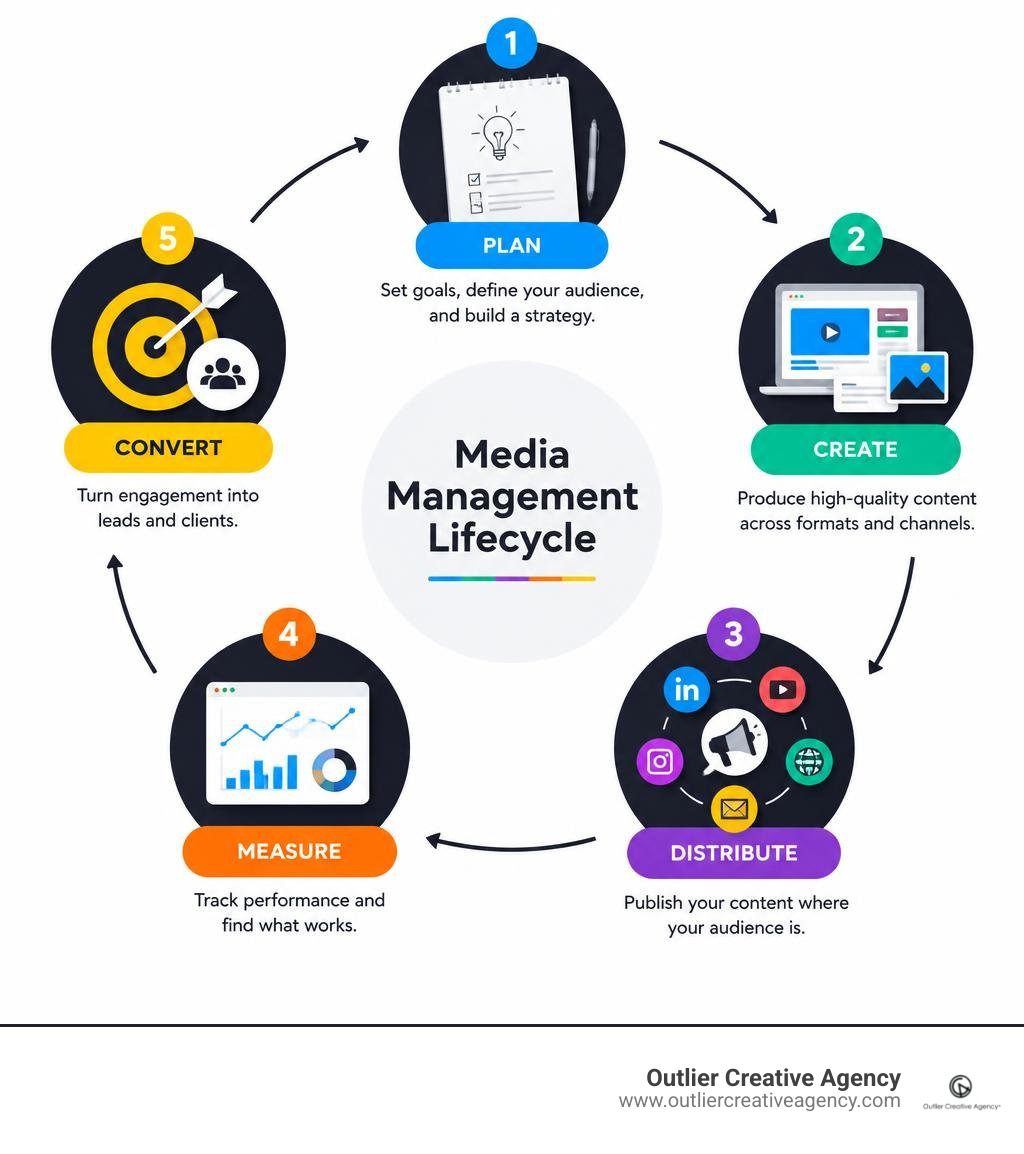
What Are Media Management Services and Why Are They Critical for Modern Businesses?
In the current digital landscape of 2026, audience attention is fragmented across dozens of digital touchpoints. Potential clients research legal counsel, evaluate corporate reputations, and consume multimedia long before ever picking up the phone. For managing partners and firm founders, coordinating this communication manually is impossible without sacrificing client work.
Professional media management creates a connected media ecosystem where every digital asset reinforces your brand authority. Whether someone finds an educational video on LinkedIn, reads an insightful guest article, or encounters a localized search ad, your messaging remains unified.
Consider how consumers make decisions today:
- Almost 4 billion people actively use social media worldwide.
- 77.6% of small businesses leverage social platforms to promote their offerings.
- 93% of consumers state that online reviews and digital sentiment directly influence their purchasing decisions.
- 91% of 18-to-34-year-olds trust online reviews and digital authority signals as much as personal recommendations.
When executed strategically through integrated social media management, media management services protect your digital reputation, ensure bar-compliant messaging, and nurture prospects through complex buying journeys.
How Do Full-Spectrum Media Management Services Differ from Basic Social Media Management?
Many founders confuse basic social media coordination with comprehensive media management. Basic social media management focuses narrowly on scheduling status updates, sourcing stock photography, and monitoring inbox notifications on platforms like Instagram or Facebook.
In contrast, full-spectrum media management orchestrates every paid, owned, and earned channel into an integrated revenue engine. It connects public relations, high-production video, paid search, digital asset management, email automation, and conversion rate optimization under a single strategic framework.
| Strategic Capability | Basic Social Media Management | Full-Spectrum Media Management |
|---|---|---|
| Primary Scope | Organic post scheduling and basic caption copywriting | Cross-channel strategy, paid acquisition, and asset workflows |
| Channel Coverage | 1–3 social networks (e.g., LinkedIn, Instagram) | Paid search, display, video distribution, email, PR, and social |
| Production Value | Stock images, basic templates, smartphone clips | Custom video production, motion graphics, and editorial copy |
| Strategic Goal | Surface-level engagement (likes, shares, comments) | Pipeline velocity, qualified client acquisition, and ROI |
| Data Integration | Basic native platform analytics | Advanced GA4 event tracking, CRM attribution, and pipeline analysis |
What Is the Difference Between Content Creation and Content Management?
Content creation and content management are complementary disciplines, but they serve fundamentally distinct functions within your marketing operations.
Content Creation is the generative phase of marketing. It involves ideation, copywriting, scriptwriting, graphic design, and on-location video production services. This stage creates the raw narrative assets that showcase your firm's subject-matter expertise.
Content Management is the strategic distribution architecture that governs those assets once produced. It includes:
- Digital asset cataloging and metadata tagging
- Repurposing long-form webinars or trial commentary into short-form clips
- Coordinating distribution calendars across multi-channel ecosystems
- Monitoring compliance archives and updating outdated legal disclaimers
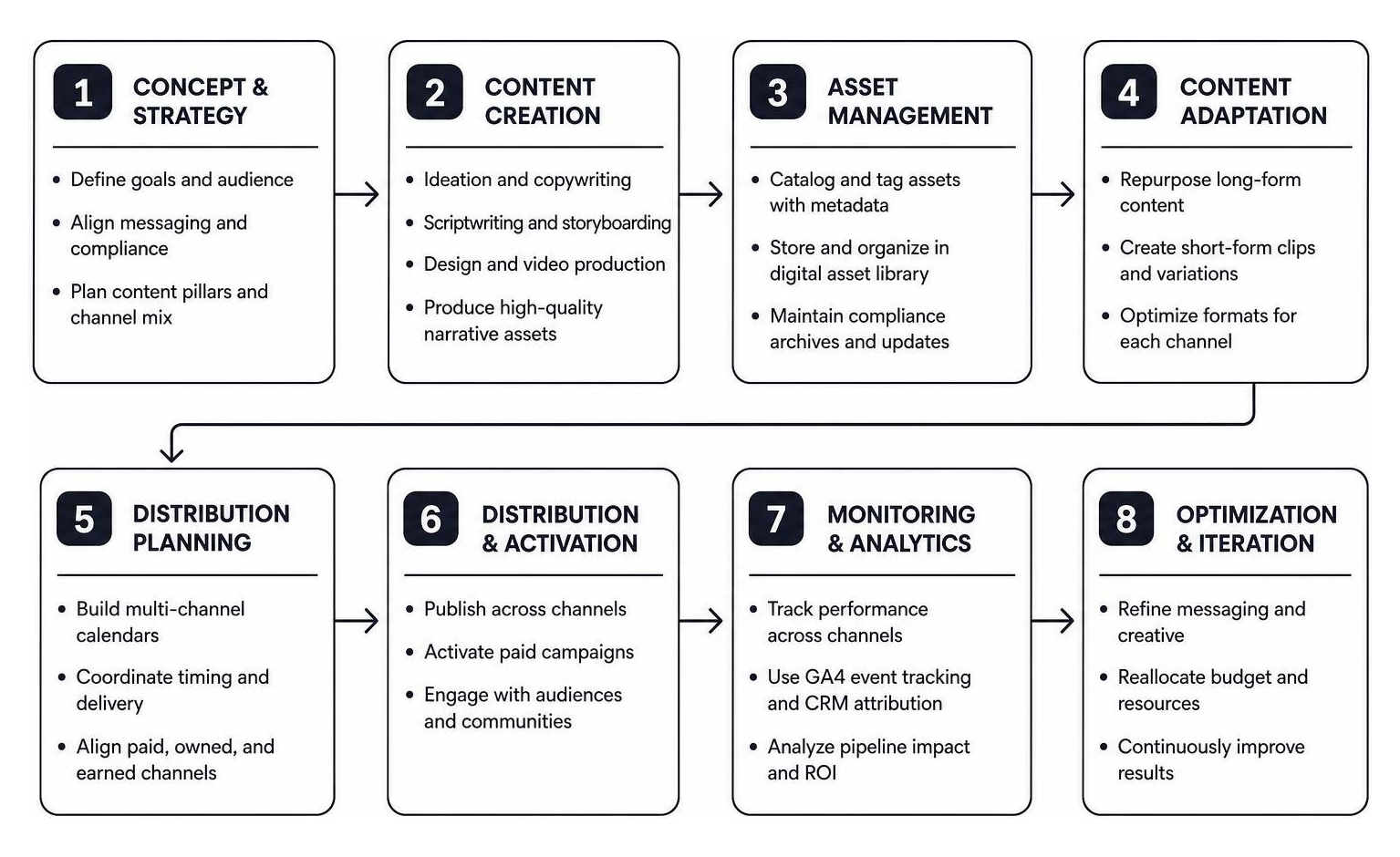
Creating high-quality assets without structured management results in expensive videos sitting idle on internal servers. Conversely, managing distribution without strong creative assets leads to dry, uninspiring feeds that fail to convert prospective clients.
What Types of Media Management Services Drive Measurable Growth?
To drive consistent caseload growth, media management cannot operate as a series of isolated experiments. Modern media solutions unite your firm's touchpoints into an orchestrated, journey-centric system.

How Do Paid, Owned, and Earned Media Channels Work Together?
High-performing campaigns rely on a balanced mix of paid, owned, and earned media channels working in sync:
- Owned Media: The foundational platforms your firm controls, such as your website, practice-area guides, email newsletters, and podcast feeds.
- Paid Media: Targeted amplification channels that guarantee immediate reach, such as programmatic display, paid social campaigns, and law firm PPC management.
- Earned Media: Third-party validation generated through public relations, journalist quotes, legal directories, organic client reviews, and peer referrals.
When managed cohesively, an earned media placement in a major legal journal feeds your owned email newsletter, while targeted paid campaigns amplify that coverage directly to corporate decision-makers in Los Angeles and Austin.
What Core Capabilities Should Modern Media Management Services Include?
A comprehensive media management partner should provide an end-to-end suite of strategic capabilities:
- Broadcast-Quality Video & Asset Production: Producing attorney profile videos, client testimonial features, and educational content that humanize complex litigation.
- Targeted Email Automation: Designing nurture sequences and case update workflows. Email remains an undisputed conversion leader; research consistently shows that for every $1 spent on email marketing, the average ROI is $36. You can deploy high-ROI email marketing campaigns to maintain top-of-mind recall with referring counsel and former clients.
- Paid Advertising & Search Engine Marketing: Managing real-time bid strategies across Google Ads, LinkedIn Ads, and YouTube to capture high-intent searchers.
- Influencer & Creator Collaborations: Establishing credibility through strategic professional partnerships. Industry data confirms that 89% of marketers find influencer marketing delivers a higher ROI than most traditional advertising channels, according to Influencer Marketing Hub's benchmark report.
- Advanced GA4 and Attribution Modeling: Implementing custom UTM parameters, conversion events, and CRM pipeline tracking to attribute signed cases to exact media touchpoints.
Why Should Founders Outsource Media Management Instead of Building In-House?
Building an internal media division requires hiring a videographer, graphic designer, copywriter, paid media buyer, SEO specialist, and creative director. For most law firms and growing enterprises, the payroll overhead, software subscriptions, and management distraction far outweigh the strategic benefits.

Outsourcing to an experienced agency provides instant access to specialized creative talent, enterprise-grade production tools, and proven distribution workflows without the operational friction of staffing an in-house department.
Which Highly Regulated Industries Benefit Most from Dedicated Media Experts?
While e-commerce and consumer brands enjoy broad creative freedom, highly regulated sectors require specialized marketing partners who understand industry-specific guardrails.
- Legal Practices & Law Firms: Legal marketing must strictly adhere to state bar advertising ethics, such as California Rule of Professional Conduct 7.1–7.5 and Texas Disciplinary Rules of Professional Conduct Part VII. Dedicated legal agencies prevent ethical violations regarding past verdict representations, specialization claims, and mandatory jurisdictional disclaimers through strategic digital marketing for attorneys.
- Healthcare & Medical Facilities: Marketing medical aesthetics, surgical practices, or specialized clinics requires absolute HIPAA privacy compliance, clear risk disclosures, and patient consent protocols.
- Financial & Corporate Advisory: Wealth managers, accounting firms, and boutique litigation practices must satisfy stringent regulatory standards regarding forward-looking statements and performance claims.
In these sectors, a single non-compliant social post or misleading ad copy can result in formal bar grievances or administrative penalties. Experienced media partners build rigorous compliance checks directly into every stage of content production and distribution.
How Much Does Professional Media Management Typically Cost?
Media management pricing varies depending on asset volume, channel scope, production frequency, and advertising spend management:
- Entry-Level Small Business Tiers ($500 – $1,500/month): Basic social media curation, template-driven graphics, and essential cross-platform scheduling.
- Mid-Market Comprehensive Retainers ($2,500 – $7,500/month): End-to-end multi-channel management, including monthly on-location or remote video production, custom copywriting, paid ad management, email marketing, and GA4 analytics reporting.
- Enterprise & High-Growth Solutions ($10,000 – $25,000+/month): Full-scale creative execution, commercial broadcast video production, multi-market paid search and social campaigns, automated CRM integration, and dedicated PR orchestration.
How Do You Select the Right Media Partner and Measure Campaign ROI?
Choosing a media management agency requires assessing strategic alignment rather than just reviewing creative reels. A compelling video reel means little if the agency cannot turn views into signed client retainers.
To position your firm effectively, combine high-performance distribution with foundational assets supported by strategic branding services.
What Key Criteria Should Founders Evaluate When Vetting Agencies?
When evaluating prospective media management companies, ask these direct questions during discovery consultations:
- Do you have demonstrable experience in my specific industry? Verify that the team understands your regulatory environment and has a proven track record of attracting qualified clients within your market.
- How are your creative and account teams structured? Ensure your account is managed directly by senior strategists who run your campaigns end-to-end, rather than being handed off to junior interns after contracting.
- What is your compliance and editorial review process? The agency should provide an organized dashboard and clear review windows so managing partners can review and approve all legal copy, ad creative, and video assets before publishing.
- How do you handle reporting and data attribution? Insist on clear, transparent reporting that tracks actual customer acquisition costs, qualified consultations, and signed revenue, rather than relying on vanity impressions.
Which Performance Metrics and Analytics Prove True Business ROI?
Top-tier media management services measure success using core commercial metrics that reflect genuine business growth:
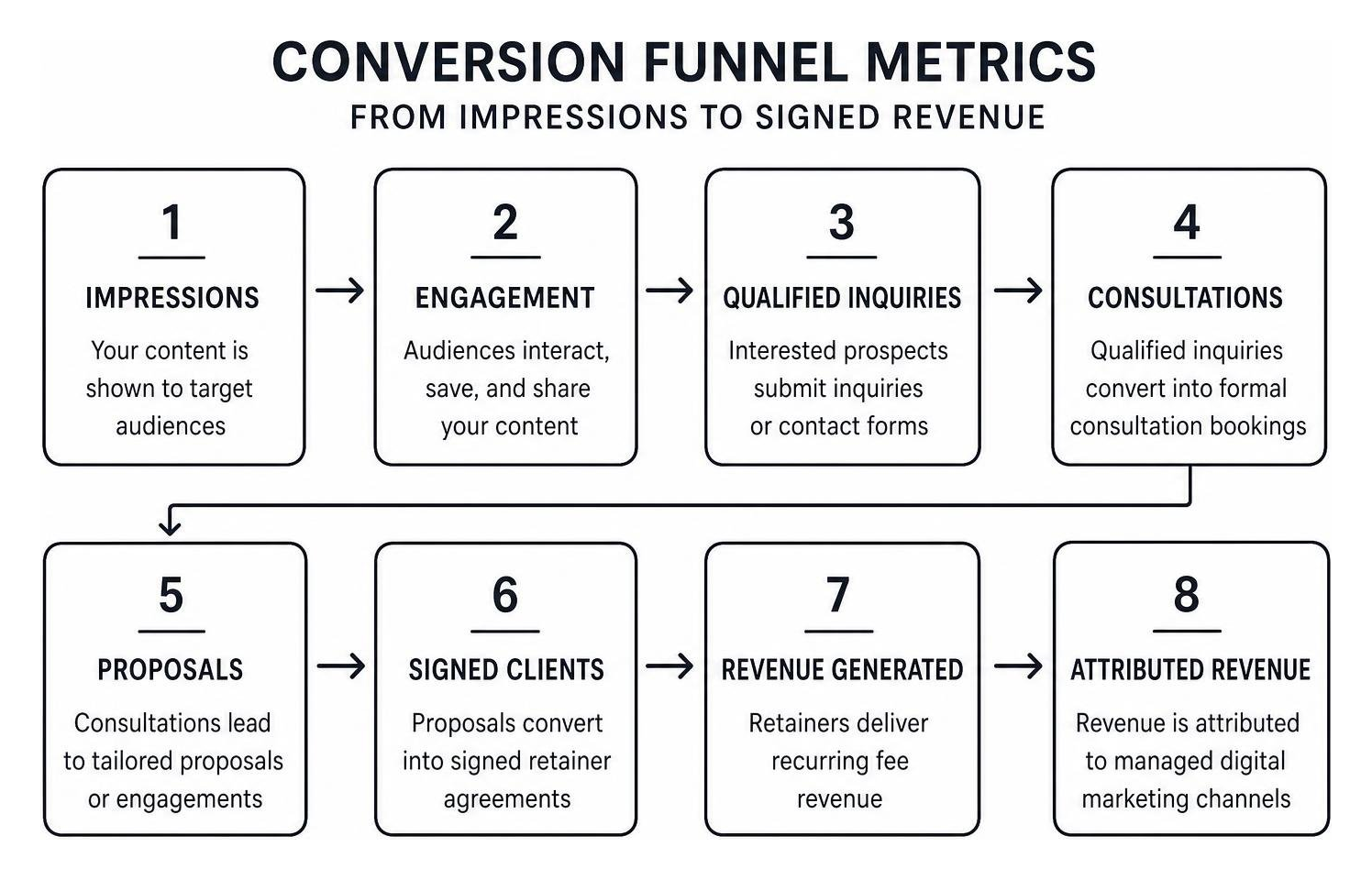
- Cost Per Acquisition (CPA): Total media spend and management fees divided by the number of signed clients.
- Consultation Conversion Rate: The percentage of qualified digital inquiries that convert into formal consultation bookings.
- Engagement Velocity: The speed at which target audiences interact with, save, and share high-value educational content across owned networks.
- Lead-to-Case Velocity: The average time it takes a prospective client to move from their initial digital impression to a signed retainer agreement.
- Attributed Net Revenue: Total fee revenue generated directly from managed digital marketing channels.
Frequently Asked Questions About Media Management Services
How quickly can a company expect to see measurable results from professional media management?
Timelines depend on the specific mix of channels deployed. Paid advertising and search engine marketing can generate qualified inquiries within the first 14 to 30 days of campaign launch. Conversely, organic social media growth, search engine optimization, and video authority building typically follow a compounding 90-to-180-day growth curve. A balanced media strategy uses targeted paid ads for immediate pipeline generation while organic authority builds over time.
Can a business bundle digital advertising with organic media management?
Yes. In fact, combining organic content with paid amplification delivers far superior results compared to running either channel in isolation. Top-performing organic posts can be transformed into paid video ads, retargeting website visitors and warm social audiences with validated, high-converting messaging.
What software and tracking tools are standard in modern media management?
Professional media management agencies rely on modern software stacks that include Google Analytics 4 (GA4) with custom event tracking, call-tracking platforms (such as CallRail), enterprise social listening and scheduling tools, and centralized project dashboards where clients can review and approve assets before publishing.
How does media management ensure compliance in regulated fields like legal and healthcare?
Dedicated media management teams establish structured pre-publication workflows. For legal marketing, this involves cross-referencing all copy against applicable state bar advertising rules, verifying that mandatory office locations and attorney responsible names are clearly displayed, including required disclaimers, and avoiding prohibited promises regarding case outcomes.
Conclusion
Building a dominant firm in today's market requires more than sporadic social posts or uncoordinated advertising campaigns. High-impact media management services establish a synchronized communication engine that enhances your brand reputation, engages high-intent prospects, and consistently turns online attention into signed cases.
At Outlier Creative Agency, we build and manage data-driven, bar-compliant marketing ecosystems for ambitious law firms and attorneys across Los Angeles, California, Austin, Texas, and nationwide. If you are ready to remove the operational burden of media coordination while accelerating firm revenue, scale your firm with specialized social media management solutions by scheduling an executive consultation with our team today.