Build a pedestrian accident PPC campaign that cuts case costs and wins high-intent leads with proven bidding, landing pages, and compliance.
Why Are PPC Economics and Lead Benchmarks Critical for Injury Firms?
Building a profitable pedestrian accident PPC campaign starts with separating pedestrian injury keywords into dedicated ad groups, pairing exact and phrase match keywords with strict negative lists, and sending clicks to high-speed landing pages with click-to-call intake. Firms should then track Cost-Per-Click (CPC), Cost-Per-Lead (CPL), and Cost-Per-Signed-Case rather than relying on impressions or raw click volume.
Running paid search for legal practices is not like standard e-commerce advertising. In the personal injury space, search auctions are among the most competitive digital marketplaces in the world. With high case values at stake, firms routinely bid aggressive sums to secure top-of-page visibility. If managing partners do not understand the underlying economics, ad spend can quickly evaporate without yielding retained clients.
To maintain profitability, legal practices must look past vanity metrics like impressions or surface-level click volume. Success hinges on tracking unit economics: Cost-Per-Click (CPC), Cost-Per-Lead (CPL), and ultimate Cost-Per-Signed-Case.
| Marketing Channel / Strategy | Average Cost-Per-Lead (CPL) | Typical Conversion Rate (Click-to-Lead) | Lead Retainer Velocity |
|---|---|---|---|
| Google Search Ads (PPC) | $400 – $900 | 5% – 10% | Fast (1–3 Days) |
| Google Local Services Ads (LSAs) | $250 – $600 | Pay-Per-Qualified-Lead | Immediate (Direct Call) |
| Legal Lead Aggregators | $300 – $700 | 10% – 20% | Moderate (Shared Leads) |
| Organic Search (SEO) | $100 – $250 | 10% – 15% | Long-Term (Months to Build) |
| Attorney Referral Networks | $100 – $200 | 20% – 30% | Variable / Relationship-Driven |
Understanding these benchmarks allows firms to calibrate budgets and evaluate whether their campaigns are generating an acceptable Return on Ad Spend (ROAS).
How Do Pedestrian Accident CPCs Compare to Other Personal Injury Niches?
Pedestrian accident claims represent a unique niche within personal injury litigation. While commercial truck litigation and catastrophic medical malpractice terms can exceed $300 to $500+ per click in major metropolitan markets, standard pedestrian injury queries frequently average between $75 and $250+ per click.
These bids reflect the severe nature of pedestrian claims. Because pedestrians lack vehicular protection, collisions often involve severe orthopedic trauma, traumatic brain injuries (TBIs), or spinal damage. State departments of transportation, such as the Texas Department of Transportation's pedestrian safety campaigns, regularly highlight the disproportionate vulnerability of pedestrians on busy urban roadways. For personal injury attorneys, these cases often involve clear liability and substantial policy payouts, making a dedicated campaign a cost-effective alternative to hyper-saturated generic car accident terms.
What Are the Average Cost-Per-Lead Benchmarks Across US Regions?
Lead costs are fundamentally tied to local population density, pedestrian traffic corridors, and attorney density. Across the legal industry, the average pedestrian accident lead cost sits around $450, but regional variations are significant:
- Major Urban Metros (e.g., Los Angeles, Houston): CPLs often range from $650 to $1,100 due to severe auction competition among large advertising firms.
- Growing Tech and Mid-Sized Metros (e.g., Austin): CPLs typically average between $400 and $750.
- Suburban and Lower-Density Markets: CPLs can drop to $350 to $600, though search volume is naturally lower.
Knowing your regional benchmark prevents underbidding—which results in zero impression share—or overpaying for unqualified clicks.
For a deeper walkthrough of campaign architecture, conversion tracking, and scaling tactics, see our personal injury PPC complete guide for 2026.
How Do You Build and Scale a Profitable Pedestrian Accident PPC Campaign in 2026?
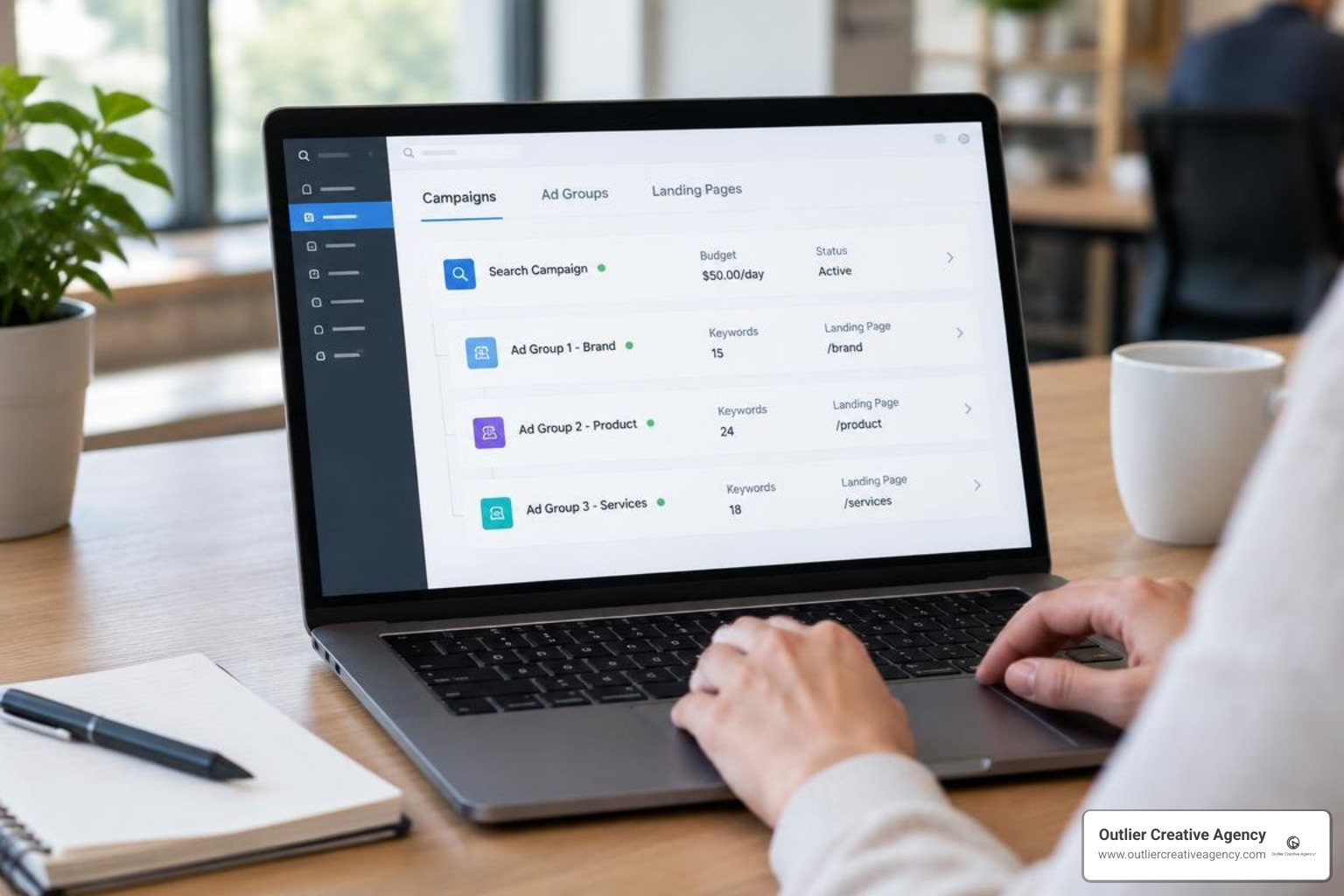
A profitable strategy requires separating pedestrian collisions from general motor vehicle accident campaigns. Grouping auto accidents, slip-and-falls, and pedestrian incidents into a single ad group ruins ad relevance, depresses Quality Scores, and inflates CPCs. Our comprehensive personal injury PPC complete guide for 2026 emphasizes that granular segmentation is the cornerstone of sustainable paid search.
Improving your Google Ads Quality Score from a baseline of 5 to an 8+ can reduce your actual CPC by 40% to 50%. This efficiency is achieved by creating dedicated ad groups where search terms, ad copy, and landing page content reflect the exact circumstances of a pedestrian crash.
How Should Match Types and Negatives Be Structured in a Pedestrian Accident PPC Campaign?
Broad match bidding without strict oversight can drain your budget on queries from drivers at fault, academic research, or pedestrian safety statistics. To capture high-intent plaintiffs, structure ad groups around Exact Match and tightly controlled Phrase Match keywords:
[pedestrian accident lawyer][hit by car attorney near me]"crosswalk accident lawyer""pedestrian hit by car settlement"
Complement these targets with master negative keyword lists applied at the account and campaign levels:
- Employment/Educational Queries: jobs, salary, law school, intern, paralegal, course
- Defendant/At-Fault Intent: I hit a pedestrian, what happens if you hit someone walking, criminal defense for hitting pedestrian
- Informational/DIY Intent: DIY settlement calculator, police report lookup free, pedestrian laws blog
For firms focusing on specific regional markets, building out localized assets—such as pages tailored for a San Diego pedestrian accident lawyer—ensures that search term relevance aligns directly with local query intent. Regular search term audits must be conducted weekly to add newly discovered irrelevant search strings to your negative lists.
What Geographic Targeting Rules Eliminate Wasted Legal Ad Spend?
Default Google Ads settings target people in, or who have shown interest in, your geographic locations. For law firms, this default setting causes budget leaks by serving ads to users researching accidents from out-of-state jurisdictions where your firm is not licensed to practice.
To protect your budget:
- Select "Presence: People in or regularly in your targeted locations." This simple setting prevents ad delivery to out-of-market users.
- Target High-Incident Corridors: Analyze municipal accident data—such as urban traffic initiatives tracked through Austin's Vision Zero program—to identify high-density pedestrian corridors, transit hubs, and downtown intersections where foot-traffic incidents occur most frequently.
- Exclude Non-Licensed Jurisdictions: Explicitly exclude neighboring counties or states where you cannot represent clients without costly pro hac vice admissions.
What Bidding Strategies and Local Services Ads Capture High-Intent Leads?
Modern legal search engine marketing blends pay-per-click ads with pay-per-lead platforms. Relying entirely on traditional Google Search Ads leaves valuable top-of-page real estate to competitors who leverage Google Local Services Ads (LSAs). Our PPC advertising lawyers guide 2026 explains that combining both formats maximizes local visibility.

How Do Google LSAs Differ from Traditional Google Search Ads?
Google Local Services Ads sit above standard PPC ads and organic results. They operate on a distinct model:
- Pay-Per-Lead vs. Pay-Per-Click: LSAs charge your firm only when a user calls or messages directly through the ad, whereas traditional PPC charges for website clicks.
- The Google Screened Badge: To qualify for LSAs, attorneys must pass background checks, state bar license verification, and malpractice insurance validation. This green checkmark fosters immediate consumer trust.
- Dispute Mechanisms: If an LSA call produces an invalid lead (e.g., wrong practice area, wrong geography, or automated spam), your marketing team can dispute the charge to receive credit back to your ad spend.
Pairing traditional services PPC search ads with an active LSA profile allows a law firm to dominate the top two screen positions on mobile devices.
How Can AI Smart Bidding and Target CPA Scale a Pedestrian Accident PPC Campaign?
While manual bidding offers control during initial launch, scaling a campaign requires leveraging Google's machine learning capabilities. However, automated bidding algorithms like Target CPA (Cost Per Acquisition) require sufficient data to function effectively.
- The 30-Conversion Threshold: Do not switch to Target CPA bidding immediately on a new campaign. Begin with Manual CPC with Enhanced bidding until the campaign accumulates at least 20 to 30 tracked lead conversions within a 30-day window.
- Value-Based Bidding: Once conversion volume is consistent, implement Smart Bidding strategies configured to optimize for high-value actions (such as phone calls lasting longer than 120 seconds or completed intake questionnaires) rather than low-intent pageviews.
Reviewing our law firm PPC analytics guide 2026 provides deeper frameworks for setting realistic target acquisition thresholds without choking off impression share.
How Do High-Speed Landing Pages and Rapid Intake Drive Conversions?
Securing a high-intent click is only half the battle. If your landing page takes four seconds to load or confuses an injured victim with generic firm histories, that expensive visitor will hit the back button. A specialized law firm PPC agency designs the post-click experience specifically around the emotional state and physical limitations of an injured claimant.
What Landing Page Elements Convert Pedestrian Injury Traffic into Signed Cases?
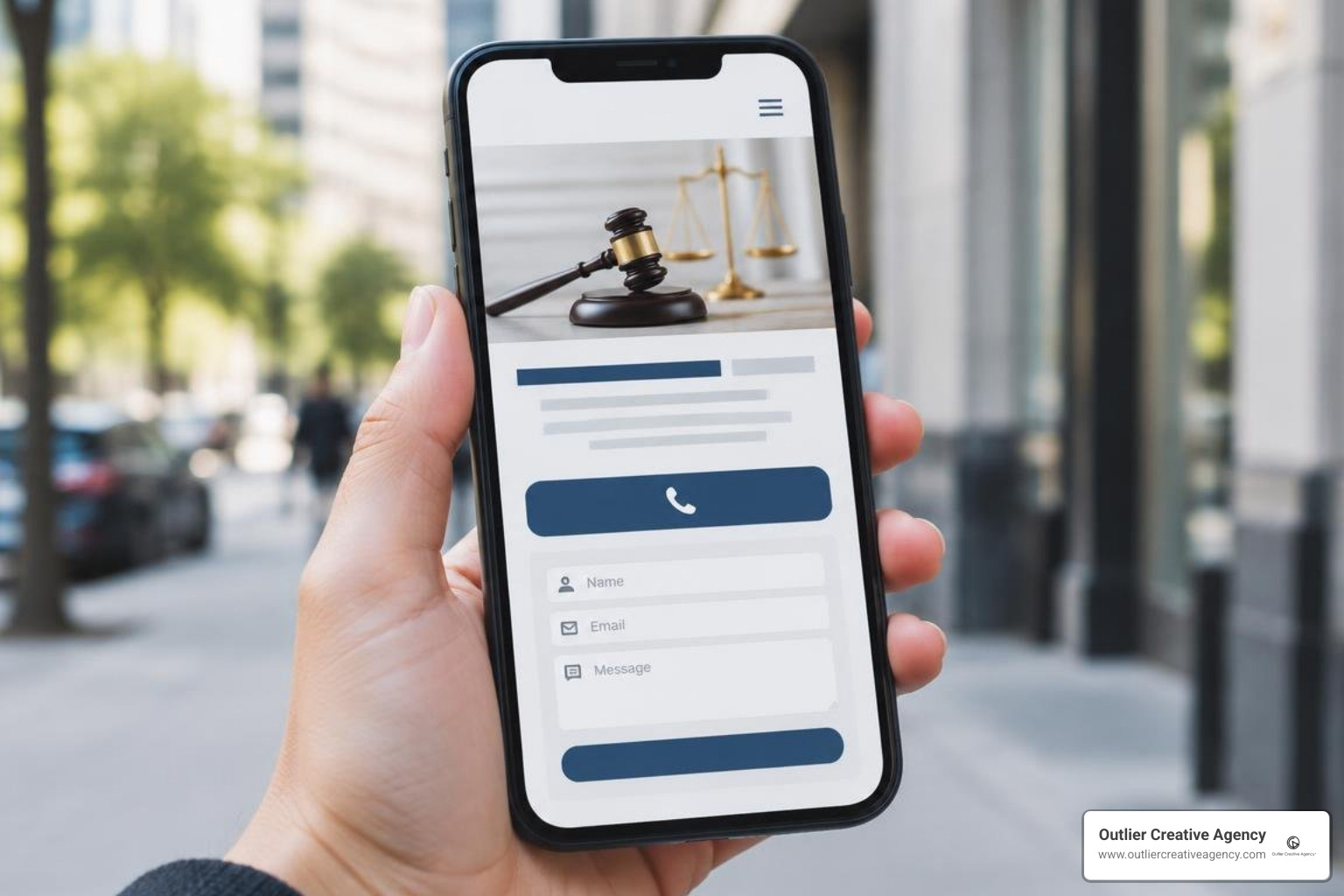
Well-optimized personal injury landing pages convert between 8% and 15% of paid traffic into inbound inquiries. Achieving this conversion rate requires specific structural elements:
- Mobile-First, High-Speed Architecture: Mobile users account for the majority of emergency legal searches. Pages must achieve a Largest Contentful Paint (LCP) under 2.5 seconds.
- Immediate Click-to-Call Functionality: Over 70% of high-intent injury prospects prefer calling directly rather than completing a form. Use sticky, persistent click-to-call headers.
- Visual Social Proof: Prominently display verified client reviews, total settlement recoveries for injured pedestrians, and bar association recognitions.
- Short Intake Forms: Limit form fields to essential contact details (Name, Phone Number, Brief Accident Summary). Every additional field decreases form completion rates.
How Does Sub-Five-Minute Speed-to-Lead Impact Retained Case Volume?
Pedestrian accident victims often research legal representation within 24 to 72 hours of the incident, frequently while dealing with emergency medical care. When a prospective client submits a form or leaves a voicemail, they often reach out to multiple firms simultaneously.
Responding to an incoming lead within 5 minutes increases the likelihood of signing that client exponentially compared to waiting 30 minutes. To capitalize on this window, modern law practices integrate their paid ads with CRM webhooks that immediately route leads to 24/7 live intake teams and trigger automated, personalized SMS confirmations to the claimant.
What Call Tracking and Bar Compliance Rules Protect Your Firm?
A high-performing PPC strategy requires transparent tracking and strict adherence to professional ethics codes. Personal injury advertising is heavily scrutinized by state bar associations, meaning marketing campaigns must maintain rigorous legal compliance.
How Does Dynamic Call Tracking and Closed-Loop CRM Attribution Prove ROI?
To calculate actual return on marketing spend, you must know which specific keyword, ad copy, and campaign generated each signed case. Dynamic Number Insertion (DNI) technology replaces the phone number displayed on your landing page based on the visitor's unique search session.
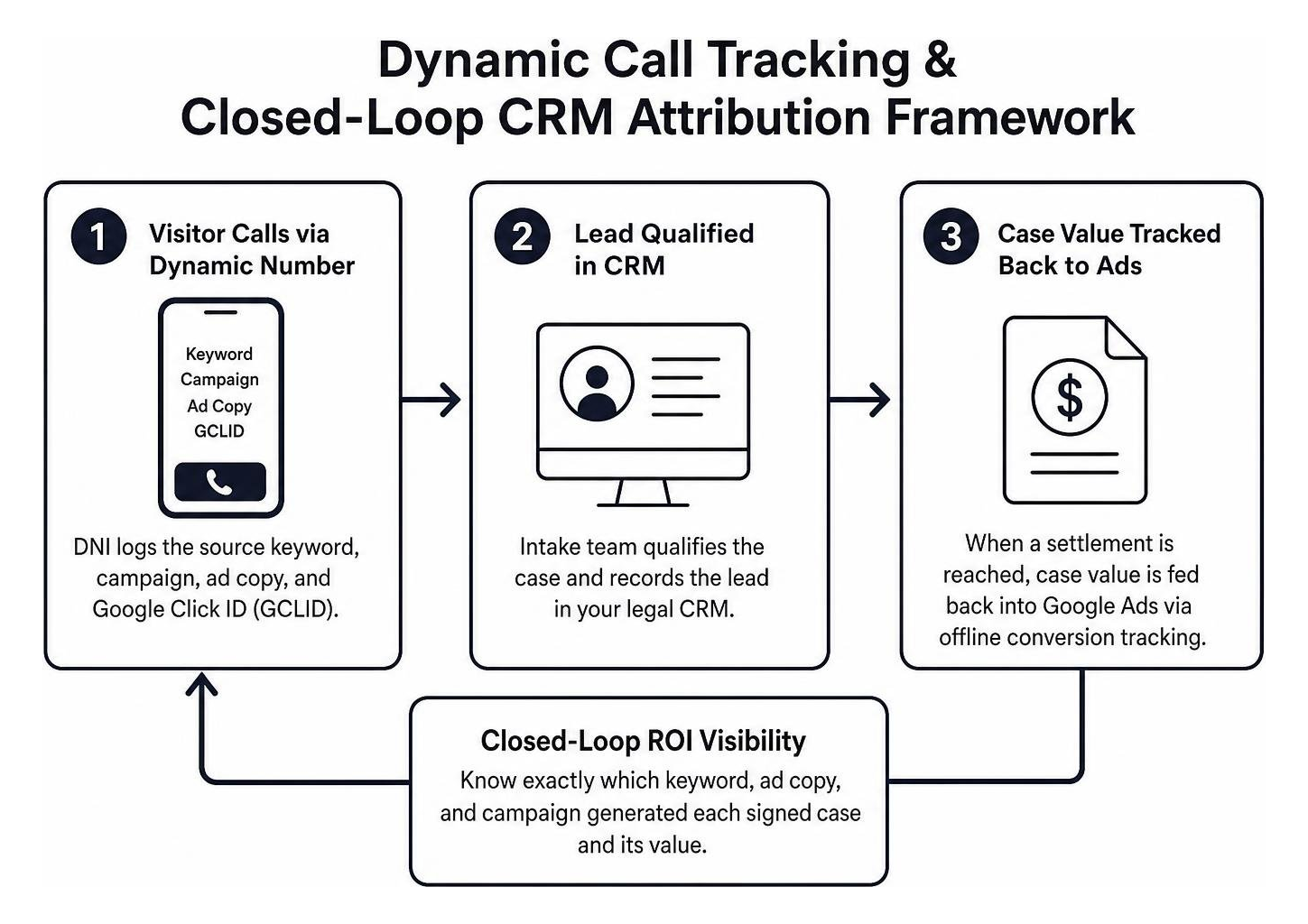
When an injured pedestrian calls your firm:
- The DNI system logs the source keyword, campaign, and Google Click ID (GCLID).
- The intake team qualifies the case in your legal CRM (e.g., Filevine, Clio, Lead Docket).
- When a settlement is reached months later, that case value is fed back into Google Ads via offline conversion tracking.
This closed-loop feedback trains Google's AI bidding algorithms to hunt for keywords and user profiles that yield profitable settlements, rather than just cheap clicks. Consulting our law firm PPC audit guide 2026 can help you verify whether your tracking architecture is properly configured.
What State Bar Advertising Rules and Disclaimers Must Legal Ads Follow?
Legal advertising requires strict compliance with state ethics rules, including those established by the State Bar of California and the State Bar of Texas:
- No Guarantees or Misleading Predictions: Never use ad copy that promises specific financial outcomes (e.g., "We Win You $1,000,000").
- Transparent Contingency Disclaimers: When advertising "No Fee Unless You Win," ensure required disclaimers regarding court costs and client expenses are visible on your landing page.
- Bona Fide Office Disclosures: Clearly state the principal office location and the attorney responsible for the advertisement.
- Approved Testimonial Language: Where client testimonials or past settlements are referenced, accompany them with mandatory state bar disclaimers indicating that past results do not guarantee future outcomes.
Frequently Asked Questions About Pedestrian Accident Ad Campaigns
How quickly can a new legal PPC campaign generate signed pedestrian accident cases?
With a well-structured account, targeted Exact Match keywords, and optimized landing pages, firms frequently generate inbound phone calls within the first 48 hours of campaign launch. Converting those leads into signed retainer agreements typically occurs within the first 2 to 4 weeks as your intake team processes and evaluates claims.
What is a realistic monthly ad budget for personal injury paid search?
For solo practitioners or boutique law firms in mid-sized markets, a competitive starting budget is typically between $10,000 and $20,000 per month. Mid-size to large regional firms operating in high-competition metropolitan markets often invest $30,000 to $75,000+ per month to maintain consistent top-of-page impression share.
Should personal injury law firms bid on competitor brand keywords?
Bidding on competitor brand names can capture high-intent users during the decision-making stage. However, keep in mind that Quality Scores for competitor terms are lower, resulting in higher CPCs. Furthermore, your ad copy must never deceptively use the competitor's trademarked name in a way that misleads searchers about your firm's identity.
Why do pedestrian accident queries peak within the first 72 hours?
Pedestrian collisions often cause immediate physical trauma, loss of transportation, and missed work. Victims and their families urgently seek clarity regarding insurance coverage, medical bills, and fault determination shortly after the crash. Establishing rapid visibility during this 24-to-72-hour window is vital for capturing retained cases.
Conclusion: Maximizing Law Firm Caseloads with Precision Paid Advertising
Building a predictable, high-yield lead generation engine requires combining precise keyword intent, disciplined geographic controls, rapid-response landing pages, and closed-loop CRM tracking. When personal injury firms treat paid search management with the same analytical rigor they apply to trial strategy, paid ad spend transforms from an unpredictable expense into a scalable revenue driver.
At Outlier Creative Agency, we build data-driven marketing campaigns engineered specifically for the economics and compliance demands of the legal industry. If your practice is ready to optimize its paid search strategy and acquire higher-quality cases, explore our approach to PPC advertising for law firms or reach out to our team to schedule a strategy consultation.