

Learn the true cost per signed case for personal injury firms, plus benchmarks by channel and case type to boost your ROI.
What Should a Personal Injury Firm Pay per Signed Case?
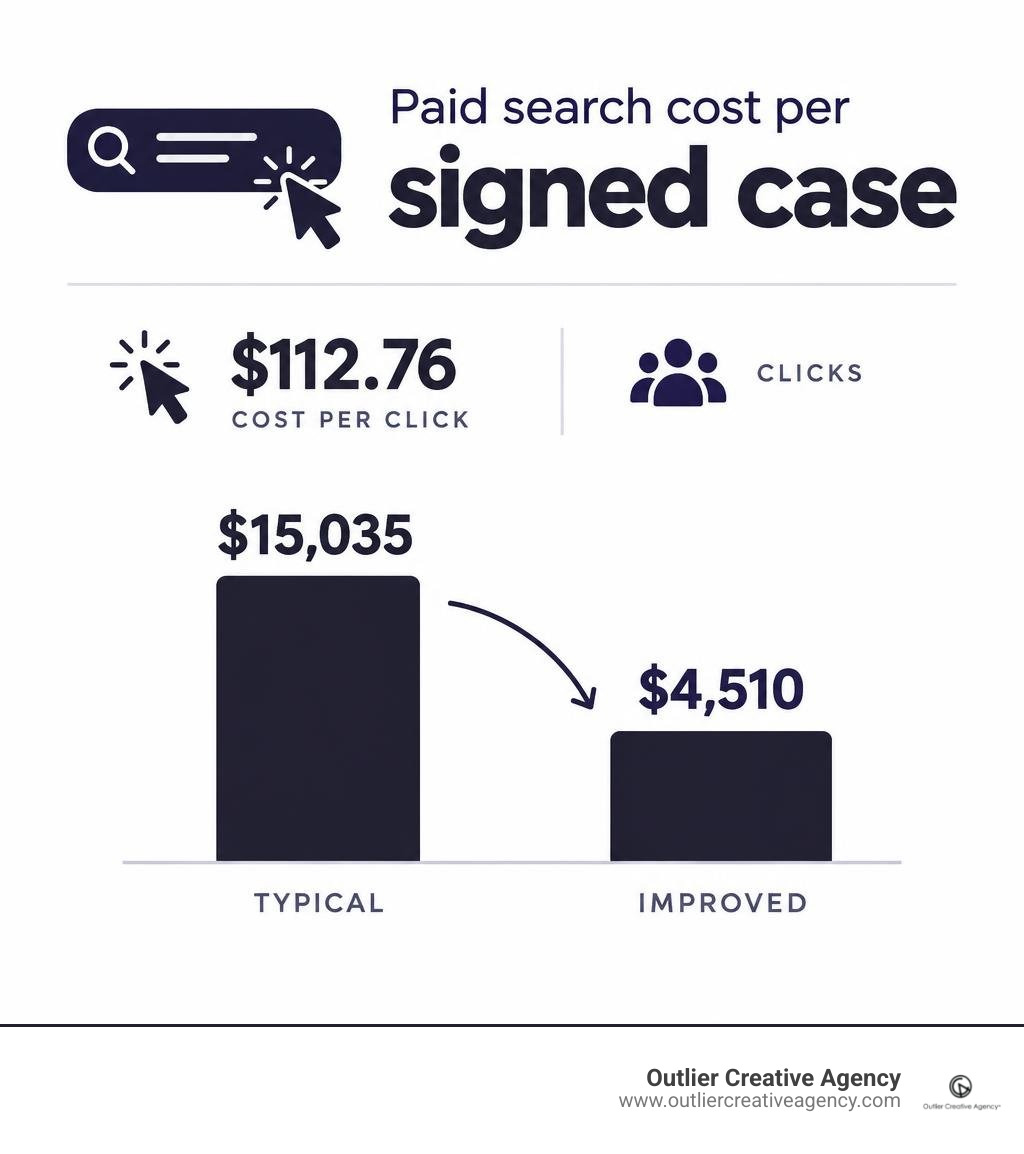
Paid search can cost about $15,035 per signed personal injury case at an average click price of $112.76. Faster intake and better lead-to-signed conversion can bring that figure down to about $4,510 without cheaper clicks.
Those are modeled outcomes from Outlier Creative Agency’s 2026 law firm marketing benchmarks, not a fixed price every firm should expect. At the same click price, a firm that turns 5% of clicks into leads and signs 15% of those leads pays about $15,035 per case. At 10% and 25%, it pays about $4,510.
For your firm, divide total acquisition spend by signed retainers, then check where prospective clients drop off. That tells you more about the value of your personal injury marketing than cost per lead alone.
I’m Corey Larson, and at Outlier Creative Agency I’ve developed legal content, websites, and video to help law firms attract clients. That work shapes how I explain the cost per signed personal injury case that campaigns produce.
Understanding Cost Per Signed Case Personal Injury Benchmarks in 2026
Evaluating your firm's client acquisition begins with understanding current bidding realities. Across major metropolitan areas like Los Angeles and Austin, personal injury remains the most competitive vertical in paid digital advertising. According to industry data, national average personal injury pay-per-click costs hover around $112.76 per click, with top competitive keywords reaching up to $800 per click during peak auction windows.
Keyword intent directly shapes click prices. Bidding on generic search queries such as "car accident lawyer" requires an average investment of $132.42 per click. In contrast, high-intent local queries like "car accident lawyer near me" demand $189.51 per click. That represents a 43% premium for immediate geographic intent. Claimants searching for nearby representation are actively seeking to sign with an attorney right away.
Managing partners must navigate these auction dynamics without draining their marketing budgets. Structuring campaigns through a dedicated personal injury PPC strategy allows firms to target high-intent long-tail terms while controlling baseline click costs. Before launching any campaign, review your state bar's advertising rules on digital lead generation and contingency fee disclosures, because noncompliant ad copy can force a campaign pause and inflate your effective acquisition cost.
| Acquisition Channel | Typical Cost Per Lead (CPL) | Lead-to-Signed Conversion Rate | Average Cost Per Signed Case |
|---|---|---|---|
| Google Local Services Ads (LSAs) | $200 to $400 | 12% to 25% | $685 to $950 |
| Google Search Ads (Standard PPC) | $250 to $600 | 15% to 30% | $2,500 to $3,000 |
| Exclusive Bought Web Leads | $585 to $1,105 | 10% to 15% | $3,900 to $11,050 |
| Shared Third-Party Leads | $40 to $90 | 2% to 5% | $1,875 to $4,500+ |
| Organic Search (SEO) | $150 to $350 | 15% to 28% | $1,000 to $2,200 |
Typical Cost Per Signed Case Personal Injury by Acquisition Channel
Different marketing channels produce wildly different cost structures and conversion dynamics. Google Search Ads deliver an average cost per signed case between $2,500 and $3,000 across competitive legal markets. Firms maintaining tight operational workflows and dedicated landing pages often achieve signed-case costs of $1,500 to $2,000 on standard search campaigns.
Google Local Services Ads (LSAs) present an exceptional acquisition opportunity. Backed by the Google Screened badge, LSAs generate direct phone inquiries that convert at higher rates. This performance produces a signed-case cost ranging from $685 to $950, which is roughly one-third the cost of standard search ads.
Long-term organic visibility through personal injury SEO offers sustainable volume, driving steady inbound case acquisition once rankings mature. In contrast, purchased lead sources yield mixed results.
As highlighted in the MVA Lead Cost Report 2026, exclusive motor vehicle accident leads cost between $585 and $1,105 each and convert at 10% to 15%. Shared leads sell for $40 to $90 each, but when three to eight firms call the same claimant, conversion rates plunge into low single digits. That collapse often makes shared leads far more expensive per signed client than exclusive sources.
Case Type Breakdown: Cost Per Signed Personal Injury Case

Acquisition costs vary significantly by matter type due to differences in policy limits, settlement potential, and competitive demand. Commercial vehicle and catastrophic injury claims carry larger contingency fees, driving aggressive auction competition.
- Standard Auto Accidents: Exclusive leads cost $585 to $1,105 each, converting at 10% to 15% for a final cost per signed case between $3,900 and $11,050.
- Commercial Trucking Accidents: Higher liability policies push acquisition costs to $5,300 to $18,400 per signed case, with lead-to-retainer conversion rates averaging 6% to 11%.
- Motorcycle Injury Claims: Driver bias and injury severity produce an average cost per signed case between $4,200 and $12,300, converting at 9% to 14%.
- Pedestrian Accident Cases: Requiring thorough liability investigation, pedestrian claims sign at 8% to 13%, with acquisition costs spanning $4,500 to $13,800.
- Wrongful Death Claims: Catastrophic and wrongful death claims range from $6,500 to over $22,100 per signed case, reflecting intensive intake screening.
- Mass Tort Litigation: Mass tort acquisition runs from $68 to $15,000 per signed case depending on the tort lifecycle. High-volume pharmaceutical dockets sign for $68 to $347, while complex product claims like mesothelioma range from $5,000 to $15,000.
The Math Behind Calculating Your True Case Acquisition Cost
Evaluating agency performance requires looking past surface-level vanity metrics. Tracking cost per click (CPC) or cost per lead (CPL) without connecting spend to executed retainer agreements obscures your actual return on investment.
A low-priced lead is not an asset if it never signs. Consider this comparison:
- Campaign A: Buys exclusive search leads at $300 each. The firm converts 20% into signed clients. Cost per signed case is $1,500.
- Campaign B: Buys shared leads at $75 each. Because five other firms dial the prospect immediately, conversion drops to 4%. Cost per signed case is $1,875.
The cheaper lead costs $375 more per signed client.
Contingency fee structures justify these upfront investments. The national standard contingency fee is 33.33% of the gross recovery. Research indicates claimants who hire legal counsel receive gross settlements 3.5 times higher on average than self-represented claimants.
On a standard $50,000 motor vehicle settlement, a 33.33% fee generates $16,665 in attorney revenue. Acquiring that case for $2,500 to $3,000 yields a fee-to-acquisition ratio of 5x to 6x. On catastrophic or commercial trucking recoveries generating $80,000 or more in fees, that ratio easily exceeds 20x.
Before scaling spend, confirm that your ad copy, landing pages, and intake scripts comply with your state bar's rules on contingency fee advertising and client solicitation. A compliance review protects your acquisition model from regulatory disruption.
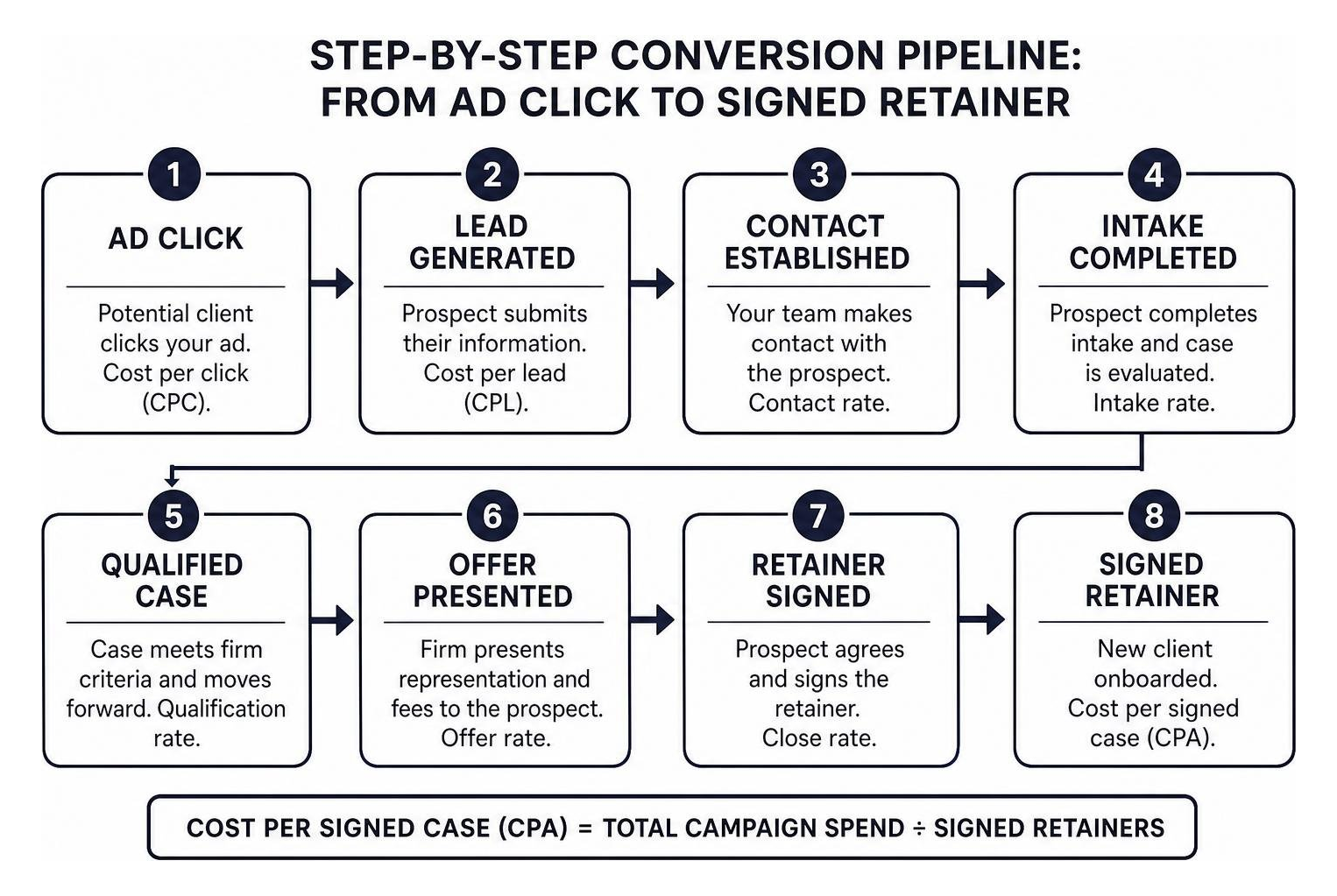
The Step-by-Step CPA Formula
Calculating your true cost per acquisition requires auditing every transition point in your intake pipeline:
Step 1: Calculate Cost Per Lead Divide total marketing ad spend by the total number of raw inquiries received. Example: $10,000 spend divided by 40 leads equals a $250 CPL.
Step 2: Determine Qualified Lead Rate Divide qualified leads (claimants with viable liability, damages, and insurance coverage) by total inquiries received. Example: 20 qualified leads out of 40 inquiries equals a 50% qualification rate.
Step 3: Measure Retainer Conversion Rate Divide signed retainer agreements by qualified leads contacted. Example: 4 signed retainers out of 20 qualified leads equals a 20% sign rate.
Step 4: Calculate True Cost Per Signed Case Divide total marketing ad spend directly by the number of signed retainers. Formula: Cost per signed case equals total marketing spend divided by total signed retainers. Example: $10,000 total spend divided by 4 signed retainers equals a $2,500 cost per signed case.
Accurate attribution requires tracking these variables in real time. Analyzing these metrics through systematic law firm PPC analytics ensures every dollar links directly to a signed matter.
Why Operational Intake Drives Acquisition Cost More Than Ad Clicks

Many managing partners assume poor marketing return stems from high click prices or flawed targeting. In practice, operational intake bottlenecks represent the single largest driver of inflated acquisition costs.
Personal injury claimants seeking counsel contact multiple firms after an accident. If your firm takes thirty minutes to return an inbound web form, the claimant has likely already spoken with and signed with a competitor.
Data shows that contacting a new lead within five minutes makes that prospect 21 times more likely to enter the qualification pipeline compared to waiting thirty minutes. Responding within 60 seconds delivers the highest conversion rates.
Modern personal injury intake requires responsive infrastructure:
- 24/7 Dedicated Coverage: Implement around-the-clock live intake staff or trained legal intake specialists rather than sending after-hours calls to basic voicemail.
- Matter-Specific Screening Scripts: Equip intake teams with customized screening logic for motor vehicle, premises liability, and commercial trucking matters to qualify liability immediately.
- Immediate Electronic Retainers: Send digital retainer agreements via SMS and email while the claimant is still on the initial phone consultation.
- Streamlined Attorney Escalation: Ensure viable high-value cases route directly to an associate or partner for instant consultation booking.
What Managing Partners Must Demand Agencies Report
To maintain financial accountability, managing partners must require their marketing agencies to report on pipeline progression rather than vanity impressions.
Demand regular reporting that includes:
- Signed Retainers by Campaign: Every report must track signed retainers directly back to the specific ad group, keyword, or paid asset.
- End-to-End UTM Attribution: Require complete UTM parameters and dynamic call tracking numbers integrated directly into your firm's case management CRM.
- Lead Quality and Rejection Categorization: Agencies must review why leads failed qualification (such as no liability, property damage only, or existing representation) to refine negative keyword lists.
- True Acquisition Cost per Retainer: Ensure your marketing agency tracks the blended acquisition cost per signed retainer, holding their campaigns accountable to actual revenue generation.
Conclusion
Securing a profitable cost per signed case requires balancing high-intent ad spend with an agile, 24/7 intake engine. While paid search click costs continue to rise, optimizing lead qualification, response speed, and retainer delivery reliably lowers acquisition costs without relying on cheaper ad clicks.
At Outlier Creative Agency, we design data-driven digital campaigns and conversion systems exclusively for growth-focused law firms nationwide. If you want to evaluate your firm's current client acquisition metrics or build a predictable case pipeline, we invite you to contact our team to schedule a consultation. For more insights on scaling your legal practice, explore our comprehensive guide to the best law firm internet marketing strategies.
Frequently Asked Questions About Cost Per Signed Case Personal Injury
What is a good cost per signed case for personal injury?
A competitive cost per signed case for standard motor vehicle accidents ranges between $2,500 and $3,000. Firms with rapid, 24/7 intake workflows frequently sign cases for $1,500 to $2,000. Complex matters involving commercial trucks or wrongful death carry higher acquisition costs, often ranging from $5,300 to $22,100, which is supported by their larger fee potential.
Is cost per lead or cost per signed case the better metric?
Cost per signed case is the superior metric. Cost per lead ignores lead quality, claimant viability, and intake efficiency. Cheap $50 shared leads that convert at 2% produce a higher cost per signed client than $300 exclusive leads that convert at 20%. Evaluating campaigns by signed retainers protects your marketing profitability.
Why do near me searches cost more?
Search queries containing "near me" carry an average click cost of $189.51, which is 43% higher than standard keywords like "car accident lawyer" at $132.42. These local-intent searches reflect urgent consumer intent. Claimants using these phrases need immediate local representation, making them highly competitive in Google ad auctions.
How fast should intake call back a new lead?
Firms should contact new leads within 60 seconds. Inbound prospects contacted within five minutes are 21 times more likely to qualify than those called after 30 minutes. Personal injury victims rarely wait for callbacks; delayed responses directly surrender viable retainers to competing firms.
How do I compare marketing agencies on cost per case?
Compare agencies based on their ability to track and optimize for executed retainers rather than raw clicks or form submissions. A qualified agency integrates directly with your legal CRM, uses call tracking attribution, analyzes intake drop-off points, and measures performance on signed case volume and fee-to-acquisition ratios.