
Find the cosmetic surgery marketing firm that delivers measurable patient acquisition, SEO, and paid ad results for aesthetic practices.
What to Look for in a Cosmetic Surgery Marketing Firm
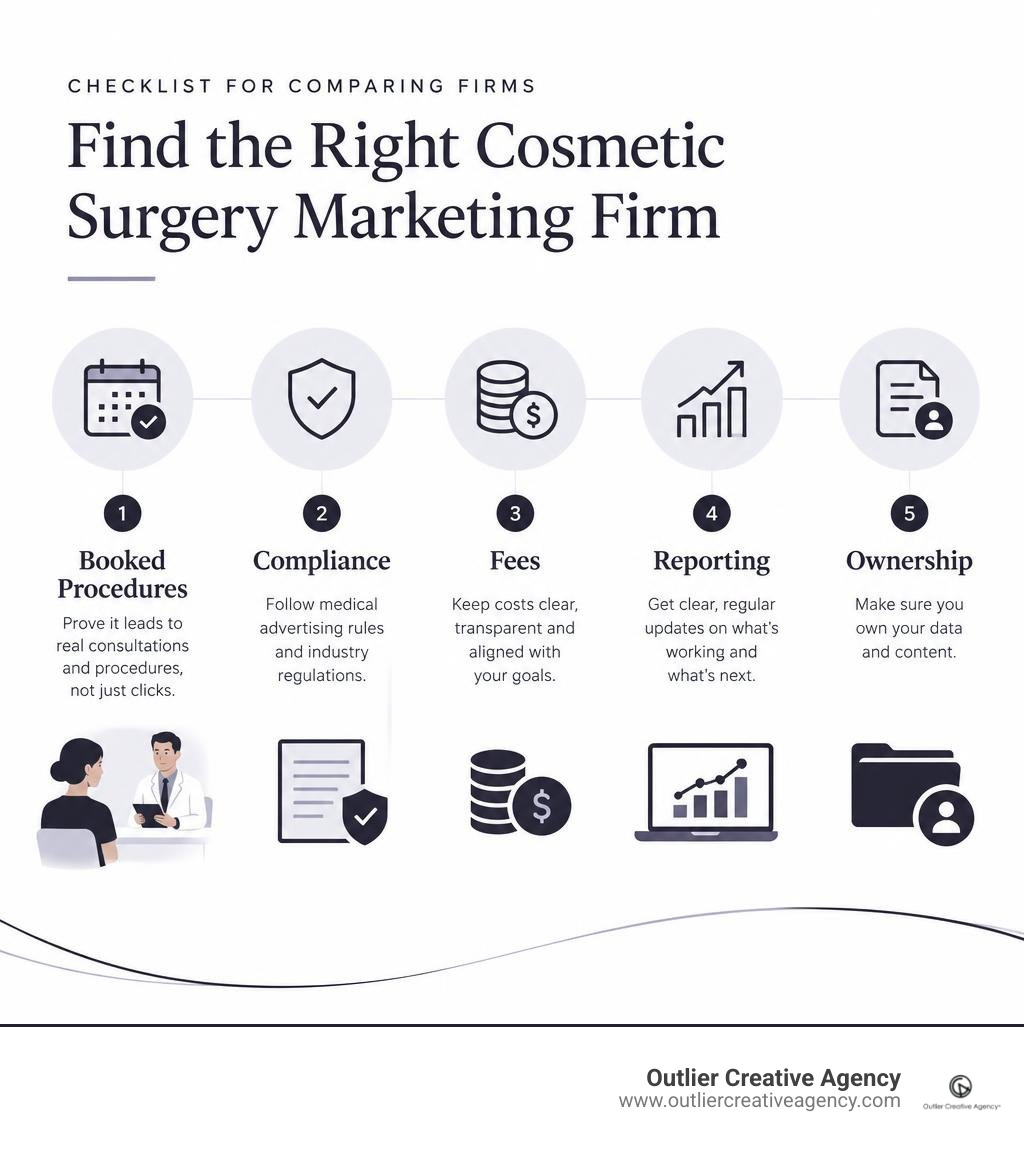
Choose a cosmetic surgery marketing firm that can show how its work leads to booked consultations and procedures, not just clicks or inquiries. Ask each firm how it handles procedure-specific search, paid ads, website conversion, patient follow-up, and medical advertising rules. Compare its fees, reporting, data ownership, and policy on working with nearby practices before you sign.
A strong proposal should fit your procedure mix and account for the time patients need to research a surgeon. It should also show who is responsible for turning an inquiry into a consultation.
I’m Corey Larson. My work at Outlier Creative Agency focuses on content and digital media for law firms, and I bring that experience in clear communication and lead generation to this guide on choosing a cosmetic surgery marketing firm.
Cosmetic Surgery Patient Search Behavior and Market Demand
Today's elective healthcare consumer behaves very differently than a traditional medical patient. Current industry data reveals that 88% of prospective patients under age 50 and 60% of those over 50 search online to evaluate aesthetic surgeons and specific operations before scheduling an initial consultation. Furthermore, 84% of individuals research healthcare facilities online prior to booking, and 90% use social media to evaluate health and wellness decisions.
Aesthetic surgery represents a high-consideration, personal investment. Surgical patients typically deliberate for 6 to 18 months before scheduling a consultation. During this prolonged research phase, 91% of prospective patients read online reviews, while 76% base their selection on media credibility and perceived clinical authority.
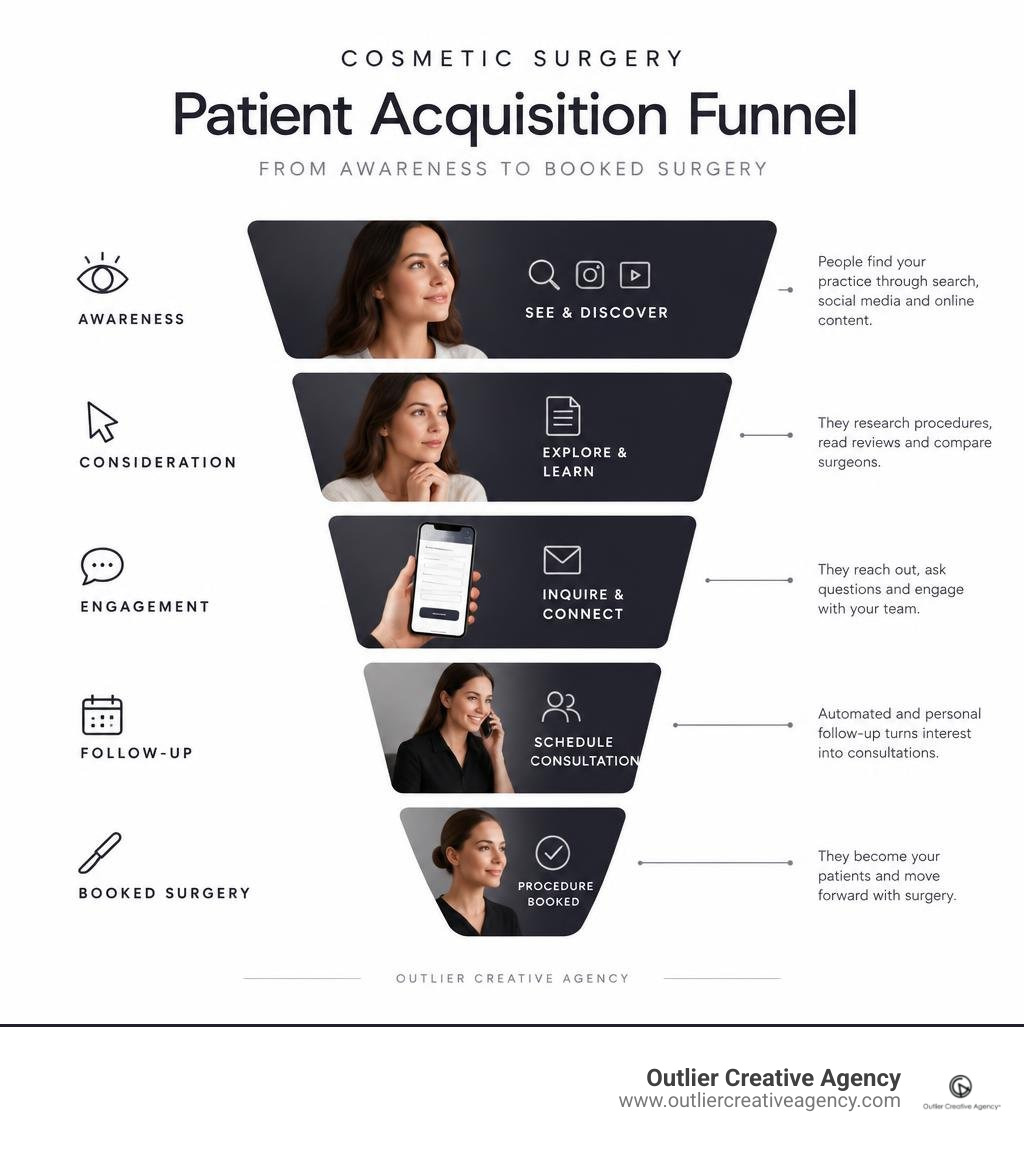
In competitive hubs like Los Angeles and Austin, capturing high-intent inquiries requires an integrated plastic surgery marketing engine. Converting qualified traffic into surgical cases demands more than raw website traffic. It requires strategic brand positioning, intuitive digital pathways, and structured lead nurture systems.
Core Services Offered by a Leading Cosmetic Surgery Marketing Firm
A dedicated aesthetic growth agency builds an ecosystem where every marketing channel reinforces the others. Rather than managing isolated campaigns, top firms integrate organic discovery, paid acquisition, high-converting digital assets, and automated nurture sequences to attract qualified patients.
Procedure-Driven Search Visibility and Conversion-Focused Web Architecture
Organic search remains the foundation of sustainable elective patient acquisition. To capture patients actively seeking procedures such as deep plane facelifts, rhinoplasty, breast augmentation, or mommy makeovers, agencies must deploy comprehensive Medical SEO strategies.
Effective search marketing for aesthetic practices focuses on structured keyword clusters organized around patient intent. This involves building dedicated procedure landing pages that thoroughly answer clinical questions, break down surgical techniques, explain candidate criteria, and address recovery timelines.
A high-performing website must pair deep content with sophisticated technical architecture. Contemporary medical web design incorporates intuitive navigation, swift load times, and frictionless mobile booking flows.
Before-and-after photo galleries are critical for aesthetic conversion. In fact, an optimized website with seamless before-and-after galleries can convert up to five times more prospective patients than an outdated web presence. Galleries must feature high-resolution, unedited imagery categorized by procedure, patient anatomy, and surgical approach, providing social proof while adhering to medical advertising guidelines.
High-Intent Paid Patient Acquisition and Cross-Channel Funnels
While organic search builds long-term equity, targeted paid advertising provides immediate visibility for high-value surgical cases. A specialized agency runs precision campaigns across Google Search and Meta platforms (Instagram and Facebook), where 70% of aesthetic patients actively follow practices.
Paid search captures users exhibiting direct commercial intent, such as searching for local specialists or procedure costs. Simultaneously, Meta platforms deliver targeted visual storytelling, video case studies, and brand messaging. In elective surgery marketing, typical paid advertising campaigns generate qualified cost-per-lead (CPL) benchmarks ranging between $60 and $150, depending on the specific procedure and local market competition.
Top agencies combine performance advertising with authority-building media initiatives. Securing earned placements and media features establishes credibility, helping practices attract discerning patients while supporting strong campaign conversion rates. When paired with high-impact video storytelling and clinical video assets developed through professional medical production, practices turn standard ad campaigns into predictable patient acquisition funnels managed via strategic medical PPC.

Evaluating Agency Models: Specialist vs. Generalist Partners
Choosing between a generalist digital agency and a specialized aesthetic marketing firm often determines whether a practice experiences predictable growth or wasted marketing spend.
| Feature / Capability | Specialized Aesthetic Firm | Generalist Marketing Agency |
|---|---|---|
| Clinical Comprehension | Understands anatomical terms, surgical nuances, and recovery processes | Uses generic consumer marketing terminology |
| Regulatory Compliance | Deep familiarity with HIPAA, state medical boards, and FTC guidelines | Limited awareness of medical privacy and advertising rules |
| Patient Psychology | Tailored to long consideration cycles (6 to 18 months) | Optimized for short, transactional consumer impulse buys |
| Asset Strategy | Standardized systems for compliant before-and-after galleries | Generic stock photography and non-compliant imagery |
| Conversion Tracking | Measures booked consults, show rates, and surgical revenue | Measures clicks, impressions, and top-of-funnel form fills |
Key Differences When Hiring a Specialized Cosmetic Surgery Marketing Firm
Aesthetic surgery is an intimate, high-stakes medical specialty. Generalist agencies often treat a surgical consultation like a typical consumer purchase, focusing on immediate lead generation rather than cultivating trust.
Specialized agencies understand surgical terminology and patient concerns. They know how to address fears about anesthesia, explain scarring protocols, and articulate why a surgeon's specific technique produces superior results. This clinical understanding allows the agency to craft authentic Medical Branding that resonates with prospective patients seeking exceptional surgical outcomes.
Establishing luxury brand positioning and deep patient trust directly impacts a practice's pricing power and long-term loyalty.
Surgical Procedures vs. Non-Surgical Med Spa Service Marketing
A primary reason generalist marketing fails in aesthetic practices is the inability to distinguish between surgical procedures and non-surgical med spa treatments.
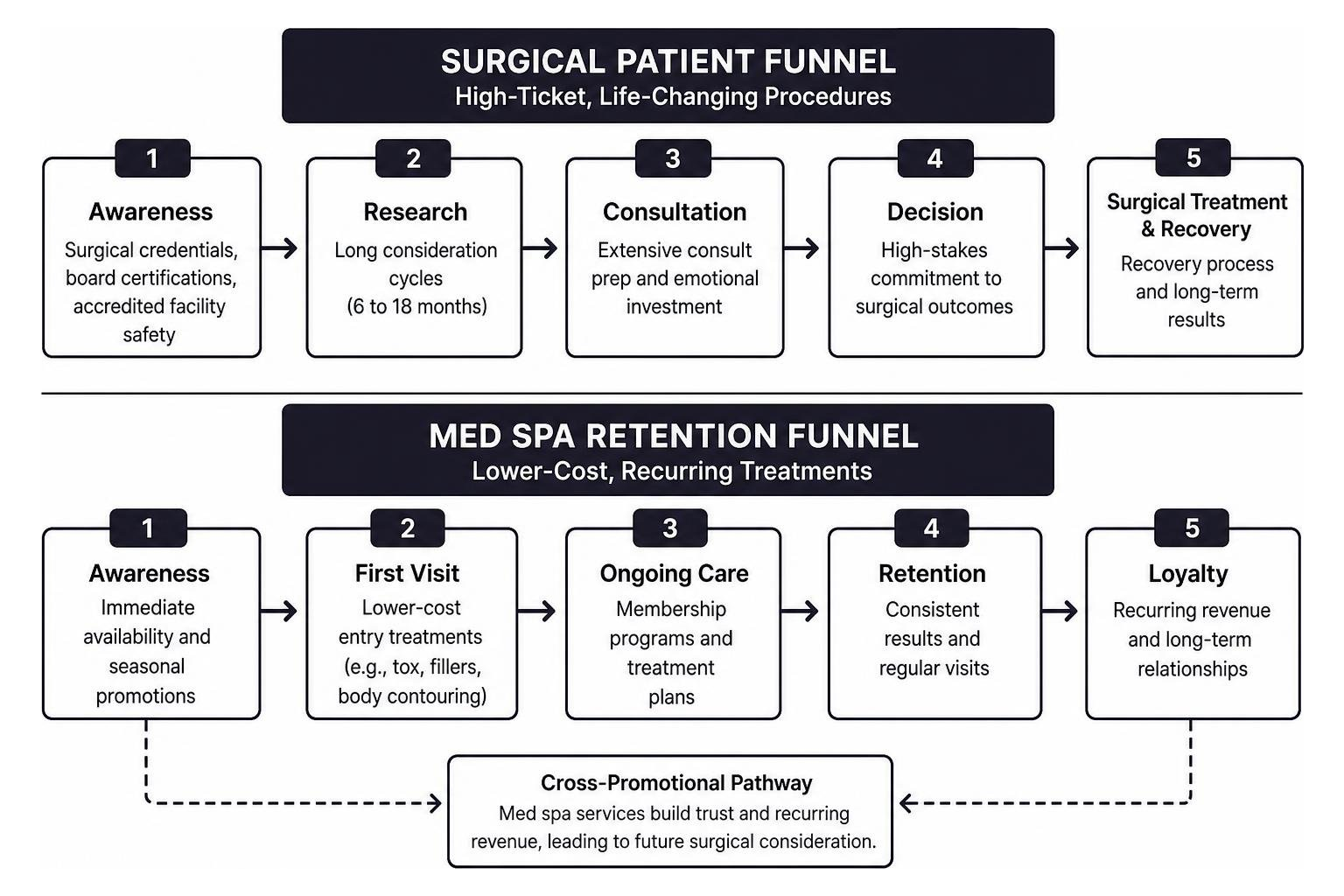
Surgical marketing targets high-ticket, life-changing procedures ranging from $8,000 to over $30,000. These procedures involve extended research cycles, extensive consultation prep, and significant emotional investment. Marketing must emphasize surgical credentials, board certifications, accredited facility safety, and long-term aesthetic outcomes.
Conversely, non-surgical med spa marketing centers on lower-cost, recurring treatments such as neurotoxins, dermal fillers, and body contouring. The sales cycle for med spa treatments is shorter, driven by immediate availability, seasonal promotions, and membership programs.
Experienced agencies build separate yet complementary funnels for both segments. They use med spa services to build recurring revenue while creating natural cross-promotional pathways for patients who may eventually seek surgical procedures, an approach we regularly implement in Texas Med Spa Marketing based on our Med Spa Search Demand 2026 Research.
Essential Criteria for Selecting an Aesthetic Growth Partner
When evaluating potential growth partners, practice directors and surgeons should focus on operational infrastructure, compliance standards, and commercial transparency.

Revenue Attribution, CRM Integration, and Lead Conversion Infrastructure
A lead is merely an inquiry; practice success depends on booked procedures. In high-performing elective practices, a standard conversion benchmark follows a clear trajectory: out of every 10 qualified inquiries, approximately 5.2 should convert into scheduled consultations, with about 1.1 completing a surgical procedure.
Top marketing agencies do not stop at delivering raw inquiries. They integrate conversion infrastructure directly with your practice management software and Electronic Medical Record (EMR) systems.
A dedicated lead management platform ensures prospective patient inquiries receive immediate, automated follow-up via two-way SMS and email nurture sequences. Implementing structured Medical Email Marketing nurtures undecided prospects, delivers educational procedure guides, tracks consultation attendance, and re-engages dormant leads to maximize conversion rates.
Regulatory Compliance, HIPAA Data Security, and Asset Ownership
Medical marketing carries strict legal, ethical, and regulatory obligations. Any firm managing patient inquiries or digital marketing assets must operate with comprehensive compliance protocols:
- Business Associate Agreements (BAA): The agency must execute a formal BAA to legally handle protected health information (PHI) collected through web forms, call tracking, and CRM systems.
- Patient Privacy and Consent: Practices must secure explicit, documented patient consent before publishing before-and-after photographs or video testimonials across digital platforms.
- Advertising Guidelines: Marketing creative and claims must comply with the Federal Trade Commission guidance on endorsements, detailed in the eCFR :: 16 CFR Part 255 -- Guides Concerning Use of Endorsements and Testimonials in Advertising, as well as state medical board regulations prohibiting outcome guarantees or deceptive imagery.
- Asset and Data Ownership: Your practice must retain 100% legal ownership of your website domain, custom code, creative assets, CRM patient data, and native ad accounts (Google Ads and Meta Business Manager). Avoid agencies that hold ad accounts or website properties in proprietary networks, which can trap your historical data.
Budget Expectations, Pricing Models, and Campaign Timelines for a Cosmetic Surgery Marketing Firm
A comprehensive digital marketing program for an aesthetic surgery practice requires realistic capital allocation. In major metropolitan markets, professional marketing retainers generally range from $5,000 to $15,000 per month, depending on market competition, practice size, and scope of services.
Ad spend is allocated separately and typically ranges from $3,000 to over $20,000 per month, directly aligned with procedure revenue targets.
Standard agency pricing models and deliverable frameworks generally include:
- Fixed Monthly Retainer: A predictable monthly fee covering ongoing SEO, content generation, ad campaign management, conversion rate optimization, and technical maintenance.
- Hybrid Retainer plus Ad Spend Management: A base management fee paired with a percentage of managed advertising spend, providing dedicated campaign optimization and split-testing.
- Core Deliverable Baselines: Top-tier partnerships deliver custom landing page architecture, continuous multi-channel attribution reporting, HIPAA-compliant lead tracking, and regular strategic reviews to assess procedure acquisition costs and return on investment.
Selecting the Right Aesthetic Growth Partner
Expanding a premier aesthetic surgery practice requires moving beyond superficial vanity metrics. Achieving sustainable, high-margin revenue demands a sophisticated patient acquisition framework that respects clinical nuance, complies with healthcare regulations, and converts prospective patients across their entire decision journey.
At Outlier Creative Agency, we design high-converting growth systems for elective medical practices and high-stakes legal firms nationwide. By combining surgical-level search visibility, targeted paid patient acquisition, and closed-loop revenue tracking, our dedicated strategies help top aesthetic surgeons dominate their local markets and consistently fill their operative calendars.
If you are ready to evaluate your current marketing performance and explore a strategic growth partnership, we invite you to schedule a consultation with our team.
Frequently Asked Questions About Aesthetic Practice Growth
How long does it take to see measurable results from plastic surgery SEO and paid ads?
Paid advertising campaigns on Google and Meta platforms generate immediate search visibility and can deliver qualified patient inquiries within the first two to four weeks of launch.
In contrast, organic SEO and local map pack optimization build compounding authority over time. Practices typically observe measurable keyword ranking improvements, traffic increases, and organic consultation growth within three to six months. Highly competitive geographic markets like Los Angeles or Austin often require sustained optimization over 6 to 12 months for top-tier competitive procedure terms.
What questions should a surgeon ask before signing an agency contract?
Before executing an agency partnership, practice leaders should ask these fundamental operational questions:
- Will our practice retain complete ownership of our website, code, ad accounts, and analytics data if we part ways?
- Do you execute a formal HIPAA Business Associate Agreement (BAA) prior to campaign launch?
- How do you track inquiries past initial submission to verify consultation attendance and surgical bookings?
- Do you offer month-to-month agreements or require long-term lock-in contracts?
- Can you share live examples and case studies from aesthetic practices operating in competitive markets?
How do marketing agencies handle market exclusivity and competing local practices?
Reputable aesthetic marketing agencies maintain clear conflict-of-interest and exclusivity policies. A dedicated agency typically limits its engagements to one plastic surgery practice within a defined geographic radius or primary market territory.
This exclusivity ensures the agency is not bidding against itself on paid search keywords or dividing organic optimization efforts between direct local competitors. Always verify territory boundaries in writing before signing an agreement.