

Learn strategic keyword research for lawyers to attract high-value cases with proven tactics for search intent, local SEO, and content optimization.
How to Find Legal Keywords That Bring in Better Cases
For keyword research for lawyers, start with the cases your firm wants. List the words clients use to describe those problems, then add the places you serve. Sort the terms by intent: put questions in helpful guides and searches for an attorney on practice-area pages. Check the search results to see what already ranks, then track which pages bring in qualified inquiries.
A broad term may draw traffic without bringing the right cases. A specific search, such as “car accident lawyer near me,” can tell you more about what the person needs and whether your firm is a good fit.
I’m Corey Larson, and at Outlier Creative Agency I work with legal experts to create content and websites for law firms. That experience shapes my approach to keyword research for lawyers: use client language, focus on relevant cases, and measure the inquiries that follow.

Why Strategic Keyword Research Dictates Law Firm Growth in 2026
Search engine visibility serves as the digital front door for modern practices. Managing partners and marketing directors often believe that ranking for any broad legal term will automatically yield signed contingency agreements or substantial retainers. However, winning in organic search requires understanding the shift in modern legal consumer behavior.
Prospective clients facing severe personal injury events, complex business disputes, or family matters do not browse the web casually. They use search engines to solve urgent problems. When your firm prioritizes data-backed search terms, you align intake capacity with high-value case acquisition. As highlighted in research on the power of keyword research for law firms, targeting qualified queries forms the bedrock of sustainable practice growth.
Modern digital marketing for attorneys must account for state bar advertising rules while capturing qualified leads. Bar associations in major jurisdictions like California and Texas heavily scrutinize digital messaging. Misleading promises, unjustified expectations of case outcomes, and deceptive search targeting can quickly lead to ethics inquiries. Structuring your keyword strategy properly ensures that your practice attracts qualified clients while staying entirely compliant with state advertising standards.
To capture these high-value cases, your practice must treat search queries as a direct reflection of client decision-making.
Understanding Client Search Intent vs. Search Volume
Search volume indicates how many times users type a specific phrase into Google each month. It does not measure how many of those users intend to hire an attorney. Evaluating search intent separates costly vanity traffic from actual retained cases.
We categorize search queries into distinct intent stages:
- Informational Intent: The searcher seeks answers to questions or wants to understand legal rights (e.g., "what is comparative fault in California").
- Commercial Investigation: The user evaluates options, compares firms, or seeks reviews (e.g., "best personal injury lawyer in Los Angeles").
- Transactional Intent: The individual is actively seeking immediate representation (e.g., "hire truck accident attorney Austin").
- Navigational Intent: The user searches for a specific attorney or firm name to find contact details.
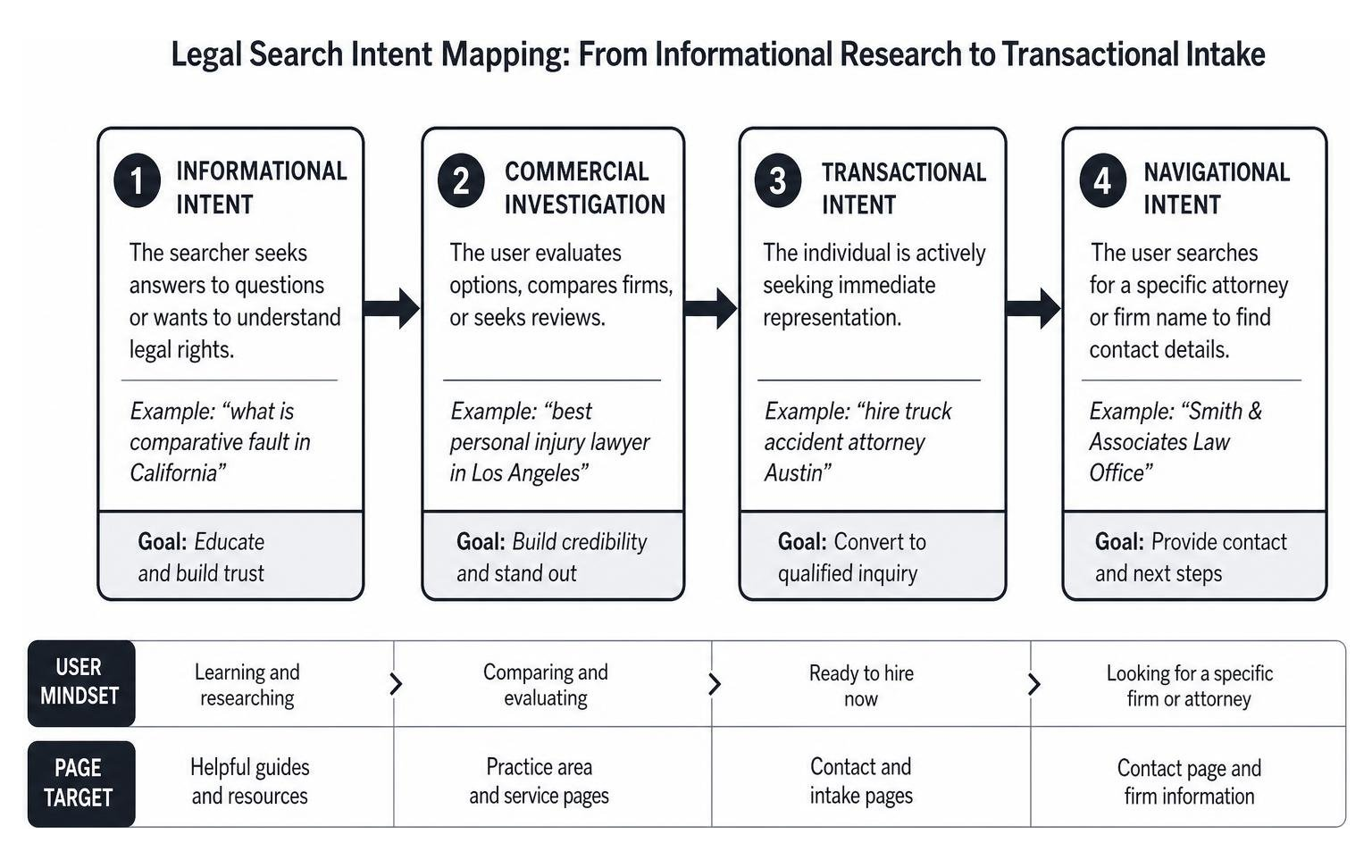
Focusing exclusively on high-volume phrases is a common trap. A search query with 5,000 monthly searches might consist of students researching statutes. Conversely, a phrase with 70 monthly searches, such as "spinal cord injury lawyer Austin TX," represents individuals who urgently require direct representation. Proper keyword research for law firms prioritizes commercial and transactional terms on primary practice pages, reserving informational phrases for authoritative guides.
Short-Tail vs. Long-Tail Search Terms for Legal Practices
Short-tail keywords are broad phrases of one to three words, such as "car accident lawyer" or "litigation attorney." These terms boast massive search volume, fierce competition, and exorbitant pay-per-click costs. However, they frequently generate lower organic conversion rates because the searcher's exact circumstance remains undefined.
Long-tail keywords contain four or more words and represent highly specific situations. Industry data demonstrates that 70 percent of Google searches involve a long-tail keyword. These queries allow specialized practices, like catastrophic injury or commercial litigation firms, to capture high-intent users with far lower competition.
| Keyword Metric | Short-Tail Legal Keywords | Long-Tail Legal Keywords |
|---|---|---|
| Example Query | "Injury lawyer" | "Commercial truck rear end collision attorney" |
| Search Volume | Very High | Low to Moderate |
| Keyword Difficulty | 80–100 (Extremely Competitive) | 15–45 (Attainable) |
| Client Search Intent | Broad, ambiguous | Specific, urgent, ready to hire |
| Average Conversion Rate | 1% – 3% | 8% – 15%+ |
| Target Page Type | Homepage, Top-level Practice Hub | Specific Service Page, Sub-practice Guide |
Targeting niche litigation through long-tail queries ensures your firm spends resources attracting cases that match your ideal fee structures and expertise.
Step-by-Step Keyword Research for Lawyers to Uncover High-Intent Queries
Uncovering queries that yield signed cases requires a repeatable, structured framework. You must map your core revenue-generating services before opening any software tool.
- Inventory High-Yield Practice Areas: Identify the exact case types that generate your firm's strongest margins, such as traumatic brain injury, rideshare accidents, or wrongful death.
- Collect Intake Phrasing: Review actual intake logs and call recordings. Note the raw phrasing clients use instead of formal legal jargon. For instance, clients search for "hit by semi truck" rather than "interstate commercial carrier liability."
- Generate Seed Keyword Lists: Combine core case types with client language and primary service regions.
- Evaluate Search Metrics: Filter terms through research tools to assess difficulty, search volume, and traffic potential.
- Cluster Keywords by Intent: Group related queries into single topics to prevent keyword cannibalization across your site.
When structuring a campaign for personal injury SEO, your keyword clusters should directly dictate site architecture. This ensures every landing page addresses a distinct legal problem without competing against other pages on your domain.
Essential Free and Paid Tools for Keyword Research for Lawyers
Executing a professional legal keyword strategy relies on specialized platforms to analyze search volume, ranking difficulty, and cost-per-click values.
- SEMrush: Widely regarded across the search marketing industry, surveys indicate that 61% of experts consider SEMrush their primary keyword research tool of choice. It offers extensive competitor gap analysis and accurate local search volume data.
- Ahrefs: Exceptional for analyzing backlink authority requirements and uncovering question-based queries across specialized practice niches.
- Google Keyword Planner: A free Google Ads tool that provides geographic search volume ranges and bidding competition benchmarks.
- Google Search Console: An essential, free platform displaying the actual queries bringing users to your law firm's site, including impressions, average position, and click-through rates.
- Google Trends: Useful for identifying emerging legal topics, class action queries, and seasonal search variations.
Evaluating Competitor Rankings to Uncover Content Gaps
Law firms do not operate in an isolated search ecosystem. Top-ranking competitors in your market have already validated search demand for specific terms. Conducting a competitor keyword gap analysis allows you to pinpoint high-value queries your competitors rank for that your website currently ignores.

Review the top three organic competitors across your primary metropolitan markets. Identify pages where rivals hold positions four through ten on Google. These middle-ranking pages often suffer from thin content or poor technical structure. By identifying these gaps, your practice can build comprehensive, authoritative landing pages that quickly claim market share.
For dedicated legal practices seeking to expand caseloads, reviewing our specialized personal injury marketing solutions provides a clear roadmap for executing these competitive gap strategies, supported by our core law firm SEO services.
Dominating Local Search with Geo-Targeted Legal Keywords
Legal services are fundamentally local. Prospective clients look for representation licensed in their specific jurisdiction, familiar with local courts, and accessible for consultations.
Research shows that 85% of American adults have a smartphone, which drives massive daily mobile search activity for immediate legal help. Mobile users frequently trigger Google's local three-pack map results when searching for legal representation nearby.
Capturing these high-intent local users requires pairing your core service keywords with geographic modifiers. Your local SEO foundation relies on optimizing your Google Business Profile (GBP) alongside dedicated geographic landing pages on your website.
Building a Service-by-Location Keyword Matrix
To capture traffic across surrounding suburbs and neighboring cities, build a service-by-location keyword matrix. This matrix prevents arbitrary content creation and ensures thorough regional coverage.
| Primary Practice Area | Core Geo-Modifier (City) | Secondary Geo-Modifier (County/Neighborhood) | High-Intent Local Target Query |
|---|---|---|---|
| Car Accidents | Los Angeles | Downtown LA / Century City | "car accident lawyer downtown los angeles" |
| Truck Collisions | Austin | Travis County | "austin commercial truck accident attorney" |
| Wrongful Death | Los Angeles | San Fernando Valley | "wrongful death lawyer san fernando valley" |
| Motorcycle Accidents | Austin | Round Rock / Central Texas | "motorcycle injury attorney travis county" |
When targeting broad metropolitan hubs, our specialized regional guides on Los Angeles SEO for lawyers and Austin law firm SEO explain how to navigate hyper-local search competition effectively.
"Near me" queries (such as "injury attorney near me") are governed primarily by the user's physical proximity and Google Business Profile optimization signals. You do not need to unnaturally insert "near me" into your page prose; focus your written content on explicit city, county, and neighborhood modifiers.
On-Page Content Optimization and Natural Keyword Placement
Once you finalize target terms, you must integrate them seamlessly into your site's content hierarchy. Historically, agencies packed target phrases repeatedly into footers and white text. Today, these outdated tactics violate search engine guidelines and damage user trust.
Search engines evaluate topical authority, natural phrasing, and user engagement metrics. Adhering to ethical SEO standards ensures your site builds enduring domain authority without risking search penalties. The objective is to produce readable, authoritative copy that answers prospective client questions while signaling exact relevance to search crawlers.
Strategic Keyword Placement in Headings, Metadata, and Body Copy
Search engine algorithms place varying weight on different on-page elements. Distribute your primary and secondary keywords strategically across your page architecture:
- Title Tag: Place your primary keyword close to the beginning, paired with a compelling hook and firm branding (e.g., "Austin Truck Accident Lawyer | Dedicated Injury Advocates | Firm Name").
- Meta Description: Write a clear, 150-to-160-character summary that features the primary term and an action-oriented invitation to schedule a consultation.
- H1 Heading: Include the primary transactional keyword clearly, confirming to the user that they have landed on the correct resource.
- H2 and H3 Subheadings: Integrate long-tail variations, related sub-topics, and question-based phrases to capture secondary featured snippets.
- First 100 Words: Introduce the core legal topic immediately in plain English to establish context.
- Body Copy: Weave secondary phrases, statutory concepts, and practical advice naturally throughout the text.
- Image Alt Text: Describe visual elements accurately while incorporating geographic or service modifiers where contextually appropriate.
To see how specialized practices structure these assets, reference our insights on family law marketing for actionable layout frameworks.
Adapting to Future Search Trends and Continuous Performance Tracking
Search engine algorithms constantly evolve to reward comprehensive, authoritative resources. A keyword strategy finalized today must adapt to changing search patterns, statutory updates, and platform advancements.
To maintain ranking dominance, managing partners must implement ongoing performance tracking rather than treating search optimization as a one-time project. Analyzing our comprehensive law firm SEO case study shows that long-term caseload growth stems from consistent quarterly refinement and data-driven updates.
Integrating AI and Voice Search into Keyword Research for Lawyers
The rise of artificial intelligence search overviews and voice-activated digital assistants has shifted user queries toward conversational, question-based patterns. Clients speaking into smartphones frequently ask complete questions, such as, "How long do I have to file a motorcycle crash claim in Texas?"
To capture voice and AI-driven search traffic:
- Target Conversational Query Structures: Structure subheadings as direct, plain-English questions.
- Provide Immediate Answers: Deliver a clear, two-to-three sentence summary directly below question headers before expanding into complex legal nuance.
- Incorporate Real Intake FAQs: Document the recurring questions received by your receptionist and intake coordinators. These real-world inquiries mirror exact search phrases used in conversational search platforms.
Tracking Keyword Rankings and Measuring Caseload Impact
Search engine rankings serve as leading indicators, but retained cases dictate true return on investment. Tracking keyword performance requires looking beyond average position metrics to measure bottom-line financial impact.
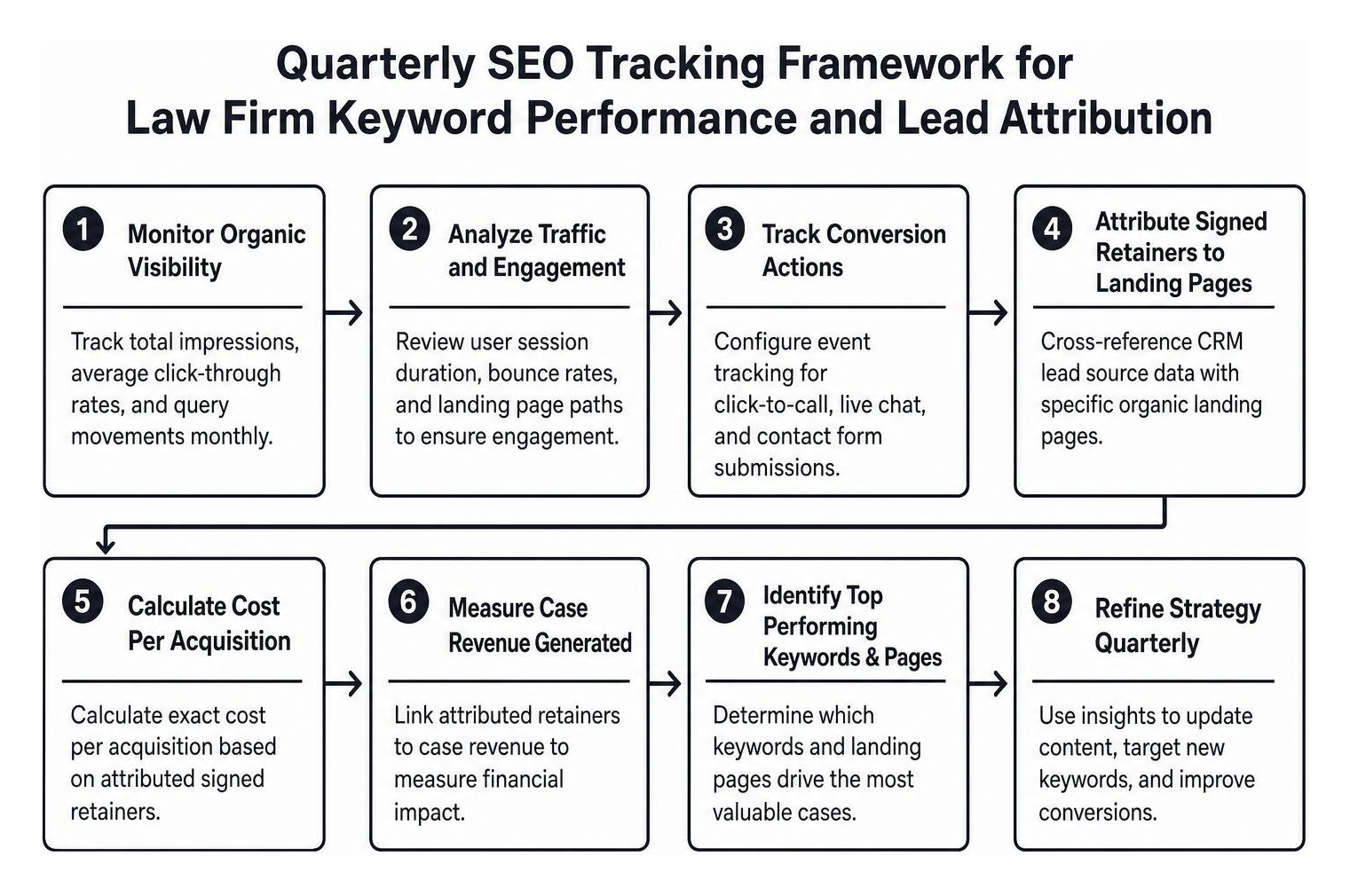
- Monitor Organic Visibility in Google Search Console: Track total impressions, average click-through rates, and query movements monthly.
- Analyze Traffic and Engagement in Google Analytics 4: Review user session duration, bounce rates, and landing page paths to ensure incoming traffic engages with your practice pages.
- Track Conversion Actions: Configure event tracking for click-to-call phone numbers, live chat engagements, and contact form submissions.
- Attribute Signed Retainers to Landing Pages: Cross-reference CRM lead source data with specific organic landing pages to calculate exact cost per acquisition and case revenue generated.
Conclusion
Securing steady caseload growth in competitive legal markets requires moving past generic keyword lists. By aligning practice areas with specific search intent, targeting localized long-tail phrases, and maintaining clean on-page execution, your firm can build an organic acquisition channel that consistently attracts high-value cases.
At Outlier Creative Agency, we build data-driven marketing systems that help elite law firms dominate search results and scale their caseloads. If you are ready to evaluate your firm's organic presence and discover untapped keyword opportunities in your market, explore our tailored legal marketing services and book a strategic consultation with our team today.
Frequently Asked Questions About Legal Keyword Research
How often should law firms update their target keyword lists?
Law firms should conduct a comprehensive keyword audit quarterly. While core practice area terms remain relatively stable, search algorithms, regional competitor activity, and emerging legal topics shift continuously. Regular reviews allow you to capture new conversational search queries and address declining positions before traffic drops.
What is the most common keyword research mistake attorneys make?
The most frequent mistake is prioritizing broad legal jargon over plain-language client phrasing. Attorneys often target formal statutory terms like "tort liability" or "subrogation" that peers recognize, rather than the practical, problem-focused terms prospective clients actually type into search engines when seeking immediate help.
How do law firms balance informational blog queries with transactional practice area pages?
Maintain clear separation between top-of-funnel informational topics and bottom-of-funnel transactional landing pages. Informational queries (e.g., "what happens after a slip and fall") should live on educational blog posts that link internally to transactional practice pages (e.g., "Los Angeles premises liability lawyer"). This structure educates the reader while guiding qualified leads directly toward scheduling a case evaluation.
How does search intent affect keyword selection for law firms?
Search intent separates costly vanity traffic from actual retained cases. A query with high monthly volume may attract students researching statutes, while a lower-volume phrase such as "spinal cord injury lawyer Austin TX" represents someone who urgently needs representation. Prioritize commercial and transactional terms on primary practice pages, and reserve informational phrases for authoritative guides.
What role do local keywords play in attracting qualified legal clients?
Local keywords connect your firm with prospective clients who need representation in a specific jurisdiction. Pairing core service terms with geographic modifiers, such as "car accident lawyer downtown Los Angeles," helps your practice appear in Google's local three-pack results and reach users who are ready to schedule a consultation with a nearby attorney.