

Master law firm AdWords with proven strategies that boost high-intent leads and maximize ROI for your practice.
Why Law Firm AdWords Is One of the Highest-Stakes Marketing Channels in 2026
Law firm AdWords campaigns are operating in the most expensive pay-per-click environment on the internet — and the stakes have never been higher.
Here's a quick answer to what you need to know:
| Question | Quick Answer |
|---|---|
| What is law firm AdWords? | Google Ads (formerly AdWords) lets law firms bid on search terms so their ads appear at the top of Google results when potential clients search for legal help |
| How much does it cost? | Legal keywords average $8.58 per click — the highest of any industry — with high-intent terms like "motorcycle injury lawyer" reaching $200+ per click |
| What's the ROI? | A well-run campaign can generate signed cases at $500–$8,000 per client depending on practice area |
| Who should use it? | Firms in high-intent practice areas: personal injury, criminal defense, DUI, bankruptcy |
| What's the alternative? | Google Local Services Ads (LSA) offer pay-per-lead pricing at lower cost, often 30–50% cheaper per lead |
| Biggest mistake? | Sending ad traffic to your homepage instead of a dedicated landing page |
In 2016, researchers found that 20 of the top 25 most expensive search terms on Google were from the legal industry. That wasn't a fluke — it reflects a simple economic reality. A single signed personal injury case can generate $50,000 or more in attorney fees. That kind of client lifetime value justifies aggressive bidding, which is why competitors keep pushing CPCs higher every year.
The result? A paid search environment where one mismanaged campaign can burn through $10,000 in weeks — but where a well-structured one can be your most profitable client acquisition channel.
This guide walks you through exactly how to build, budget, and optimize a legal PPC strategy that signs real cases, not just clicks.
I'm Corey Larson, and at Outlier Creative Agency I've worked directly with legal practices to cut through the noise on law firm AdWords — from crafting compliant ad copy to building landing pages that actually convert. Let's get into what separates the campaigns that sign cases from the ones that drain budgets.
Google Ads vs. LSA: How Do They Differ for Lawyers?
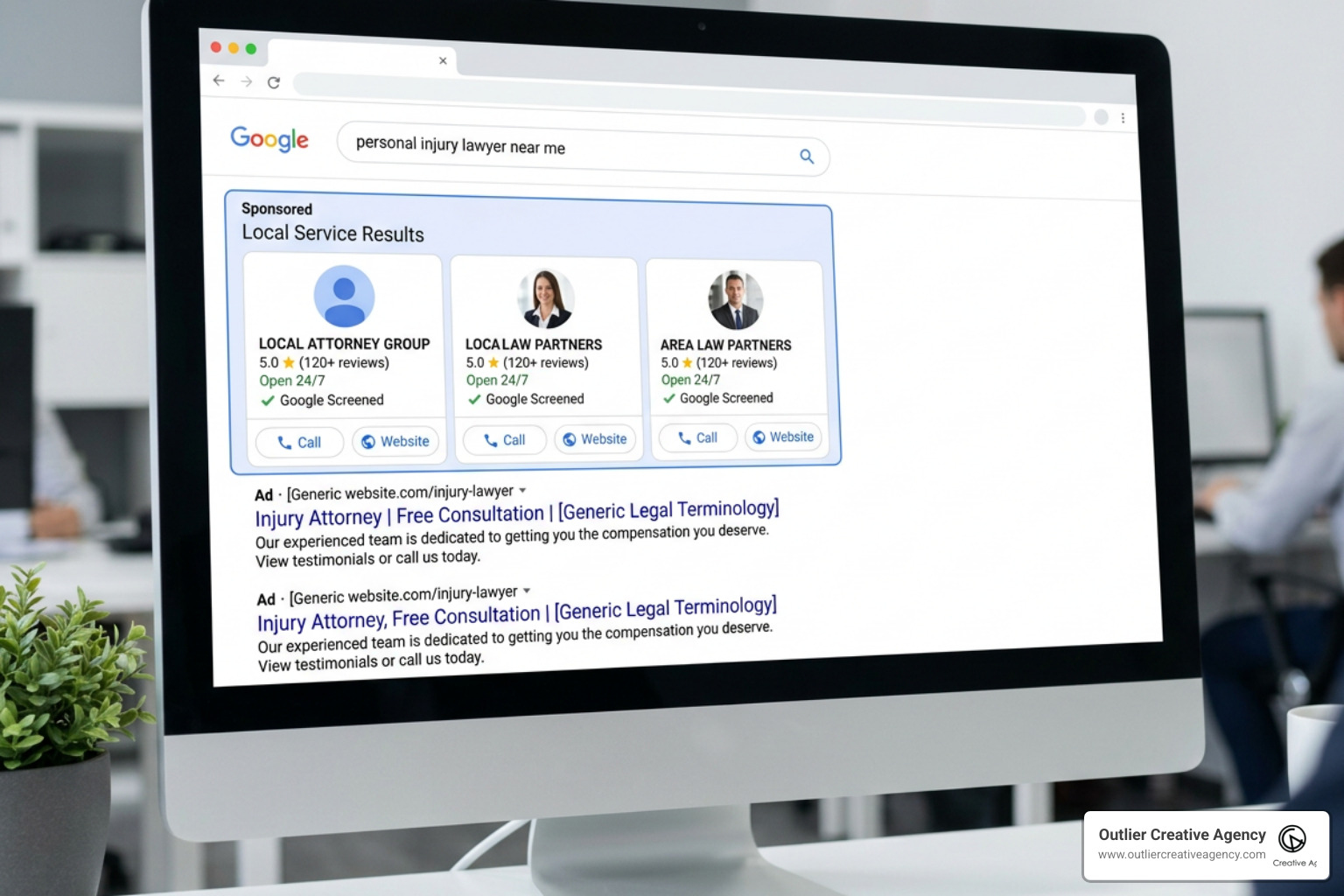
Many attorneys lump all Google advertising into one bucket. However, navigating the modern search engine results page (SERP) requires understanding the clear division between traditional Google Ads (formerly AdWords) and Google Local Services Ads (LSAs). Both are powerful lead generation channels, but they function on completely different models.
To build a balanced, comprehensive strategy, we often advise firms to combine both approaches. But before launching any campaign, it is vital to understand where your dollars are going and how each channel operates. For a deep dive into setting up your overall digital marketing footprint, explore our PPC Marketing Guide for Lawyers.
| Feature | Traditional Google Search Ads (AdWords) | Google Local Services Ads (LSA) |
|---|---|---|
| Payment Model | Pay-Per-Click (PPC) | Pay-Per-Lead (PPL) |
| Ad Placement | Directly below LSAs; highly customizable text | Absolute top of the page; features headshots |
| Trust Signals | Quality Score, ad extensions, customized copy | Google Screened badge, star ratings, background checks |
| Targeting Control | High (bids on specific keywords, match types) | Low (selects broad categories/practice areas) |
| Landing Page | Fully customized landing page | Google-hosted profile page |
| Setup Barrier | High (requires strategic copy, tracking, and design) | Medium (requires background checks and license verification) |
Understanding Traditional Law Firm AdWords Campaigns
Traditional Google Search Ads operate on the classic pay-per-click model. You bid on specific keywords (such as "car accident lawyer near me"), and Google runs an instant auction every time a user types that query.
The primary advantage of traditional search campaigns is unmatched control. We can write tailored ad copy that directly addresses a searcher's pain point, highlight specific firm victories, and direct users to a highly optimized, custom landing page. Furthermore, we can leverage quality score optimization to lower our actual cost-per-click (CPC) by ensuring a tight alignment between the search query, the ad copy, and the landing page experience.
Google Local Services Ads (LSA) vs. Google Search Ads
Google LSAs appear at the very top of the SERP, even above traditional search ads. Instead of a text ad, LSAs display the attorney’s headshot, firm name, star rating, and the trusted "Google Screened" badge.
Unlike AdWords, LSAs operate on a pay-per-lead model. You only pay when a prospect calls or messages your firm directly through the ad. However, LSAs offer very little creative flexibility; you cannot customize the copy or direct users to your website.
Additionally, LSAs carry a unique geographic threshold: Google typically requires at least three active, background-checked lawyers in the same practice area and market to display LSA results. If your market lacks enough participating attorneys, or if you do not have enough verified lawyers on your team, your LSA visibility may be limited.
Which Practice Areas Benefit Most from a Law Firm AdWords Strategy?
Not all legal practices are built equally when it comes to paid search. Because law firm adwords relies heavily on high-intent search queries, practice areas that address immediate, urgent crises perform exceptionally well. Conversely, relationship-driven practice areas often require a more nuanced approach.
When analyzing practice area suitability, we look at the client's search journey. Is the prospect experiencing an emergency that requires an immediate solution, or are they carefully evaluating options over several months?
For reference on how major regional firms structure their practice focus, you can look at established models like the Los Angeles - Law Offices of Snell & Wilmer .
High-Intent Practice Areas: Personal Injury, Criminal Defense, and Bankruptcy
High-intent, consumer-facing practice areas are the sweet spot for traditional Google Search campaigns. When a person is arrested, injured in a car wreck, or facing foreclosure, they do not ask their social network for recommendations—they go to Google to find immediate help.
- Personal Injury: Highly lucrative but fiercely competitive. Keywords like "car accident attorney" carry some of the highest CPCs in the industry, but the massive client lifetime value makes it incredibly profitable when managed correctly. For a step-by-step breakdown of managing these budgets, read our Personal Injury PPC Complete Guide 2026.
- Criminal Defense & DUI: These campaigns frequently generate high-quality phone calls outside of traditional business hours. In fact, our data shows that criminal defense leads peak significantly between 10 PM and 6 AM, making 24/7 call routing and automated bidding adjustments vital.
- Bankruptcy: Driven by high stress and the need for immediate relief, bankruptcy prospects search with transactional terms like "chapter 7 lawyer near me" and convert quickly on simple, reassuring landing pages.
Relationship-Driven Practice Areas: Corporate Law and Estate Planning
For relationship-driven practices, the client journey is longer and more deliberate. Sophisticated B2B buyers and families planning their estates rarely make hiring decisions on a single click.
- Corporate Law: B2B buyers search during business hours and primarily on desktop devices (mobile traffic accounts for only 35-45% of corporate searches compared to over 65% in consumer law). To capture these leads, campaigns must bid on highly specific, industry-focused transaction terms (e.g., "M&A attorney mid-market") rather than broad head terms like "business lawyer." Leading corporate firms, such as those working out of major business hubs like the Austin - Duane Morris LLP - Offices , rely on highly tailored messaging to signal deep, sector-specific capability.
- Estate Planning: While there is steady search volume for estate planning, many searchers are in the early, informational phase. To prevent wasting budget on searchers looking for "how to write a simple will," we must target decision-stage keywords like "trust administration attorney Austin" and leverage remarketing campaigns to stay top-of-mind.
Firms seeking to build a robust brand presence in competitive markets often pair their search campaigns with specialized legal marketing experts to ensure their offline and online marketing efforts are perfectly aligned.
How to Build a High-ROI Keyword, Bidding, and Budgeting Strategy
The single fastest way to burn through a legal marketing budget is to launch a campaign with broad keywords and unoptimized bidding. Because legal clicks are so expensive, you must treat every search query as a financial transaction.
To help small to mid-sized firms compete without breaking the bank, we developed the Affordable PPC for Lawyers Guide. The core of any high-ROI campaign lies in keyword discipline and smart bid management.
Mastering Match Types and Negative Keywords in Law Firm AdWords
Google offers three primary keyword match types: Broad Match, Phrase Match, and Exact Match. For law firms, Broad Match is a massive financial risk at launch. Bidding on the broad term personal injury lawyer can cause your ad to show for irrelevant queries like "free legal advice," "law school requirements," or "how to represent myself in court."
Instead, we recommend launching campaigns exclusively with Phrase Match (e.g., "car accident lawyer") and Exact Match (e.g., [car accident lawyer Austin]). This ensures your ads only appear when the searcher's query closely aligns with your target intent.
Equally important is building an aggressive negative keyword library. A robust legal campaign should launch with hundreds of negative keywords designed to filter out non-converting traffic.
- Geographic Negatives: Exclude cities, states, and neighborhoods outside your practice area.
- Employment Negatives: Exclude terms like "jobs," "careers," "salary," and "internship."
- Low-Intent Negatives: Exclude "free," "pro bono," "cheap," "court forms," and "law school."
Smart Bidding vs. Manual Bidding for Legal Campaigns
When launching a brand-new campaign, starting with Maximize Clicks or Manual CPC gives us absolute control over our initial spend, allowing us to gather baseline traffic data without Google's algorithms overspending on unproven terms.
However, once a campaign reaches a consistent conversion threshold—typically 30 conversions within a 30-day window—we transition to Google's machine-learning-driven Smart Bidding, such as Target CPA (Cost-Per-Acquisition). Smart Bidding analyzes hundreds of real-time signals (including device, location, time of day, and browser) to adjust bids dynamically, frequently reducing cost-per-lead by 20-30%.
What Do Google Ads Cost and How Do You Measure True Cost-Per-Case?

Understanding the financial metrics of your campaign is the difference between treating legal PPC as an expensive gamble or a predictable business investment. We must look past simple vanity metrics like impressions and clicks to focus on what truly matters: signed cases and revenue. For a complete blueprint on setting up these tracking systems, read our Law Firm PPC Analytics Guide 2026.
Average CPC and Cost-Per-Lead Benchmarks by Practice Area
Legal services carries the highest average cost-per-click of any industry on Google, with an overall average of $8.58. However, this average is heavily skewed by highly competitive practice areas and geographic markets.
- Personal Injury: Clicks routinely cost $75 to $250+ in highly competitive metros like Los Angeles and Austin. Landmark keywords like "mesothelioma settlement" historically set records at over $140 per click in 2012, and top mass tort terms can easily exceed $300 to $500 per click today.
- Criminal Defense & DUI: Average CPCs typically range from $50 to $150, with an average cost-per-lead (CPL) of $100 to $150.
- Family Law: Average CPCs range from $30 to $100, with a CPL hovering around $100 to $130.
- Estate Planning: Average CPCs run much lower at $15 to $50, with a CPL averaging $80 to $120.
Calculating Your True Cost-Per-Case (CPC)
To measure campaign success, we must calculate the exact cost to acquire a signed client. This requires tracking the prospect's journey from the initial ad click, through the consultation, to the signed retainer.
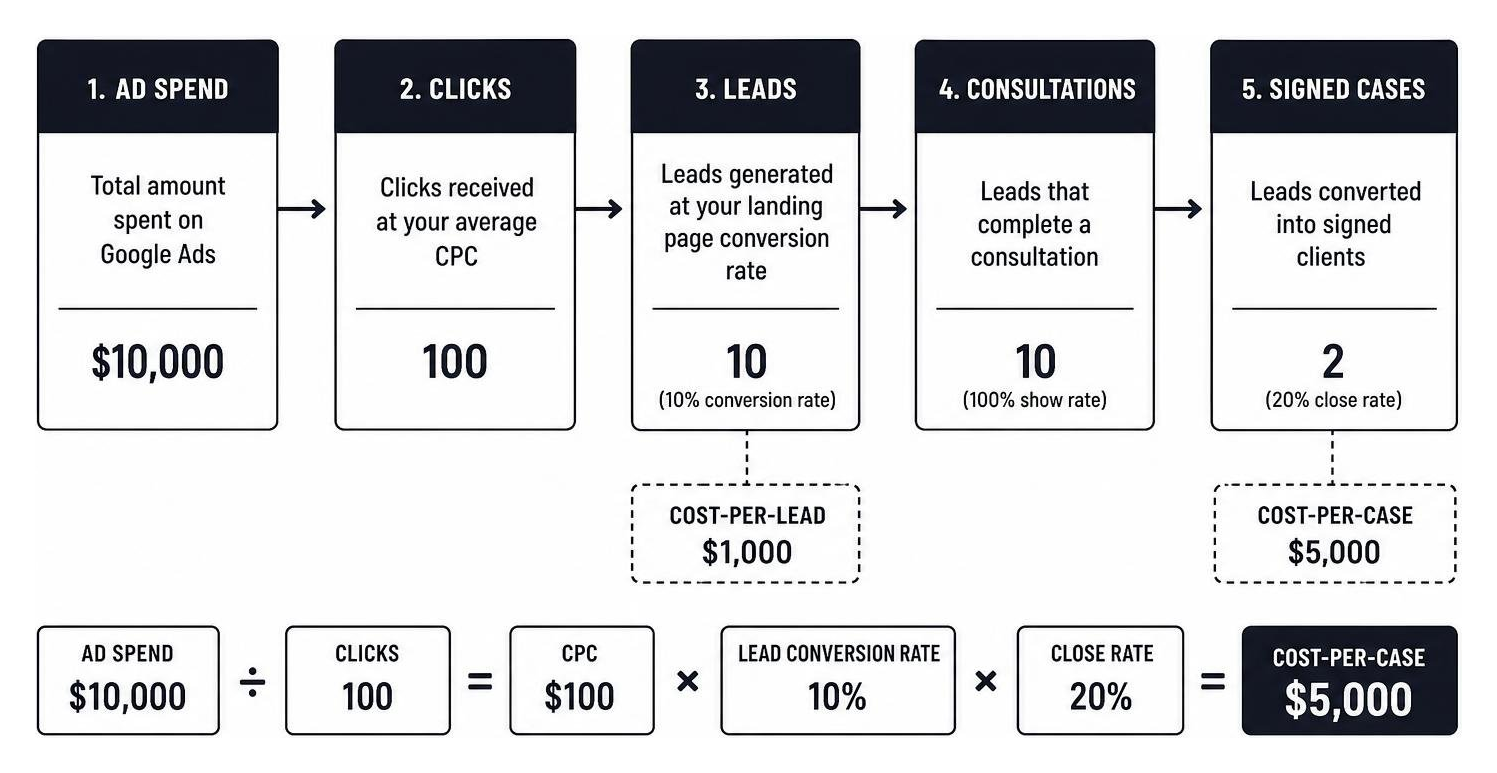
Let's look at the math for a typical personal injury campaign:
- Ad Spend: You spend $10,000 on Google Ads.
- Clicks: At an average CPC of $100, you receive 100 clicks.
- Leads: Your landing page converts at 10%, generating 10 leads (phone calls or form submissions). Your Cost-Per-Lead is $1,000.
- Signed Cases: Your intake team converts 20% of those leads into signed clients, resulting in 2 signed cases.
- Cost-Per-Case: Your actual client acquisition cost is $5,000 per signed case.
If those two cases result in average settlements of $30,000 each (generating $10,000 in attorney fees per case), your $10,000 ad spend has generated $20,000 in revenue—a highly profitable 2.0x Return on Ad Spend (ROAS). By connecting Google Ads directly to your law firm’s CRM (like Clio or Filevine), we can track this exact attribution loop automatically.
Landing Page and Conversion Tracking Best Practices
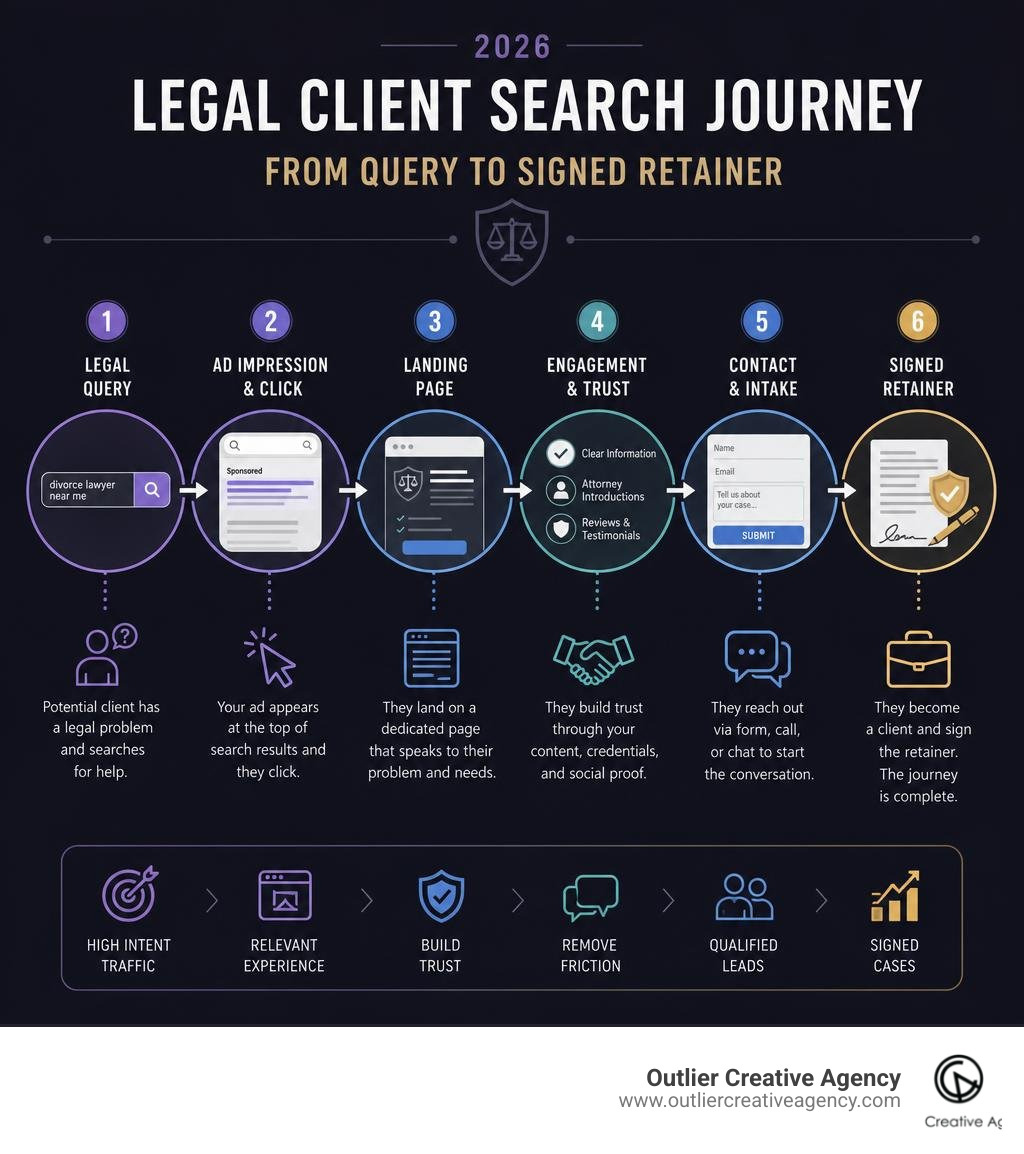
No matter how perfect your keyword strategy is, your campaign will fail if you send expensive paid traffic to a generic website. When a user clicks your ad, they should land on a page designed for one single purpose: converting their anxiety into a phone call or form submission. If you want to audit your current landing page performance, check out our Law Firm PPC Audit Guide 2026.
Designing High-Converting Legal Landing Pages
A high-converting legal landing page must be clean, fast, and highly persuasive.
- Above-the-Fold Trust Signals: Within the first three seconds, the user must see your firm's name, professional headshots, prominent badges (such as Super Lawyers or Avvo ratings), and a clear, compelling headline that matches the ad they clicked.
- Singular Call-to-Action (CTA): Do not distract users with links to your blog, social media, or full "About Us" pages. Keep the focus entirely on a prominent "Call for a Free Consultation" button and a short contact form (limited to 4-5 fields max).
- Mobile Optimization & Speed: Over 65% of legal searches occur on mobile devices. Your page must load in under 2.5 seconds (targeting a Core Web Vitals Largest Contentful Paint of under 2.5s) to prevent users from bouncing back to the search results.
- Live Chat Integration: Adding a 24/7 managed live chat feature to your landing page can boost total lead volume by 15% to 25%, especially for late-night searches.
Setting Up Call Tracking and CRM Integrations
To measure your campaign's true ROI, you must implement keyword-level call tracking. Using platforms like CallRail, we deploy Dynamic Number Insertion (DNI) on your landing pages.
DNI automatically swaps out the phone number displayed on your site based on the specific Google Ads keyword the visitor searched. When the user calls, the system attributes that call back to the exact ad campaign, ad group, and keyword that drove the click.
By integrating this call-tracking data directly with your CRM, your intake staff can log case outcomes and feed "signed case" data back into Google Ads as offline conversions. This teaches Google's AI exactly which keywords generate revenue, rather than just which keywords generate cheap clicks.
Ethical Compliance and Agency Management for Legal PPC
Legal marketing is heavily regulated, and running a successful campaign requires navigating strict state bar rules alongside complex technical platform management. To protect your firm's reputation and ensure maximum performance, working with a specialized Law Firm PPC Agency is often the safest path to scale.
State Bar Rules and Competitive Keyword Bidding Ethics
Bidding on a competitor's brand name as a keyword is a common practice in digital marketing, but it carries unique ethical and legal considerations for lawyers.
- Trademark Law: In the landmark Wisconsin case Habush Habush & Rottier v. Cannon & Dunphy, the court ruled that purchasing a competitor's name as a keyword is legally permissible under publicity rights, provided the competitor's name does not appear in the ad copy itself.
- State Ethics Opinions: While most states allow competitive keyword bidding, some jurisdictions have strict interpretations. For example, North Carolina's ethics opinions historically placed highly restrictive guidelines on competitive bidding, whereas states like California, Texas, and Florida focus heavily on preventing consumer confusion.
- Best Practices for Compliance: When bidding on competitor names, ensure your ad copy focuses strictly on your own firm's unique value proposition and does not mislead the consumer into thinking you are affiliated with the competitor. For assistance navigating these complex regional rules, consult with specialized legal counsel, such as the Best Los Angeles, California Advertising Lawyers .
Hiring a Legal PPC Agency vs. Managing Campaigns In-House
Because of the high cost of legal keywords, managing campaigns in-house without dedicated, certified PPC experts often leads to massive budget waste. When evaluating external agencies, look for partners that offer:
- Flat-Fee or Fixed-Rate Pricing: Agencies that charge a flat monthly fee (rather than a percentage of ad spend) have no incentive to artificially inflate your monthly budget.
- Full Account Ownership: Ensure that you own the Google Ads account, the landing pages, and all historical campaign data. If you ever part ways with the agency, you must be able to keep your account.
- Legal-Specific Specialization: Generalist agencies lack the pre-built legal negative keyword libraries and landing page templates needed to launch campaigns successfully from day one.
Frequently Asked Questions About Law Firm Google Ads
Is Google Ads worth it for small law firms?
Yes, but only if you use a highly focused strategy. A small firm with a modest budget (e.g., $3,000 to $5,000 per month) should avoid broad, high-competition keywords. Instead, focus on a tight geographic radius around your office, target specific niche practice areas, and use exact match keywords to capture high-intent local cases.
How long does it take to see results from a legal PPC campaign?
While Google Ads provide immediate search visibility, campaigns typically go through a 30-to-90-day optimization phase. During this initial window, we gather critical search term data, refine our negative keyword list, and build the conversion volume needed to transition safely to automated smart bidding.
Why did Google Ads charge me unexpectedly?
Unexpected charges typically occur due to Google's billing thresholds (charging you once you reach a certain spend level or at the end of the monthly billing cycle) or because of automatic targeting settings. If you do not manually disable settings like "Search Partners" or "Display Network expansion," Google may distribute your budget across low-converting partner sites.
Conclusion
Running a successful law firm adwords campaign in 2026 requires absolute precision, constant optimization, and a deep understanding of the legal client's search journey. When executed with the right keyword discipline, dedicated landing pages, and end-to-end CRM tracking, Google Ads remains one of the most powerful and predictable ways to scale your caseload.
At Outlier Creative Agency, we specialize in building high-ROI, ethically compliant paid search campaigns designed exclusively for law firms nationwide. If you are ready to stop paying for empty clicks and start signing high-value cases, explore our specialized PPC Services or book a consultation with our legal marketing experts today.