

Learn how to choose a personal injury marketing company with key questions on case acquisition, data ownership, and ethical compliance before signing.
How to Choose a Personal Injury Marketing Company Before You Sign
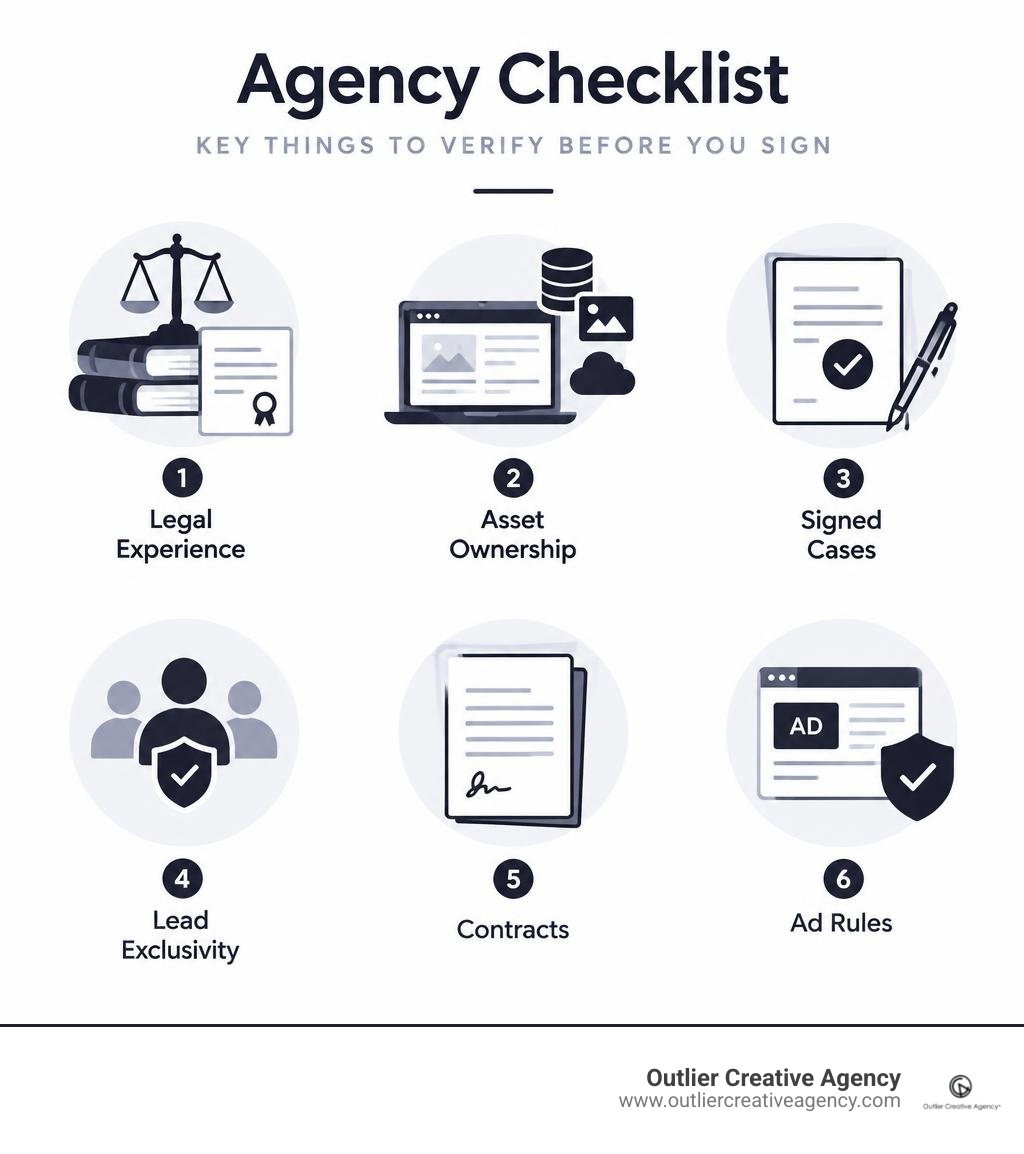
Choose a personal injury marketing company by asking for proof of work with firms like yours, then checking how it turns inquiries into signed cases. Before you sign, ask who owns your website, ad accounts, and data; whether leads are exclusive; who will do the work; and how the agency handles your state bar's advertising rules. Require reports that show signed cases and cost per signed case, not just traffic or lead counts. Read the contract for its length, cancellation terms, and what you keep when you leave.
These questions matter because a busy campaign can still leave your firm with few cases. A clear agreement lets you judge the work and change course if it is not delivering.
I'm Corey Larson. My work creating websites, video, and content for law firms informs my guidance on how to choose a personal injury marketing company. At Outlier Creative Agency, we welcome direct questions about deliverables, ownership, reporting, and ad review before you sign.
The article editor does not render LaTeX. Do not write LaTeX commands or math delimiters in article copy. Explain calculations in plain language, or use an ordinary-text formula when useful, such as watts = volts × amps. Write units as readable text, such as ft³/hour or gallons/kWh. When asked to remove formulas or confusing mathematical notation, replace them with prose; do not substitute different equations or hide the notation in code.
Core Criteria for How to Choose a Personal Injury Marketing Company
Selecting the right growth partner requires looking beyond flashy sales pitches. Personal injury law is one of the most competitive legal practice areas in the United States. In major markets like Los Angeles or Austin, dozens of firms compete for the exact same high-value motor vehicle accident, slip-and-fall, and wrongful death cases.
Generic digital marketing agencies often treat a personal injury firm like an e-commerce shop or a local plumbing company. This approach fails. Legal client acquisition involves complex legal ethics, high customer acquisition costs, and prospective clients who are experiencing significant physical and financial stress.

Dedicated Experience and Domain Expertise in Legal Marketing
A marketing partner must understand the mechanics of personal injury case acquisition. If an agency cannot distinguish between a minor soft-tissue fender bender and a catastrophic commercial truck collision, their campaign targeting will misallocate your advertising budget.
Review our Lawyer Marketing Guide 2026 to see how practice-specific messaging drives higher intent. A specialized legal agency understands that different case types carry different acquisition costs and intake requirements. They know how to structure practice-area silos on your website, develop authoritative educational resources, and filter out low-value inquiries before they drain your intake staff.
Ownership of Website Assets, Ad Accounts, and Campaign Data
One of the most dangerous traps in legal marketing is vendor lock-in. Some agencies build law firm websites on proprietary content management systems or run ad campaigns through their own master ad accounts. If you decide to end the relationship, they keep the website, the historical conversion data, and the digital assets you funded.
Before signing any agreement, demand written confirmation of full ownership:
- Website Assets and Code: You must own the domain, the design files, custom graphics, and all written content. If the site is built on WordPress, your firm must hold primary administrative access.
- Advertising Accounts: All Google Ads, Meta Ads, and Local Services Ads accounts should be created under your firm's billing profile. The agency should access these accounts as an external manager.
- Analytics and Call Data: Your firm must own its Google Analytics 4 property, Google Tag Manager container, and call tracking dashboard. Historical data is your property, not the agency's leverage.
Strategic Questions to Ask Before Signing an Agency Agreement

To protect your budget, conduct a thorough vetting process. Ask who will actually execute your strategy day-to-day. Many large agencies use senior strategists to pitch your managing partners, only to hand account execution to junior staff or offshore freelancers once the contract is signed. Ask for the names, locations, and backgrounds of the specific account managers, media buyers, and copywriters dedicated to your firm.
How to Choose a Personal Injury Marketing Company Based on Proven Case Acquisition
Clicks, impressions, and form fills do not pay firm overhead. The only metrics that determine campaign success are qualified intakes and signed retainers.
According to data compiled in our Law Firm Marketing Benchmarks 2026, personal injury firms seeing sustainable returns evaluate agencies on cost per signed retainer rather than cost per click.
When evaluating past performance, look for verified case studies that demonstrate how an agency grew a firm's caseload in competitive jurisdictions. Ask to see examples of how they reduced wasted ad spend, improved intake conversion rates, and scaled signed retainers month over month.
Multi-Channel Strategy Across SEO, Paid Search, and Generative Engine Optimization
Relying on a single acquisition channel creates operational vulnerability. A well-constructed strategy integrates organic search, paid media, and artificial intelligence visibility.
- Organic Search and Practice-Area Architecture: A common mistake is grouping every case type onto a general practice-area page. High-performing campaigns build dedicated silos for auto accidents, commercial vehicle crashes, premises liability, and catastrophic injuries. Learn more about structural optimization in our guide to legal SEO.
- High-Intent Paid Search: Google Ads puts your firm directly in front of people actively seeking legal counsel immediately following an accident. Managing these campaigns requires strict negative keyword lists, geo-fencing, and high-converting landing pages. Read our Personal Injury PPC Complete Guide 2026 for details on paid search management.
- Generative Engine Optimization (GEO): As prospective clients use conversational AI tools and search engine AI Overviews to research their legal rights, your digital footprint must supply clear, direct answers. Google confirms that established technical SEO best practices, structured schema markup, and robust E-E-A-T (Experience, Expertise, Authoritativeness, and Trustworthiness) signals drive visibility in AI-generated answers.
Evaluating Agency Accountability, Lead Quality, and Reporting Metrics
The resource on How to Choose a Personal Injury Lawyer notes that prospective clients must look past billboard visibility to evaluate trial readiness and real resources. Law firm partners must take the same approach with marketing agencies. High search rankings and raw traffic often stem from vanity tactics rather than true commercial intent.
| Agency Reporting Metric | Business Impact | What It Actually Tells Your Firm |
|---|---|---|
| Website Impressions & Pageviews | Low (Vanity Metric) | Shows how many screens loaded your content, not whether users were injured or in your jurisdiction. |
| Raw Form Fills and Inbound Calls | Medium | Indicates search volume, but includes spam, vendor solicitations, and unqualified inquiries. |
| Qualified Consultations | High | Confirms marketing campaigns are reaching injured individuals who match your target case profile. |
| Signed Retainers and Cost Per Case | Critical (True ROI) | Measures net firm growth and determines actual marketing profitability. |
Tracking Signed Cases and Cost Per Case vs. Raw Traffic
People searching for personal injury representation frequently contact multiple attorneys. If your intake team takes hours to respond while a competitor answers instantly, that lead is lost.
A competent marketing partner integrates call tracking and digital forms directly into your firm's Legal Customer Relationship Management (CRM) platform, such as Lead Docket, Filevine, or Clio. This dynamic integration tracks lead status from initial click to signed retainer. It allows the agency to optimize ad spend around keywords that yield actual signed clients, not just spam form fills.
How to Choose a Personal Injury Marketing Company with Clear Contract and Exclusivity Terms
Demand clarity on territory exclusivity and contract structure. Avoid agencies that lock your firm into multi-year contracts with aggressive cancellation penalties.
Ask the agency if they work with your direct competitors in the same geographic territory. If an agency represents three different personal injury firms targeting car accident cases in the same zip codes, a conflict of interest exists. They are essentially bidding against themselves with your marketing dollars. Require written geographic exclusivity for your core practice areas within your target market.
Ensuring Bar Advertising Compliance and Ethics Management

Attorney advertising is governed by strict ethical rules that vary by jurisdiction. Violating state bar advertising regulations can lead to disciplinary actions, fines, and reputational damage. Our guide to Digital Marketing for Attorneys covers the core compliance standards modern firms must maintain.
Adhering to State Bar Rules and Disclaimers in Legal Advertising
Your agency must understand the specific advertising rules governing your market. For example, rules in California and Texas strictly regulate how law firms present past verdicts, client testimonials, and claims of specialization:
- Past Verdict and Settlement Disclosures: Advertising past financial recoveries requires clear, conspicuous disclaimers explaining that past results do not guarantee future outcomes.
- Prohibition of Misleading Statements: Agencies cannot use subjective superlatives like "the best accident attorney" without verifiable, objective facts.
- Specialization Claims: Lawyers cannot claim to be certified specialists unless officially certified by their respective state board of legal specialization.
- Required Disclaimers: All landing pages, social media ads, and video promotions must clearly identify the attorney or law firm responsible for the ad and note where legal services are performed.
Ethical Review Generation and Online Reputation Workflows
Online client reviews significantly impact Local SEO, Google Business Profile (GBP) map rankings, and prospective client trust. Before calling a firm, injured individuals read reviews to assess communication, compassion, and responsiveness.
Your agency must implement an automated, compliant review generation workflow. Ethical guidelines strictly prohibit paying for reviews, offering incentives, or drafting fake testimonials. A sound strategy uses automated SMS and email sequences sent to satisfied clients immediately following successful case resolution, directing them to leave honest feedback on your Google Business Profile.
Frequently Asked Questions About Hiring a Legal Marketing Agency
What is the most critical question to ask when vetting an agency?
Ask who owns the website, ad accounts, and campaign data, and how the agency tracks signed cases. If the agency retains ownership of your digital assets or only reports on vanity metrics like impressions and clicks, look elsewhere.
How long should it take to see signed cases from marketing campaigns?
Paid search and Local Services Ads can generate qualified inquiries within the first few weeks of campaign launch. Comprehensive organic SEO, content marketing, and local map pack optimization typically require three to six months of consistent optimization to produce a compounding volume of signed retainers.
Should our law firm require market exclusivity for our practice area?
Yes. Your marketing agency should not manage direct competitors running identical personal injury campaigns in your primary geographic market. Ensure your agreement defines clear territorial boundaries and practice-area protections.
How does Generative Engine Optimization impact our law firm?
Generative Engine Optimization (GEO) ensures your firm's educational content, attorney credentials, and case results are structured so AI search models cite your practice when users ask complex legal questions. It complements traditional SEO by reinforcing E-E-A-T signals across your digital footprint.
Conclusion
Selecting the right growth partner is an important business decision for your practice. At Outlier Creative Agency, we provide transparent reporting focused on signed retainers, maintain strict ethical standards, and ensure you retain full ownership of all digital assets. If you are ready to evaluate your current marketing performance and scale your caseload, book a consultation with our team at Outlier Creative Agency.