
Find local SEO services for your law firm with this step-by-step guide covering assessment, agency selection, and ROI tracking.
What Is Local SEO and Why Does Your Law Firm Need It in 2026?
To find, vet, and choose the right local SEO services for your law firm, start by auditing your current Google Business Profile, local citation accuracy, and review volume across target neighborhoods. Then evaluate specialized legal marketing agencies on their ability to pair technical local optimization with state bar advertising compliance, transparent geo-grid reporting, and proven frameworks for building prominence in both map packs and AI-driven search tools.
Local SEO is the specialized practice of optimizing your firm's digital footprint so you appear prominently when nearby prospective clients search for legal representation. Whether someone searches for a "car accident lawyer near me" on a smartphone or queries an AI search engine about local statutory limits, local search optimization determines whether your practice gets discovered or overlooked.
In 2026, roughly 46% of all Google searches carry distinct local intent. For attorneys, these searches represent the highest-intent prospective clients in your market: individuals dealing with urgent legal matters who require immediate counsel. The top 3 Local Pack listings capture 44% of all clicks for local queries, and 78% of mobile local searches lead to a direct offline action or consultation within 24 hours.
Understanding how local search differs from traditional national search helps managing partners allocate marketing budgets effectively:
| Feature / Metric | Local Search Optimization | National Organic SEO |
|---|---|---|
| Primary Goal | Top 3 Local 3-Pack & Google Maps visibility | Standard organic search engine listings |
| Target Audience | Geo-specific prospective clients | Broad national or international audience |
| Core Ranking Signals | Proximity, GBP signals, reviews, citations | Domain authority, comprehensive backlinks |
| Average Cost Per Lead | ~$32 per qualified inbound inquiry | $75–$150+ via competitive paid campaigns |
| Conversion Timeline | 76% visit or call within 24 hours | Extended multi-touch research funnel |
As outlined in standard industry resources like Search Engine Land's guide to local ranking, local search is not a generic marketing checklist. It requires a tailored framework designed around physical office locations, regional practice rules, and community prominence.
How Does Local SEO Differ from Traditional Organic SEO?
Traditional organic SEO focuses on ranking web pages across broad geographic regions based on topical authority and backlink profiles. In contrast, local search algorithms prioritize physical proximity, user location, and verified entity data.
When a prospective client searches for counsel, Google checks whether your firm has an active physical presence within the user's immediate vicinity. This involves complex entity validation across Google Maps, knowledge graphs, and legal directories. To maintain long-term standing with search engines and state bar associations, firms must rely on sustainable, ethical SEO that builds authentic authority rather than relying on automated spam tactics.
What Are the Core Ranking Factors in Google's Local Algorithm?
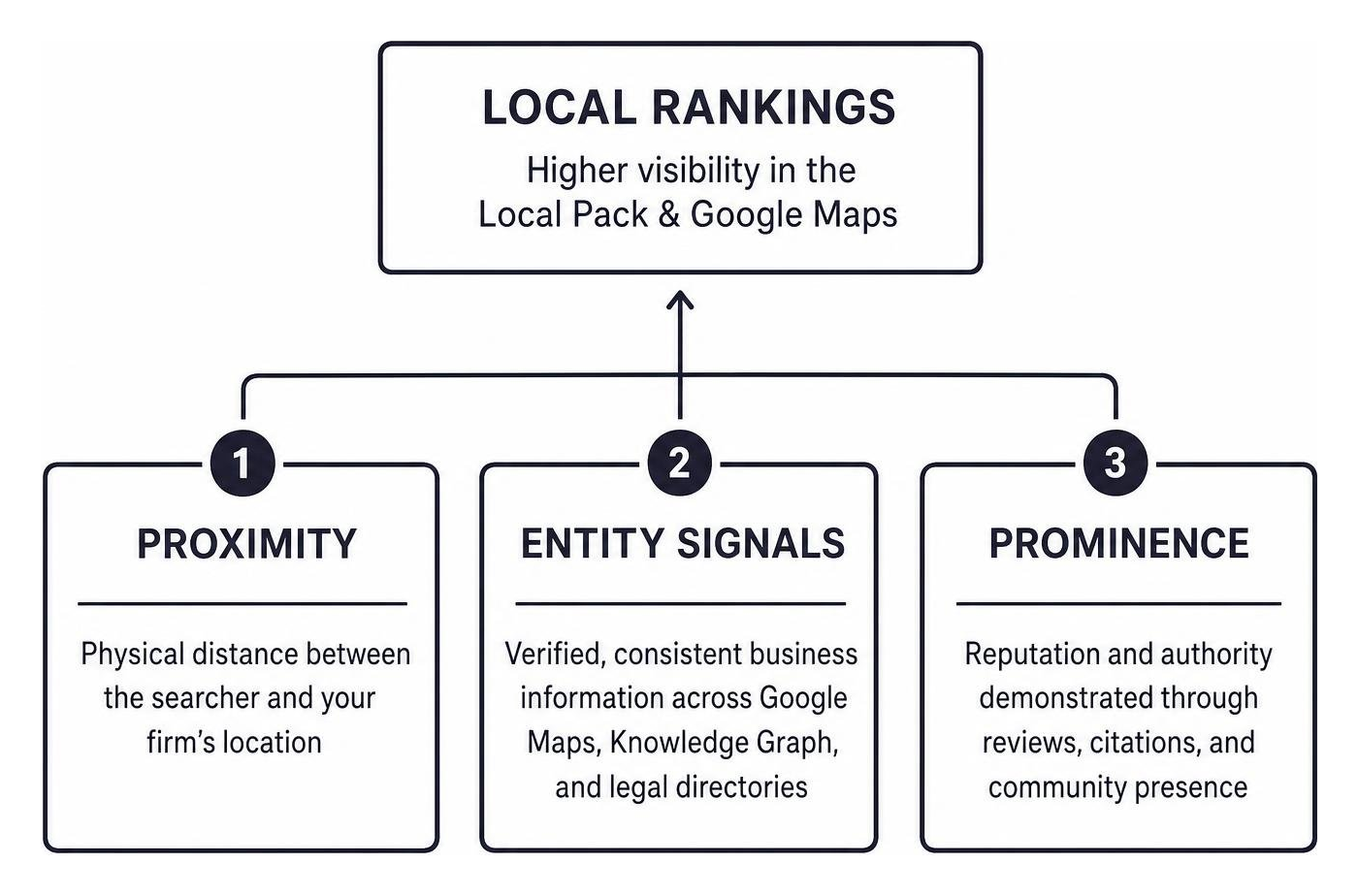
Google evaluates three foundational pillars to calculate local search rankings:
- Relevance: How accurately your business profile and website match what the user is searching for. This relies on selecting the precise primary category (e.g., "Personal Injury Attorney" vs. "Trial Attorney") and creating detailed practice area pages.
- Distance (Proximity): The physical distance between the searcher’s device coordinates and your verified office address.
- Prominence: How well-known and reputable your firm is in the digital and physical world. Prominence is driven by review volume, review velocity (consistent incoming reviews), local press mentions, structured citations, and backlink authority.
How Can You Assess Your Law Firm's Local Search Needs Before Hiring?
Before engaging an external marketing partner, conduct an internal audit of your firm's current digital footprint. Many law firms overspend on third-party services without understanding their foundational weaknesses.
Start by examining your geographic ranking spread using a geo-grid heatmap. A firm may rank #1 directly outside its office door, but drop to position #15 just two miles away. Identify whether your issues stem from technical site deficiencies, broken citation data, or insufficient review volume.
What Are the Critical Google Business Profile and On-Page Requirements?
A fully optimized Google Business Profile (GBP) accounts for roughly 32% of your local pack ranking signals. Your profile must feature:
- Accurate Primary & Secondary Categories: Select your specific primary specialty first, supported by relevant secondary practice classifications.
- Complete Business Attributes: Highlight wheelchair accessibility, virtual consultations, and appointment requirements.
- High-Quality Visual Assets: Profiles featuring high-resolution office photos, team headshots, and interior photos receive 42% more requests for directions and 35% more click-throughs.
- Structured Schema Markup: Implement clean
LocalBusinessandLegalServiceJSON-LD structured data on your website's location pages, detailing exact coordinates, operating hours, and bar-certified practice areas.
For firms operating in rapidly growing, competitive legal hubs, reviewing established benchmarks like our Austin law firm SEO guide illustrates how structured on-page signals directly influence map pack expansion.
How Has the Rise of AI Search Changed Local Discovery?
Local discovery has shifted dramatically. Today, 45% of consumers use AI search tools (such as ChatGPT, Perplexity, and Gemini) for local service discovery, up from just 6% a year ago.
AI-driven recommendations represent high-intent engagement: businesses recommended by AI tools see 4 to 23 times higher call conversion rates than traditional listings. However, gaining visibility in AI tools requires a distinct approach:
- ChatGPT sources location data from providers like Mapbox and Bing Places, recommending only 1.2% of local options.
- Perplexity extracts answers via live web search and relies heavily on structured
FAQPageschema. - Google Gemini relies on the Google Knowledge Graph and entity consistency across directories.
Because only 45% of brands leading in traditional local packs also lead in AI engine recommendations, your local strategy must optimize for both Google Maps algorithms and conversational AI search agents.
How Can You Find and Choose the Right Local SEO Services?
Selecting an agency requires evaluating whether a team understands legal marketing regulations, state bar advertising guidelines, and technical local optimization.
| Model | Pros | Cons | Ideal For |
|---|---|---|---|
| In-House Specialist | Full daily dedication to your firm | High overhead, limited broad tool access | Large multi-state enterprise firms |
| General Freelancer | Low hourly cost | Lacks legal ethics knowledge, inconsistent capacity | Solo practitioners with minimal competition |
| Specialized Legal Agency | Deep regulatory expertise, proven data frameworks | Structured monthly retainer investment | Growth-oriented firms scaling caseloads |
When evaluating partners, look for teams experienced in legal marketing compliance and technical performance. Review our framework on choosing the best agency for local SEO to structure your interview questions.
How Can You Evaluate Proven Local SEO Strategies Before Hiring an Agency?
A reputable provider should provide transparent, repeatable frameworks that balance technical compliance with content marketing. Ask prospective agencies how they handle:
- Hyperlocal Content Creation: Templated location pages no longer rank. Studies show a 107% lift in rankings when firms publish genuine hyperlocal content referencing local court jurisdictions, municipal ordinances, and community landmarks.
- Systematic Review Workflows: Review acquisition must be a consistent, monthly operational process complying with ABA Model Rule 7.1 regarding misleading communications.
- Local Digital PR: Earning authoritative local backlinks from regional news outlets, legal associations, and community sponsorships generates sustainable prominence signals.
Reviewing an in-depth law firm SEO case study will help you understand what sustained organic growth looks like in competitive markets.
What Red Flags and Costly Local Mistakes Should You Avoid?
When vetting providers, steer clear of tactics that violate Google's guidelines or state bar advertising rules:
- GBP Name Keyword Stuffing: Adding unauthorized keywords to your business title (e.g., "Smith Law Firm - Best Car Accident Lawyer") risks immediate profile suspension.
- Incentivized or Fabricated Reviews: Buying reviews or running quid-pro-quo review contests violates FTC regulations and state bar ethics rules.
- Low-Quality Citation Blasts: Submitting your firm's details to hundreds of automated, spam-heavy directories creates data conflicts that dilute trust.
- Cookie-Cutter Location Pages: Duplicating the same 500-word page across multiple suburban cities without localized content leads to algorithmic filtering.
What Should You Expect in Pricing, Timelines, and Measurable ROI?
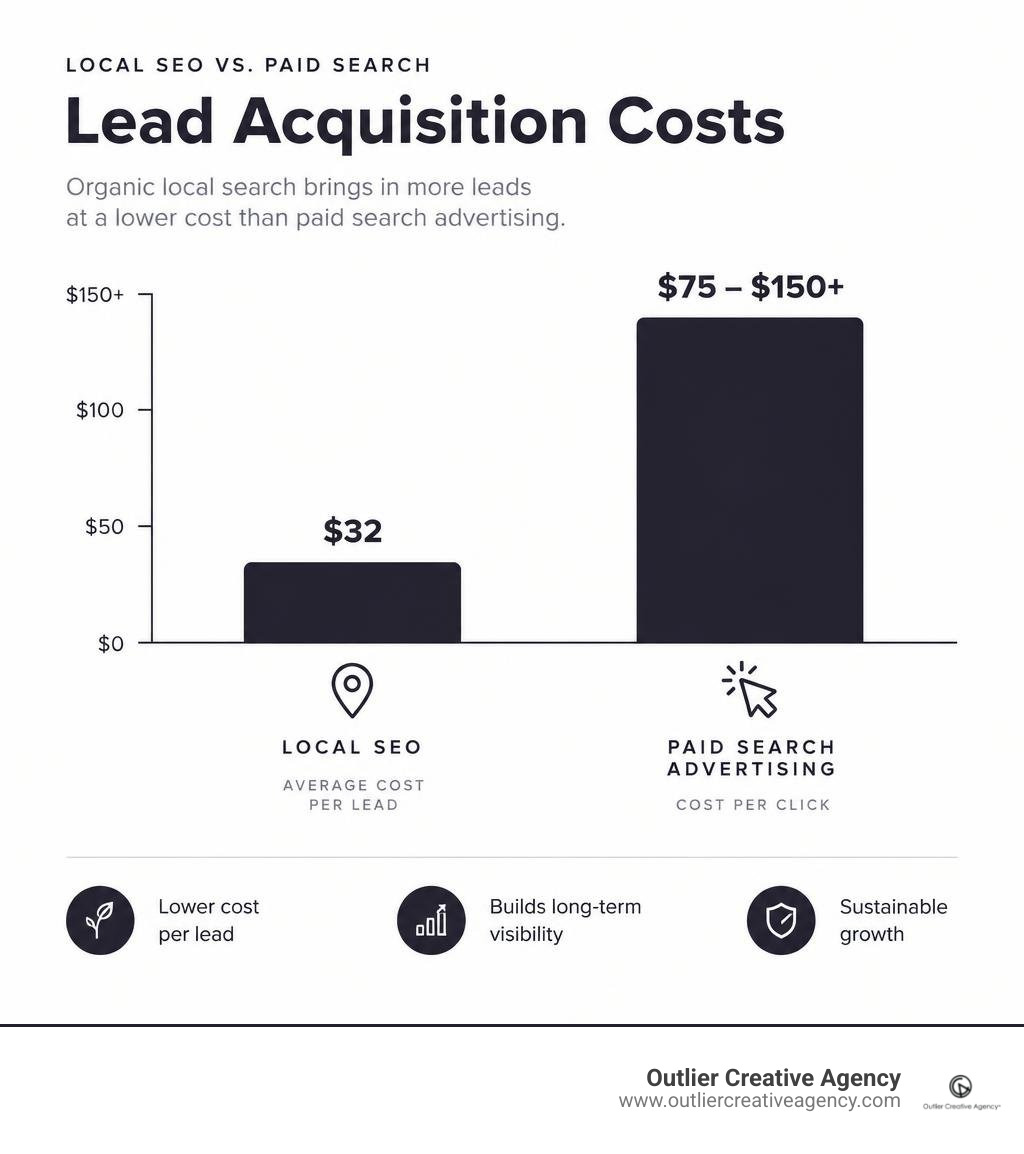
Local search optimization provides significant cost advantages over paid search. While competitive legal keywords on Google Ads often range from $75 to over $150 per click in major metropolitan markets, the average cost per lead from organic local search is approximately $32.
Standard professional retainers for legal practices typically range from $1,500 to $5,000+ per month depending on metro competition and practice area difficulty.
How Can You Track Local Search Visibility and Conversion Performance?
Avoid vanity metrics like national keyword rankings. Evaluate your local search investment through clear conversion indicators:
- Google Business Profile Interactions: Track direct phone calls, website clicks, and direction requests generated directly from the Local Pack.
- Geo-Grid Visibility: Monitor map pack rank improvements across target zip codes and neighborhoods.
- Qualified Retained Cases: Track inbound case intake forms attributed to location landing pages.
Tracking these metrics in high-stakes jurisdictions—such as analyzing Los Angeles legal market metrics—ensures your marketing budget drives profitable case acquisition.
What Are the Frequently Asked Questions About Local SEO Services?
How long does it take to see results from local search optimization?
Most law firms observe initial ranking movements and increased profile views within 60 to 90 days of resolving technical citation errors, optimizing Google Business Profiles, and establishing a regular review workflow. Highly competitive metropolitan areas or new office locations may require 4 to 6 months of consistent authority building to achieve top-3 Local Pack dominance.
Can multi-location law firms scale local visibility without losing consistency?
Yes. Scaling requires establishing centralized standards for core Name, Address, and Phone (NAP) formatting and structured schema architecture, paired with localized execution for landing page content. Each office location must have a distinct, verified Google Business Profile, dedicated local phone number, and unique website landing page with city-specific case studies and attorney bios.
How do AI-driven recommendations impact traditional map pack rankings?
AI search engines do not replace the local pack; they add a second discovery channel. While Google Maps relies heavily on proximity and GBP signals, AI engines (like ChatGPT and Perplexity) pull information from web-wide entity mentions, directory databases, and schema markup. Optimizing for both traditional local search and conversational AI ensures your firm captures prospective clients across all discovery platforms.
How Can You Build Long-Term Local Search Visibility in 2026?
Building lasting local visibility requires a coordinated strategy: maintaining accurate entity data, generating authentic client reviews, and publishing high-value localized legal resources.
At Outlier Creative Agency, we deliver data-driven marketing strategies designed specifically for attorneys and law firm managing partners. If you want to expand your geographic footprint, capture high-intent prospective clients, and remain fully compliant with legal advertising standards, explore our law firm SEO services and book a strategic consultation with our team today.