
Analyze this law firm SEO case study to diagnose growth bottlenecks and accelerate case inquiries using ethical authority-building tactics.
How to Analyze a Law Firm SEO Case Study to Diagnose Growth Bottlenecks
Evaluating any legal marketing campaign requires looking past vanity metrics. Organic traffic spikes look impressive on a reporting dashboard, but if those visitors are reading out-of-state legal articles or bouncing within three seconds, your firm is generating zero signed retainers. To diagnose what is actually holding back your firm's pipeline, you must dissect campaign data across four foundational layers: technical crawlability, mobile rendering, semantic topical authority, and local conversion infrastructure.
When assessing a firm's digital presence, we start by conducting an audit to uncover crawl inefficiencies and code-level bottlenecks. In competitive legal markets like Los Angeles and Austin, high-volume competitors invest aggressively in paid search ads where cost-per-click (CPC) rates routinely exceed $150 to $250 for catastrophic injury terms. Outranking these established players organically demands an airtight technical foundation. Investing in comprehensive law firm SEO services ensures that every dollar and hour spent on content directly influences search engine ranking algorithms rather than getting trapped in technical debt.
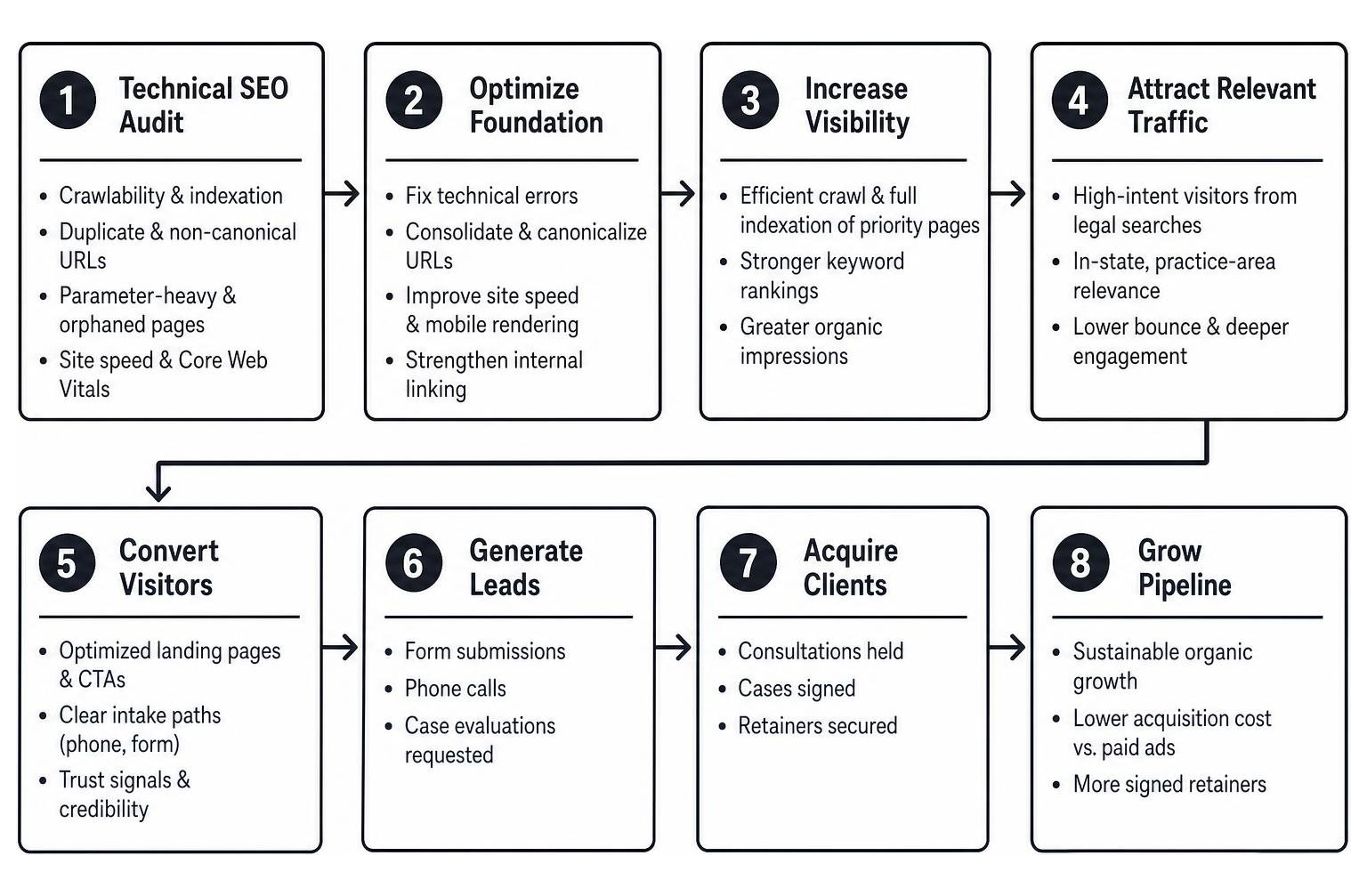
What a Law Firm SEO Case Study Proves About Resolving Technical Debt
Technical debt is the silent killer of legal search rankings. In one detailed case study involving a Texas personal injury practice, technical bloat caused search engine bots to waste up to 90% of their allocated crawl budget on non-canonicalized URLs, parameter-heavy filter strings, and orphaned non-HTML assets. When Google’s spiders are forced to navigate millions of low-value, duplicate URLs, high-intent practice pages covering complex torts, commercial vehicle collisions, and wrongful death claims never get indexed or re-crawled promptly.
Resolving over 180 technical errors—such as standardizing canonical tags, configuring proper schema markup for legal services, and purging indexation dead ends—produced immediate gains in real-world campaigns. For instance, after correcting critical technical architecture errors, the Texas practice saw total organic clicks jump 61.63% (from 5.11K to 8.26K), total impressions climb 22.37% (from 1.99M to 2.43M), and average SERP position improve by 9.23%. Reviewing real-world legal case studies consistently proves that fixing technical debt before producing new practice content is the single most efficient way to unlock rapid SERP growth.
How Does Core Web Vitals Optimization Accelerate Case Inquiries?
Prospective legal clients seeking counsel after a devastating accident are almost exclusively browsing on mobile devices. When an injured individual or their family member visits your website, an unoptimized, slow-loading page will cause them to bounce back to the search results and contact the next attorney on the list.
Optimizing Core Web Vitals is therefore not merely a technical checkbox; it directly impacts your firm's intake volume. In high-performing legal campaigns, aggressively resolving JavaScript render-blocking scripts, compressing heavy case result media, and streamlining server response times slashed mobile page load speeds from 7.8 seconds down to 1.9 seconds—a 4.1x speed improvement. Maintaining fast load times keeps bounce rates low, sends strong user experience signals to information retrieval models, and drives prospective clients straight into your intake forms. Practicing ethical law firm SEO strategies means building responsive, compliant digital experiences that respect user intent without resorting to deceptive pop-ups or manipulative click-triggers. For further insights on technical SEO best practices, refer to Google's official documentation on Core Web Vitals.
How Do Dual Topical Maps and Entity SEO Establish Legal Authority?
Modern legal search algorithms operate on entity-based information retrieval. Search engines do not merely look for exact-match strings like "car accident lawyer"; they evaluate your firm's domain against a broader legal knowledge graph. To establish undeniable authority, your site architecture must demonstrate deep expertise across two intersecting dimensions: legal practice taxonomy and regional geographic relevance.
Recent legal marketing benchmarks for 2026 show that law firms relying on superficial 500-word blog posts are being outranked by practices that utilize structured entity mapping. By establishing a dual topical map, a law firm systematically answers every question, statute detail, procedural step, and liability nuance related to their core practice areas while cementing strong regional location signals.

How to Bridge Practice Specialties with Semantic Content Architecture?
To bridge legal specialties with local search queries, you must construct a semantic content network that moves logically from macro concepts to micro applications. Rather than producing disconnected articles, organize your content into structured topic clusters supported by detailed content briefs:
- Macro Hub (Core Practice Area): Comprehensive landing page covering the core legal discipline (e.g., Commercial Vehicle Accidents in Texas or California Serious Injury Claims).
- Sub-Topic Nodes (Specific Incident & Injury Entities): Dedicated pages dissecting specific scenarios such as underride collisions, black-box data preservation, driver fatigue violations, and traumatic brain injury (TBI) claims.
- Micro Nodes (Statutory & Procedural Content): In-depth guides breaking down state-specific negligence standards, statutory filing deadlines, third-party liability rules, and insurance bad-faith litigation.
- Local Context Bridges: Explicit internal links that connect state and municipal traffic codes, local court jurisdictions, and regional emergency medical facilities directly back to the core practice hub.
Using data-driven law firm keyword research allows you to map out every query permutation your prospective clients use during the legal research cycle, ensuring your firm answers their pressing legal questions at every phase of intent.
Why Do E-E-A-T Signals Outperform Generic Content in High-Value Legal Niches?
Search engines classify legal content under the strictest "Your Money or Your Life" (YMYL) standards. Generic, AI-generated legal copy devoid of real courtroom insight fails to establish the Experience, Expertise, Authoritativeness, and Trustworthiness (E-E-A-T) required to rank for high-value legal queries.
In a standout case study examining a boutique personal injury practice targeting complex catastrophic injury cases, the agency executed an aggressive E-E-A-T overhaul across 50+ practice area pages. Rather than relying on generic summaries, the content integrated:
- Published Authority Assets: Showcasing the founding attorney's authored books, scholarly publications, and continuing legal education (CLE) lecture series.
- Master Class Landing Pages: Structuring deep-dive educational resources (such as a Traumatic Brain Injury Master Class page) that ranked #1 for niche-specific authority terms.
- Verifiable Case Summaries & Settlements: Highlighting multi-million dollar recoveries (such as a landmark $7.25M resolution) with context regarding liability and insurance disputes, fully compliant with state bar advertising regulations.
- Authoritative Medical Citations: Referencing peer-reviewed neurological studies, diagnostic imaging protocols (DTI and SPECT scans), and economic life-care planning frameworks.
This intense focus on real-world subject matter expertise transformed a boutique practice into a dominant regional authority, increasing total organic traffic by 342% and generating a 4.2x surge in qualified case inquiries within 9 months.
How Can Law Firms Dominate Multi-Location Map Packs and City Pages?
Securing organic visibility in legal search requires dominating both the traditional organic 10 blue links and the local Google Map Pack (the Local 3-Pack). Prospective clients looking for immediate representation almost always interact with local map listings first.
For firms operating across major metropolitan areas in California and Texas, building local dominance requires an integrated strategy that aligns Google Business Profiles (GBP) with hyper-localized organic landing pages. Utilizing specialized California personal injury SEO techniques guarantees that your practice triggers local map pack inclusions across your entire target geographic radius rather than just a narrow radius around your physical office.
How to Structure Scalable City-Service Pages Without Triggering Thin Content?
One of the most common pitfalls legal marketing directors make is generating dozens of low-effort "city + keyword" doorway pages by swapping out city names on duplicate templates. Search engines quickly identify and de-index this thin content.
To scale local visibility ethically across multiple target municipalities, you must build unique, intent-matched city-service pages. In proven campaigns, expanding from a handful of thin pages to over 30 deeply researched city-service pages expanded Map Pack and localized organic reach across regional sub-markets.
Applying proven San Francisco law firm SEO blueprints ensures that every regional page provides distinct, localized value that helps both human searchers and search algorithms identify geographic relevance.
What GBP Optimization Tactics Drive Qualified Phone Leads?
Optimizing your Google Business Profile goes far beyond simply filling out your Name, Address, and Phone number (NAP). In the Colorado niche dominance campaign, tactical GBP optimization produced a massive 475% increase in direct incoming phone inquiries from qualified prospects.
Key tactics to deploy across your GBP include:
- Strict Primary Category Selection: Align your primary category exactly with your highest-converting practice discipline (e.g., "Personal Injury Attorney" or "Trial Attorney") before selecting supporting secondary categories.
- Proactive Review Generation Workflows: Implement automated SMS and email review collection sequences to gather steady, detailed client reviews mentioning specific accident types and legal resolutions.
- Regular Legal Updates & Q&A Publishing: Seed your GBP profile with accurate answers to common legal intake questions, ensuring full compliance with local bar advertising rules prohibiting explicit guarantees.
- Direct Call Tracking & Local Citations: Maintain pristine NAP consistency across tier-one legal directories (Avvo, Justia, Martindale-Hubbell, FindLaw) while routing calls through clean call-tracking numbers connected to your CRM.
Firms executing high-converting personal injury marketing connect their GBP profiles directly to optimized intake software, ensuring that high-intent inbound calls convert into signed retainer agreements immediately.
How Do You Build Ethical Backlinks in High-Competition Practice Areas?
Link building in the legal sector is notoriously competitive. Because high-value injury keywords command massive revenue potential, legal search is filled with low-quality PBNs (private blog networks), spammy directory submissions, and paid link schemes that risk Google manual penalties and state bar ethical violations.
Building real domain authority requires an editorial-first digital PR approach. In our case study analysis, the featured firm saw its Ahrefs Domain Rating (DR) jump from 18 to 42 in just 9 months by earning 67 high-authority, topically relevant backlinks without engaging in black-hat link schemes.
| Link Acquisition Strategy | Quality & Risk Profile | Typical Authority Impact | Best Use Case for Law Firms |
|---|---|---|---|
| Digital PR & Expert Legal Commentary | High Authority / Zero Risk | Major DR Increase (DR 70+) | High-profile case filings, local news commentary, legal analysis |
| Niche Medical & Industry Editorial Citations | High Relevance / Zero Risk | Targeted Topical Authority Boost | TBI associations, trucking safety organizations, biomechanical journals |
| Tier-One Legal Directories (Justia, Avvo, FindLaw) | Foundational / Zero Risk | Baseline Trust & NAP Signals | Core business listings, local entity verification |
| Paid Link Networks & Low-Quality PBNs | High Penalty Risk / Negative Value | Algorithmic Devaluation / Penalty | Never recommended; violates state bar ethics & search engine guidelines |
Which Off-Page Authority Signals Matter Most to Google?
To rank for competitive terms like commercial trucking collisions or traumatic brain injury litigation, Google's algorithm evaluates link relevance above raw link volume. Earning five links from authoritative medical research foundations, neurological rehabilitation centers, and specialized transportation industry publications passes significantly more topical authority than hundreds of generic web directory links.
Studying a detailed law firm organic growth case study reveals that off-page success comes from positioning attorneys as true subject-matter experts. When your attorneys provide on-the-record commentary for regional news broadcasts covering catastrophic transit accidents or contribute scholarly insights to accredited legal journals, your backlink profile becomes an unassailable competitive moat.
What Actionable Takeaways from This Law Firm SEO Case Study Support Practice Growth?
The central insight from analyzing comprehensive legal SEO data is that boutique firms do not need massive multi-million-dollar advertising budgets to outrank mega-firms. By deploying a focused, niche-first strategy, small and mid-sized practices can systematically capture high-value case inventory.
As demonstrated across our law firm SEO case study insights, dominating organic search comes down to methodical execution. Aligning technical precision with authoritative content creation creates a sustainable client acquisition engine that pays dividends for years.
Frequently Asked Questions About Law Firm SEO
How long does it take for a law firm to see measurable organic growth?
A well-structured legal SEO campaign typically produces measurable improvements in indexation and keyword rankings within 60 to 90 days. However, achieving dominant Page 1 rankings and substantial increases in qualified case inquiries generally requires 6 to 9 months of consistent technical refinement, content publishing, and backlink acquisition.
Why do legal websites frequently waste significant crawl budget?
Law firm websites often accumulate significant technical bloat over time. Legacy CMS platforms, auto-generated tag pages, improper facet filtering on case results, duplicate HTTP/HTTPS protocols, and non-canonicalized PDF or media files consume search engine crawl budget, preventing high-value practice pages from being indexed and evaluated efficiently.
How can a boutique law firm outrank established high-budget competitors?
Boutique practices win by targeting deep topical niches rather than competing solely on broad, hyper-competitive keywords. By publishing comprehensive, E-E-A-T-rich content on specific litigation areas (such as spinal cord injuries, commercial fleet negligence, or rideshare accidents) and coupling it with granular city-service pages, smaller firms build higher topical authority in specialized niches than generalist competitors.
Conclusion
Cracking the legal search algorithm is not about chasing short-term ranking tricks or flooding your domain with low-grade content. As the case study data proves, sustained organic growth requires a methodical commitment to technical site health, semantic entity mapping, uncompromising E-E-A-T content standards, and ethical authority building. When these elements operate together, a law firm transforms its website from a static digital business card into its most profitable client acquisition channel.
At Outlier Creative Agency, we specialize in helping ambitious law firms navigate complex legal marketing landscapes to build dominant digital presences. By pairing data-driven search strategies with integrated digital and social media campaigns, we empower attorneys to increase qualified caseloads, elevate their brand authority, and maintain strict compliance with legal advertising ethics. If you are ready to diagnose your firm's growth bottlenecks and engineer an organic search strategy that delivers measurable retainers, connect with our team today to schedule your comprehensive practice consultation.