

Learn how content marketing for attorneys drives signed cases with video, SEO, and practice-area playbooks from Outlier Creative Agency.
How to Make Content Marketing for Attorneys Drive Signed Cases
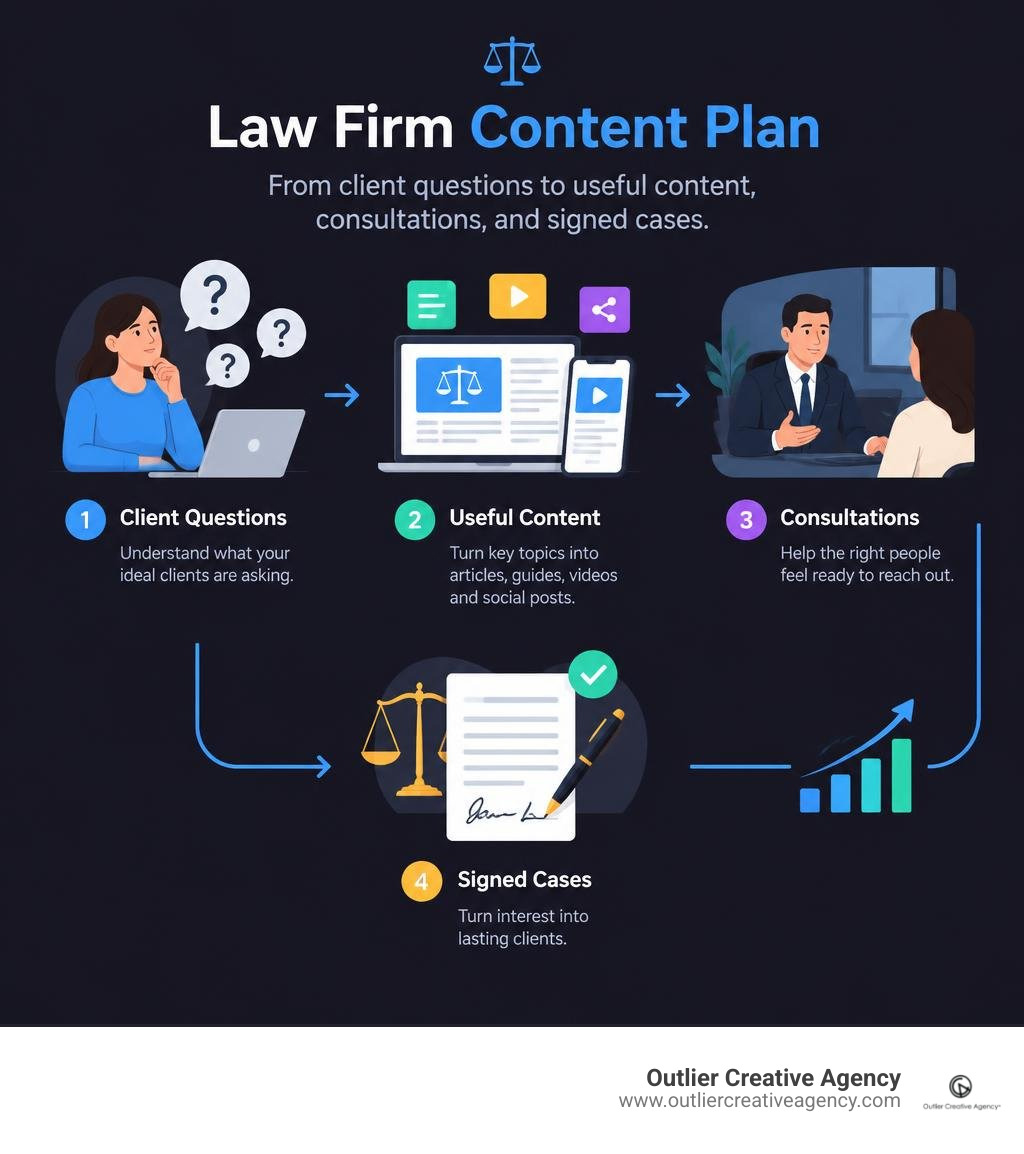
To improve content marketing for attorneys, start with the questions your ideal clients ask before they call. Publish clear answers on practice-area pages and in guides, then turn the most useful topics into short videos and social posts. Show who reviewed the legal information, check every claim for accuracy and advertising compliance, and track which content leads to consultations and signed cases.
In 2026, your firm needs more than website traffic. It needs content that helps the right people understand their options and feel ready to contact you.
I’m Corey Larson. At Outlier Creative Agency, I’ve worked with legal experts to create websites, copy, social media, and video for content marketing for attorneys, and this guide shows how to put those pieces to work together.
The Business Case for Content Marketing for Attorneys in 2026
Relying solely on pay-per-click advertising has become unsustainable for growing law firms. In competitive legal markets like Los Angeles, California, and Austin, Texas, aggressive bidding has pushed pay-per-click costs to record highs. When your firm stops paying ad networks, your inbound lead flow immediately drops to zero. Content marketing builds a permanent digital asset that generates qualified retainers every month without recurring media fees. For personal injury practices, strategic personal injury marketing turns that asset into a steady pipeline of qualified consultations.
Data shows that 96 percent of people seeking legal advice start their search with a search engine. Over a third of prospective legal clients begin their journey by researching their exact legal dilemma online. If your website only features generic sales copy, searchers will move on to a firm that clearly explains their legal situation. Businesses that maintain active editorial publishing earn an average of 126 percent higher lead growth than firms that ignore organic channels.
Our Lawyer Marketing Guide 2026 outlines how modern search algorithms prioritize deep subject-matter expertise. Search engines evaluate legal content under strict "Your Money or Your Life" (YMYL) standards. Publishing authoritative, highly structured legal resources positions your practice as the premier regional authority across both organic search and artificial intelligence answer engines.
| Acquisition Channel | Average Cost Per Lead | Intake-to-Sign Rate | Effective Cost Per Signed Case | Long-Term Equity |
|---|---|---|---|---|
| Paid Search (PPC) | $400 | 12% | $3,333 | None (Stops when ad spend stops) |
| Organic Content Marketing | Amortized production | 38% | ~$200 | Compounding permanent asset |
Why Traditional Referral Networks Require Content Marketing for Attorneys
Word-of-mouth referrals remain valuable, but modern client behavior has changed the intake path. Today, when a professional peer or former client recommends your law firm, the prospect does not simply call your office. They search your firm online, examine your practice pages, watch your video content, and review your attorney bios.
Prospective clients consume three to five pieces of content before reaching out to a legal professional. If your digital presence looks neglected, referred prospects will hire a competitor whose website demonstrates active legal authority. A report from the American Bar Association on Mastering Law Firm Marketing: Innovative Strategies to Attract and Retain Clients highlights that firms combining strong digital content with referral generation scale much faster than firms relying on offline networking alone. High-caliber educational guides validate peer recommendations and remove friction before the initial consultation.
Measuring Real ROI: Cost Per Signed Retainer vs. Vanity Traffic
Most agencies report on vanity metrics like impressions, keyword rankings, and website clicks. For a law firm partner, pageviews do not pay overhead. The only metric that matters is the fully loaded cost per signed retainer.
Consider a personal injury practice spending $400 per lead on commercial pay-per-click ads. Because ad-driven clicks often produce cold or price-sensitive inquiries, the intake-to-sign conversion rate frequently hovers around 12 percent. That puts the true acquisition cost at $3,333 per signed case.
When that same firm invests in a comprehensive practice-area cluster, the organic searchers arriving on the site are actively seeking solutions to specific legal issues. Because these visitors read deep-dive resources written by your firm, they arrive at intake pre-sold on your expertise. Their intake-to-sign rate jumps to 38 percent. Once the production cost of the content is amortized across twelve months, the effective acquisition cost drops to roughly $200 per signed case. That is a 16-times efficiency advantage over paid advertising. Implementing advanced attribution modeling through Digital Marketing for Attorneys ensures your firm tracks every signed client back to the exact article or video that initiated the intake.
High-Impact Formats: Video Production, Pillar Pages, and Divisible Assets
Publishing random 500-word blog posts no longer generates signed retainers. Modern legal marketing demands a cohesive media system that combines long-form written authority with high-production video assets. These integrated production workflows give your firm the kind of compound visibility we build through our legal marketing services for practices that want predictable monthly caseload growth.

With 91 percent of businesses utilizing video as a primary marketing tool, firms that fail to put their attorneys on camera lose ground to media-forward competitors. Video allows prospects in distress to evaluate an attorney's courtroom presence, communication clarity, and empathy before booking a consultation.
Video Marketing and Transcript Indexing for Law Firms
Short-form vertical video has become an essential client acquisition tool for legal practices. Producing 60-second video answers to specific legal questions captures user attention on platforms like YouTube Shorts, LinkedIn, Instagram Reels, and TikTok.
Modern search engine crawlers dynamically index spoken video transcripts as primary ranking copy alongside traditional text. When our video production team captures an attorney breaking down a complex statute, that audio is transcribed, formatted with structured markup, and embedded onto the relevant practice-area page. This gives your firm double the indexable search footprint for a single production effort.
Law firm video production requires strict adherence to legal ethics. Pre-shoot workflows must verify that no confidential client details are visible, that past settlement discussions include appropriate jurisdictional disclaimers, and that all statements comply with state bar rules such as California Rule 7.1 and Texas Disciplinary Rules of Professional Conduct.
Practice-Area Topic Clusters and Long-Form Evergreen Guides
To dominate high-value search terms, law firms must organize their websites into structured topical clusters. Rather than publishing disconnected articles, your site should feature comprehensive pillar guides supported by targeted sub-topic articles that link back to the main practice hub.
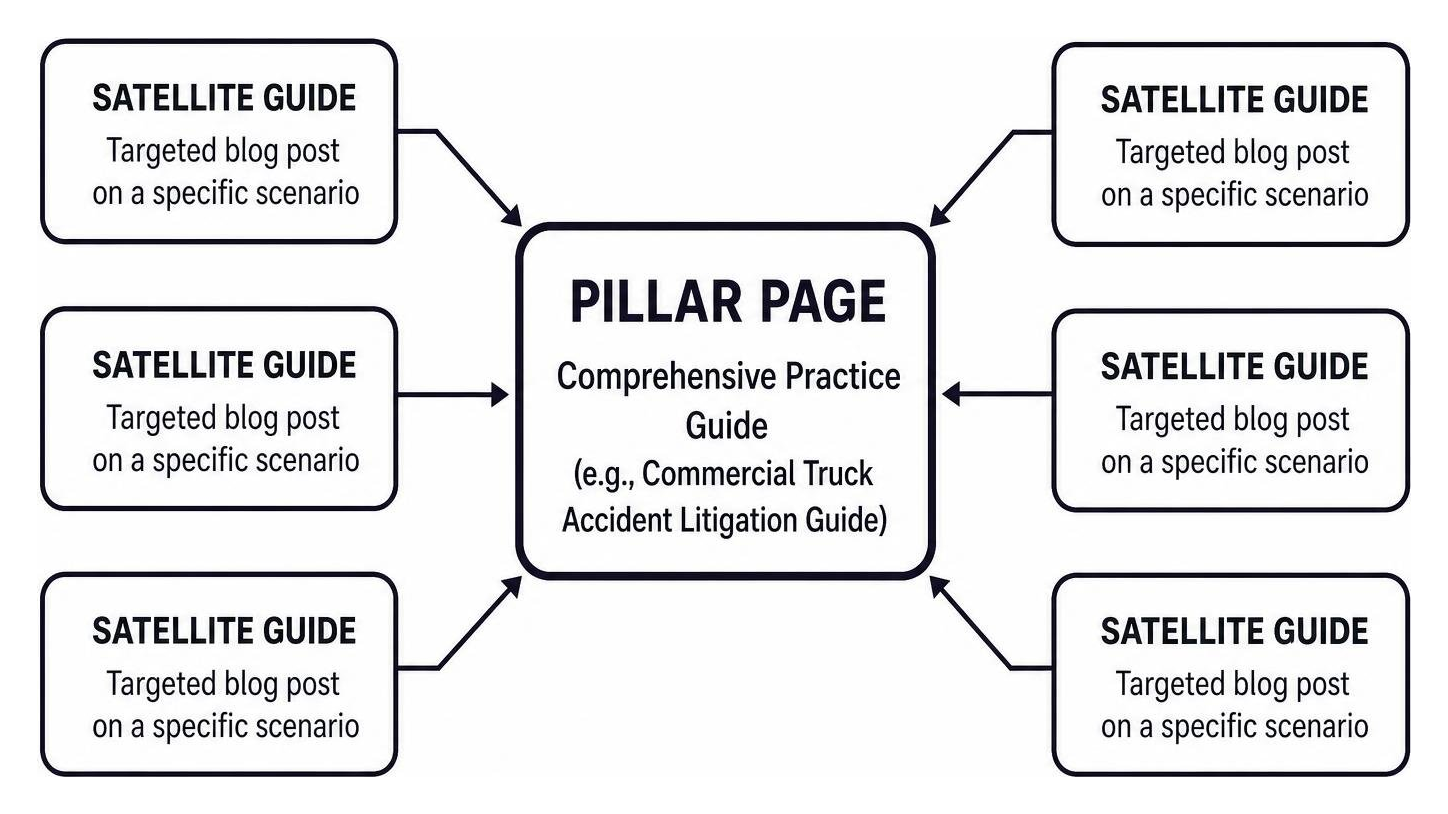
As detailed in Law Firm Content Marketing: The Experience-Driven Guide, high-performing firms use a 9-to-1 divisible content workflow to protect billable hours:
- One comprehensive practice guide (e.g., Commercial Truck Accident Litigation Guide)
- Three targeted blog posts addressing hyper-specific client scenarios
- Two short-form educational videos answering direct client questions
- Two LinkedIn thought-leadership posts highlighting case law developments
- One downloadable checklist for prospective clients to evaluate their legal claims
This model ensures every hour your attorneys spend consulting on content produces multi-channel marketing assets that drive traffic for years.
Generative Engine Optimization (GEO) and Technical Search Architecture
The search landscape in 2026 is defined by artificial intelligence answer engines. Tools like ChatGPT, Perplexity, Google Gemini, and Google AI Overviews answer legal search queries directly on the results page. If your firm does not practice Generative Engine Optimization (GEO), AI models will summarize your practice area without citing your firm as the authoritative source.
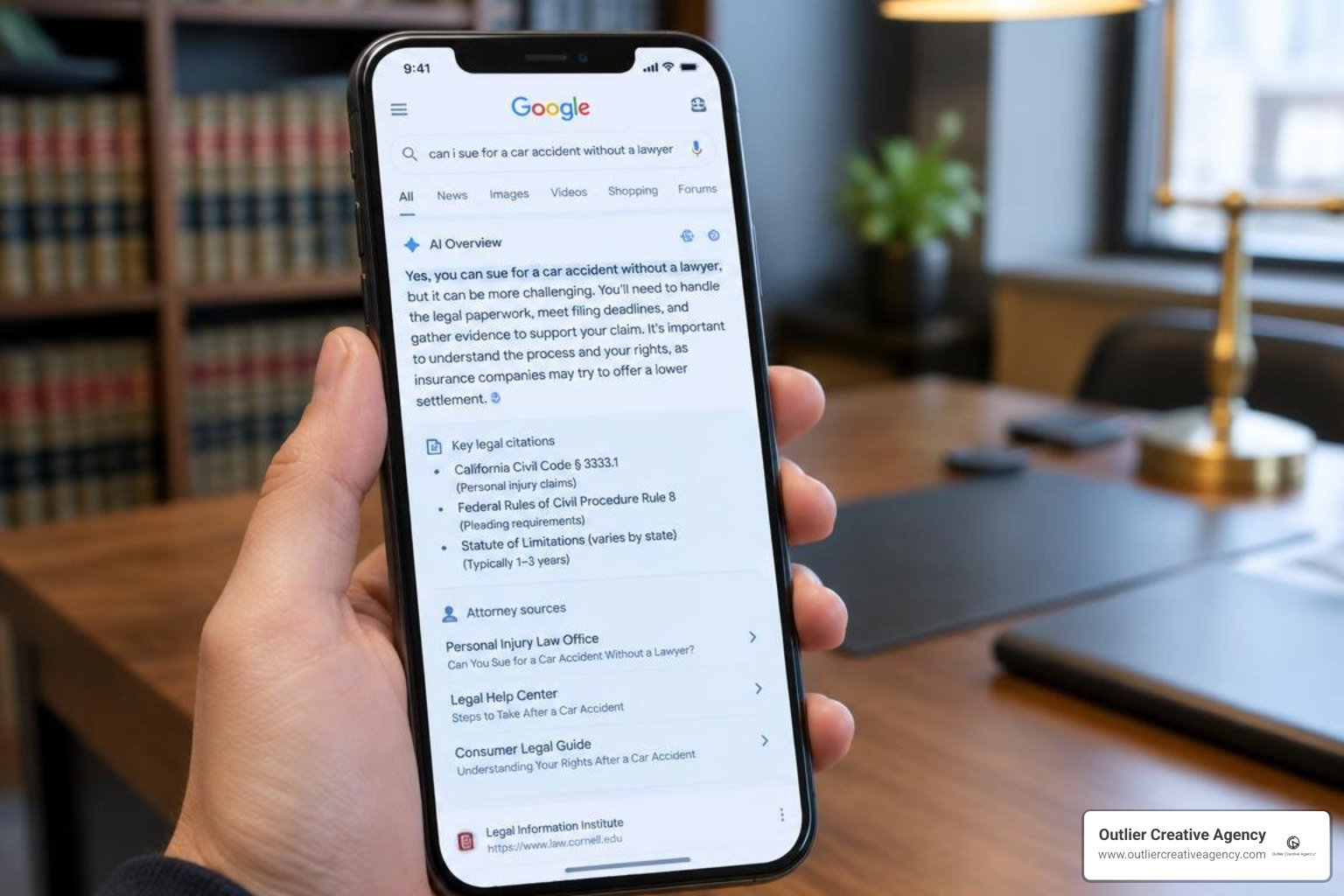
Securing citations in AI-generated answers requires technical authority, structured data markup, and high entity density. AI systems do not summarize generic marketing text. They extract clear, well-structured definitions, step-by-step statutory timelines, and verified attorney insights. Integrating these tactics into your overall Law Firm Advertising Strategies ensures your brand remains visible across every new search interface.
Implementing Structured Schema for Content Marketing for Attorneys
Search engines and large language models rely on structured schema markup to understand the entities, authors, and legal services on your website. Schema.org has deprecated the outdated general schema types in favor of explicit semantic code.
Your technical foundation must implement a connected schema graph combining three essential types:
LegalServiceschema identifying your physical office locations, operational hours, practice areas, and bar association licenses.Personschema marking up your attorneys, their educational credentials, state bar admissions, and professional accolades.FAQPageschema structuring your direct question-and-answer pairs for instant algorithmic indexing.
Data shows that legal web pages deploying a synchronized LegalService, Person, and FAQPage schema graph receive 3 to 5 times more AI search citations than identical pages without structured markup.
Answer Engineering for AI Search Overviews
Answer engineering is the practice of formatting legal copy so large language models can easily extract and cite your content. To win AI citations, place a concise, definitive answer directly below your H2 or H3 heading before expanding into nuanced analysis.
Follow this direct definition with structured comparison tables, statutory bullet points, and local jurisdiction rules. This architecture satisfies both the human searcher looking for quick reassurance and the AI crawler looking for extractable facts.
Practice-Area Content Playbooks: Personal Injury, Family Law, and Estate Planning
Content strategies cannot follow a generic template. Every practice area operates under distinct client emotions, decision timelines, and conversion paths. Aligning your content production with tailored practice-area strategies ensures your firm connects with clients during their moment of need.
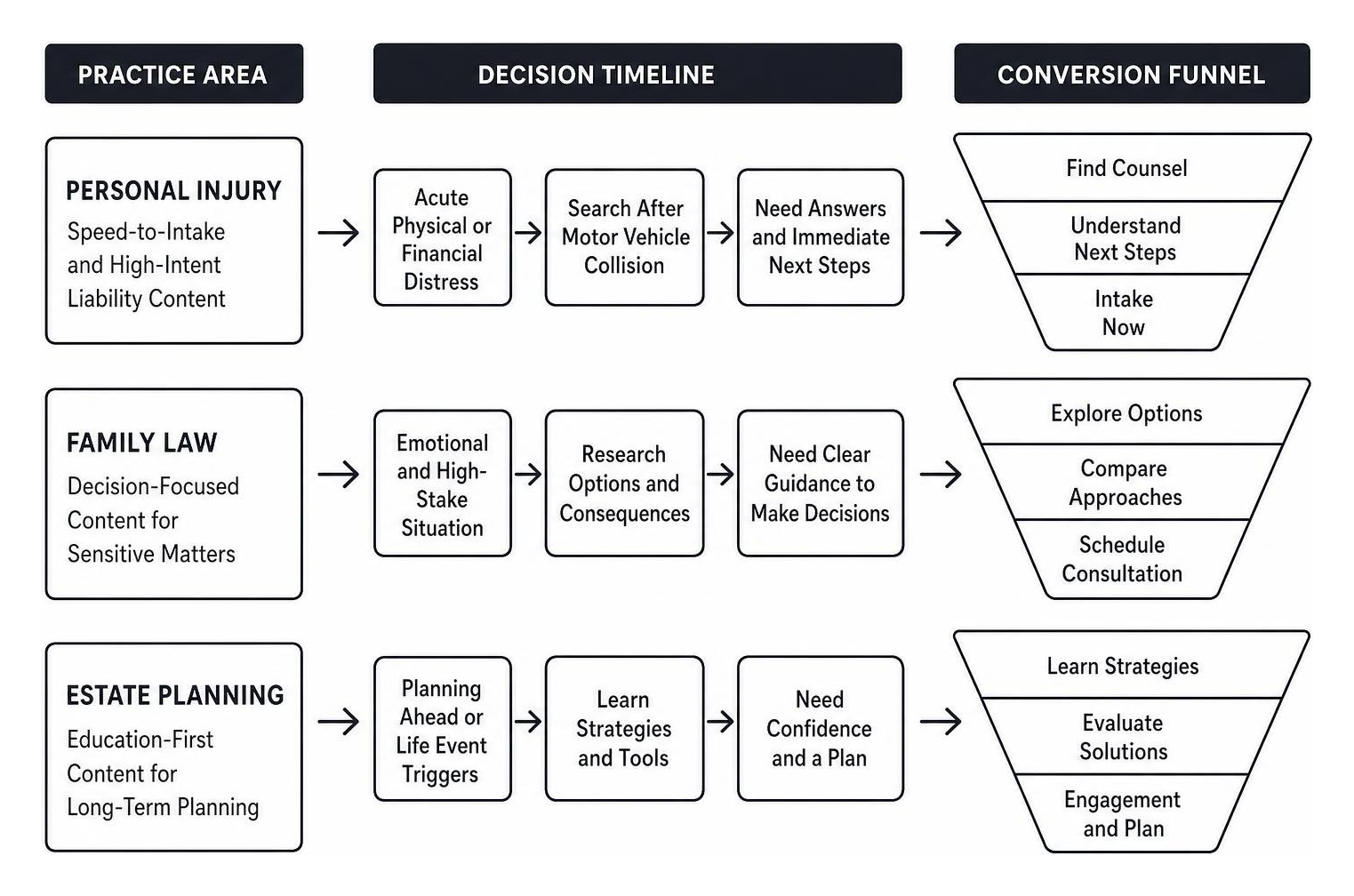
Personal Injury: Speed-to-Intake and High-Intent Liability Content
Personal injury searchers are often in acute physical or financial distress. When someone searches for counsel following a motor vehicle collision, they are not looking for academic legal theory. They want to know who will pay their medical bills, how lost wages are recovered, and what steps to take immediately following an accident.
Personal injury content must focus on speed-to-intake and practical emergency guidance:
- Publish detailed liability guides for specific accident types (rideshare collisions, commercial trucking wrecks, catastrophic spinal injuries).
- Outline immediate post-accident checklists clearly on mobile-optimized pages.
- Address local municipal hazards, notorious intersections, and regional roadway data in your metropolitan market.
- Connect high-intent pages directly to a 24/7 intake pipeline. Leads followed up within five minutes convert at significantly higher rates than those contacted later.
Family Law and Estate Planning: Stigma-Free Education and Lifecycle Checklists
Family law and estate planning prospective clients operate on longer evaluation cycles. A searcher researching divorce proceedings or trust administration may evaluate options for months before scheduling an initial consultation.
- Family Law: Focus content on demystifying complex court procedures. Publish clear timelines for contested versus uncontested dissolutions, child custody mediation frameworks, and asset division guides. Avoid aggressive sales copy. Write with empathetic, non-judgmental language that reduces emotional distress.
- Estate Planning: Build interactive digital assets and life-stage trigger guides. Create content centered on milestone events, such as purchasing a home, welcoming a child, or inheriting family assets. Downloadable estate planning checklists serve as lead generation assets that feed automated email nurture campaigns, keeping your firm top-of-mind until the client is ready to execute their documents.
Conclusion
Building a dominant legal practice requires moving beyond obsolete, high-volume keyword publishing. In today's digital landscape, modern search engines and AI answer tools reward deep legal experience, multi-format media production, and technically flawless site architectures. When your firm creates structured, empathetic, and compliant educational resources, you build a sustainable client acquisition engine that scales your caseload.
Outlier Creative Agency provides award-winning, data-driven content marketing, advanced SEO, and high-end video production exclusively for law firms looking to scale signed cases. If you are ready to build a compounding organic marketing system, explore our expert legal content and video production to see how our team helps practices grow. Reach out to Outlier Creative Agency to schedule a strategy consultation for your firm.
Frequently Asked Questions About Law Firm Content Strategy
How quickly does content marketing produce signed legal cases?
Content marketing follows a 3-to-6-month compounding timeline. While initial search engine indexing occurs within weeks, significant organic keyword rankings and AI search citations build momentum over several months of consistent publishing. Once established, this content library produces inbound signed cases every month without additional advertising spend.
How can law firms maintain State Bar advertising compliance with online content?
Law firms must follow the advertising rules established by their state bar associations, including California Rules of Professional Conduct Rule 7.1 through 7.5 and Texas Disciplinary Rules of Professional Conduct Part VII. Always include clear disclaimers stating that legal content is for informational purposes only and does not establish an attorney-client relationship. Never guarantee specific case outcomes, and ensure past settlement results clearly state that results depend on individual case facts.
What ratio of short-form to long-form legal content should a firm produce?
The ideal content distribution ratio depends on firm size and marketing resources:
- Small and solo practices (under 5 attorneys) should focus 70% of their effort on comprehensive, long-form evergreen pillar pages to establish foundational domain authority, and 30% on short-form Q&A videos.
- Mid-sized firms (5 to 30 attorneys) should maintain a 60/40 long-form to short-form split.
- Large practices (30+ attorneys) should allocate 40% to long-form deep guides and 60% to rapid-turnaround short-form video and social Q&As to capture broad AI search citation surface area.
What is Generative Engine Optimization (GEO) for law firms?
Generative Engine Optimization (GEO) is the practice of structuring legal content, schema markup, and technical authority signals so AI-powered search platforms (such as ChatGPT, Google Gemini, and Perplexity) accurately extract and cite your law firm as the authoritative source in conversational search answers.