
Master the unique challenges of mass tort litigation PPC with targeted keyword strategies, compliant ads, and high-converting landing pages.
How to Make Mass Tort Litigation PPC Work for Your Firm
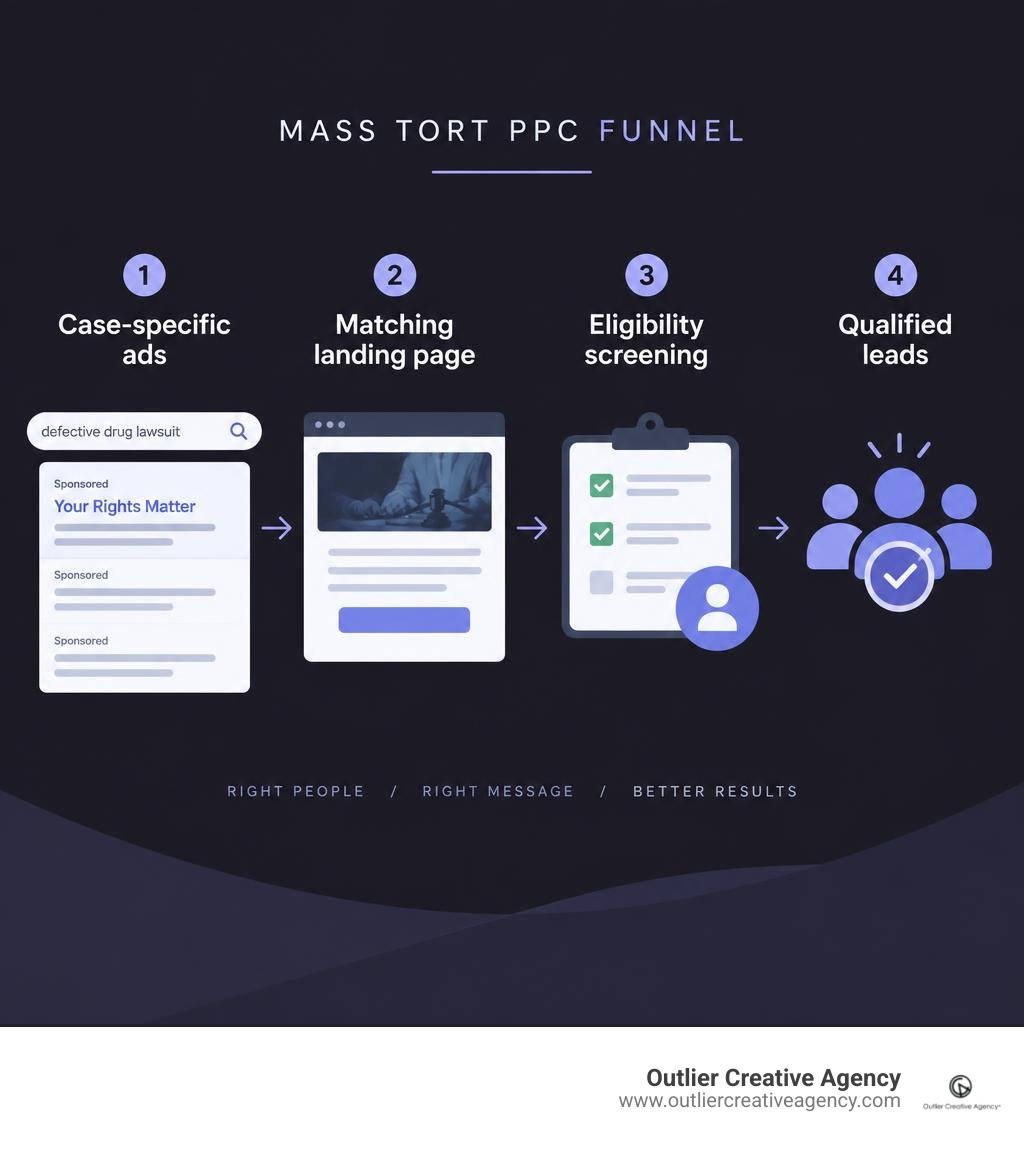
Start with case-specific search terms that signal someone is looking for legal help. Send each click to a page about that case, screen inquiries for basic eligibility, and measure qualified leads and signed clients rather than clicks alone. Before launch, check your ads and landing pages against the advertising rules in every state you target.
Mass tort campaigns differ from local legal ads: they may need to reach claimants across many states, and demand can change as a case develops. Google Search can reach people actively seeking counsel, while paid social can build awareness. The hard part is connecting both channels to a careful intake process without wasting your budget.
I'm Corey Larson, and my work with legal experts on law firm content, video, and websites shapes how I approach mass tort litigation PPC. That experience informs the practical choices on targeting, conversion, and lead quality we'll cover next.
Why Is Mass Tort Litigation PPC Fundamentally Different from Standard Legal Ads?
Running paid search for mass torts is an entirely different operational game than managing local personal injury campaigns. While standard personal injury marketing focuses on capturing high-intent local queries immediately following an accident, mass tort lead acquisition requires managing national scale, fluctuating multi-district litigation (MDL) dockets, and massive intake volumes.
In standard personal injury PPC, you might target a 25-mile radius around your physical office in Los Angeles or Austin. In contrast, mass tort acquisition casts a nationwide net. The average cost-per-click (CPC) for legal keywords across the United States sits around $6.75, but competitive tort terms routinely surge past $10 to $100+ per click depending on the maturity of the litigation.
| Feature | Standard Personal Injury PPC | Mass Tort Litigation PPC |
|---|---|---|
| Geographic Scope | Local / Metro Radius (e.g., city, county) | Nationwide / Multi-State |
| Average CPC | $50 - $150+ (High local variance) | $10 - $100+ (High national keyword competition) |
| Intake Mechanism | Immediate call / Consultation booking | Multi-tier qualification questionnaires |
| Case Lifecycle | Steady, year-round search volume | Spikes tied to FDA recalls, MDL rulings, bellwethers |
| Lead Quality Metric | Proximity and immediate liability | Medical criteria and proof of product use |
Because you are aggregating hundreds or thousands of prospective claimants across jurisdictions, the margin for error is razor-thin. If your targeting is loose, you can spend tens of thousands of dollars on unqualified clicks in a matter of days.
What Keyword Strategies Drive Mass Tort Litigation PPC Success?
Targeting keywords like "pharmaceutical litigation lawyer" or specific product liability phrases demands absolute precision. Setting up effective PPC for attorneys requires organizing your campaigns around exact medical diagnoses, branded drug names, and defective medical devices rather than generic legal queries.
To protect your budget:
- Focus on Problem-Aware Keywords: Target phrases containing the specific product name alongside the injury (e.g., "Ozempic gastroparesis lawsuit" or "Exactech knee replacement revision lawyer").
- Use Exact and Phrase Match Aggressively: Broad match terms will trigger informational queries from students, medical researchers, or patients looking for basic drug side effects.
- Build Robust Negative Keyword Lists: Proactively exclude terms like "stock price," "prescribing information," "dosage," "career," "mechanism of action," and "class action defense."
- Isolate High-Intent Commercial Queries: Reserve higher bids for searches that explicitly contain "lawyer," "attorney," "compensation," or "lawsuit criteria."
How Does Multi-District Litigation Impact Search Behavior and Timelines?
Claimant search volume does not follow a linear path. Instead, search behavior experiences violent spikes triggered by external milestones: an initial FDA recall, the formal consolidation of an MDL, or the announcement of early bellwether trial verdicts.
Practicing attorneys—such as Melissa A Agnetti, Lawyer in Los Angeles, California —understand how critical the litigation lifecycle is when evaluating plaintiff viability. As statutes of limitations approach or settlement matrices take shape, consumer awareness surges. Your paid campaigns must adjust bid pacing in real time to capitalize on news cycles while throttling back when dockets close or qualification criteria tighten.
Which Advertising Channels and Audience Targeting Methods Work Best?
A successful mass tort acquisition engine rarely relies on a single ad platform. We find that combining the direct intent of search with the broad discovery power of paid social delivers the lowest blended cost per signed retainer.
When partnering with a dedicated team for law firm PPC services, firms typically split their media spend to balance high-intent search queries with lower-cost social lead generation.
When Should Law Firms Prioritize Google Search Ads Over Social Media?
Google Ads commands over 90% of all legal industry PPC spend, and for good reason: search captures active intent. When a potential claimant actively searches for a "defective knee implant replacement lawyer," they are already aware of their injury and seeking representation.
Firms should prioritize Google Search when:
- The litigation is mature, and public awareness of the harm is already established.
- You need immediate, highly qualified claims with documented proof of use.
- You need to execute brand-protection campaigns to prevent competitors from bidding on your firm's name.
Applying the best PPC for lawyers principles means using Search for your bottom-of-funnel conversions, where claimants are ready to sign a retainer agreement immediately.
How Does Custom Audience Targeting Capture Affected Claimants?
While search engines capture existing demand, paid social media channels (such as Facebook and Instagram) create demand by educating passive victims.
To reach prospective plaintiffs effectively:
- Demographic Layering: Align age and gender parameters with known plaintiff demographics (e.g., targeting individuals aged 55+ for joint replacement hardware failures).
- Geographic Clustering: Concentrate ad spend in states or regions where medical records indicate high usage rates of a particular drug or device.
- Interest-Based Proxies: Layer lifestyle or condition-specific interest indicators, ensuring ads deliver educational content that prompts claimants to check their eligibility.
How Do You Build High-Converting Landing Pages and Maintain Compliance?
Even the most optimized paid search campaign will fail if clicks land on a generic homepage. Research shows that law firms using dedicated, conversion-optimized landing pages can lift conversion rates by up to 30% compared to sending traffic to generic web pages.

How Can You Maximize Conversion Rates in Mass Tort Litigation PPC Campaigns?
The average legal conversion rate falls between 2% and 5%, but mass tort landing pages can achieve substantially higher numbers when friction is minimized. Implementing the strategies detailed in our PPC marketing guide for lawyers ensures your landing pages turn expensive traffic into validated retained cases.
Key conversion elements include:
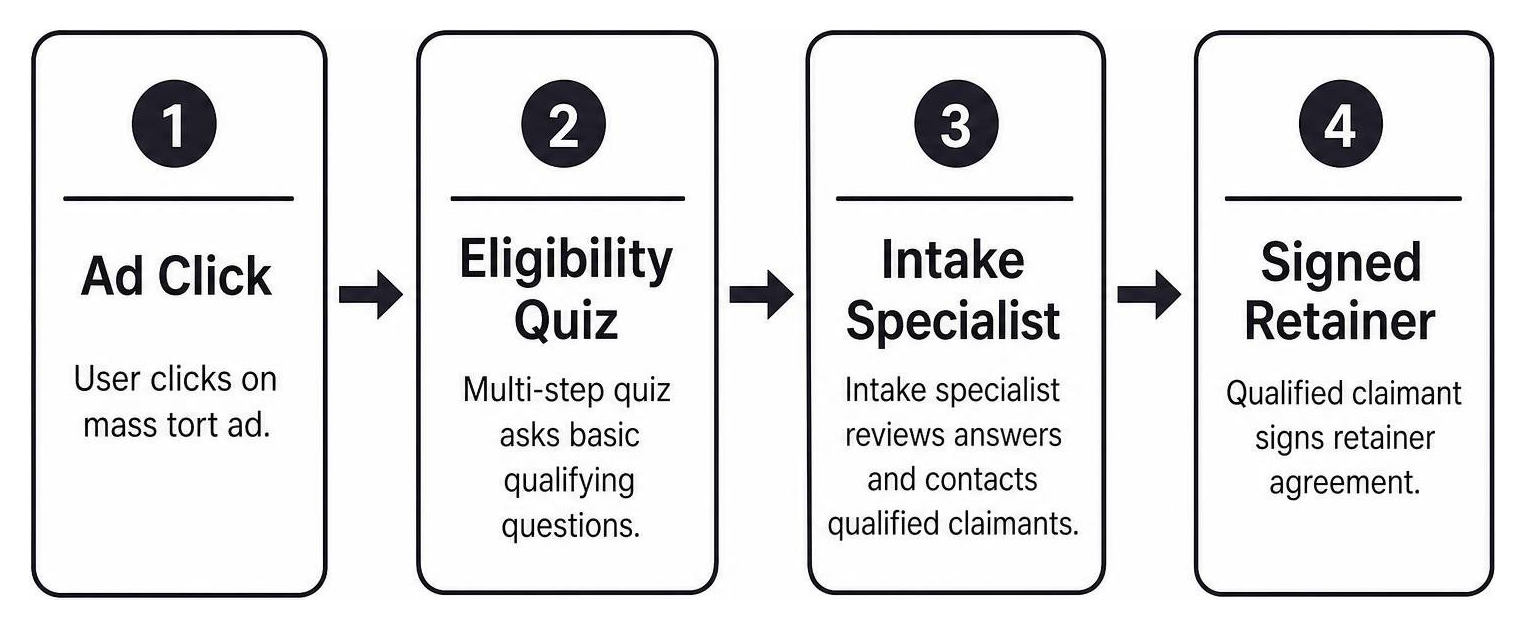
- Multi-Step Eligibility Forms: Rather than intimidating users with a massive form, use a multi-step quiz asking basic qualifying questions (e.g., "Did you take Suboxone between 2018 and 2024?", "Were you diagnosed with severe tooth decay?").
- AI Chatbots and 24/7 Virtual Receptionists: Claimants search at all hours. Automated intake assistants capture inquiries outside standard business hours, reducing missed inquiries by over 40%.
- Trust Badges and Clear Value Propositions: Prominently display zero-fee guarantees ("No fee unless we win") and secure data encryption notices to alleviate privacy concerns regarding sensitive medical history.
How Can Ads Stay Compliant with State Bar Advertising Rules?
Legal advertising is heavily policed. When running multi-state campaigns, your ads and landing pages must comply with state bar ethics rules across every jurisdiction where the ad appears:
- Mandatory Disclaimers: Include clear disclosures such as "Attorney Advertising," the name of the licensed attorney responsible for the advertisement, and their primary office location (e.g., Los Angeles, CA or Austin, TX).
- Medical Disclaimers: Explicitly state that patients must not stop taking prescribed medication without first consulting their physician.
- Truth in Advertising: Never guarantee financial outcomes or characterize past case results as promises for future settlements.
How Should Law Firms Budget and Measure ROI to Avoid Wasted Ad Spend?
With approximately 70% of law firms identifying PPC as their most effective channel for generating qualified mass tort leads, disciplined budget allocation is essential. Mass tort firms routinely dedicate 15% to 20% of their total marketing budget to paid search.
To prevent budget exhaustion, conduct regular reviews following our law firm PPC audit guide 2026 framework, ensuring bids align with signed case value.
What Are the Essential Metrics for Tracking Mass Tort Campaign Performance?
Do not let vanity metrics like clicks and raw impressions cloud your analysis. Real law firm PPC results depend on downstream case metrics:
- Cost Per Lead (CPL): Total ad spend divided by total form submissions or calls.
- Lead Qualification Rate: The percentage of raw leads that meet the basic legal and medical criteria of the tort.
- Cost Per Acquisition (CPA) / Cost Per Signed Retainer: The true benchmark of marketing efficiency—total spend divided by executed retainer agreements.
- Signed Case Velocity: The time elapsed between the initial click, intake completion, and signed retainer return.
How Can Law Firms Integrate Paid Ads with SEO and Content Marketing?
Paid ads should not exist in a silo. By pairing immediate PPC lead acquisition with long-term organic content assets, law firms build sustainable authority.
When you publish authoritative guides detailing MDL procedural updates, settlement criteria, and scientific studies, your organic pages support your paid efforts. Retargeting past organic website visitors with focused search ads lowers your overall acquisition costs and builds multi-touch brand credibility.
Frequently Asked Questions About Mass Tort PPC
How much does mass tort PPC cost per click in 2026?
While average legal search keywords hover around $6.75 per click, competitive mass tort keywords routinely range from $10 to well over $100 per click. Pricing varies based on case maturity, the remaining statute of limitations window, and the total national bidding competition among plaintiff firms.
What is the average conversion rate for mass tort PPC landing pages?
Standard legal PPC campaigns typically convert between 2% and 5%. However, optimized mass tort landing pages utilizing dynamic multi-step qualification quizzes, mobile-first layouts, and integrated 24/7 intake support routinely reach conversion rates of 8% to 15% for initial eligibility inquiries.
What is the biggest mistake law firms make in mass tort advertising?
The single most expensive mistake is failing to implement rigorous intake qualification. Driving high-volume traffic to an unvetted intake team creates bottlenecks, wastes marketing dollars on unqualified claims, and allows high-value claimants to slip away due to slow response times.
Conclusion
Scaling a mass tort docket requires balancing high-intent search campaigns, strict state bar advertising compliance, and rapid intake mechanisms. Because competition for claimants remains intense, firms must eliminate wasted spend through rigorous negative keyword management, multi-step qualification landing pages, and cross-channel synergy.
At Outlier Creative Agency, we engineer data-driven digital marketing campaigns designed exclusively for law firms across the nation. Explore our full suite of PPC advertising for law firms to discover how our award-winning legal marketing team can help you capture qualified claimants, maximize your marketing budget, and scale your firm's case inventory.