

Master social media management with this complete guide covering multi-platform strategy, automation tools, analytics, and brand consistency for 2026.
What Is Social Media Management and Why Is It Vital in 2026?
Social media management is the continuous operational process of curating, publishing, monitoring, and analyzing content across digital platforms to build an authoritative brand and generate measurable business growth. In 2026, it is no longer just an optional public relations exercise. It functions as the primary digital front door for modern practices.
Without a structured system, digital marketing quickly turns chaotic. Industry research shows that social media managers spend over six hours a week just switching between disconnected tools before a single post goes live. For legal practices and corporate professionals, this tool fragmentation leads to inconsistent posting, delayed client responses, and missed retention opportunities.

Modern multi-channel management requires enterprise-grade oversight. A dedicated system prevents brand dilution across fragmented networks, maintains strict ethical governance, and transforms passive accounts into active conversational channels. Utilizing an advanced social listening and management platform allows organizations to consolidate their publishing queues, catch potential compliance risks before publication, and monitor public sentiment in real time.
How Does Social Media Management Differ from Social Media Marketing?
While the terms are often used interchangeably, they represent two distinct operational layers. Social media marketing establishes the overarching strategic direction—identifying target demographics, defining key value propositions, allocating advertising budgets, and designing broader campaign frameworks.
In contrast, social media management represents the day-to-day execution and administrative engine. It ensures posts go live on time, monitors direct messages, responds to comments, enforces editorial guidelines, and tracks operational performance.
| Strategic Dimension | Social Media Marketing | Social Media Management |
|---|---|---|
| Primary Focus | Strategy, campaign positioning, and ad budget allocation | Day-to-day execution, publishing workflows, and community care |
| Core Activities | Audience persona definition, creative briefs, paid campaign setup | Content scheduling, comment moderation, asset formatting |
| Time Horizon | Quarterly campaigns and long-term positioning | Daily publishing schedules and real-time community engagement |
| Success Metrics | Return on ad spend (ROAS), cost per acquisition, market reach | Publishing consistency, response times, engagement rates |
How Has Social Discovery Replaced Traditional Search Engines?
Consumer discovery habits have fundamentally shifted. Current industry data reveals that 46% of Gen Z now prefer social platforms over search engines to find information, service providers, and expert answers.
Algorithms across platforms like Instagram, TikTok, LinkedIn, and YouTube prioritize semantic search over strict hashtag matching. Prospective clients no longer type disjointed search queries into standard browser bars. Instead, they search for conversational phrases such as "what to do after a workplace dispute" or "steps for filing a trademark" directly within social search bars.
To capitalize on this behavior, social posts must feature keyword-rich captions, clear text overlays, and structured metadata. Because short-form video drives 2 to 8 times more engagement than static graphics, visual educational content has become the fastest way to capture high-intent audiences. Integrating these formats into a broader digital marketing strategy ensures your firm remains discoverable where prospective clients spend their time.
What Core Pillars Drive a Successful Multi-Platform Strategy?
Building a dependable, high-converting social media operation requires moving beyond spontaneous, ad-hoc publishing. Sustainable growth stems from a structured, repeatable framework that aligns daily output with regulatory standards and firm goals.
What Are the Essential Pillars of Social Media Management?
An effective social media program rests on five core operational pillars:
- Content Creation and Curation: Developing high-value assets tailored to each channel's specific audience, from short educational video clips to detailed case summaries.
- Smart Scheduling and Publishing: Orchestrating a consistent delivery pipeline that reaches prospective clients when they are most active, without requiring manual intervention for every post.
- Active Community Management: Moderating incoming comments, answering direct inquiries, and cultivating authentic two-way dialogue while strictly adhering to ethical communication standards.
- Proactive Social Listening: Monitoring broader industry conversations, competitor activity, brand mentions, and shifts in client sentiment across all major digital channels.
- Analytics and Performance Reporting: Evaluating objective engagement and conversion metrics to continuously refine content distribution and demonstrate return on investment.
Deploying specialized marketing automation tools eliminates operational bottlenecks across these pillars, allowing your internal team to maintain consistency while safeguarding billable hours.
How Can You Establish a Cohesive Brand Presence?
To stand out in competitive digital feeds, practices must establish a clear identity. Over 300,000 marketing professionals have studied structured branding models like Meta's EPIC framework, which focuses on four core elements:
- Existence: Clarifying your specific practice focus, geographical reach, and primary service offerings.
- Purpose: Defining the foundational mission of your firm and why your legal team advocates for clients.
- Identity: Maintaining a consistent visual aesthetic, professional color palette, typography, and authoritative tone of voice.
- Connection: Creating content that addresses prospective clients' real-world questions and legal concerns.
In legal marketing, establishing a cohesive presence requires balancing engaging creative formats with state bar compliance. For example, law firms operating in California or Texas must ensure that social copy avoids promising specific financial outcomes, clearly displays required attorney advertising disclaimers, and accurately represents past verdicts.
High-caliber visual storytelling—such as professional video production for legal practices—builds immediate trust and emotional rapport far more effectively than generic stock photography.
How Do Modern Tools and Automation Streamline Publishing?
Juggling multiple native social applications without a centralized control hub creates significant operational friction. Modern publishing platforms resolve this by unifying content pipelines, social inboxes, and scheduling queues into a single administrative view.

Connecting your channels through comprehensive platforms like Zoho Social simplifies multi-account syndication. Teams can draft a master message, customize platform-specific elements (such as character limits, aspect ratios, and tagging protocols), and dispatch assets across multiple profiles with a single click.
Which Social Media Management Tool Features Best Fit Your Practice?
Selecting the appropriate platform depends heavily on your team's operational structure, client intake workflows, and compliance requirements. Essential features to look for include:
- Multi-Network Publishing: Broad integration covering key professional networks (LinkedIn, YouTube, Facebook, X, Instagram, TikTok, Threads, and Google Business Profile).
- Unified Inbox Management: A consolidated stream combining public comments, mentions, reviews, and private direct messages into one triaged workflow.
- Role-Based Permissions and Approval Queues: Administrative controls that prevent junior staff or external contributors from publishing content without formal partner or compliance review.
- Integrated CRM and Lead Routing: Connecting social interactions directly with intake software to drive effective lead generation automation.
How Do Free and Low-Cost Platforms Compare for Lean Teams?
Solo practitioners, boutique firms, and small marketing teams do not always require enterprise-tier suites immediately. Several budget-conscious platforms offer robust scheduling and tracking capabilities, though each comes with specific functional trade-offs.
| Tool Name | Starting Pricing Model | Best Use Case | Notable Platform Limitations |
|---|---|---|---|
| Buffer | Free plan available; paid tiers start at $6/month per channel | Solo creators and lean teams needing simple scheduling | Lacks advanced social listening; reporting is basic on entry plans |
| Zoho Social | Free tier for basic publishing; Standard from ~$15/month | Practices already utilizing the broader Zoho software ecosystem | Deepest value requires full integration with other Zoho CRM tools |
| Metricool | Free plan for 1 profile per network; paid from $25/month | Detailed social analytics combined with ad-spend monitoring | Interface can feel dense; team collaboration requires higher plans |
| Sendible | Creator plans start around $29/month | Small agencies and growing practices managing multiple brands | Strict limits on connected profiles and scheduled posts per tier |
| Tailwind | Free trial; paid plans starting around $15–$30/month | Visual-heavy practices leveraging Pinterest and Instagram | Limited utility for text-heavy B2B channels like LinkedIn or X |
Lean practices must weigh whether per-channel pricing models will scale affordably as they expand into new social formats, or if a flat-rate platform makes more financial sense over a 12-month period.
How Do Analytics, AI, and Social Listening Drive Measurable Growth?
Modern social management is grounded in objective data rather than guesswork. Continuous performance monitoring allows organizations to identify which topics resonate, refine posting cadences, and protect their professional reputation.

Deploying real-time social listening ensures you catch brand mentions, client reviews, and localized legal discussions across millions of public web sources. Advanced platforms like EVA Social AI allow teams to model audience sentiment and predict engagement trends before launching broad campaigns.
How Do Agentic AI and Predictive Tools Transform Operations?
Artificial intelligence in social management has evolved far beyond simple caption generators. Autonomous agentic systems now assist marketing teams with complex, multi-step operational workflows.
Modern tools can evaluate years of historical engagement data to pinpoint exact optimal posting windows for specific audience subsets. Furthermore, emerging predictive systems can analyze draft video scripts, creative imagery, and copy to forecast probable audience reactions and comment sentiment prior to distribution.
While AI significantly accelerates ideation and drafting, maintaining human oversight remains non-negotiable—especially for regulated professions. An attorney or compliance officer must verify all factual assertions to prevent ethical missteps. For an in-depth breakdown of safe automation practices, review our marketing automation guide.
How Can You Evaluate Performance Data and Track Return on Investment?
Proving the real-world value of social media requires moving past surface-level vanity metrics. While high impression counts and post likes indicate content reach, they do not directly reflect business viability.
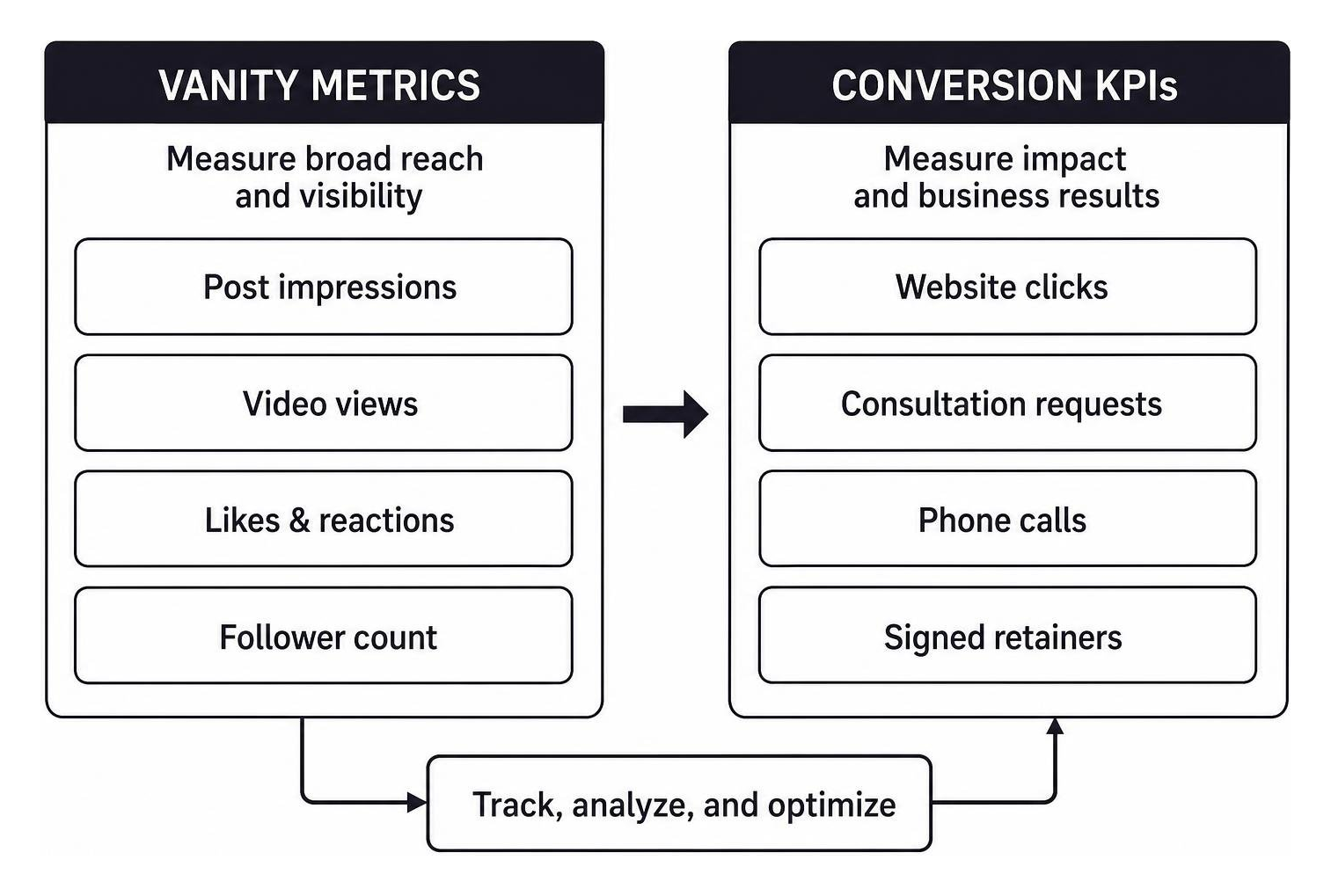
Law firm managing partners need to understand how social touchpoints translate into signed retainers and qualified consultations. Implementing structured tracking protocols—such as custom UTM parameters, unique call-tracking numbers, and dedicated landing page funnels—bridges the gap between social engagement and firm revenue.
| Measurement Level | Metric Category | Key Data Points Tracked | Practical Business Implication |
|---|---|---|---|
| Top of Funnel (Vanity) | Brand Awareness & Reach | Total post impressions, video views, follower count, profile visits | Measures broad audience exposure and initial brand visibility |
| Middle of Funnel (Engagement) | Audience Interaction | Comments, post shares, saves, average watch time, click-through rate (CTR) | Validates content resonance, authority, and audience interest |
| Bottom of Funnel (Conversion) | Business Impact & ROI | Inbound consultation requests, phone calls, form fills, signed retainers | Measures tangible revenue contribution and client acquisition cost |
Integrating high-intent video campaigns with tailored intake pathways directly strengthens your firm's client acquisition strategies.
What Should You Remember About Social Media Management?
Succeeding on social media requires consistency, strategic governance, and audience-first content. For professional service firms and legal practices, your social presence serves as an active portfolio of your expertise, firm culture, and client dedication.
Managing content across multiple fast-moving platforms while running a demanding practice can stretch internal resources thin. At Outlier Creative Agency, we build tailored, compliant, and data-driven campaigns designed to expand your reach, establish digital authority, and drive qualified caseload growth.
If your firm is ready to turn social channels into a dependable growth asset, explore our full-service social media management solutions or connect with our team to schedule a strategy consultation.
What Questions Do People Ask About Content Operations?
How Much Time Does Effective Social Media Management Take Per Week?
For a small to mid-sized business, managing 2 to 3 social media profiles effectively takes approximately 8 to 15 hours per week. This time includes content ideation, asset design, video editing, copywriting, compliance reviews, daily comment moderation, and monthly performance reporting.
Firms that use batching workflows and automated scheduling tools can often reduce routine publishing time by 30% to 50%, allowing them to focus their energy on direct community engagement and client inquiries.
What Is the Biggest Challenge When Managing Multiple Social Media Accounts?
The primary challenge is maintaining platform-specific relevance without burning out internal resources. Each social network features unique audience demographics, aspect ratio standards, algorithm preferences, and content cultures.
Repurposing a single static post across LinkedIn, Instagram Reels, and X without adapting the creative format leads to poor engagement. Successful teams solve this by creating core message pillars and tailoring the visual assets, aspect ratios, and captions to fit each channel's native expectations.
How Does Consistent Social Media Activity Improve AI Answer Engine Visibility?
Modern AI search tools and answer engines (like ChatGPT, Perplexity, and Google AI Overviews) pull real-time entity data, brand sentiment, and contextual authority from public web conversations.
Active, well-structured social media accounts that regularly publish informative content, engage in public discussions, and answer industry-specific questions provide clear context for AI crawlers. Maintaining a consistent, authoritative presence increases the likelihood that AI answer engines cite your firm when users ask for service recommendations in your practice area.
Should Businesses Manage Social Channels Internally or Hire an Agency?
The decision comes down to available capacity, specialized technical skill, and long-term business goals. Managing social media in-house works well if your firm has dedicated, marketing-focused personnel who understand video production, graphic design, analytics, and advertising compliance.
However, if your attorneys or intake specialists are sacrificing billable hours to write captions or edit video clips, partnering with an agency like Outlier Creative Agency provides immediate access to professional production, full compliance oversight, and scalable growth strategies.