

Compare attorney marketing automation pricing across firm tiers, hidden fees, and ROI. See how automation cuts costs vs. staff and agencies.
How Much Does Attorney Marketing Automation Cost Across Firm Tiers?
When evaluating attorney marketing automation pricing, law firms quickly discover that software costs are structured around three main vectors: firm size, monthly inquiry volume, and contact database capacity. Small practices handling a handful of new inquiries per week require very different infrastructure than multi-state personal injury or family law practices processing hundreds of potential client contacts each month.
To help managing partners and legal marketing directors evaluate options, software vendors structure their pricing tiers to reflect these operational demands:
| Tier | Primary Target | Typical Monthly Base Cost | Contact & User Limits | Core Capability Highlights |
|---|---|---|---|---|
| Entry-Level / General CRM | Solo practitioners & early-stage firms | $10 - $49 / user / month | 1,000 - 2,000 contacts | Basic email newsletters, simple web forms, contact storage |
| Legal-Specific CRM & Automation | Small to mid-sized law firms | $39 - $299 / month | 2,500 - 10,000 contacts | Automated text/email drip, e-signatures, intake pipelines, case software sync |
| Enterprise & Multi-Channel Systems | High-volume & enterprise practices | $1,250 - $3,250+ / org / month | 10,000+ contacts | Dynamic lead scoring, multi-channel journeys, cross-channel attribution, agentic AI |
Only 41% of law firms currently utilize CRM software, and a mere 22% of lawyers personally use one for client intake and follow-up. Understanding these tier structures enables firms in competitive markets—from Los Angeles to Austin—to invest in platforms that close the intake gap without overpaying for enterprise features they will never use.
What Key Factors Influence Attorney Marketing Automation Pricing?
Software providers calculate attorney marketing automation pricing using several key variables:
- Active Contact Database Thresholds: Most subscription plans set limits on how many active marketing contacts you can hold in your database. For instance, Zoho Marketing Automation Software offers a Standard plan starting at $10/month for 2,000 contacts, but as your contact list scales into tens of thousands of dormant leads, subscription costs scale alongside it.
- User Seat Licensing: Platforms like MyCase (starting around $39/user/month) and Clio Grow (starting around $49/user/month) charge per user seat. Adding intake specialists, associate attorneys, and paralegals to the workflow directly increases the monthly bill.
- Multi-Channel Communication Capabilities: Basic email automation is relatively inexpensive. However, adding two-way SMS messaging, automated ringless voicemails, and WhatsApp touchpoints requires additional usage credits or higher tier subscriptions.
When selecting specialized Marketing Automation Tools, firms must balance per-seat fees against raw contact storage limits to determine their true monthly investment.
How Do Entry-Level, Legal CRM, and Enterprise Pricing Models Compare?
Entry-level solutions like general CRMs or lower-tier email tools offer low monthly commitments but lack legal-specific workflows. Conversely, specialized legal automation platforms like Lawmatics (starting around $199/month) charge flat monthly fees for full automation suites built specifically for legal intake, custom intake forms, and automated engagement letters.
At the enterprise level, platforms such as Salesforce Marketing Cloud Pricing feature org-wide pricing models rather than simple per-user pricing. For example, Salesforce Marketing Cloud Next Growth Edition starts at $1,500/org/month (billed annually), while Advanced Editions reach $3,250/org/month. These systems provide deep data unification and cross-channel orchestration, but they require substantial software investments designed for multi-office or national legal organizations.
For firms focused primarily on client acquisition, pairing solid legal intake software with specialized Marketing Automation and Lead Generation tactics yields a far better return than over-engineered enterprise platforms.
What Are the Hidden Fees and Onboarding Expenses of Legal Automation Tools?

The sticker price listed on a software vendor's website rarely reflects the total cost of ownership. Beyond basic monthly subscriptions, law firms frequently encounter implementation fees, data migration costs, and messaging overage charges that can significantly alter the overall budget.
How Can Law Firms Uncover Hidden Costs in Automation Pricing Models?
To avoid unexpected bills, firms should carefully audit vendor agreements for the following hidden charges:
- Contact Block Overages: Exceeding your plan’s contact limit can pause ongoing marketing automation campaigns or automatically upgrade your firm to a higher pricing tier. Enterprise platforms often charge approximately $100/month per additional 10,000 contacts.
- SMS and WhatsApp Messaging Credits: Outbound text messaging is essential for high-converting legal intake, but cellular carrier fees and messaging credits add up. SMS credit packages typically start around $10 per 1,000 credits, depending on message length and volume.
- Third-Party API & Middleware Integrations: Connecting your marketing automation platform to practice management tools, document management systems, or proprietary intake forms may require paid connectors like Zapier or custom API development services.
Reviewing a comprehensive Law Firm Marketing Automation Cost Guide 2026 prior to signing contracts ensures managing partners account for these operational variables.
What Do Implementation, Success Plans, and AI Messaging Credits Cost?
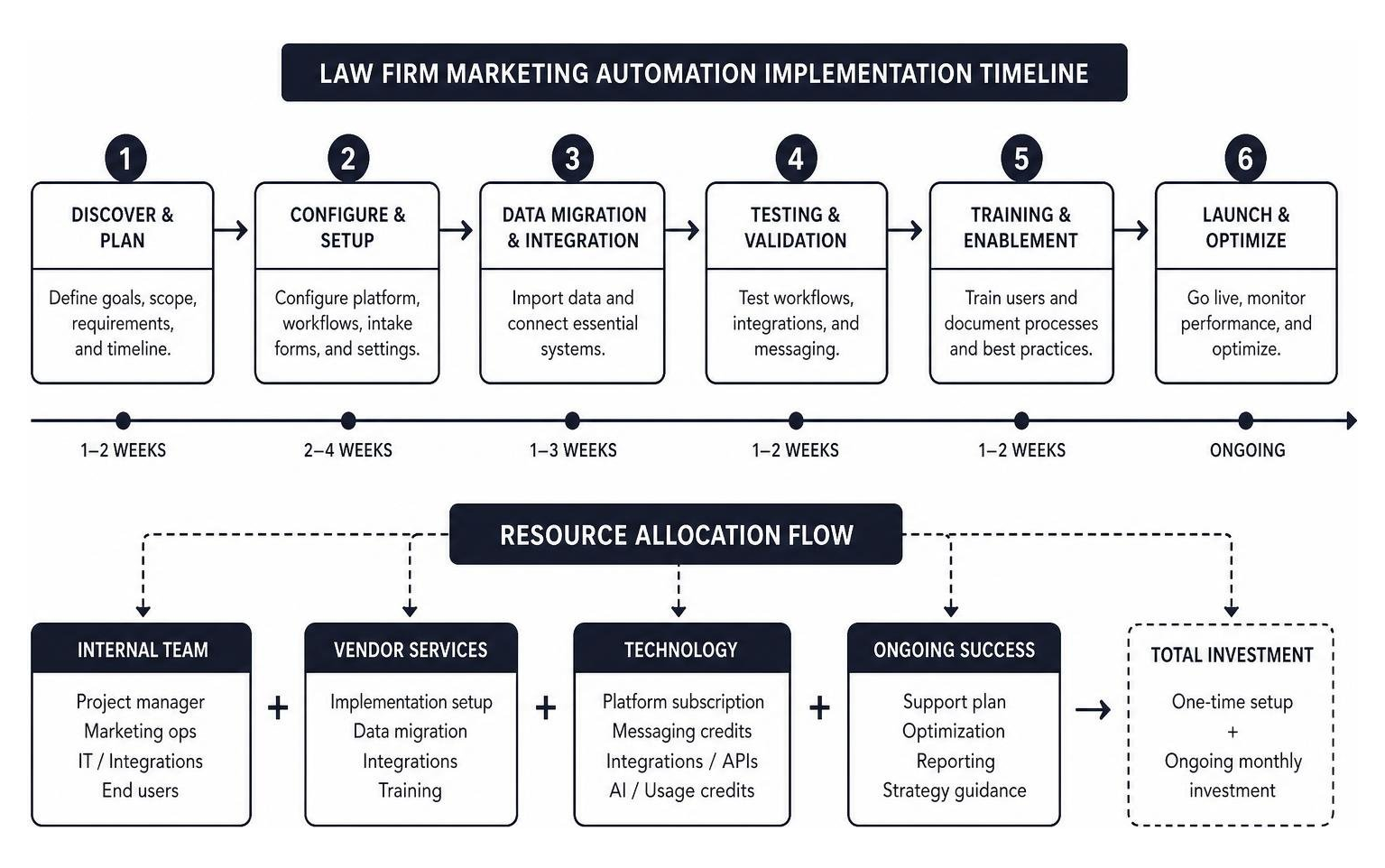
Onboarding a dedicated legal CRM or enterprise marketing system involves professional services. Mid-tier legal platforms frequently charge mandatory setup fees ranging from $500 to $2,500 to configure workflows, import historical lead data, and train staff.
For enterprise platforms, success plans represent a substantial ongoing cost. Customer support add-ons—such as Salesforce's Premier Success Plan—cost an additional 30% of net license fees annually. Furthermore, modern AI-driven platforms that leverage predictive lead scoring or automated conversational intake rely on credit-based consumption models for natural language processing and agentic AI features.
How Do Automation Software Costs Compare to In-House Staff and Agencies?
When law firm leadership evaluates attorney marketing automation pricing, they are ultimately deciding between software-driven leverage, full-time internal hires, or specialized agency partnerships.
What Is the Cost-Benefit Breakdown of Automation Software vs. Personnel?
Hiring a full-time legal marketing coordinator or intake specialist represents a significant financial commitment. In metropolitan markets like Los Angeles and Austin, a qualified marketing employee commands a base salary between $60,000 and $85,000 annually. When factoring in payroll taxes, health insurance, paid time off, and workspace overhead, the true employee cost easily exceeds $7,000 per month.
By contrast, an AI SDR platform or automated lead generation tool like AnyBiz AI SDR Pricing starts around $497/month (billed quarterly), while comprehensive legal marketing automation suites run between $200 and $1,000 per month.
While software tools operate 24/7 without taking vacations, software alone cannot write high-converting ad copy, build strategic campaigns, or monitor regulatory compliance. This is why many firms pair automation platforms with targeted legal marketing services. Combining automated intake workflows with tailored legal strategies outlined in our Email Marketing Guide for Lawyers delivers full-funnel execution without internal headcount bloat.
What Compliance and Risk Factors Impact Automated Marketing Costs Under ABA Rule 7.3?
Automated marketing in the legal sector carries regulatory compliance obligations. American Bar Association (ABA) Model Rule 7.3 governs solicitation and direct communications with prospective clients. Automated text messages or emails that cross the line into impermissible real-time electronic solicitation can lead to bar disciplinary inquiries and mandatory ethics reviews.
Compliance risk impacts pricing in three ways:
- Tool Configuration & Opt-Out Management: Software must support strict opt-out mechanisms, unsubscribe management, and clear legal disclaimers.
- Content Audit Expenses: Automated drip sequences must be reviewed by experienced legal marketers or ethics counsel to verify that practice-area claims comply with local state bar rules (such as the State Bar of California or the State Bar of Texas).
- Data Privacy Safeguards: Automated intake systems collecting sensitive health or personal injury information must comply with strict data privacy regulations, requiring secure, encrypted database environments.
At Outlier Creative Agency, we design all automated outreach and advertising campaigns with legal ethics compliance built directly into every workflow.
How Can Law Firms Measure ROI and Payback Speed from Marketing Automation?

Investing in marketing automation is an investment in revenue acceleration. Because the average nationwide cost per lead (CPL) for legal search ads sits around $111—and easily tops $150 per click in high-stakes fields like personal injury or commercial litigation—wasting prospective client leads due to delayed follow-up directly destroys campaign profitability.
Which Automation Tasks Generate the Fastest ROI for Intake and Reviews?
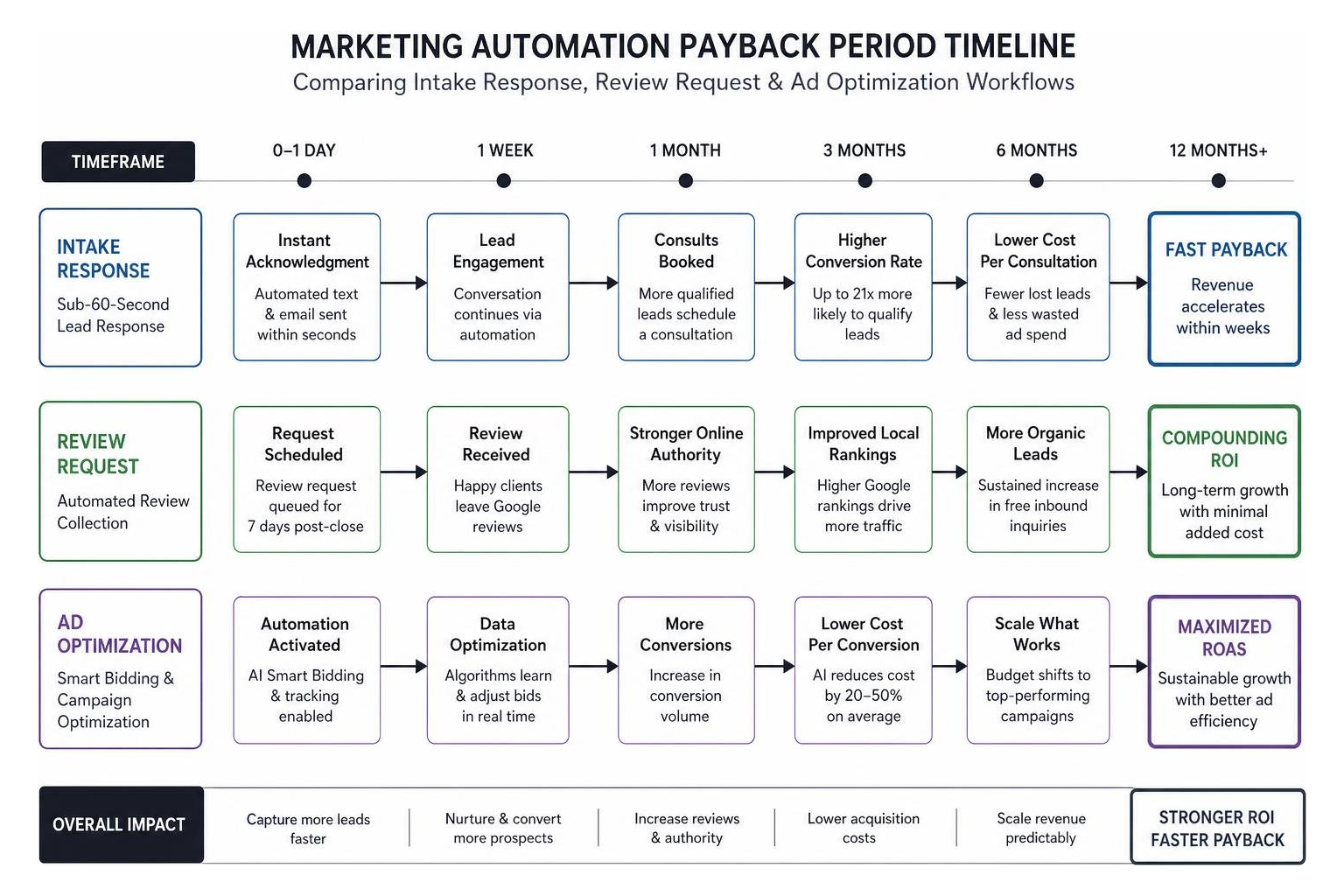
The fastest payback period for any law firm comes from automating three core touchpoints:
- Sub-60-Second Lead Response: Responding to an online inquiry within five minutes makes a practice 21 times more likely to qualify that lead compared to waiting 30 minutes. Automated instant text and email acknowledgments capture prospect attention before they contact a competing firm.
- Dormant Lead Reactivation: Acquiring a brand-new client costs 5 to 25 times more than re-engaging an existing relationship or past inquiry. A simple 3-email automated reactivation sequence sent to unconverted leads from the past 12 months generates immediate consultations at zero additional ad spend.
- Automated Review Collection: Automatically triggering google review requests seven days after closing a matter builds online authority, directly driving higher organic rankings through our specialized SEO strategies.
How Does Automation Lower Cost-Per-Lead and Eliminate Wasted Ad Spend?
Industry studies indicate that 42% of digital advertising spend produces no measurable results due to poor attribution, uncontacted leads, and non-converting landing pages. Marketing automation eliminates this loss by capturing lead source data down to the specific campaign and keyword.
When combined with dynamic advertising optimizations, law firms see immediate reductions in acquisition costs. Implementing AI Smart Bidding across search engines increases overall conversion volume by 25-70% while simultaneously reducing cost-per-conversion by 20-50%. Pairing smart advertising through our paid media management services with instant automated intake ensures every paid click gets converted into a qualified consult.
How Should Law Firms Budget for Scaling Lead Inquiries?
As a law practice grows from receiving 10 lead inquiries per month to handling 200+ monthly inquiries, its software infrastructure, budget allocation, and operational workflows must evolve accordingly.
How Do You Allocate Marketing Spend when Scaling from 10 to 200+ Inquiries?
Scaling intake requires strategic budgeting transitions across three distinct operational growth phases:
- The 10-50 Inquiry Phase (Foundation): Focus spending on basic legal CRM tools ($50-$200/month) that automate immediate response texts, simple email follow-ups, and calendar booking links. Software costs represent a minor fraction of the overall marketing budget.
- The 50-150 Inquiry Phase (Optimization): Introduce advanced conditional routing logic based on practice area (e.g., separating contested divorce leads from high-asset estate planning). Budget for text credit packages, automated document collection, and dynamic lead scoring.
- The 200+ Inquiry Phase (Scale): Deploy advanced platforms featuring conversational AI intake concierges and automated conflict checks. At this level, firms spend $1,000+ monthly on software, while dedicating 15-20% of their overall marketing budget toward comprehensive multi-channel campaigns, including custom legal plan offerings like those detailed in Subscription Legal Plans and Why Your Law Firm Needs One.
How Do Free Entry-Level Tools Compare to Dedicated Paid Software?
Many solo attorneys start with free tools, such as HubSpot's free CRM tier or standard website contact forms. While free tools store contact names and send standard notification emails, they fall short for legal practices in critical ways:
- Static Forms vs. Conversational AI Intake: Static web forms collect superficial details, forcing staff to conduct lengthy follow-up calls. Dedicated legal tools use conversational intake to capture detailed narrative facts, party names for immediate conflict checks, and critical court deadlines.
- Conversion Rate Disparities: Generic free tools lack automated SMS sequences and legal e-signature integrations, resulting in significantly lower lead-to-consultation conversion rates compared to purpose-built legal marketing automation software.
Frequently Asked Questions about Attorney Marketing Automation Pricing
What is the typical monthly cost range for law firm marketing automation software?
Basic email automation and general legal CRMs range from $39 to $199 per user per month. Mid-sized to large law firms utilizing specialized legal marketing automation suites or enterprise platforms spend between $300 and $1,500+ per month, depending on total contact database size, user seats, and multi-channel messaging volume.
What hidden expenses should attorneys expect when implementing marketing automation?
Beyond the base monthly subscription fee, law firms should budget for one-time implementation and setup fees ($500–$2,500), third-party integration connectors, SMS messaging text packages ($10+ per 1,000 credits), contact list overage fees, and ongoing staff training or success plan subscriptions.
How does marketing automation compare financially to hiring a full-time marketing employee?
A full-time legal marketing employee costs $60,000–$85,000+ annually in base salary, plus an additional 20-30% in taxes, benefits, and administrative overhead. Marketing automation software costs a fraction of that amount ($500–$12,000 annually) and operates 24/7. Most growing firms achieve maximum ROI by combining automation software with an expert digital agency partner rather than carrying full internal salary overhead.
How quickly do law firms usually see a return on investment from marketing automation?
Firms implementing immediate lead response sequences (sub-60-second text/email acknowledgments) and automated dormant lead reactivation campaigns frequently see measurable returns within 30 to 60 days. Automated client review collection campaigns typically show clear results in Google rankings and lead volume within 60 to 90 days.
Conclusion
Navigating attorney marketing automation pricing requires looking beyond base subscription fees to assess total strategic value. While basic software tiers cost as little as $39 per month and enterprise platforms run over $1,250 per month, the real metric is how effectively your automation tech stack captures high-intent leads, accelerates client intake, and boosts overall case acquisition revenue.
At Outlier Creative Agency, we build fully integrated, ethical, and high-converting marketing engines exclusively for law firms across California, Texas, and nationwide. From custom web design and search engine optimization to automated email workflows and pay-per-click advertising, we ensure every marketing dollar delivers measurable firm growth.
Ready to optimize your law firm's intake pipeline and eliminate wasted ad spend? Contact Outlier Creative Agency today to schedule a consultation with our legal marketing team.