

Discover how personal injury video marketing builds trust, boosts conversions, and wins cases with emotional storytelling.
Why Does Emotional Storytelling Drive Personal Injury Video Marketing?
Personal injury video marketing converts distressed claimants by building immediate empathy, trust, and human connection during their tight hiring window. Injured prospects are overwhelmed, dealing with medical appointments, facing lost wages, and fielding aggressive calls from insurance adjusters. Video eliminates friction by communicating empathy, capability, and reassurance far faster than dense text blocks ever could.
Pay-per-click costs in personal injury law continue to reach unprecedented levels. In competitive markets like Los Angeles and Austin, Google Ads CPCs routinely hit $100 to $300 per click. When a single click carries that price tag, sending high-friction traffic to static text pages with standard stock photography is an expensive mistake. Legal prospects in crisis operate within a tight hiring window—often four days or fewer following an incident.
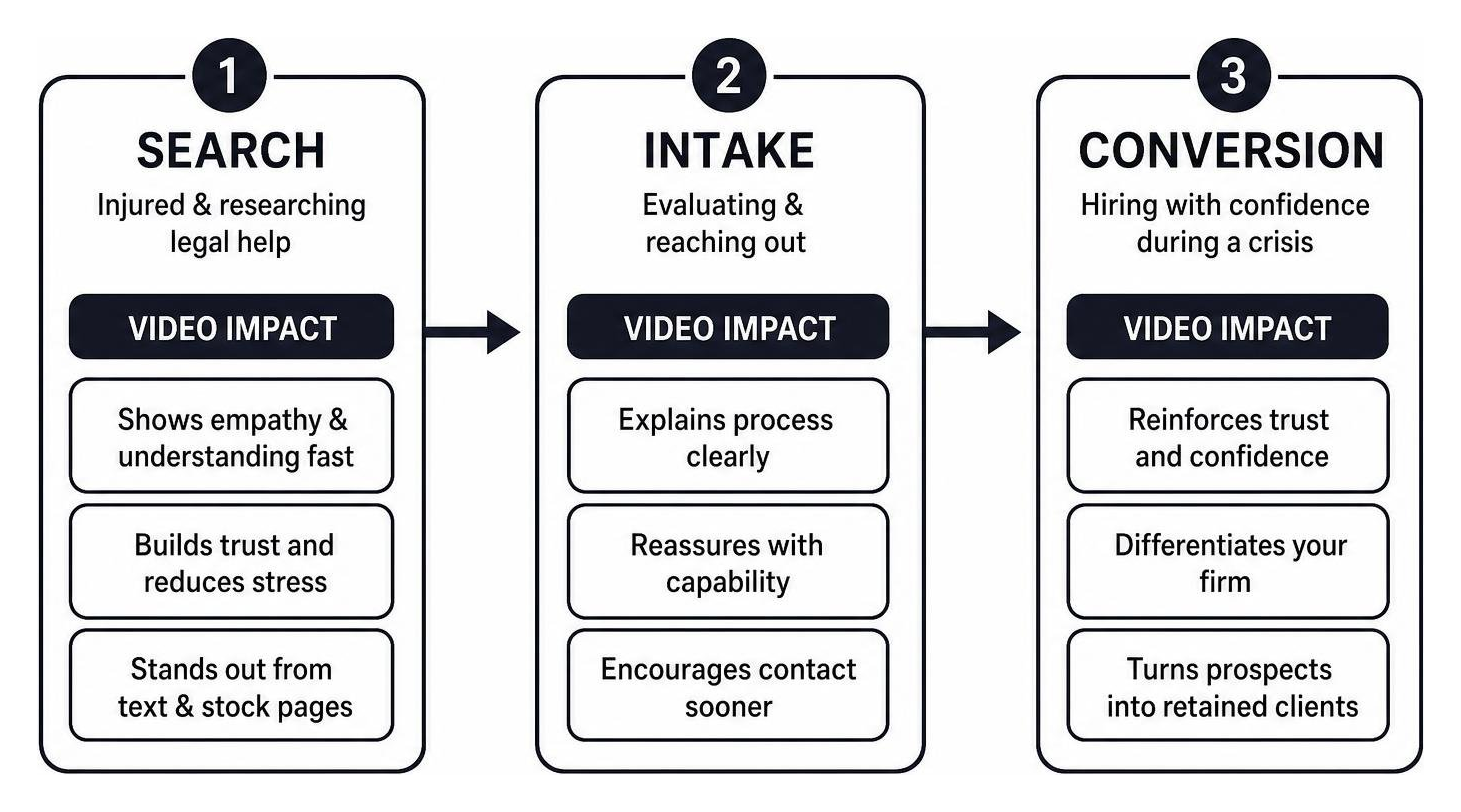
When injured claimants search for legal counsel, they rarely lead with pure legal logic. They are stressed, vulnerable, and often scared about their financial stability and physical recovery. While many law firms default to leading with massive settlement numbers on billboards and digital ads, prospects are fundamentally looking for an advocate who will listen, understand their pain, and guide them through a crisis.
Leading purely with money can alienate people who have moderate or hard-to-prove injuries, making them feel their situation is too minor for your firm. Emotional storytelling bridges this divide by focusing on the client's lived experience before, during, and after litigation. When planning video production for law firms, human relief and advocacy should always lead, while technical case values take a supportive role.
How Do the Three Emotional Pillars Convert Distressed Prospects?
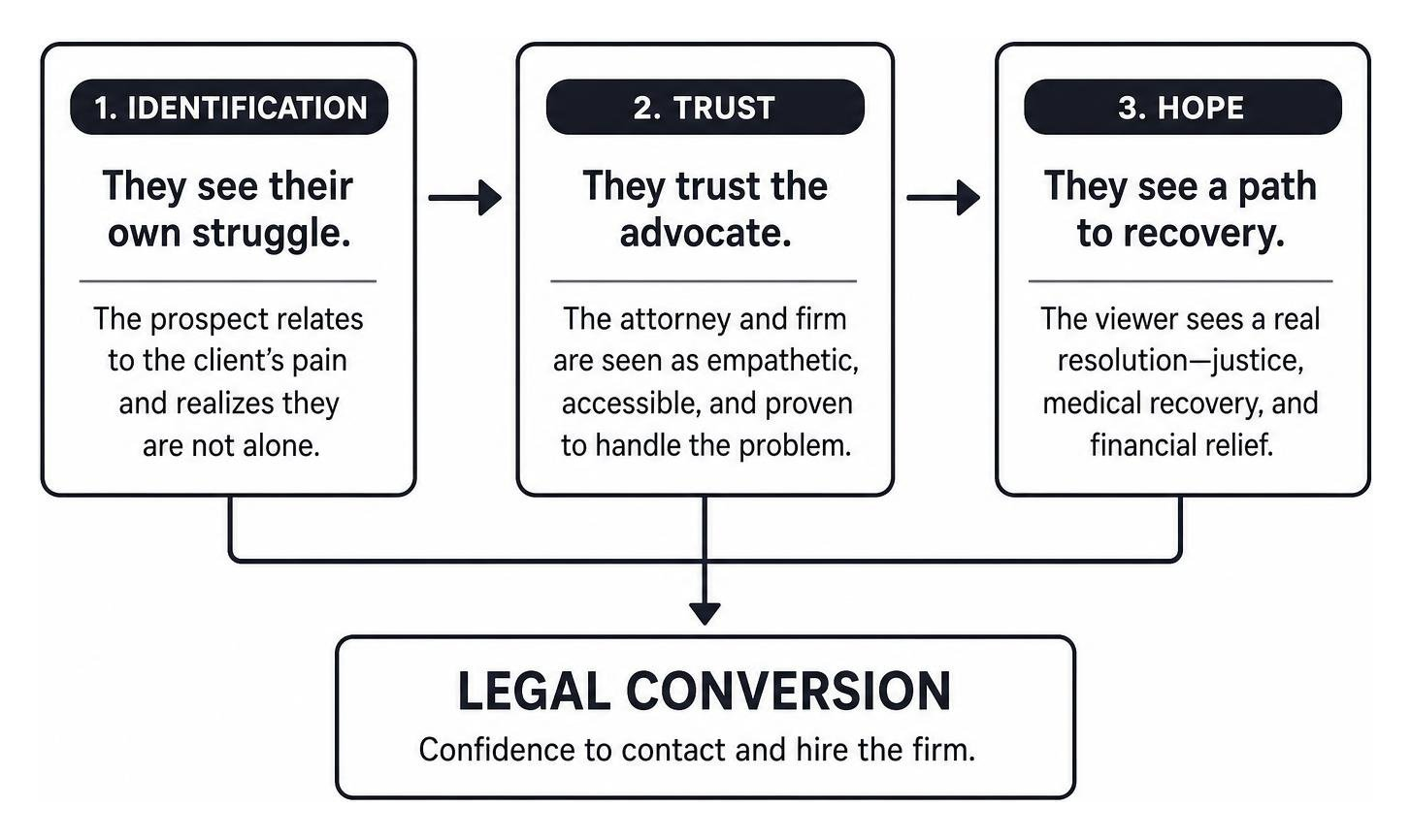
Effective personal injury narratives rely on three core emotional pillars:
- Identification: The prospect sees someone facing their exact pain points, emotional turmoil, and physical challenges. They realize they are not alone.
- Trust: The attorney and firm are introduced not as unapproachable figures, but as accessible, empathetic guides with the proven experience to handle the problem.
- Hope: The viewer sees a tangible resolution arc, demonstrating that justice, medical recovery, and financial relief are entirely achievable.
Clear communication also reduces perceived risk. For instance, when firms intentionally highlight a "no fee unless you win" contingency policy within their video messaging, prospects are 50% more likely to call compared to firms that omit this reassurance.
Why Can a Relatable $50K Case Story Outperform a $5M Verdict Video?
A common misconception among personal injury firms is that only multi-million-dollar verdicts belong on camera. While massive catastrophic injury verdicts demonstrate trial capability, they can backfire with the average claimant. A prospective client rear-ended in an intersection who needs physical therapy might assume a firm highlighting only $10M truck crash verdicts will ignore their $45,000 soft-tissue case.
A relatable $50,000 case story detailing how a client overcame insurance denials and recovered lost wages resonates with the vast majority of searchers. It provides an accessible narrative arc: fear, legal conflict, professional guidance, and eventual peace of mind. Deploying authentic case stories through caseload boosting video ads consistently creates an engine for inbound calls and word-of-mouth referrals.
How Does Video Strategy Differ Across Legal Practice Areas?
A personal injury victim requires immediate empathy and reassurance, whereas a corporate client facing a contract dispute evaluates an attorney based on technical precision, risk mitigation, and commercial track record. Translating an emotional personal injury format to high-stakes commercial disputes fails because corporate decision-makers look for institutional capability over personal emotional catharsis, which is why business litigation lawyer videos require an entirely different messaging framework.
How Should Personal Injury Video Marketing Differ for Awareness and Consideration?
Your video strategy must match where the prospective client stands in their decision-making process. Top-of-funnel awareness videos capture early attention, whereas consideration-stage assets build deep relational trust.
| Stage | Primary Viewer Goal | Video Focus | Production Style |
|---|---|---|---|
| Awareness (Top Funnel) | Discover options after an accident | Immediate hook, common mistake warnings, local relevance | Fast-paced, recognizable local B-roll, high visual contrast |
| Consideration (Middle Funnel) | Evaluate firm credibility & fit | Client case stories, attorney philosophy, FAQ handling | Empathetic pacing, genuine client interviews, clear process walk-throughs |
For awareness, incorporating recognizable local landmarks—such as community bridges or well-known intersections in Los Angeles or Austin—grounds your firm geographically. For the consideration stage, firms use lead generation lawyer videos to resolve specific consumer objections, answer billing questions, and establish credibility before the prospect speaks to intake.
How Can Law Firms Avoid Costly AI Mistakes in Personal Injury Video Marketing?
With the rise of generative video tools, some firms attempt to cut corners using synthetic avatars or automated voiceovers. In personal injury marketing, this is counterproductive.
Injured clients seek a genuine human connection. If a distressed viewer senses an artificial voice or an uncanny digital avatar representing your firm, credibility dissolves instantly. Authentic video production highlights real people, real courtroom advocates, and real staff members. Specialized personal injury law creative teams prioritize human-led capture over synthetic generation to protect and build brand equity.
How Can Law Firms Capture Authentic Stories with the GPS Interview Framework?
Getting genuine emotion out of everyday clients requires a structured approach. The GPS Interview Framework simplifies this process:
- G (Goals): What did the client want their life to look like before the injury disrupted it?
- P (Problems): What specific medical, financial, and emotional barriers did the insurance company or opposing party create?
- S (Stakes): What was truly on the line for their family if their case failed?
By asking open-ended questions centered on the GPS model during client interviews, your team extracts natural emotion without coaching or scripting. If a client is camera-shy, you can record an audio-only interview and layer B-roll of the firm, recovery milestones, and community locations over their voiceover. This technique is a foundational pillar of modern media production for law firms.
How Does Production Turn a 14-Minute Interview into a 5-Minute Case Story?
An unedited 14-minute interview contains pauses, tangents, and legal jargon. Professional post-production shapes this raw footage into a tight, emotionally resonant narrative:
- The Hook (0:00–0:15): The client states the core stakes or the immediate aftermath of the incident.
- The Conflict (0:15–1:30): The struggle against insurance pushback and mounting bills.
- The Partnership (1:30–3:00): How the attorney stepped in, took over the stress, and provided clear communication.
- The Resolution & Future (3:00–4:30): The settlement or verdict outcome and what it allowed the client to rebuild.
- Call to Action & Compliance (4:30–5:00): Clear next steps with required State Bar disclaimers (e.g., "past results do not guarantee future outcomes").
Where Should Law Firms Distribute Video Content for Maximum ROI?
Creating a high-impact video is only half the battle; distribution determines performance. Rather than uploading a video to a single webpage, firms should deploy video assets across key digital touchpoints:
- Practice area landing pages
- Attorney biography pages
- Google Business Profile updates
- YouTube video channels
- Pre-consultation email drip campaigns
- Post-intake chase sequences
- Paid social retargeting ads
- Local service landing pages
The data demonstrates the compounding value of video engagement. A prospect who watches 33 minutes of your video content across various assets is 47% more likely to hire your firm than someone who spends 90 seconds reading static copy. For law practices investing in California personal injury SEO, embedded video significantly boosts page dwell time, signaling topical authority to search engines.
How Can Law Firms Optimize YouTube and Google Business Profile for Late-Night Searches?
Accident victims often perform deep-dive legal research late at night while dealing with insomnia or pain. When prospects search your firm's name directly, your YouTube and Google profiles must present clear proof of your capabilities.
Use name-first titling on YouTube (e.g., [Law Firm Name] Client Story: How Sarah Recovered After Her Crash) so prospective clients find genuine stories instead of generic competitor ads. Furthermore, 20% of AI-generated search results now directly reference YouTube video transcripts when answering user queries. Optimizing these properties with lawyer Google My Business videos alongside structured SEO optimized lawyer videos ensures visibility across both traditional and AI-driven search engines.
How Can Intake Teams Use Video to Boost Close Rates?
A law firm spending $8,000 per month on Google Ads with no branded video presence often faces flat conversion rates when leads stall at intake. Integrating video directly into intake operations bridges this gap:
- Immediate Confirmation: Send an automated text message with a 60-second video explaining what happens next right after a form submission.
- Objection Handling: When prospects express hesitation about signing a contingency fee agreement, intake specialists can send an explanatory video detailing the "no fee unless you win" model.
- Chase Sequences: If an unrepresented caller drops off, an automated three-part video sequence highlighting past client recoveries keeps your firm top of mind.
Integrating video into your intake process maximizes the return on your personal injury PPC campaigns, turning cold ad clicks into signed retainers.
What Should Law Firms Know About Personal Injury Video Marketing?
Should Personal Injury Video Case Stories Focus on Big Verdicts or Relatable Situations?
Both have value, but relatable situations should form the backbone of your strategy. Outlier verdicts demonstrate trial readiness, but everyday case stories highlighting relatable injuries connect with a wider audience and encourage prospective clients to reach out.
How Can Law Firms Handle Case Stories When Clients Do Not Want to Appear on Camera?
Record an audio-only interview using the GPS framework and pair their spoken words with high-quality B-roll of the office, attorney meetings, medical recovery settings, and the community. This protects client privacy while preserving genuine emotional delivery.
How Does Video Content Influence AI-Generated Search Results and Legal Discovery?
Search engines and AI discovery tools index video transcripts, closed captions, and chapter markers. Maintaining an active, keyword-optimized YouTube presence ensures that AI engines draw from your firm's video content when delivering answers to searchers.
What Compliance Disclaimers Are Required on Legal Video Case Stories?
State bar associations enforce strict rules regarding client testimonials and case results. Most jurisdictions align with American Bar Association Model Rule 7.1 guidelines, requiring prominent disclaimers such as "Past results do not guarantee a similar outcome" displayed both as on-screen video text and in accompanying written descriptions. Always review local advertising ethics rules before publishing.
How Can Law Firms Build a Comprehensive Video Strategy?
A successful video strategy is an interconnected ecosystem of assets that support your practice across search, paid advertising, intake, and referral generation. When you treat video as a core operational asset rather than a one-time project, you build an enduring advantage over competitors reliant solely on search ads.
At Outlier Creative Agency, we build comprehensive video marketing systems designed specifically for legal advertising compliance, caseload growth, and high-converting client acquisition. Discover how our professional video production for legal services can help your practice dominate your local market. Schedule a consultation with our team today to get started.