
Build a winning social media video strategy for your law firm to increase client conversions and brand authority.
Build a Social Media Video Strategy That Brings in Qualified Leads
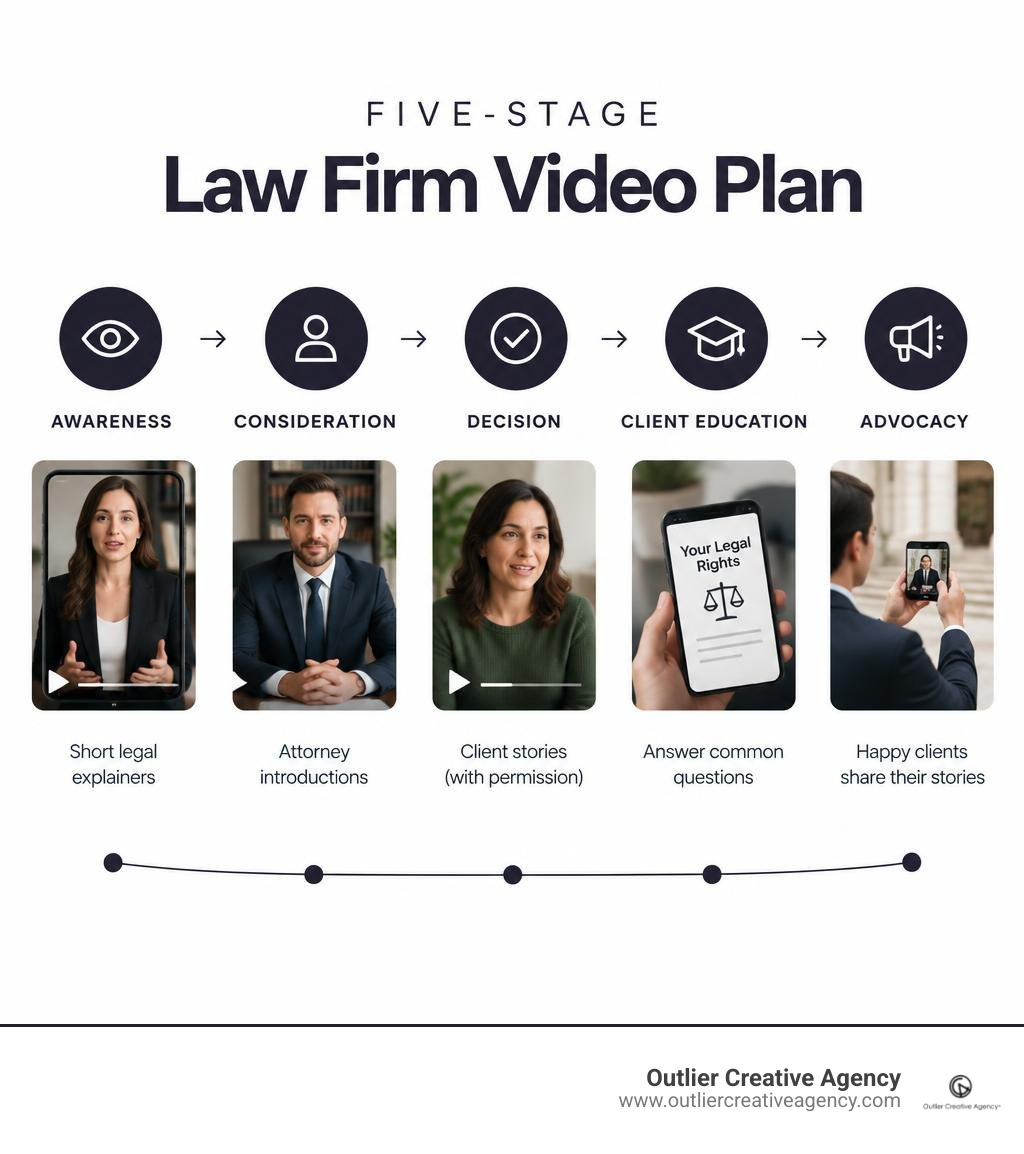
Build a social media video strategy around one clear goal, such as more consultation requests. Choose the platforms your prospective clients use, then create videos that answer their questions at each stage of the client journey. For a personal injury firm, that could mean short legal explainers to build awareness, attorney introductions to build trust, and client stories, shared with permission, to support a decision. Track inquiries and booked consultations alongside views.
I'm Corey Larson of Outlier Creative Agency, where I create video and social media content for law firms. That work shapes the social media video strategy in this guide, starting with a plan for each stage of the client journey.
Why Your Law Firm Needs a Dedicated Social Media Video Strategy
Prospective clients do not hire law firms based on static billboards or text-heavy websites alone. Legal services require deep personal trust. When an injured person needs representation after a catastrophic commercial trucking accident or slip-and-fall, they search for an advocate who demonstrates empathy, authority, and trial readiness. Video establishes that human connection faster than any other digital medium.
Our comprehensive personal injury marketing campaigns prove that pairing visual storytelling with strategic distribution elevates conversion rates across every digital channel. According to Sprout Social's video marketing study, short-form video serves as the top return-on-investment driver for 71% of video marketers. Modern social media algorithms on Instagram, TikTok, and YouTube reward video content with superior reach. Law firms that incorporate professional social media management consistently outpace competitors relying solely on traditional print or standard text search ads.
Legal Industry Benchmarks and Consumer Video Consumption
Video consumption has expanded into a primary daily activity for potential clients across all demographic brackets. Research demonstrates that 91% of businesses now deploy video as an essential marketing tool, with 90% reporting a positive ROI.
Consider these critical benchmarks when structuring your firm's annual marketing budget:
- Over 87% of consumers report that viewing a brand's video directly convinced them to purchase a product or retain a service.
- Americans spend an average of nearly one hour every day watching social media videos.
- Video quality alters consumer perception, with 87% of consumers stating production quality directly impacts their trust in a business.
- In competitive metropolitan markets like Los Angeles and Austin, social channels represent a major portion of discovery for local service providers.
When potential clients research personal injury attorneys, authentic on-camera explanations shorten the consideration cycle. Video accelerates trust velocity, converting passive viewers into active consultation bookings.
Overcoming Common Production Barriers for Attorneys
Managing partners and legal marketers frequently encounter three internal bottlenecks:
- Time constraints from managing active litigation caseloads (33% of businesses cite lack of time).
- Perceived production expenses for commercial-grade assets (20% cite budget fears).
- On-camera hesitation or discomfort (62% of marketers experience negative emotions when tasked with video creation).
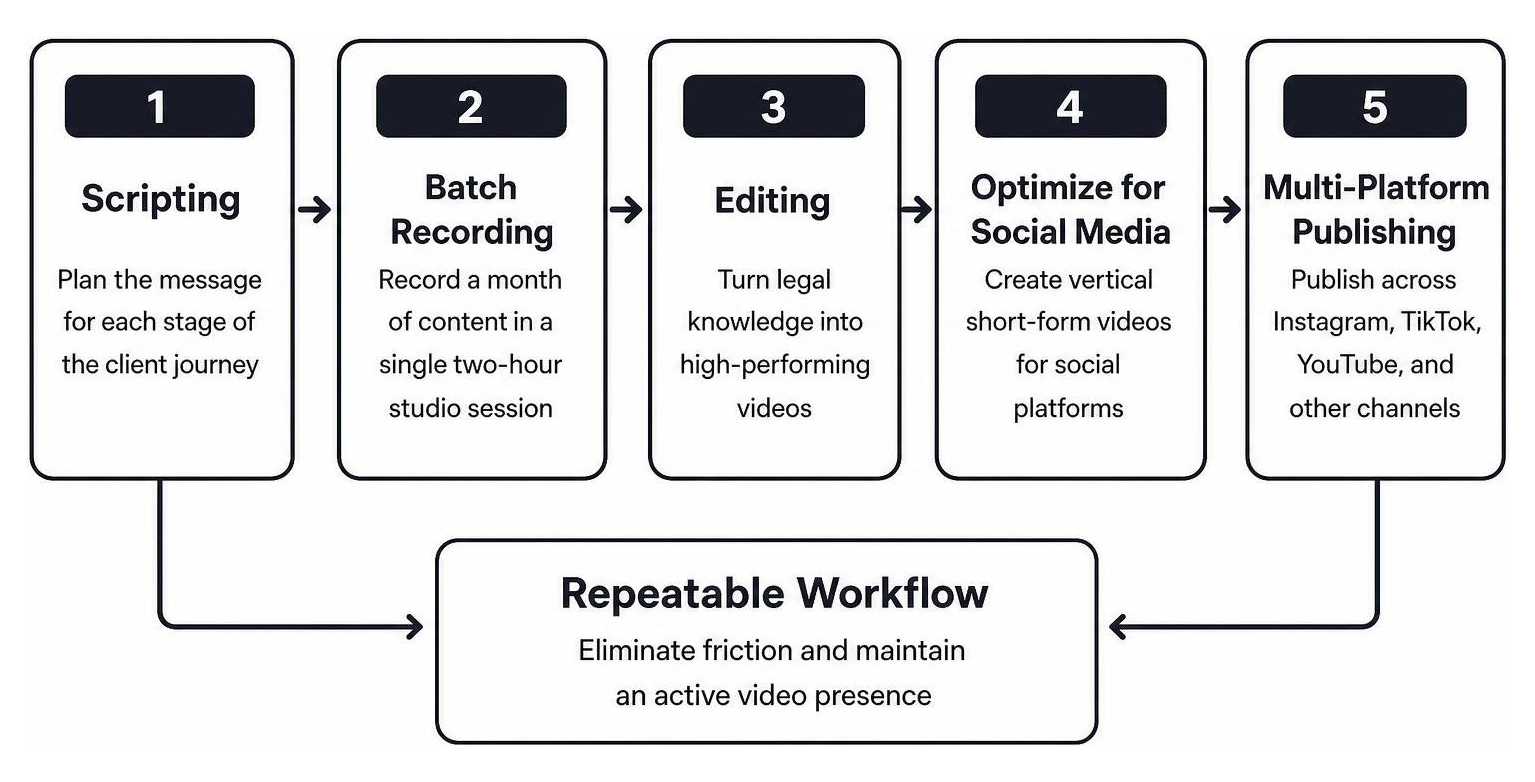
You do not need to pause your legal practice to maintain an active video presence. By implementing batch recording frameworks and systematic video production for law firms, attorneys can record an entire month of vertical short-form content in a single two-hour studio session. Repeatable workflows eliminate friction, turning legal knowledge into high-performing client acquisition assets.
Aligning Video Formats Across the Legal Client Journey
Randomly posting viral trends or humorous dances does not generate high-value personal injury retainers. A profitable video engine maps specific video styles directly to the prospective client's decision-making process.

How to Align Your Social Media Video Strategy with the Legal Funnel
An effective legal campaign deploys tailored creative across four distinct phases:
- Awareness Stage: Capture prospective clients browsing feeds before an immediate crisis occurs. Use punchy, 30-second educational hooks that explain basic legal rights, common insurance adjuster myths, or steps to take immediately following an auto accident.
- Consideration Stage: Educate prospects actively evaluating their legal options. Deploy structured lead generation lawyer videos and in-depth analyses of fault, comparative negligence, and medical damages.
- Decision Stage: Overcome final friction for clients ready to sign a retainer. Showcase verifiable firm results, attorney courtroom philosophies, and peer accolades.
- Advocacy Stage: Maintain post-settlement relationships through client onboarding walkthroughs, settlement process guides, and firm community initiatives.
High-Converting Video Types for Personal Injury Practices
To maximize your firm's intake volume, incorporate these proven video formats into your content calendar:
- Client Stories and Proof: Professionally produced video testimonials for lawyers provide social proof. Always obtain signed media releases and confirm compliance with state bar advertising guidelines.
- Micro-Explainers: Clear, authoritative legal explainer video production deconstructs complex statutes, such as premises liability or wrongful death damages, into actionable insights.
- Attorney Profiles: Introduce your partners through authentic attorney bio video creation pieces that highlight trial experience and client dedication.
- Behind-the-Scenes Litigation Preparation: Film mock trial sessions, focus group preparations, and dynamic office walkthroughs to show the intensive resources your firm commits to every case.
- Visual Concepts: Combine real footage with motion graphics legal videos to illustrate collision dynamics or anatomical injury diagrams cleanly.
Best Practices for Law Firm Video Production and Platform Optimization
Social platforms operate on interest-based distribution algorithms. Your video performance depends heavily on technical formatting, opening hooks, and platform-specific user expectations.
| Platform | Optimal Video Length | Aspect Ratio | Target Audience Intent | Best Legal Content Fit |
|---|---|---|---|---|
| TikTok | 15 to 45 seconds | 9:16 (Vertical) | Fast entertainment, rapid legal myth-busting | Quick tips, auto accident checklists, FAQs |
| Instagram Reels | 30 to 60 seconds | 9:16 (Vertical) | Visual discovery, local brand prestige | Case breakdowns, attorney lifestyle, culture |
| YouTube Shorts | 30 to 60 seconds | 9:16 (Vertical) | High-intent search queries, mobile education | Legal definitions, procedural walkthroughs |
| YouTube Main | 5 to 15 minutes | 16:9 (Horizontal) | In-depth research, long-form consideration | Comprehensive litigation guides, webinars |
| 60 to 120 seconds | 1:1 or 9:16 | Professional networking, B2B referrals | Settlement analysis, co-counsel recruitment |
Viewers decide whether to stay or scroll within the first 3 seconds. Start your videos immediately with an intriguing premise or question. Never open with a generic corporate logo animation or a slow introduction.
Executing a Multi-Platform Social Media Video Strategy
Maximize your return on production by creating pillar assets that feed multiple networks. Record a high-resolution, long-form discussion analyzing a landmark settlement or new traffic safety legislation. From that single recording, extract five distinct vertical clips formatted for TikTok videos for lawyers and Instagram Reels.
Simultaneously, publish the long-form version to your YouTube channel and embed it within your written content using blog video integration for lawyers. To capture lucrative co-counsel and catastrophic injury referral opportunities, publish polished thought-leadership cuts directly through your LinkedIn video for attorneys distribution engine.
Social SEO, Subtitles, and Bar Ethics Compliance
Modern social networks function as visual search engines. Potential clients regularly search platforms directly for queries like "what to do after an Uber accident" or "average slip and fall settlement."

To dominate social search feeds:
- Craft spoken audio containing high-intent legal keywords to feed automated transcription indexers, applying principles from Search Engine Land's guide to social video search optimization.
- Produce fully SEO optimized lawyer videos featuring keyword-rich descriptions, natural chapter markers, and platform tags.
- Integrate burned-in open captions across every clip. Over 80% of users browse mobile feeds with audio muted.
- Maintain total digital accessibility by adhering to ADA compliance video for lawyers standards, including accurate screen-reader descriptions and high-contrast color palettes.
- Comply strictly with state bar advertising requirements. Include mandatory promotional disclaimers ("Attorney Advertising," office locations, identifying the attorney responsible), and avoid guaranteeing specific financial outcomes.
Measuring Video ROI and Key Performance Metrics
Do not evaluate your video marketing based solely on vanity metrics like view counts. A viral video with millions of views provides little value if it fails to generate signed personal injury contingency agreements.
Monitor these core operational metrics:
- Average Watch Time and Retention Rate: Measures whether your opening hook successfully engages viewers and retains their attention past the 15-second mark.
- Click-Through Rate to Consultation Pages: Tracks how many viewers tap profile links to request a free case evaluation.
- Cost Per Qualified Lead (CPQL): Measures paid ad spend efficiency when boosting top-performing organic video clips into targeted local geographic feeds.
- Intake Source Attribution: Train your intake staff to ask every incoming caller: "Did you see one of our attorney videos on Instagram, TikTok, or YouTube before calling?"
Systematically A/B test your opening hooks, on-screen title cards, and call-to-action phrasing monthly to consistently lower your cost-per-case.
Conclusion
A well-crafted social media video plan changes how prospective clients perceive your firm. By replacing unfocused, sporadic posting with a structured client journey framework, your firm builds lasting digital authority and secures a consistent stream of qualified personal injury leads.
At Outlier Creative Agency, we build and manage full-service video, search, and social growth campaigns designed exclusively for leading personal injury law firms nationwide. If your firm is ready to scale caseloads and dominate your market with high-converting video assets, we invite you to book a consultation with our strategy team today.
Frequently Asked Questions About Law Firm Video Marketing
What is the ideal video length for law firm social media?
For short-form vertical feeds on TikTok, Instagram Reels, and YouTube Shorts, keep your videos between 15 and 60 seconds. Focus on delivering one clear takeaway or answering a single legal question. For in-depth YouTube explainers or complex litigation breakdowns, aim for 5 to 10 minutes to satisfy high-intent researchers.
How often should an attorney post video content?
Aim for a consistent cadence of three to five high-quality short-form videos per week across your primary vertical channels. Consistency signals authority to social algorithms and builds steady brand recognition. Batching your filming sessions monthly makes this publishing schedule manageable without disrupting your trial calendar.
Do law firms need professional production gear to get started?
You can start recording basic social updates with a modern smartphone, a wireless lavalier microphone, and clean natural window lighting. However, for conversion-critical assets like firm introduction films, high-stakes case studies, and paid social campaigns, professional video production services provide the lighting, crisp sound, and cinematic finish needed to establish elite market authority.
How do state bar advertising rules apply to short-form social videos?
State bar advertising rules apply to social media videos just as they do to traditional television commercials and print ads. Ensure your firm includes required jurisdictional disclaimers, identifies the attorney responsible for the content, avoids promising specific monetary recoveries, and secures written client consent before referencing prior case results.