
Learn how plastic surgery influencer marketing builds patient trust and drives consultations with compliant, ethical creator partnerships.
How to Run Plastic Surgery Influencer Marketing Responsibly
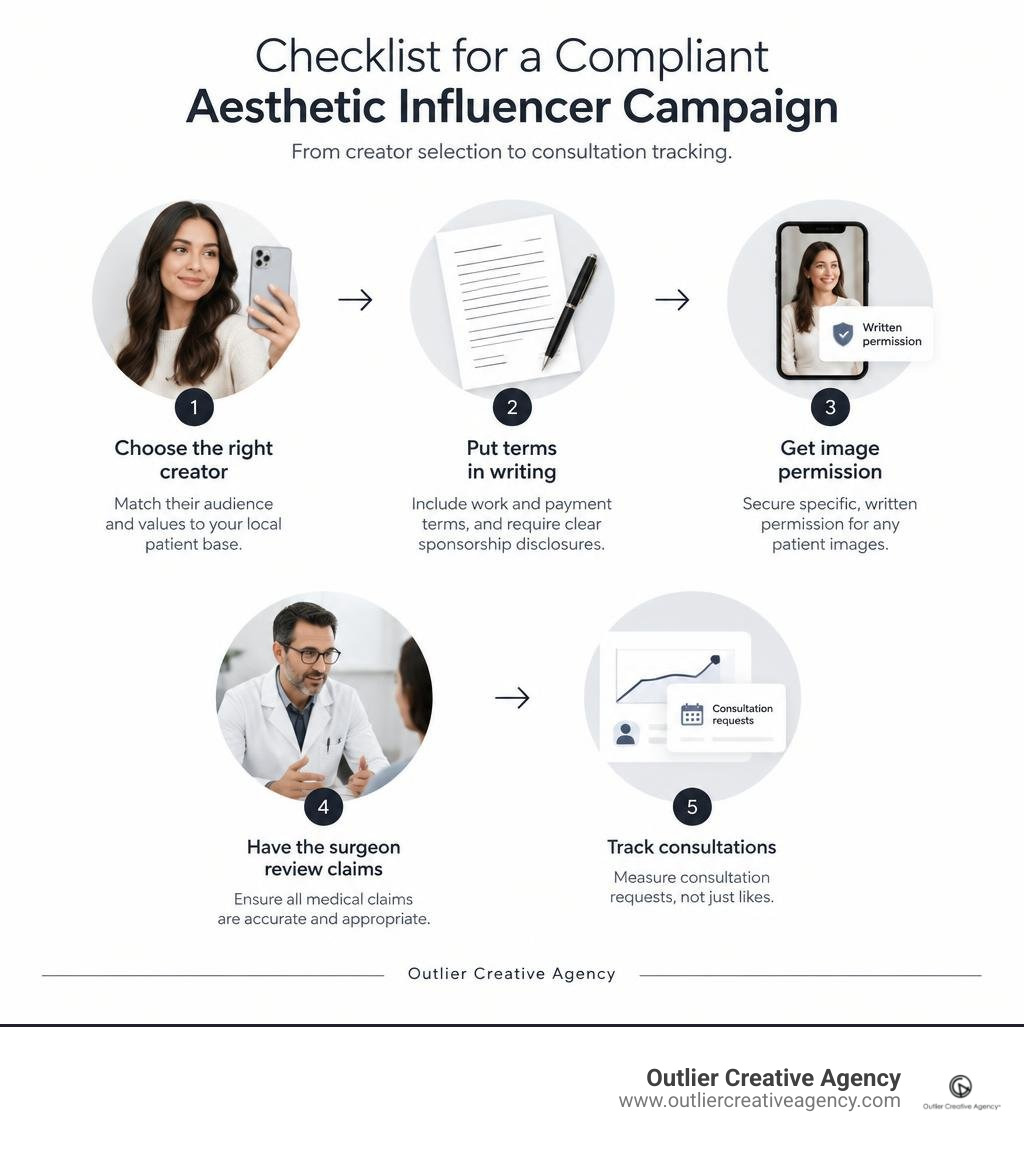
To run plastic surgery influencer marketing responsibly, choose a creator whose audience matches your local patient base and who has a genuine interest in the procedure. Before posting, put the work and payment terms in writing, require clear sponsorship disclosures, and get specific written permission for any patient images. Have the surgeon review medical claims, then measure consultation requests rather than likes alone.
A trusted peer can make a procedure feel easier to discuss, but a personal story is not medical advice. The strongest campaigns show what a consultation and recovery may involve without promising that every patient will get the same result.
I’m Corey Larson. At Outlier Creative Agency, I’ve produced video and social content for legal professionals, experience I bring to explaining the advertising and consent issues behind plastic surgery influencer marketing.
The Strategic Value of Plastic Surgery Influencer Marketing
Patient acquisition in aesthetic surgery has shifted permanently away from traditional print and broadcast advertising. In 2010, 92% of plastic surgeons relied primarily on practice websites, while only 30% used social channels. Today, social platforms directly influence up to 40% of patients when selecting a plastic surgeon (Shauly et al., 2023).
Over a 21-month tracking period, the hashtag #PlasticSurgery generated more than 2 million Instagram posts, 369 million likes, and 6 billion views (Shauly et al., 2023). Yet, only 4% of plastic surgery-related social posts are created by board-certified plastic surgeons (Shauly et al., 2023). This gap creates a critical opportunity for board-certified practices to partner with credible creators who communicate accurate medical narratives.
Why Peer Influence Outperforms Celebrity Endorsements
For surgical practices in competitive metros like Los Angeles and Austin, peer influence consistently outperforms national celebrity endorsements. Mega-celebrities create passive awareness, but peer creators generate active consultation intent.
Prospective patients view peers as relatable proxies for their own surgical journeys. When a local micro-creator shares their surgical experience, followers evaluate the results through a realistic lens of recovery, cost, and lifestyle compatibility.
| Dimension | Peer Aesthetic Creators | Celebrity Endorsements |
|---|---|---|
| Audience Trust | High personal rapport and active engagement | Aspirational, detached admiration |
| Geographic Targeting | Concentrated in local practice draw areas | Broad national or global distribution |
| Cost Efficiency | Accessible fee or service-aligned structures | Prohibitive six-figure retainers |
| Conversion Intent | High consultation and booking velocity | Low procedural intent, general brand lift |
| Compliance Risk | Highly manageable via direct agreements | Complex multi-tier management hurdles |
A detailed study on social media algorithms and marketing in plastic surgery confirms that direct digital engagement drives deeper patient trust than static brand visibility (Shauly et al., 2023).
Patient Journey Documentation vs Product Promotion
Selling a surgical procedure is not the same as promoting a consumer skincare product. Surgery carries clinical risks, recovery periods, and irreversible anatomical changes.
Effective campaigns prioritize patient journey documentation over scripted promotional pitches. A creator documenting their initial consultation, pre-operative preparation, surgical day, and staged post-operative recovery (weeks 1, 4, 12, and 24) demystifies the surgical experience. This transparency actively reduces prospective patient anxiety, establishing your practice as an authority. Integrating this narrative approach into your wider plastic surgery marketing strategies creates authentic social proof that static ads cannot replicate.
Selecting and Vetting Creators for Your Practice
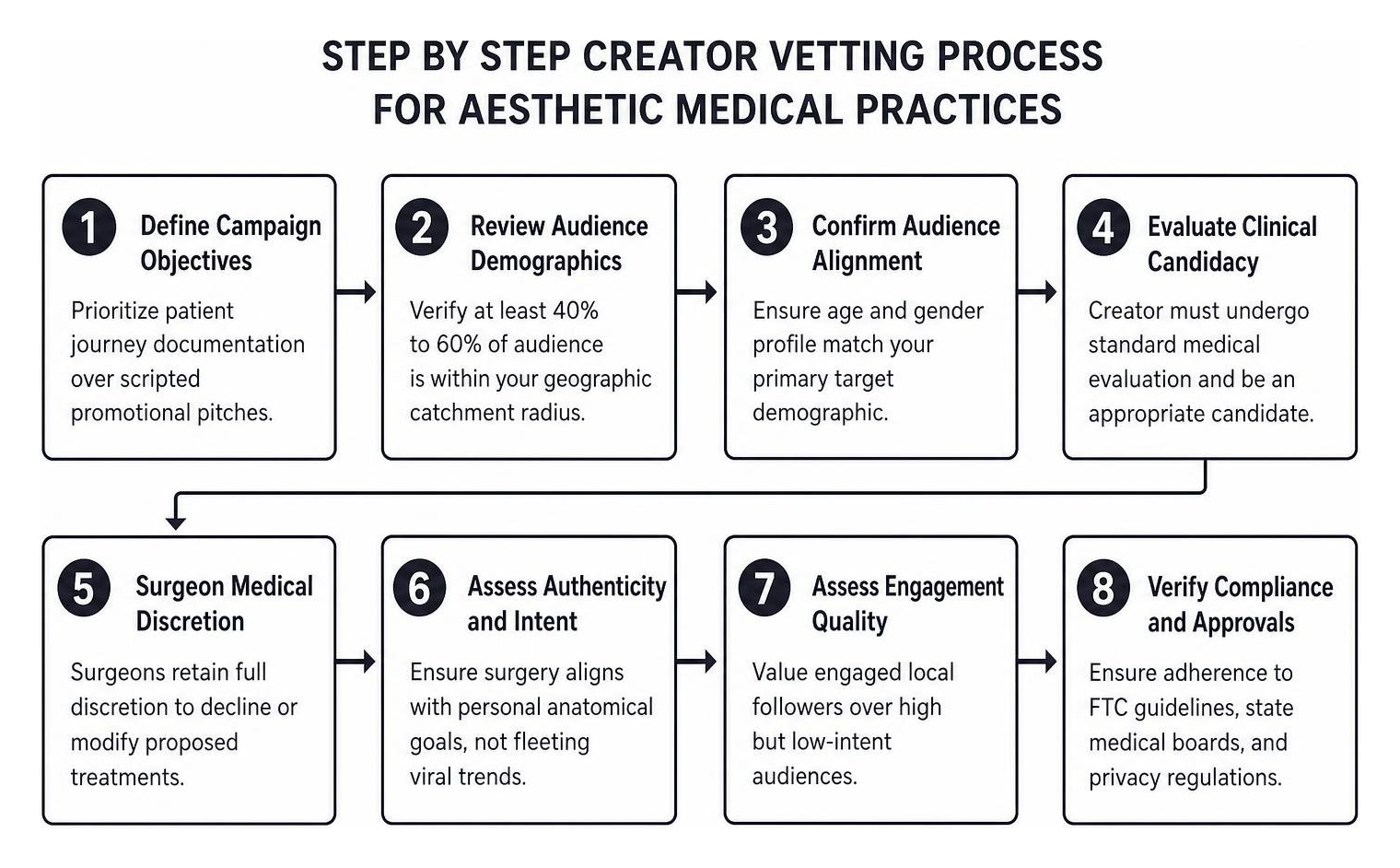
Selecting the wrong creator can expose your practice to regulatory penalties, public backlash, and low-intent leads. Vetting requires evaluating clinical candidacy, audience demographics, and authentic alignment with your brand.
According to ASPS insights on influencer-driven surgical trends, social trends heavily dictate patient procedure demand. Your vetting process must ensure the creator seeks surgery for personal anatomical goals rather than fleeting viral trends.
Local Market Concentration and Demographic Alignment
A surgical practice requires physical consultations and in-person surgery. A creator with 30,000 highly engaged followers in your immediate metropolitan area delivers far higher ROI than a creator with 500,000 followers scattered globally.
When reviewing creator media kits and backend analytics, verify that at least 40% to 60% of their audience resides within your geographic catchment radius. Verify that their audience age and gender profile match your primary target demographic:
- Breast Augmentation & Rhinoplasty: Females aged 18 to 34
- Body Contouring & Mommy Makeovers: Females aged 28 to 45
- Facial Rejuvenation (Deep Plane Facelifts, Blepharoplasty): Patients aged 40 to 70
Evaluating Clinical Candidacy and Authenticity
Never select a creator purely based on follower count. The creator must undergo standard medical evaluation and be an appropriate clinical candidate for the procedure they wish to document.
Surgeons must retain full medical discretion to decline or modify proposed treatments during the consultation. If a creator is anatomically unsuitable for a requested procedure, offering it for marketing exposure violates medical ethics and invites poor surgical outcomes.
Compliance, Legal Risks, and Regulatory Safeguards
Aesthetic medical marketing operates under heavy scrutiny from the Federal Trade Commission (FTC), state medical boards, and federal privacy regulators.
A comprehensive literature review on ethical considerations for plastic surgery influencers highlights the necessity of upholding core medical ethics (autonomy, beneficence, non-maleficence, and justice) when sponsoring online content (Gupta et al., 2020).
FTC Disclosures and State Medical Board Rules
The FTC requires clear, conspicuous disclosure of any material connection between an advertiser and an endorser. If an influencer receives complimentary surgery, discounted treatments, or financial compensation, every associated post, reel, story, and video must disclose this relationship.
Compliant disclosure standards include:
- Placing clear identifiers like #Ad, #Sponsored, or #PaidPartnership within the first two lines of text captions, visible before clicking "more."
- Superimposing plain text disclosures over video content and Instagram Stories for a sufficient duration to be read easily.
- Avoiding ambiguous hashtags such as #Collab, #Partner, or #Ambassador.
State medical board advertising rules also prohibit false, misleading, or deceptive claims. Influencers must not state or imply that a specific surgical result is guaranteed.
HIPAA Authorizations and Before-and-After Protocols
Standard photo releases are legally insufficient for marketing campaigns. Under HIPAA, any identifiable patient image or surgical story constitutes Protected Health Information (PHI).
Your practice must execute a formal, standalone HIPAA Marketing Authorization before publishing any content. This authorization must explicitly detail:
- The specific media formats authorized (video, high-resolution photography, audio).
- The exact digital platforms where the material will appear.
- The expiration date of the authorization or explicit terms for revocation.
- An acknowledgment that revocation will not affect content distributed prior to the revocation request.
Managing these assets securely is essential when executing social media management for aesthetic practices.
Structuring Contracts for Plastic Surgery Influencer Marketing
Every campaign requires a binding written agreement drafted specifically for medical advertising. Key contractual provisions include:
- Scope of Deliverables: Explicit timeline of pre-op, intra-op, post-op, and long-term milestone posts.
- Medical Accuracy Review: Practice approval rights on all video scripts and captions before public posting to verify clinical terminology.
- Content Licensing and Usage Rights: Perpetual, non-exclusive rights for the practice to repurpose raw and edited footage across practice websites, email newsletters, paid ad funnels, and consultation galleries.
- Exclusivity Covenants: Prohibiting the creator from endorsing competing aesthetic practices within your local market for a defined timeframe.
- Termination and Crisis Clauses: Immediate contract termination rights if the creator engages in conduct that compromises the practice's professional reputation.
Age-Specific Platform and Content Strategies
Different patient demographics discover and consume cosmetic surgery content through distinct digital channels. Aligning content format with platform demographics maximizes consultation conversion.
Research on plastic surgery content on Instagram reveals that personal and educational content achieves higher engagement than direct promotional posts (Thawanyarat et al., 2023). Furthermore, an analysis of aesthetic surgery on TikTok demonstrates that educational video formats yield strong viewer retention among emerging patient groups (Rivera et al., 2022).
Platform Selection in Plastic Surgery Influencer Marketing
Selecting platforms based on data ensures your marketing spend aligns with target procedural margins.
Younger Demographics: Visual Formats on Instagram and TikTok
Patients aged 17 to 35 primarily seek information on rhinoplasty, breast augmentation, and non-surgical aesthetic enhancements. A survey of facial plastic clinic visitors found that 81% were aged 25 to 34, with 68% confirming cosmetic social accounts influenced their decision (Shauly et al., 2023).
Campaign strategies for this segment include:
- TikTok Day-in-the-Life Recovery Vlogs: Authentic video journals documenting post-op milestones.
- Instagram Story Takeovers: Real-time creator Q&A sessions on the day of suture removal.
- Micro-Form Education: Quick, myth-busting reels addressing downtime and recovery essentials.
Explore our tactical plastic surgeon marketing tips for actionable frameworks on pacing short-form video releases.
Mature Demographics: Long-Form Education on Facebook and YouTube
Patients aged 36 to 70+ seek transformative procedures such as deep plane facelifts, blepharoplasties, abdominoplasties, and body contouring. This demographic values clinical expertise, surgeon credentials, and procedural safety above viral trends.
Campaign strategies for mature demographics include:
- YouTube Mini-Documentaries: Comprehensive 10 to 15-minute case studies featuring creator consultations, anatomical surgical planning, and 6-month post-op evaluations.
- Facebook Live Panels: Surgeon and creator live streams discussing surgical longevity, anesthesia protocols, and recovery expectations.
- Detailed Photographic Carousels: Unfiltered, standardized medical before-and-after photo series showing progressive healing over a full calendar year.
For detailed campaign architectures, consult our commetic surgery marketing guide.
Mitigating Misinformation and Managing Patient Expectations
While 97% of patients find aesthetic social media accounts helpful, 78% report that the medical information provided online is insufficient or incomplete (Shauly et al., 2023).
A published social media growth blueprint for plastic surgeons demonstrates that combining transparent storytelling with rigorous clinical facts builds long-term practice authority while shielding against misinformation (Saadya & El-Tantawy, 2025).
Combating Unrealistic Trends and Filtered Results
Digital editing, beauty filters, and stylized lighting on social media frequently produce distorted expectations. Nearly two-thirds of individuals report that social media before-and-after images directly influence their cosmetic procedure choices (Shauly et al., 2023).
Surgeons and marketing teams must establish clear guidelines:
- Prohibit the use of digital filters or airbrushing on all clinical before-and-after imagery.
- Ensure consistent studio lighting, standardized patient positioning, and neutral backgrounds.
- Require creator captions to highlight that surgical outcomes depend entirely on individual anatomy, tissue elasticity, and natural healing.
Ethical Consultation Screening for Socially Driven Patients
When influencer campaigns drive high consultation volumes, clinic coordinators must implement robust pre-consultation screening.
Assess prospective patients for:
- Internal vs External Motivation: Is the patient seeking surgery for personal wellness or trying to replicate an online creator's aesthetic?
- Body Dysmorphic Concerns: Identifying red flags where digital media consumption drives unhealthy fixations on minor perceived flaws.
- Realistic Recovery Understanding: Confirming the patient understands surgical downtime and potential revision rates, rather than assuming recovery matches an edited 30-second video.
How should practices compensate influencers for surgical procedures?
Practices typically compensate creators via flat-fee production payments, complimentary surgical fees (where the creator pays out-of-pocket facility and anesthesia costs), or a structured discount schedule tied directly to defined content deliverables.
Federal and state laws strictly prohibit fee-splitting or referral kickbacks based on patient volume generated. Compensation must reflect fair market value for content production and advertising reach, rather than patient conversion bounties.
Who owns the content created during an influencer campaign?
Content ownership is governed strictly by your written influencer agreement. Without explicit contractual assignments, the creator retains primary copyright over footage they capture.
Your contracts must specify that the practice receives a perpetual, irrevocable, royalty-free, worldwide license to use, modify, distribute, and display all campaign media across owned websites, social channels, and paid advertising funnels.
What should a practice do if an influencer experiences a surgical complication?
Every agreement should include a clear crisis communication protocol. If a complication arises, the primary focus remains patient safety and confidential medical management under standard clinical protocols.
The contract should mandate that neither party publish disparaging or medically speculative content publicly during active management. Transparent, professional, and empathetic clinical communication prevents public misunderstandings and protects patient privacy under HIPAA.
What are the main risks of running influencer campaigns without an agency?
Managing campaigns in-house often leads to compliance oversights, including missing HIPAA authorizations, non-compliant FTC disclosures, vague usage rights, and poorly targeted creator selections that attract unqualified leads. Professional agency management ensures strict legal compliance, verified audience quality, and measurable consultation tracking.
Conclusion
When executed with clinical precision and legal compliance, influencer partnerships build practice authority, educate prospective patients, and generate high-intent consultations. Outlier Creative Agency builds data-driven, fully compliant marketing engines for elite aesthetic practices.
To evaluate your practice's social strategy and scale patient acquisition responsibly, connect with our team for a growth-driven plastic surgery marketing consultation.
Scientific References
Shauly O, Marxen T, Goel P, Gould DJ. "The New Era of Marketing in Plastic Surgery: A Systematic Review and Algorithm of Social Media and Digital Marketing.." Aesthetic surgery journal. Open forum, 2023. PMCID PMC10078152. Gupta N, Dorfman R, Saadat S, Roostaeian J. "The Plastic Surgery Social Media Influencer: Ethical Considerations and a Literature Review.." Aesthetic surgery journal, 2020. PMID 31738821. Saadya A, El-Tantawy T. "Social Media Growth Blueprint for Plastic Surgeons: Insights and Considerations From Personal Experience.." Plastic and reconstructive surgery. Global open, 2025. PMCID PMC11723679. Thawanyarat K, Hinson C, Gomez DA, Rowley MA, Navarro Y, Venditto CM. "Content and Engagement Among Plastic Surgeons on Instagram.." Aesthetic surgery journal. Open forum, 2023. PMCID PMC9898873. Rivera JC, Juan HY, Long AS, Hauc SC, Junn AH, Persing JA, Alperovich M. "Presence of Cosmetic and Aesthetic Surgery on TikTok.." Plastic and reconstructive surgery. Global open, 2022. PMCID PMC9509022.