

Learn how the discrimination lawsuit Google Ads parent company faced impacts legal ad compliance and law firm PPC budgets.
Why the Discrimination Lawsuit Google Ads Context Matters for Law Firm Advertisers
If you've been following the discrimination lawsuit Google ads giant settled in 2026, you already know this story goes beyond employment law. It touches something every law firm advertiser needs to understand: how Google's internal conduct and ad tech practices affect your clients, your campaigns, and your compliance obligations.
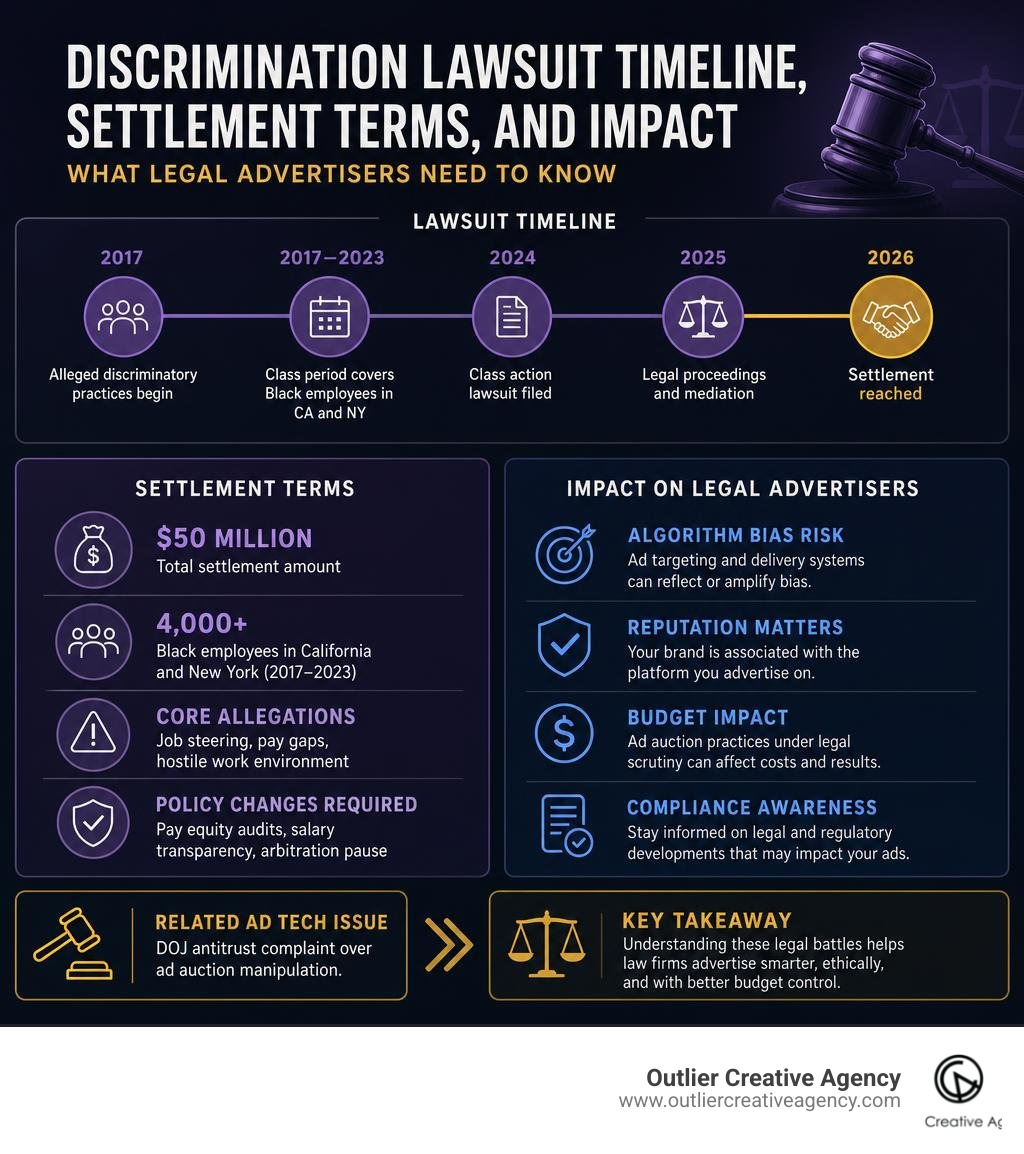
Here's a quick snapshot of the key facts:
| Topic | Key Detail |
|---|---|
| Lawsuit type | Class action racial discrimination |
| Settlement amount | $50 million |
| Employees covered | 4,000+ Black employees in CA and NY (2017-2023) |
| Core allegations | Job steering, pay gaps, hostile work environment |
| Policy changes required | Pay equity audits, salary transparency, arbitration pause |
| Related ad tech issue | DOJ antitrust complaint over Google's ad auction manipulation |
Google is simultaneously defending itself against multiple major legal challenges — from systemic employment discrimination to Department of Justice antitrust complaints over how it runs its ad auctions. For law firms spending real money on Google Ads, that context is not just background noise.
It raises a direct question: Can you trust the platform you're advertising on?
The short answer is that understanding these legal battles helps you advertise smarter, more ethically, and with better budget control.
I'm Corey Larson from Outlier Creative Agency, and our team has spent years helping law firms navigate the intersection of digital advertising compliance and legal marketing strategy — including the evolving landscape shaped by cases like the discrimination lawsuit Google ads users and employees have brought against the platform. In the sections below, we'll break down exactly what these cases mean for your firm's ad strategy and how to protect your marketing investment.
1. Navigating Ad Compliance and the Discrimination Lawsuit Google Ads Context
When we talk about the discrimination lawsuit Google ads parent company Alphabet resolved, we are looking at a landmark $50 million class-action settlement. But for legal professionals, particularly those running high-stakes campaigns like a Wrongful Termination Attorney PPC campaign, this case highlights a broader, systemic issue: algorithmic bias and compliance.
If you are a premises liability lawyer or an employment attorney, you already know that marketing rules are strict. But when the very platform you use to find clients is facing massive litigation for its own internal practices, you must look closely at how those practices translate to consumer ad delivery.
What was the basis of the racial discrimination lawsuit google ads parent company settled?
The class-action lawsuit, originally filed in 2022, alleged systemic racial disparities in hiring, pay, and promotions. Led by plaintiffs like April Curley—a former recruiter hired to bring talented Black students into the tech giant—the lawsuit claimed that Google systematically steered Black employees into lower-level and lower-paid roles.
According to the Google Employment Discrimination Class Action Lawsuit filings, employees who spoke out against these practices or a hostile work environment faced retaliation. The $50 million settlement provides compensation to more than 4,000 current and former Black Google employees who worked in California and New York between 2017 and 2023. Rather than using a rigid, one-size-fits-all formula, the settlement features an individualized claims process overseen by a law professor to ensure fair distribution.
How does the discrimination lawsuit google ads parent company faced affect legal advertisers?
For law firms, this case is a wake-up call regarding ad compliance and brand safety. If Google’s internal algorithms and corporate structures are prone to bias, those same biases can seep into automated ad targeting systems.
Over the years, major ad networks have faced scrutiny for allowing discriminatory targeting in housing, employment, and credit ads. When we build campaigns for our clients from our offices in Los Angeles, California, and Austin, Texas, we must strictly adhere to legal ethics and civil rights standards. Working with a platform undergoing intense scrutiny means legal advertisers must manually audit their targeting parameters to ensure they do not unintentionally exclude protected classes, protecting both their reputation and their bar license.
2. Understanding Google's Internal Legal Battles: The $50 Million Racial Discrimination Settlement
Corporate accountability is no longer optional. As part of the $50 million settlement, Google did not just write a check; they agreed to structural policy changes. These include:
- Conducting regular, pre-programmatic pay equity audits.
- Disclosing salary ranges in job postings to promote transparency.
- Temporarily pausing mandatory arbitration for employment disputes until August 2026, allowing employees to seek judicial relief directly.
These reforms are designed to address systemic gaps, but they also serve as a blueprint for how modern organizations—including large law firms—should structure their internal HR practices.
Comparing Google's History of Employment Discrimination Cases
This $50 million settlement is not an isolated incident. Google has a long history of battling systemic discrimination claims across different demographics.
| Case / Plaintiff | Basis of Lawsuit | Key Outcome / Settlement |
|---|---|---|
| April Curley (Class Action) | Systemic racial discrimination, job steering, and pay disparities affecting Black employees. | $50 million settlement (2026), pay equity audits, and a temporary pause on mandatory arbitration. |
| Ellis v. Google (Class Action) | Gender pay discrimination involving female software engineers. | Google agreed to a Google Pays $118M in Gender Discrimination Settlement of $118 million to resolve systemic pay gaps. |
| Ulku Rowe (Individual Trial) | Gender discrimination, retaliation, and denial of promotion. | A jury ordered Google to pay $1.15 million to the New York-based executive. |
| Age Discrimination Settlement | Systemic age bias against older job applicants. | Google settled the class action to resolve claims of systemic hiring bias. For more details on this case, see how Google Settles Age Discrimination Lawsuit. |
For law firm owners, these cases demonstrate that courts and juries are increasingly holding tech companies accountable. When you run ads on these platforms, you must ensure your own messaging and landing pages reflect the highest standards of professional responsibility.
3. How Google's Ad Tech Monopoly Impacts Your Law Firm's PPC Budget
While Google's employment practices have drawn massive public scrutiny, its backend advertising technology is facing an even larger threat from the federal government. The Department of Justice (DOJ), alongside several state attorneys general, filed a major antitrust complaint against Google's ad tech practices, demanding a jury trial to break up its monopoly.
According to the DOJ's JURY TRIAL DEMANDED complaint, Google built a dominant monopoly over the digital ad tech stack by acquiring key competitors (like DoubleClick) and forcing publishers and advertisers to use its proprietary tools.
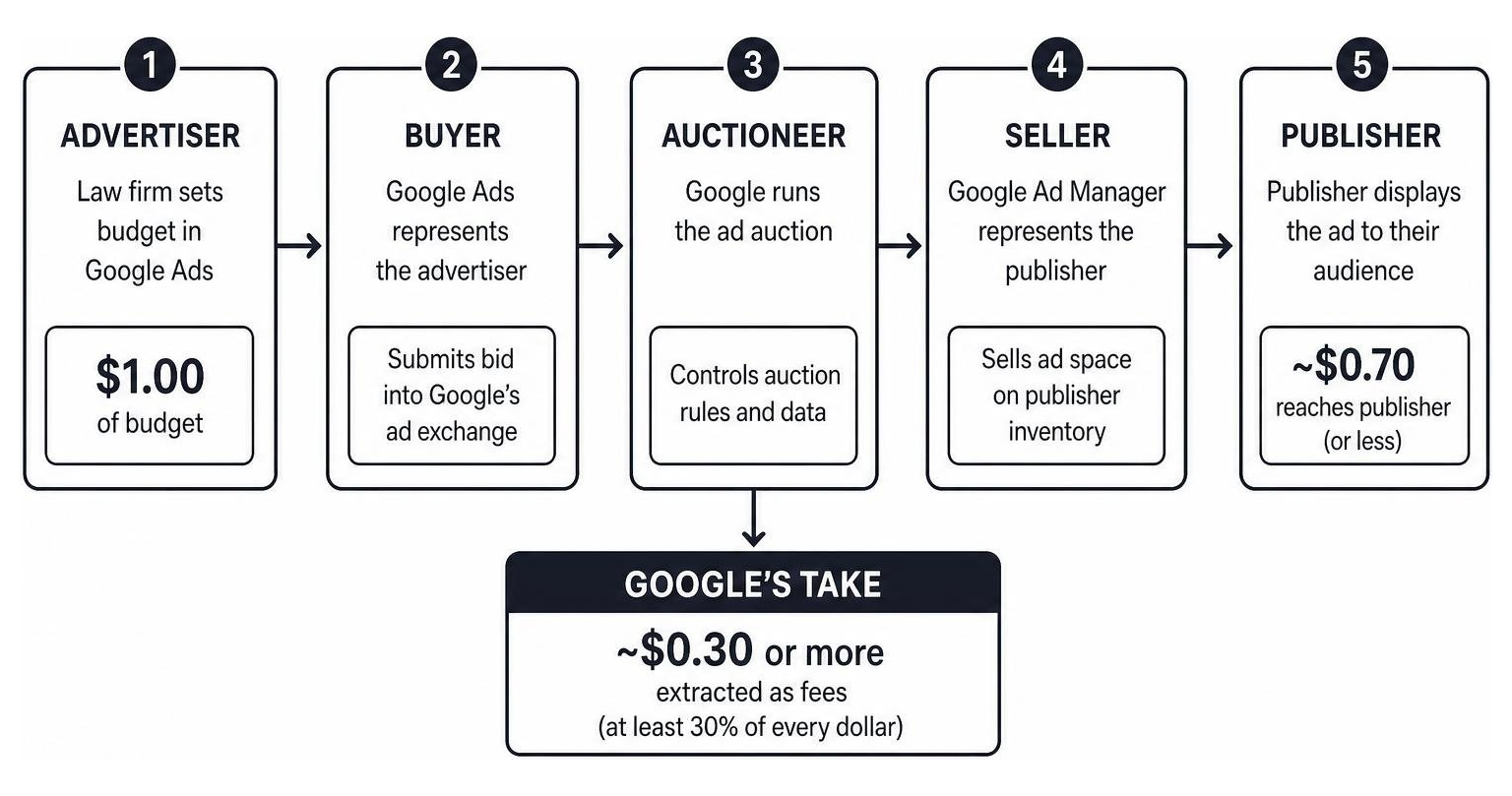
This monopoly directly impacts your law firm's Attorney PPC Advertising budget. The DOJ complaint highlights that Google acts simultaneously as the buyer (representing advertisers), the seller (representing publishers), and the auctioneer (running the ad exchange). Because of this profound conflict of interest, Google pocketed an average of at least 30 cents—and sometimes far more—of every single advertising dollar that flowed through its tools.
Furthermore, secret programs like "Project Bernanke" were used to manipulate bids submitted by Google Ads into its own exchange to shut out rival exchanges. For premises liability lawyers competing for high-value clicks, this means you may have been paying inflated fees for years due to artificial auction manipulation rather than true market competition.
4. Implementing Ethical SEO and Geotargeting Best Practices
With ad auction costs artificially high, legal marketers must find ways to eliminate ad spend waste. One of the most common ways law firms throw away money on Google Ads is through poorly configured location targeting.
Historically, Google has used "query parsing" to show ads to users outside of your targeted geographic areas if their search query indicates an "interest" in that area. For example, if a user in New York searches for "Los Angeles slip and fall lawyer," an LA-based firm could be charged for that click—even if they only practice in California.
This exact issue led to a decade of litigation in cases like Rene Cabrera v. Google LLC and Woods v. Google, LLC. In these cases, advertisers argued that Google breached its contract by charging them for out-of-market clicks that did not match their strict location settings. The court's order on class certification, which you can read on Woods v. Google, LLC., No. 5:2011cv01263 - Document 675 (N.D. Cal. 2023) :: Justia, highlights how Google's backend algorithms can bypass your intended settings if you aren't careful.
To protect your budget, we recommend these three actionable steps:
- Change Default Location Settings: In Google Ads, change your target location setting from "Presence or interest" to "Presence: People in or regularly in your targeted locations."
- Add Negative Locations: Explicitly exclude neighboring states or cities where you do not practice law.
- Invest in Organic Search: Combine your paid ads with Ethical SEO strategies to build long-term, high-intent organic traffic that doesn't cost you per click.
5. Diversifying Your Legal Marketing Channels Beyond Google Search
If the discrimination lawsuit Google ads parent company settled and the DOJ's antitrust case prove anything, it's that relying solely on a single platform for your firm's growth is a high-risk strategy. To build a resilient practice, premises liability lawyers must practice "multi-homing"—diversifying their digital marketing footprint across multiple channels.
A healthy legal marketing mix should include:
- Video Marketing: Create high-quality educational videos explaining premises liability concepts (like property owner negligence or commercial building codes) to build trust.
- Social Media Advertising: Platforms like Meta (Facebook and Instagram) and LinkedIn allow you to target local demographics with highly visual client testimonials and educational content.
- Strategic Email Campaigns: Stay top-of-mind with past clients and referral networks through automated newsletters.
- Diversified PPC: Balance your Google Ads with Bing Ads and localized directories to lower your overall cost per lead.
By diversifying, you ensure that an algorithm update or a sudden shift in ad platform pricing won't dry up your lead flow overnight. If you're looking to scale your firm's reach, implementing a comprehensive PPC for Attorneys strategy across multiple networks is the safest way to grow.
Frequently Asked Questions About Legal Ad Compliance
What are the terms of Google's $50 million racial discrimination settlement?
Google agreed to pay $50 million to resolve a class-action lawsuit alleging systemic racial discrimination, job steering, and pay disparities affecting Black employees. The settlement covers over 4,000 current and former Black employees in California and New York who worked at the company between 2017 and 2023. As part of the agreement, Google must also implement pay equity reviews, increase salary transparency in job listings, and temporarily pause mandatory arbitration for employment disputes.
How does Google's ad tech monopoly affect law firm PPC costs?
According to the DOJ's antitrust lawsuit, Google's monopoly over the ad tech stack allows it to extract an average of 30% or more of every advertising dollar. By controlling the buyer, seller, and auction platforms, Google has been accused of inflating ad costs and manipulating auctions through internal programs like "Project Bernanke," directly increasing the cost-per-click (CPC) for competitive legal keywords.
Can law firms target specific geographic areas without wasting ad spend?
Yes, but you must manually adjust Google's default settings. By changing your targeting criteria from "Presence or interest" to "Presence" (only targeting people physically in your selected location) and actively adding negative locations, you can prevent Google's query parsing algorithm from charging you for out-of-market clicks.
Conclusion
The legal landscape surrounding big tech is changing rapidly. From the discrimination lawsuit Google ads parent company settled to ongoing federal antitrust trials, the platforms we rely on to market our firms are under intense scrutiny.
As a law firm owner, navigating these changes requires a partner who understands both the technical side of digital marketing and the strict ethical compliance rules of the legal industry. At Outlier Creative Agency, we build data-driven, compliant marketing engines that help firms nationwide—including our local communities in Los Angeles and Austin—increase their caseloads and build authoritative brands.
Ready to audit your current PPC campaigns and diversify your lead generation? Contact Outlier Creative Agency today to schedule a consultation and let's optimize your marketing spend.