

Learn how personal injury SEO drives signed cases, not just traffic, with a strategy built for firm growth and client acquisition.
How Personal Injury SEO Turns Google Searches Into Signed Cases
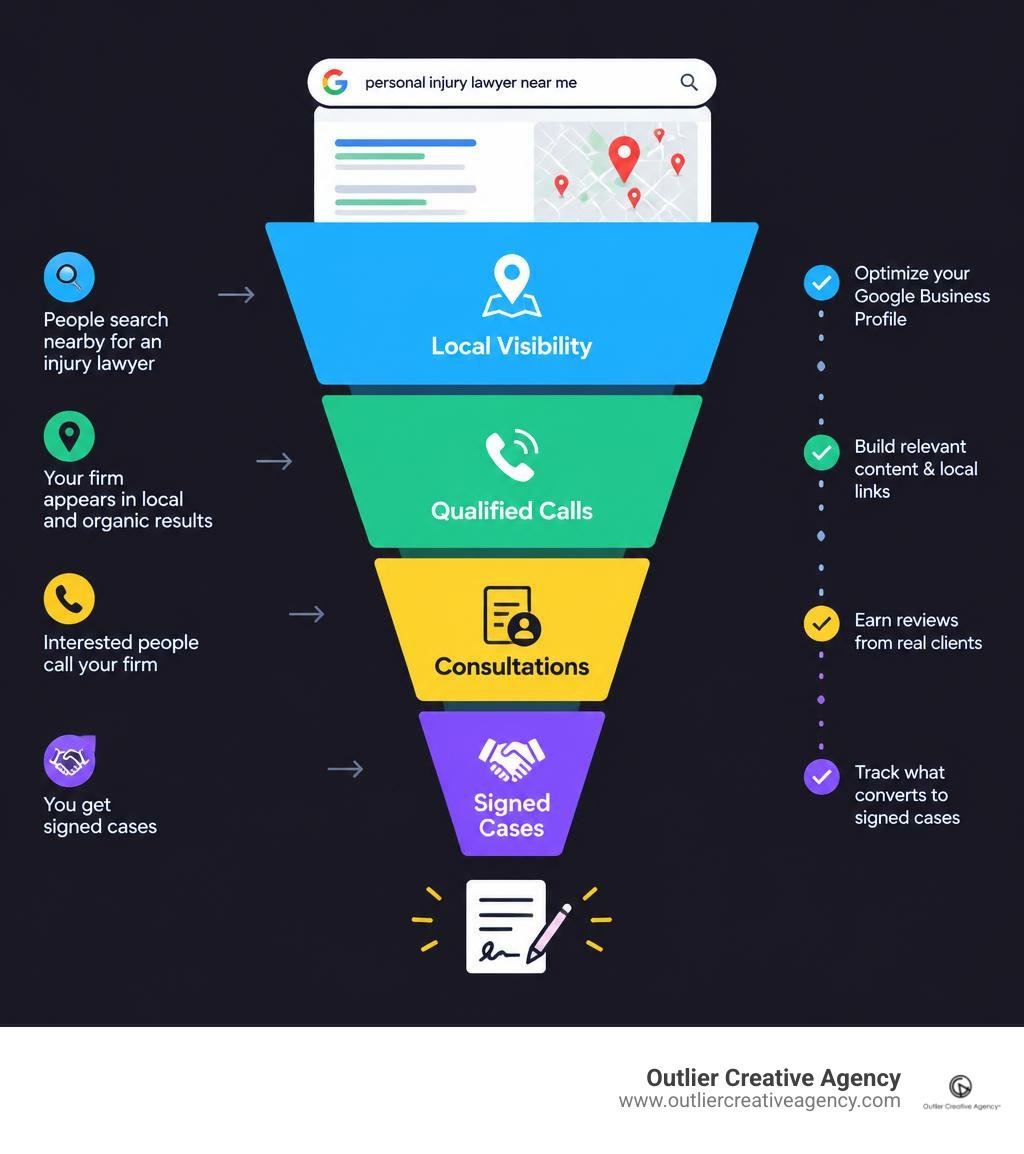
Personal injury SEO helps your firm appear when people nearby search for an injury lawyer. Start with a complete Google Business Profile, clear pages for each practice area, useful local content, and a mobile-friendly site. Earn relevant local links and ask clients for reviews without offering incentives. Then track which searches lead to qualified calls and signed cases, not just more website visits.
For a firm owner, the goal is not a higher traffic chart. It is a lower cost per signed case and a steadier source of new work. SEO is one part of a broader personal injury marketing plan, and it takes ongoing work to compete in local search.
I’m Corey Larson of Outlier Creative Agency. Our work with legal firms spans website builds, content, video, and lead-focused communication; in this guide, I’ll show how we approach personal injury SEO with signed cases as the measure that matters.
How Google Ranks Personal Injury Law Firms in Local and Organic Search
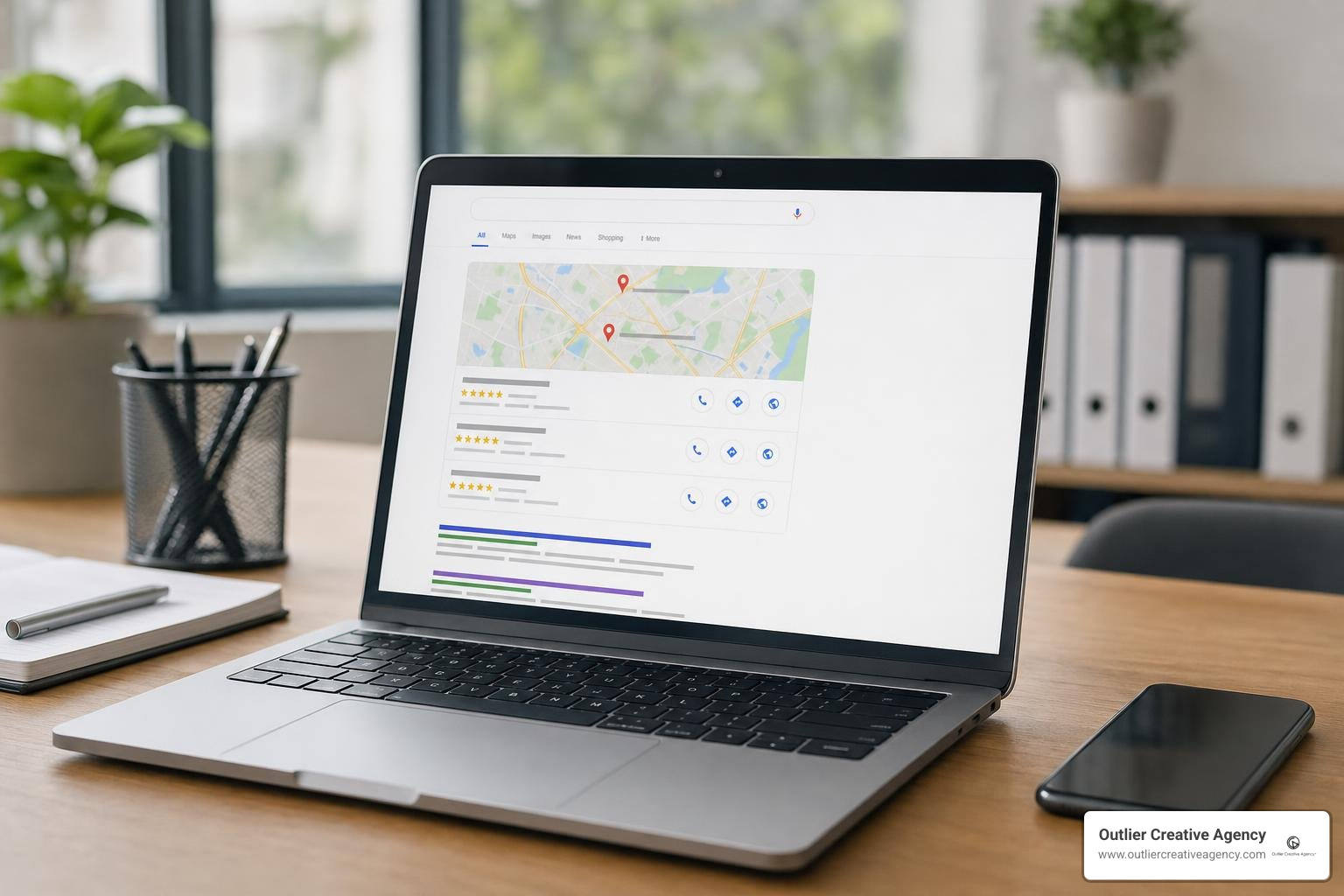
Google evaluates personal injury firms through two distinct search systems: the local map pack and traditional organic results. Both systems aim to deliver the most relevant, reputable legal resources to individuals seeking immediate counsel following an accident. Understanding how these algorithms work allows firm owners to deploy marketing capital effectively.
In local search, Google relies on three core ranking factors:
- Relevance: How well your law firm's profile and website content match what the user is searching for.
- Distance: How close your physical office is to the user or the geographic location specified in their query.
- Prominence: How established and reputable your firm is, measured by reviews, directory citations, local news coverage, and authoritative backlinks.
Organic search results rely heavily on Google's Experience, Expertise, Authoritativeness, and Trustworthiness (E-E-A-T) framework. Because legal services directly impact a consumer's financial and physical well-being, Google classifies personal injury law under Your Money or Your Life (YMYL). YMYL standards require legal websites to demonstrate verified attorney credentials, clear editorial standards, and helpful, compliant information. Mastering local SEO allows personal injury firms to secure prime visibility across both map packs and organic listings.
Google Business Profile Optimization and Local Trust Signals
Your Google Business Profile (GBP) functions as the digital front door to your practice. Winning placements in the Google Local 3-Pack requires complete, accurate profile optimization.
Start by selecting the most accurate primary category: "Personal Injury Attorney." Secondary categories such as "Trial Attorney," "Legal Services," or "Car Accident Lawyer" should support your main practice areas. Keep your Name, Address, and Phone number (NAP) identical across your profile, website footer, and external directories. Even minor discrepancies in suite numbers can weaken Google's trust in your physical location.
Upload real, high-resolution photographs of your attorneys, office interiors, and conference spaces every month. Geo-grid tracking tools show that firms maintaining active, complete profiles with clear service areas capture higher call volumes across wider suburban radiuses. To see an example of how location signals impact local rankings, watch this Austin, TX Personal Injury Law Firm SEO Ratings breakdown.
The Impact of Reviews and Reputation Management on Rankings
Online reviews serve as one of Google's strongest prominence signals in local search algorithms. Beyond search rankings, reviews provide the primary social proof accident victims evaluate before calling your intake team.
A high-performing review strategy focuses on three key factors:
- Review Velocity: Securing a steady stream of authentic client reviews each month rather than sporadic bulk additions.
- Sentiment and Keywords: Unprompted client mentions of specific case types, such as commercial truck collisions or motorcycle crashes, reinforcing your topical relevance.
- Prompt Response Protocols: Responding professionally to every review within 24 to 48 hours to demonstrate client care and active management.
All review collection must strictly follow state bar advertising rules. Never offer gift cards, fee discounts, or financial incentives in exchange for reviews. Maintain client confidentiality by avoiding case specifics in public review responses.
Core Pillars of Personal Injury SEO for Practice Growth
Scaling organic case acquisition requires a solid technical and architectural foundation. If your website loads slowly or confuses search engine crawlers, even the best legal content will fail to rank.
Prioritize core web vitals, mobile responsiveness, and page speed. The majority of injury searches occur on mobile devices immediately following accidents. A seamless mobile experience with prominent click-to-call buttons and instant chat directly improves intake conversions. Implement structured data schema markup across your site, including LocalBusiness, Attorney, and FAQPage schemas, helping search engines understand your credentials and services. Maintaining ethical SEO practices protects your firm from algorithmic penalties while building long-term equity.
Practice Area Architecture and Strategic Keyword Targeting
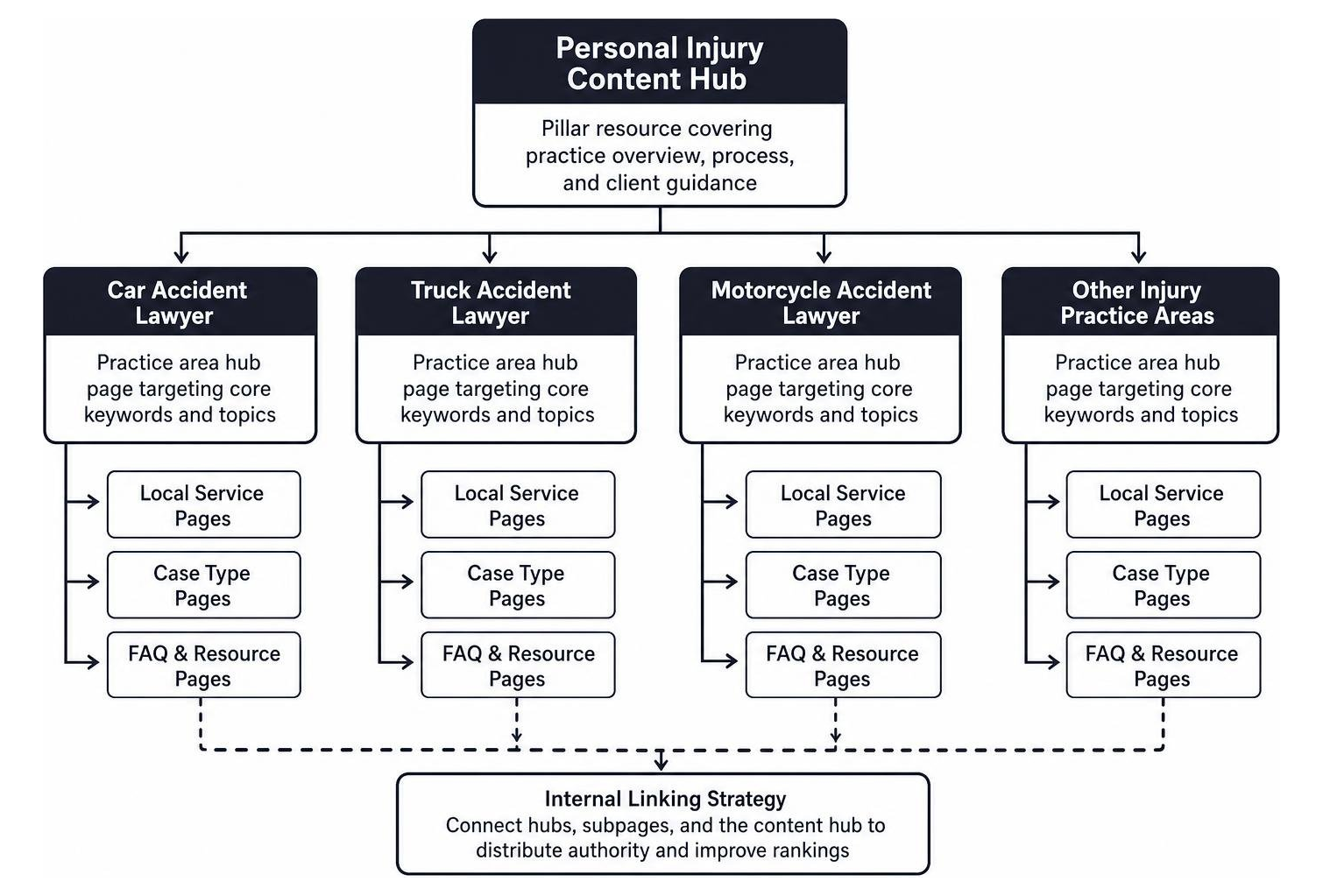
A flat website architecture where all legal services sit on a single page prevents Google from recognizing your depth of expertise. Instead, organize your website into structured practice area hubs.
Build dedicated parent pages for core pillars such as Car Accidents, Truck Accidents, Slip and Fall Injuries, and Catastrophic Injuries. Beneath these pillar pages, create supporting child pages targeting specific case types, including rear-end collisions, rideshare accidents, and brain injuries. This approach establishes clear topical hierarchy.
Conduct thorough keyword research for law firms to identify high-intent search terms. Target specific commercial phrases like "commercial vehicle accident lawyer" alongside city-specific variations. Connect these pages using contextual internal links to distribute authority throughout your site.
Local Content Creation That Builds Case Authority
Publishing generic legal definitions does not attract qualified cases or impress search engines. Your content must answer real client questions and reflect your local operating market.
High-impact local content formats include:
- Accident Hotspot Breakdowns: In-depth reviews of high-collision intersections, highway corridors, and local traffic patterns based on municipal crash data.
- Local Court and Procedure Guides: Clear explanations of how personal injury claims move through county civil courts and local settlement conferences.
- State Statute Explanations: Accessible breakdowns of state-specific comparative negligence laws, insurance minimums, and statutes of limitations.
Pairing written content with SEO optimized lawyer videos improves on-page engagement, increases dwell time, and builds trust with prospective clients facing complex legal challenges.
Link Building and Digital PR for Injury Law Firms

Backlinks from reputable, relevant websites signal to Google that your practice is an established authority. In personal injury law, the quality and topical relevance of your backlink profile matter far more than link volume. A handful of links from respected legal associations and local institutions will outperform hundreds of low-tier directory submissions.
For practices targeting competitive metro markets, localized link acquisition forms the backbone of California personal injury SEO campaigns. Earning natural editorial links requires a proactive digital PR and outreach strategy.
Earning High-Authority Legal Citations and Local Backlinks
Build a resilient link profile by pursuing several authoritative acquisition channels:
- Authoritative Legal Directories: Maintain claimed, complete profiles on respected national legal directories and your state bar directory.
- Community Sponsorships and Partnerships: Support local youth sports leagues, non-profit events, and civic organizations that provide official sponsor links from their regional domains.
- Digital PR and Legal Commentary: Offer expert legal commentary on current court rulings or traffic safety trends to local journalists and regional news outlets.
- Local Business Citations: Ensure consistent business listings across local chambers of commerce and regional business directories.
Comparing SEO and Paid Media for Law Firm Growth
According to legal advertising benchmark data from industry marketing research groups, personal injury keywords are among the most expensive search terms in Google Ads, with cost-per-click rates regularly exceeding $150. Law firm owners must understand the distinct roles that organic search, pay-per-click (PPC), and Local Services Ads (LSAs) play in case acquisition.
| Strategy | Speed of Results | Cost Model | Long-Term ROI | Lead Intent |
|---|---|---|---|---|
| Personal Injury SEO | 6 to 12 Months | Fixed Agency Retainer | High & Compounding | High |
| Google PPC Ads | Immediate | Pay Per Click ($100 to $300+) | Moderate (Stops when spend stops) | High |
| Local Services Ads | Immediate | Pay Per Qualified Lead | Moderate to High | Very High |
While paid campaigns deliver immediate visibility, organic search engine optimization builds sustainable digital assets that generate cases without recurring per-click fees. Combining organic SEO with a targeted personal injury PPC campaign creates a balanced marketing strategy that captures immediate demand while driving down long-term acquisition costs.
Evaluating Personal Injury SEO by Signed Cases Instead of Traffic
Many marketing agencies present firm owners with vanity metrics: keyword impressions, total site clicks, and raw traffic volume. For a personal injury practice, these numbers mean little if they do not convert into signed retainer agreements.
To evaluate marketing performance accurately, connect your organic search campaigns directly to your firm's intake management software and CRM. Track key metrics including:
- Qualified Phone Calls: Intake inquiries meeting your practice's specific liability and insurance criteria.
- Cost Per Acquisition (CPA): Total marketing investment divided by the number of signed cases generated from organic search.
- Caseload Value Attribution: Total settlement and fee values originating from organic search queries over time.
Our detailed law firm SEO case study demonstrates how focusing on intake qualification and search intent drives measurable practice growth.
Adapting to the Future of Search in 2026 and Beyond
Search engines continue to evolve with the expansion of AI Overviews, conversational search queries, and voice-assisted devices. Accident victims increasingly ask complete, conversational questions, such as "What happens if the other driver was uninsured in Texas?"
To maintain search visibility, law firms must optimize for semantic search and brand entity recognition. Google rewards legal brands that demonstrate authoritative answers, verified author credentials, and multi-channel prominence. Integrating technical website health with comprehensive law firm digital marketing ensures your practice remains visible across AI syntheses and traditional search results alike.
Future-Proofing Your Personal Injury SEO for AI Search
To prepare your practice for ongoing search evolution, implement these forward-looking tactics:
- Direct-Answer Formatting: Structure blog posts and practice pages with concise summaries at the top of the page to answer core legal questions.
- Conversational Long-Tail Target Keywords: Optimize content for natural speech patterns and voice searches common among mobile users.
- Entity Authority Building: Maintain active profiles across social platforms, video networks, and professional legal directories to reinforce your firm's brand identity.
Conclusion
Building a dominant search presence requires a clear strategy centered on practice authority, local visibility, and measurable intake results. At Outlier Creative Agency, we design data-driven search campaigns engineered to lower your cost per acquisition and deliver high-value retainers. If you are ready to expand your caseload with a proven legal marketing partner, contact Outlier Creative Agency today to schedule a consultation.
Frequently Asked Questions About Personal Injury SEO
How long does it take for a personal injury law firm to rank on Google?
Most personal injury law firms begin seeing measurable improvements in organic rankings and qualified phone calls within 6 to 12 months. Timelines depend on the firm's historical domain authority, the technical health of the website, local market competition, and the consistency of content and link-building efforts.
Why are personal injury keywords more competitive than other legal practice areas?
Personal injury keywords carry higher competition because the average case values and contingency fees are substantial. Because a single catastrophic injury case can generate significant revenue, firms invest heavily in digital marketing, driving up competition across organic rankings and paid advertising auctions.
How should firm owners measure the true ROI of search engine optimization?
Firm owners should measure SEO ROI by tracking signed retainer agreements and resulting legal fees rather than raw website traffic. By integrating web analytics with your intake CRM, calculate your true cost per signed case (total SEO investment divided by signed clients) to evaluate profitability accurately.
What is the most important ranking factor for Google Local Pack visibility?
Google's Local Pack rankings rely primarily on a balance of relevance, distance, and prominence. For established practices, prominence is the primary factor separating top-ranking firms from lower-tier competitors. Genuine client reviews, consistent NAP citations, and authoritative local backlinks drive that prominence.