

Dominate California personal injury SEO with proven strategies for local rankings, high-value case acquisition, and State Bar compliance in 2026.
If you run an injury firm and would rather have a team build this for you, start with personal injury marketing and see how Outlier helps injury firms sign more cases.
Why California Personal Injury SEO Matters for Case Growth
California personal injury SEO works when your firm matches high-intent case keywords with fast mobile pages, a fully optimized Google Business Profile, unique city and practice-area content, and reliable conversion tracking. Start by prioritizing the accident types and California markets that produce your best cases, then make it easy for injured people to call or request a consultation.
More than 75% of personal injury searches happen on mobile devices, and "near me" searches have grown by more than 500% since 2015. In a market as competitive as Los Angeles, San Diego, Orange County, and the Bay Area, visibility in both Google Maps and organic results can determine whether your firm earns the inquiry or loses it to a competitor.
The goal is not to rank for every broad legal term. It is to earn qualified local traffic for searches such as "car accident lawyer Los Angeles," "truck accident attorney San Diego," and questions an injured person asks before contacting counsel. Long-tail terms often convert 2-5 times better than broad keywords because the searcher has a clearer need.
Meaningful SEO traction often takes 4-9 months, while major-metro service terms may require 6-12 months or longer. A focused strategy gives your firm a durable asset: content and local authority that can keep generating cases beyond the life of an ad campaign.
I am Corey Larson of Outlier Creative Agency. Our team creates legal websites, video, and content designed to support California personal injury SEO, help firms communicate clearly, and turn online attention into qualified case inquiries.
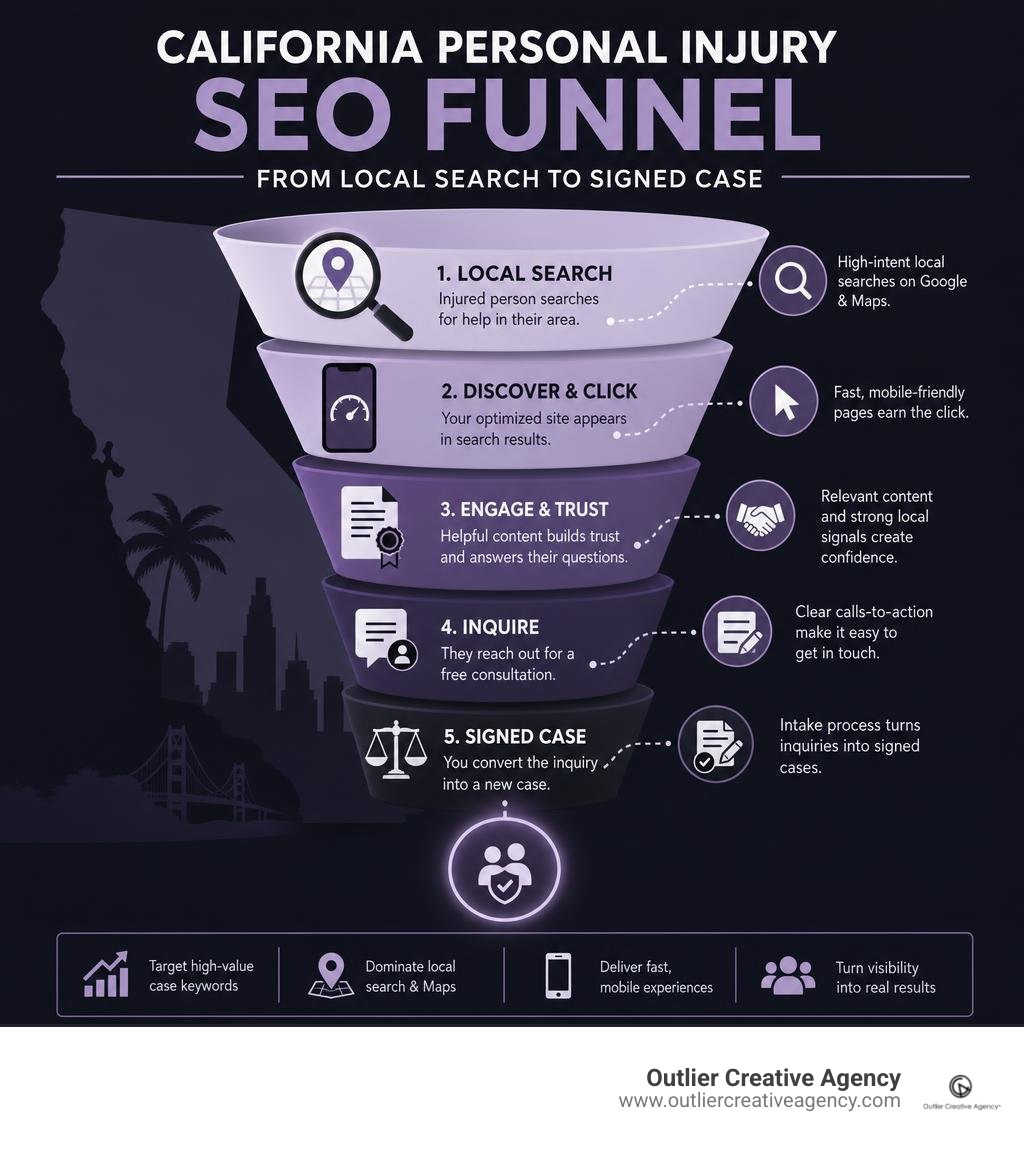
Core Pillars of California Personal Injury SEO That Drive High-Value Cases
Personal injury law in the United States generates over $50 billion annually, making it one of the most competitive spaces in digital marketing. When navigating search engine rankings across California, simply having a generic website is no longer sufficient. Law firms must deploy an integrated strategy rooted in comprehensive SEO that addresses search intent, local presence, technical infrastructure, and on-page authority.
Prospective clients do not look for legal help casually. They search under immense stress following a collision, slip and fall, or catastrophic event. To win these high-value cases, your digital presence must satisfy both Google's search algorithms and the urgent needs of the injured person. Trusted resources such as directories that showcase the Best Personal Injury Lawyers in Los Angeles, CA demonstrate how authority, location signals, and clear practice categorization drive visibility in crowded markets.

High-Intent Keyword Strategy and Search Intent
The foundation of an effective campaign begins with distinguishing between informational curiosity and transactional intent. High-intent keywords represent users actively seeking immediate legal representation. Rather than targeting vanity terms with immense difficulty and poor conversion rates, your firm should target high-value practice-specific terms.
Conducting effective keyword research for law firms allows you to map terms across every stage of the client journey:
- Transactional Queries: "Motorcycle accident lawyer free consultation," "Los Angeles catastrophic injury attorney."
- Commercial Investigation: "Best truck accident law firm near me," "contingency fee lawyer California."
- Informational/Long-Tail: "How long do I have to file an injury claim in California," "who pays medical bills after an auto collision."
While head terms like "injury lawyer" boast high monthly volume, long-tail, case-specific phrases frequently convert 2 to 5 times higher because the searcher is primed to take immediate legal action.
Technical Architecture for California Personal Injury SEO
Even the most persuasive copy will fail if your technical foundation is flawed. Google demands fast, secure, and mobile-friendly websites, particularly in legal search where over three-quarters of users browse from a smartphone.
To maximize search visibility and user retention, ensure your website meets these technical benchmarks:
- Core Web Vitals & Page Speed: Aim for largest contentful paint (LCP) times under 2.5 seconds. Slow-loading pages cause injured users to bounce to a competing firm's site.
- Mobile Usability: Ensure sticky tap-to-call buttons, click-to-chat widgets, and simplified lead capture forms are accessible above the fold on mobile screens.
- Structured Data Markup: Implement detailed JSON-LD schema markup, specifically
LegalService,Attorney, andLocalBusinesstypes. Include geographic coordinates, aggregate review ratings, service areas, and accepted payment types. - Site Security (HTTPS): Maintain valid SSL certificates across all subdomains to guarantee user data privacy during intake submissions.
Dominating Local Search and Google Business Profile in Competitive California Metros
For personal injury practices, the Google Local 3-Pack is prime digital real estate. When a prospective client searches "car accident lawyer near me" from downtown Los Angeles or central San Diego, Google displays the top three map listings above traditional organic results.
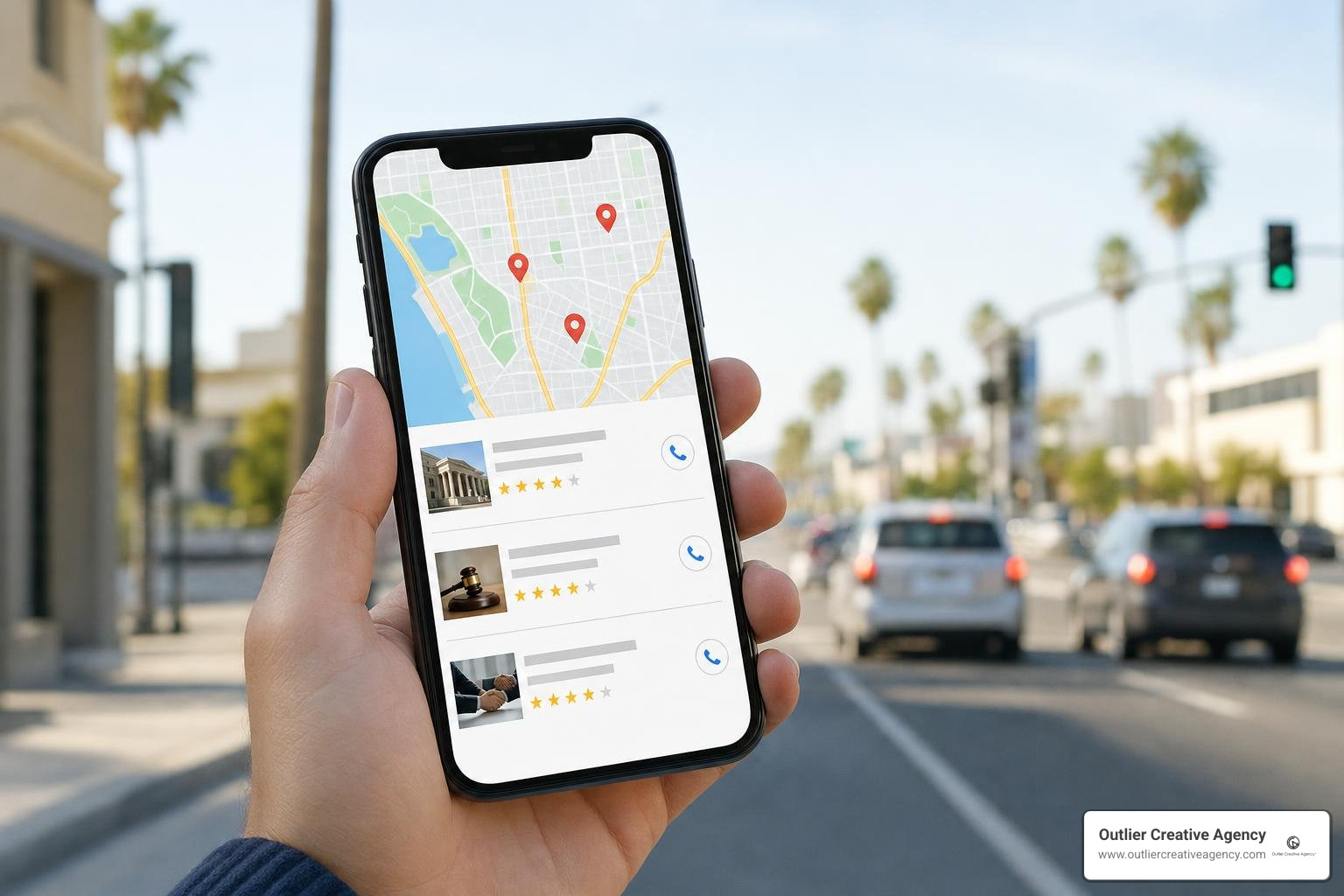
Dominating the Local 3-Pack requires a meticulous Google Business Profile (GBP) optimization plan:
- Primary and Secondary Categories: Set your primary category to "Personal Injury Attorney" and add relevant secondary categories such as "Trial Attorney" or "Legal Services."
- Name, Address, and Phone (NAP) Consistency: Your firm's NAP must be identical across your GBP listing, website footer, local directories, and state bar listings.
- Review Velocity and Sentiment: Actively gather authentic reviews from satisfied clients. Respond professionally to every review while respecting attorney-client confidentiality rules.
- Local Photos and Updates: Regularly post high-resolution imagery of your office, attorney headshots, and updates discussing community involvement or firm announcements.
Optimizing Multi-Location Geo-Pages Across Major Markets
If your firm serves multiple jurisdictions across the state, creating dedicated municipal landing pages is critical. Rather than duplicating content, build unique, value-driven pages tailored to each service area.
Firms targeting Southern California can implement proven Los Angeles legal SEO tactics by creating hyper-local content that references specific corridors like the I-405 or local superior courts. Similarly, firms in Northern California should adopt specialized San Francisco law firm search strategies that speak to local transit systems, regional collision trends, and local jurisdiction rules.
Every municipal landing page should include:
- A distinct, localized H1 header (e.g., "Pasadena Car Accident Attorney").
- Embedded Google Maps pointing directly to your local office.
- Unique local client testimonials and regional case settlements.
- Relevant jurisdictional context, including local courthouse procedures.
Local Backlink Acquisition and Citation Building
Backlinks serve as votes of confidence from other authoritative websites. In the legal sector, acquiring backlinks from trusted local organizations, community partners, and industry directories signals domain authority to search engines.
Prominent firms such as Panish | Shea | Ravipudi LLP: Los Angeles Personal Injury maintain exceptional domain authority by earning editorial coverage, publishing groundbreaking trial results, and participating in high-profile appellate cases.
You can build a strong backlink profile by:
- Securing profile listings in respected legal directories (Justia, Avvo, FindLaw, Super Lawyers).
- Sponsoring local charitable events, youth sports leagues, and regional educational scholarships.
- Contributing legal commentary to local news publications and business journals.
- Engaging actively with regional bar associations, including the Los Angeles County Bar Association (LACBA) and the Consumer Attorneys Association of Los Angeles (CAALA).
Creating High-Converting Content for Niche Practice Areas
High-converting legal content addresses prospective clients' specific fears, questions, and recovery paths. Content clusters—where a comprehensive "pillar" page links to in-depth supporting articles—position your firm as an authoritative resource on complex tort topics.
When drafting California personal injury content, incorporate distinct state legal doctrines:
- Pure Comparative Fault: Explain how California's comparative negligence rule allows injured plaintiffs to recover damages even if they share partial fault.
- Statute of Limitations: Clarify the strict two-year filing deadline under California Code of Civil Procedure § 335.1 (or six months for claims against government entities under the California Tort Claims Act).
- Insurance Requirements: Detail minimum policy limits and uninsured/underinsured motorist (UM/UIM) coverage nuances in the state.
Practice Area Landing Pages and Sub-Niche Targeting
Targeting sub-niche practice areas yields higher conversion rates and attracts high-damages litigation. Instead of relying solely on a broad "motor vehicle accident" page, build dedicated service pages for specific collision types.
For instance, addressing San Diego pedestrian accident claims requires distinct content detailing crosswalk regulations and severe trauma care. Similarly, targeting the growing rideshare market with dedicated rideshare and Uber accident SEO ensures your firm captures complex multi-tier insurance policy disputes following transportation network accidents.
High-value sub-niches include:
- Traumatic Brain Injuries (TBI): Explaining long-term cognitive care, lifetime vocational loss, and specialized medical testing.
- Commercial Trucking Collisions: Detailing Federal Motor Carrier Safety Administration (FMCSA) regulations, electronic logging devices (ELD), and multi-party liability.
- Spinal Cord & Catastrophic Injuries: Highlighting complex life care plans and seven-figure recovery requirements.
Multimedia and Video Content Optimization
Search patterns have shifted toward conversational, voice, and video-driven queries. With 20% of all online searches performed via voice assistants, prospective clients frequently ask complete questions such as: "Who pays my hospital bills if I was hit by an uninsured driver in California?"
Integrating SEO optimized lawyer videos across your practice area pages boosts on-page dwell time and increases trust. To maximize video content for search:
- Host videos on YouTube and embed them natively onto matching service pages.
- Implement
VideoObjectschema containing the video title, description, and upload date. - Transcribe videos verbatim and place the text beneath the media player to provide indexable content for search engines and AI Overviews.
California State Bar Compliance and Common SEO Pitfalls
Legal search marketing in California is governed by strict ethical guidelines. The State Bar of California enforces rules designed to protect the public from false, misleading, or deceptive advertising. When executing digital optimization campaigns, law firms must adhere strictly to the California Rules of Professional Conduct (CRPC), specifically Rule 7.1 through Rule 7.5.
| Non-Compliant Marketing Copy | Compliant Alternative | Relevant Compliance Rule |
|---|---|---|
| "We are the best personal injury lawyers in Los Angeles and guarantee maximum compensation." | "Our experienced Los Angeles trial attorneys fight tirelessly to pursue the recovery you deserve." | CRPC Rule 7.1 (Prohibits false or misleading statements and unjustified expectations). |
| "Hiring our firm guarantees a million-dollar settlement for your car accident." | "Past case results do not guarantee, warrant, or predict future case outcomes. Each case depends on its facts." | CRPC Rule 7.1 / Required settlement disclaimer disclosures. |
| "Specialist personal injury attorney serving all of Southern California." | "Personal injury attorney with 15+ years of dedicated litigation experience." | CRPC Rule 7.4 (Restricts using 'certified specialist' without State Bar certification). |
Adhering to ethical SEO practices for attorneys protects your firm's professional license while creating trust with potential clients.
Avoiding Critical SEO Mistakes in California
Many law firms fall victim to aggressive or outdated marketing tactics that harm their search standing:
- Keyword Stuffing: Artificially inserting phrases like "California injury attorney" repeatedly into headers and body paragraphs ruins readability and triggers Google search spam penalties.
- Doorway Pages: Publishing dozens of nearly identical city pages without adding distinct local value or localized case information violates search engine quality guidelines.
- Inconsistent Directory Data: Discrepancies in office suite numbers, phone numbers, or firm names confuse search engine crawlers and suppress local Map Pack rankings.
- Chasing Vanity Metrics: Focusing purely on organic impressions rather than qualified consultation phone calls and signed retainers leads to wasted marketing budgets.
Measuring Success: Analytics, Conversion Tracking, and Ranking Timelines
Optimizing your firm's search visibility is an iterative, data-driven discipline. To evaluate campaign performance accurately, your practice must implement a comprehensive tracking stack.
Essential tracking components include:
- Google Analytics 4 (GA4): Track organic user engagement, geographic traffic distributions, top landing pages, and key conversion events (form submissions, click-to-call events).
- Google Search Console (GSC): Monitor indexation status, mobile usability errors, query impressions, average keyword positions, and click-through rates (CTR).
- Dynamic Call Tracking: Deploy dynamic number insertion (DNI) to attribute incoming intake calls directly to specific organic search landing pages and keyword clusters.
- Legal Intake & CRM Integration: Connect digital forms directly to case management software to measure lead-to-retained-case conversion rates.
Tracking ROI and California Personal Injury SEO Performance
Law firm partners often ask about realistic timelines for search optimization returns. In competitive California metropolitan areas, SEO results compound steadily over time rather than occurring overnight.
By measuring cost per acquisition (CPA) against the average settlement value of retained cases, personal injury law firms can verify that organic search delivers the lowest cost-per-case acquisition rate of any digital marketing channel.
Frequently Asked Questions About California Personal Injury SEO
How long does it take for a California personal injury law firm to rank on Google?
Most personal injury law firms begin seeing organic keyword movement and initial lead generation within 4 to 9 months. In hyper-competitive metro areas like Los Angeles or San Francisco, achieving page-one rankings for high-intent head terms (e.g., "Los Angeles car accident lawyer") typically requires 6 to 12 months or longer. However, niche long-tail blog posts and localized FAQ content can earn top rankings in as little as 1 to 3 months.
What California State Bar advertising rules impact law firm SEO?
Law firms must comply with California Rules of Professional Conduct Rules 7.1 through 7.5. Key requirements include avoiding false or misleading claims, prohibiting unprovable superlatives (such as claiming to be the "best" or "#1" attorney without verifiable evidence), including explicit disclaimers on past case results, and refraining from claiming specialist status unless officially certified by the State Bar of California Board of Legal Specialization.
Why do personal injury firms need separate pages for each California city?
Search engines deliver localized results based on the geographic intent of the user. Having dedicated, unique municipal landing pages for each primary city you serve allows you to target geo-specific search terms, embed localized driving directions and maps, highlight regional courthouse experience, and capture local Map Pack traffic in neighboring cities.
Conclusion
Building a dominant online presence in California's competitive personal injury landscape requires an approach that integrates high-intent keyword targeting, strong technical site architecture, localized Google Business Profile management, and strict State Bar compliance. When executed methodically, search optimization transforms your website into a reliable source of qualified case inquiries.
At Outlier Creative Agency, we help ambitious personal injury law firms build durable organic authority, increase intake efficiency, and outrank regional competitors. If you are ready to scale your caseload through an integrated search strategy or complement your organic presence with expert PPC and digital marketing for law firms, contact our team today to schedule an initial consultation.