
Stop wasting budget on bankruptcy law firm ads. Audit, test, and optimize your PPC campaigns to cut costs and win more cases.
Test Before You Scale Bankruptcy Law Firm Ads
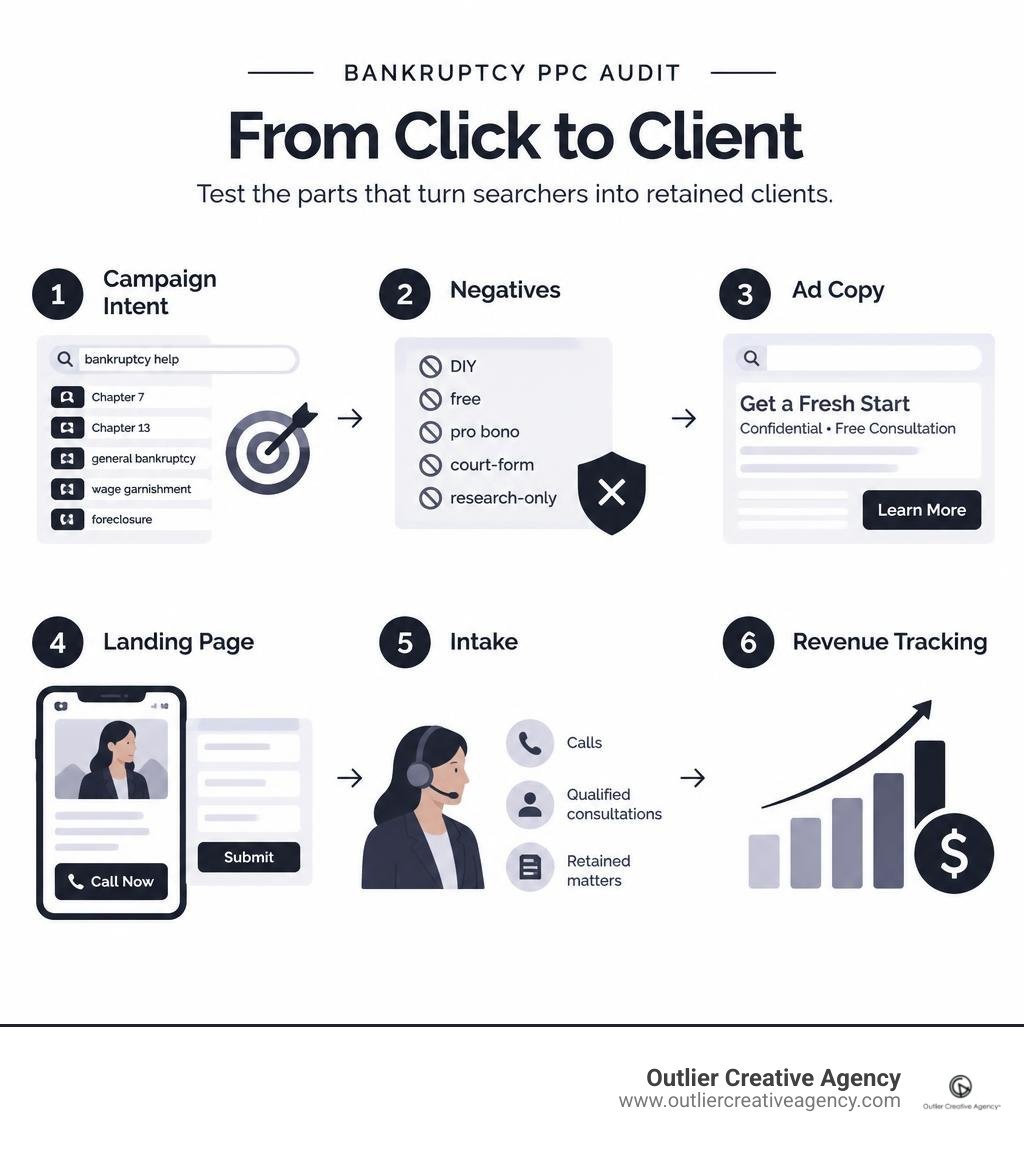
Before you raise the budget on bankruptcy law firm ads, test the parts that determine whether a click becomes a retained client:
- Split campaigns by intent: Chapter 7, Chapter 13, general bankruptcy, and urgent searches such as wage garnishment or foreclosure.
- Add strong negative keywords to block DIY, free, pro bono, court-form, and research-only traffic.
- Test empathy-led ad copy that stresses confidentiality and a free consultation.
- Send each ad group to a fast, mobile-friendly page with a click-to-call button and a short form.
- Track calls, qualified consultations, retained matters, and revenue - not just clicks or form fills.
Bankruptcy prospects are not typical legal buyers. Many search under stress, compare several firms quickly, and may hesitate to share personal details. That makes relevance, privacy signals, and fast intake just as important as bids. A high cost per click can still be profitable; an inexpensive lead is not valuable if it never reaches a consultation or retains the firm. For broader context on how legal advertising rules shape these decisions, the American Bar Association’s lawyer advertising resources outline the ethics and compliance considerations that apply to attorney marketing.
At Outlier Creative Agency, we help legal teams turn complex services into clear, conversion-focused marketing across websites, video, social media, and paid campaigns. I am Corey Larson, and my work on bankruptcy law firm ads focuses on building trustworthy messages and practical lead paths that help firms compete for high-intent cases.
Why Are Your Bankruptcy Law Firm Ads Bleeding Budget?
Legal keywords are consistently among the most competitive and expensive on search engines. In major metropolitan areas like Los Angeles, California, and Austin, Texas, legal clicks regularly cost between $50 and $200+ each. When running attorney PPC advertising, unchecked campaigns can burn thousands of dollars in days without signing a single paying client.
The reason bankruptcy campaigns bleed cash is rarely a lack of market demand. Instead, it stems from a disconnect between high costs per click (CPC), delicate consumer behavior, and strict regulatory requirements.
Without rigorous management, 20% to 40% of legal ad spend is wasted on clicks from individuals seeking free government aid, DIY court forms, or legal advice outside your firm’s licensing jurisdiction. Before increasing your monthly advertising spend, you must address the psychological, structural, and legal elements driving your campaign performance.
How Does Prospect Psychology Shape Bankruptcy Search Behavior?
Bankruptcy prospects operate under extreme emotional and financial distress. Unlike someone looking for a commercial real estate attorney or drafting a trademark application, a consumer seeking debt relief is often dealing with shame, fear, and decision paralysis.
Several distinct behavioral traits define this audience:
- Off-Hours Searching: A substantial portion of bankruptcy searches occur late at night (often after 10 PM) when wage garnishment notices, past-due bills, and insomnia converge.
- Rapid Multi-Firm Outreach: Distressed prospects frequently open three to five law firm tabs simultaneously, submitting contact forms across multiple sites to see who responds first.
- High Trust and Privacy Sensitivity: Consumers are reluctant to submit extensive personal financial information into a generic online form due to the social stigma surrounding debt.
If your ad copy appears cold, judgmental, or overly institutional, prospects will bounce immediately, sending your conversion rates plummeting below the typical 4% to 7% legal baseline.
What Legal Disclosures Are Required for Bankruptcy Law Firm Ads?
Advertising for debt relief is uniquely regulated at both the federal and state levels. Under the Bankruptcy Abuse Prevention and Consumer Protection Act of 2005 (BAPCPA), codified in 11 U.S.C. § 528, law firms providing bankruptcy assistance to consumer debtors are classified as "Debt Relief Agencies."
Federal statute mandates that any advertisement offering bankruptcy assistance must clearly and conspicuously include the following disclosure:
"We are a debt relief agency. We help people file for bankruptcy relief under the Bankruptcy Code."
Failing to include this mandatory language in your ad assets, landing page footers, and consultation agreements can lead to severe penalties. Non-compliant law firms face statutory damages, the voiding of client attorney-fee contracts, and fee disgorgement ordered by bankruptcy trustees.
Furthermore, state bar rules in jurisdictions like the State Bar of California and the State Bar of Texas strictly prohibit misleading guarantees (such as "Erase 100% of your debt guaranteed") and require verifiable office addresses.
How Should You Structure and Segment Your Bankruptcy PPC Campaigns?
A common mistake law firms make is grouping all debt-related keywords into a single campaign. Combining broad terms like "debt help" with specific legal queries like "emergency Chapter 7 attorney" forces your ads to serve generic copy to distinct audiences, which lowers your Google Quality Score and inflates your acquisition costs.
When structuring debt relief and bankruptcy PPC campaigns, you must segment campaigns by search intent, bankruptcy chapter, and geographic focus.
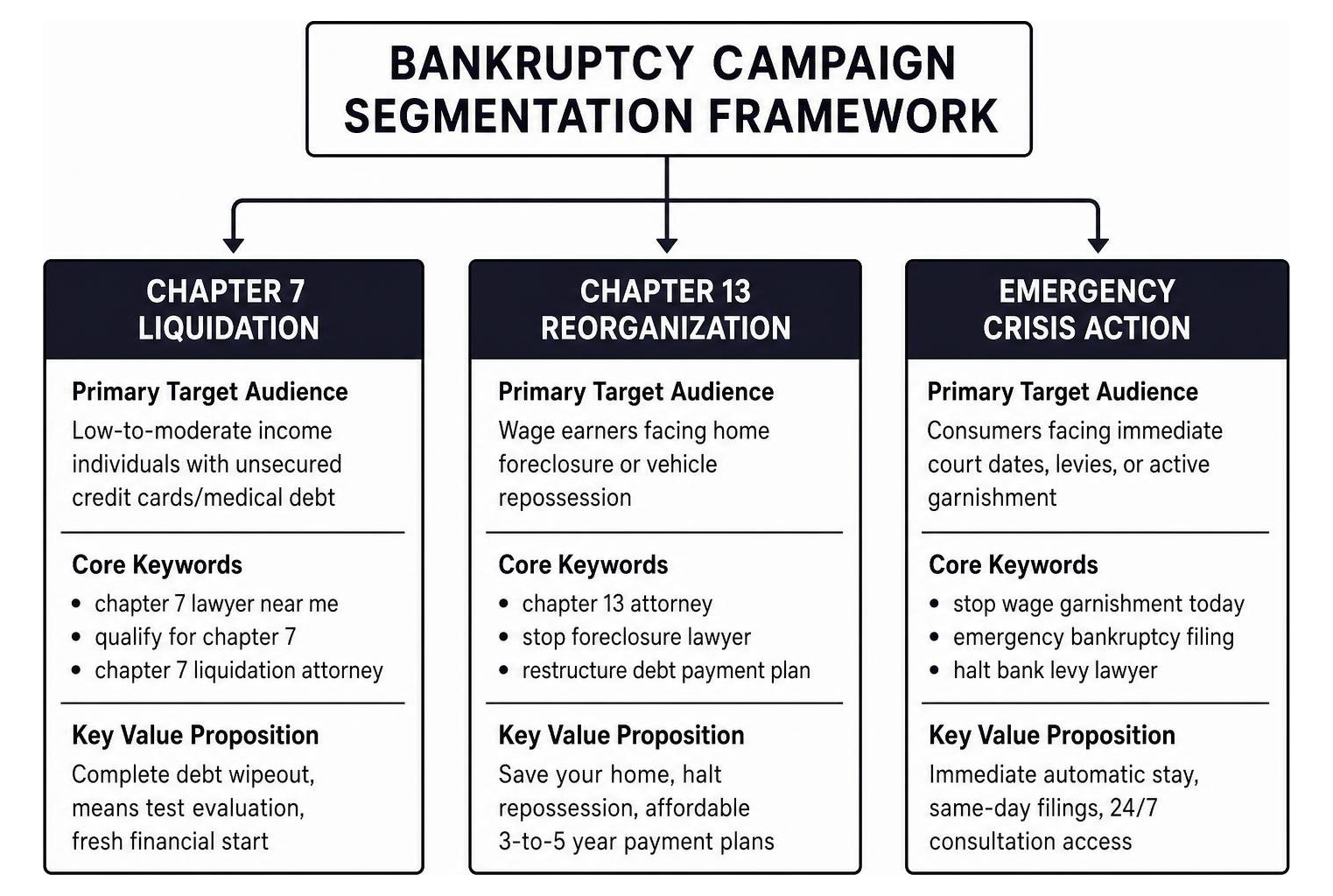
| Campaign Type | Primary Target Audience | Core Keywords | Key Value Proposition |
|---|---|---|---|
| Chapter 7 Liquidation | Low-to-moderate income individuals with unsecured credit cards/medical debt | chapter 7 lawyer near me, qualify for chapter 7, chapter 7 liquidation attorney |
Complete debt wipeout, means test evaluation, fresh financial start |
| Chapter 13 Reorganization | Wage earners facing home foreclosure or vehicle repossession | chapter 13 attorney, stop foreclosure lawyer, restructure debt payment plan |
Save your home, halt repossession, affordable 3-to-5 year payment plans |
| Emergency Crisis Action | Consumers facing immediate court dates, levies, or active garnishment | stop wage garnishment today, emergency bankruptcy filing, halt bank levy lawyer |
Immediate automatic stay, same-day filings, 24/7 consultation access |
How Do Chapter 7, Chapter 13, and Urgency Campaigns Differ?
Segmenting your campaigns by chapter and urgency allows you to customize ad headlines, extension callouts, and landing page messaging to the user's specific problem:
- Chapter 7 Campaigns: Focus on eligibility and immediate relief from unsecured debt. Prospects are worried about passing the "means test" and keeping their exempt assets. Your copy should emphasize wiping out credit card balances and medical bills while retaining essential property.
- Chapter 13 Campaigns: Appeal to individuals with steady incomes or significant non-exempt equity who want to protect their homes or vehicles. The messaging must center on stopping foreclosure sales and consolidating debts into manageable court-approved payments.
- Emergency Crisis Campaigns: Address acute legal actions such as an active bank levy, a vehicle repossession scheduled for tomorrow, or a scheduled foreclosure auction. These searches require aggressive ad scheduling, direct click-to-call extensions, and messaging highlighting the protection of the Bankruptcy Code's Automatic Stay.
What Negative Keywords Stop Wasted Spend in Bankruptcy Law Firm Ads?
Legal keywords are costly, making an aggressive negative keyword list essential for campaign efficiency. Without comprehensive negative coverage, up to 40% of your budget will go to non-converting clicks from students researching coursework, individuals looking for free legal aid, or people attempting DIY filings.
Conducting a regular review using our law firm PPC audit guide ensures you continuously filter out budget-draining search queries.
Key negative keyword lists to implement immediately include:
- DIY and Informational Negatives:
how to,diy,forms,packet,sample,template,pdf,self file,court clerk,steps to. - Low-Income and Free Aid Negatives:
free,pro bono,legal aid,charity,government grant,volunteer,cheap,no money. - Academic, Career, and Industry Negatives:
salary,jobs,internship,paralegal,bar exam,statute text,rules of procedure,course. - Corporate and Unhandled Practice Areas:
chapter 11,chapter 12,corporate restructuring,commercial liquidation,creditor rights(unless your firm explicitly represents creditors).
What Ad Copy and Landing Page Elements Drive Real Conversions?
A targeted ad campaign will fail if your messaging and landing page experience do not establish trust immediately. Distressed searchers need reassurance, clear next steps, and minimal friction.
Reviewing our PPC marketing guide for lawyers highlights how aligning empathetic messaging with an optimized mobile user experience directly drives signed cases.
Why Does Empathy-First Ad Copy Outperform Credential-Heavy Messaging?
Law firms often build ad headlines focused on internal accolades: "30 Years Experience," "Top Rated Litigators," or "Ivy League Educated."
However, data from consumer legal campaigns consistently shows that empathy-first, benefit-driven ad copy outperforms credential-heavy messaging in conversion rate and cost per lead.
When writing responsive search ads (RSAs), test ad copy focused on solving immediate pain points:
- Headline Set 1 (Immediate Relief): "Stop Creditor Calls Today," "Halt Foreclosure & Repossession," "End Wage Garnishment Now"
- Headline Set 2 (Reassurance & Confidentiality): "100% Confidential Legal Help," "Judgment-Free Debt Relief," "Explore Your Fresh Start"
- Headline Set 3 (Friction Removal): "Free 30-Min Consultation," "Affordable Payment Plans," "Speak With An Attorney Today"
How Should You Optimize High-Converting Bankruptcy Landing Pages?
Sending paid clicks to your firm's general homepage wastes valuable budget. Distressed prospects will not navigate complex menus to find your contact form. Every campaign must direct users to dedicated, conversion-optimized landing pages.
Key landing page requirements include:
- Sub-2.5 Second Mobile Load Times: Over 70% of consumer bankruptcy clicks originate from mobile devices. If your page is slow to load, users will hit the back button.
- Prominent Click-to-Call Buttons: Mobile users in immediate financial distress prefer calling over filling out forms. Keep a sticky tap-to-call button visible across the entire page.
- Short 3-Field Contact Forms: Request only essential information: First Name, Phone Number/Email, and an optional dropdown for Debt Amount ($10k-$30k, $30k-$50k, $50k+). Do not ask for Social Security numbers or full asset lists on the initial page.
- Visible Confidentiality Seals: Reassure users that their submission is protected by attorney-client privilege and completely confidential.
How Do You Scale Bidding and Automate Intake for Maximum ROI?
Driving clicks is only half the battle. If your law firm takes hours or days to follow up with leads, your cost per retained client will skyrocket. Maximizing campaign profitability requires combining automated intake workflows with modern bidding strategies.
Scaling your bankruptcy lawyer PPC ads successfully means tracking closed revenue rather than settling for surface-level click metrics.
How Do Seasonal Surges and Intake Speed Affect Cost Per Retained Matter?
Consumer bankruptcy searches follow distinct seasonal cycles. Search volume typically spikes in January, when holiday credit card bills come due and individuals reassess their finances. Conversely, search volume often dips in late February and March as tax refund checks arrive, temporarily alleviating cash flow pressure for struggling households.
Because distressed consumers often contact several attorneys at once, intake speed is the single largest variable determining conversion rate. Data shows that reaching a lead within 5 minutes can increase retained client rates by up to 50% compared to responding after 30 minutes.
Implementing an integrated legal CRM enables your firm to:
- Trigger instant automated SMS and email confirmations with a calendar scheduling link.
- Route inbound calls directly to an on-call intake specialist 24/7.
- Track lead attribution from initial click to signed retainer and paid filing fee, verifying true law firm PPC results.
What Bidding Strategy Should You Use Before Scaling Budget?
Avoid switching to automated Smart Bidding on day one of a new campaign. Google's machine-learning algorithms require conversion data to optimize effectively.
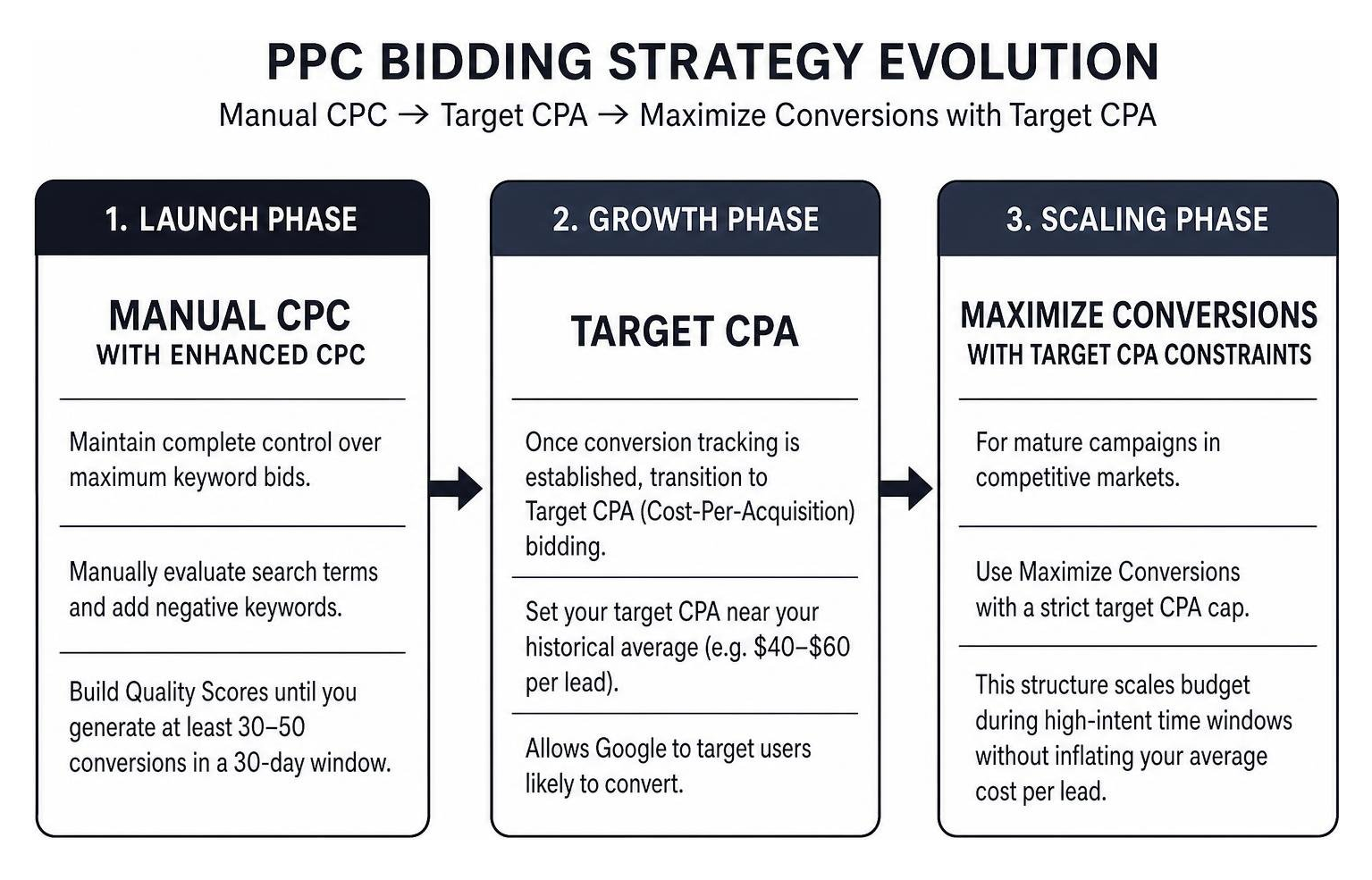
Follow a structured three-stage bidding evolution:
- Launch Phase (Manual CPC with Enhanced CPC): Maintain complete control over maximum keyword bids. Manually evaluate search terms, add negative keywords, and build your Quality Scores until your account generates at least 30 to 50 conversions in a 30-day window.
- Growth Phase (Target CPA): Once conversion tracking is established, transition to Target CPA (Cost-Per-Acquisition) bidding. Set your target CPA near your historical average (e.g., $40–$60 per lead) to allow Google to target users likely to convert.
- Scaling Phase (Maximize Conversions with Target CPA constraints): For mature campaigns in competitive markets, use Maximize Conversions with a strict target CPA cap. This structure scales budget during high-intent time windows without inflating your average cost per lead.
Frequently Asked Questions About Bankruptcy Law Firm Ads
How much should a bankruptcy law firm spend on Google Ads?
In competitive metro markets such as Los Angeles or Austin, a solo or boutique bankruptcy law firm typically needs a starting budget of $2,000 to $4,000 per month. This spend generates enough click volume (40 to 80 clicks at $30–$80 average CPC) to gather conversion data, test ad copy, and sign 3 to 8 retained clients monthly, yielding a strong return on investment against an average client lifetime value of $3,500.
What is a good cost per lead for bankruptcy attorney advertising?
Early-stage bankruptcy PPC campaigns without historical optimization usually see costs per lead (CPL) between $80 and $200. However, a mature, properly structured campaign with refined negative keyword lists, localized ad groups, and optimized landing pages should consistently generate qualified leads at $20 to $50 per lead, with landing page conversion rates reaching 15% to 25%.
Why do bankruptcy ad conversion rates spike in January?
Bankruptcy search queries and conversion rates surge every January due to post-holiday debt realization. After navigating the holiday season on credit cards, consumers face year-end financial accounting, collection notices, and new financial resolutions, driving motivated searchers to seek legal debt relief.
What happens if a bankruptcy ad omits the Debt Relief Agency disclosure?
Under federal law (11 U.S.C. § 528), omitting the mandatory "Debt Relief Agency" language from your advertising can result in legal sanctions. A bankruptcy court judge or trustee can void your attorney representation contract, force the disgorgement of legal fees paid by the debtor, and award actual damages and attorney fees to the client.
Conclusion
Scaling an underperforming bankruptcy campaign simply wastes your marketing budget faster. Real growth requires testing campaign intent, refining negative keywords, ensuring BAPCPA compliance, and streamlining your intake process before increasing ad spend.
If your firm is ready to audit its ad performance, cut wasted spend, and build a predictable client acquisition pipeline, our team can help. Explore our full suite of PPC advertising for law firms or book a strategy consultation with Outlier Creative Agency today to optimize your legal campaigns for long-term growth.