

Find the right marketing automation platform for agencies to streamline client campaigns, boost efficiency, and scale growth.
What Makes a Dedicated Marketing Automation Platform for Agencies Essential?
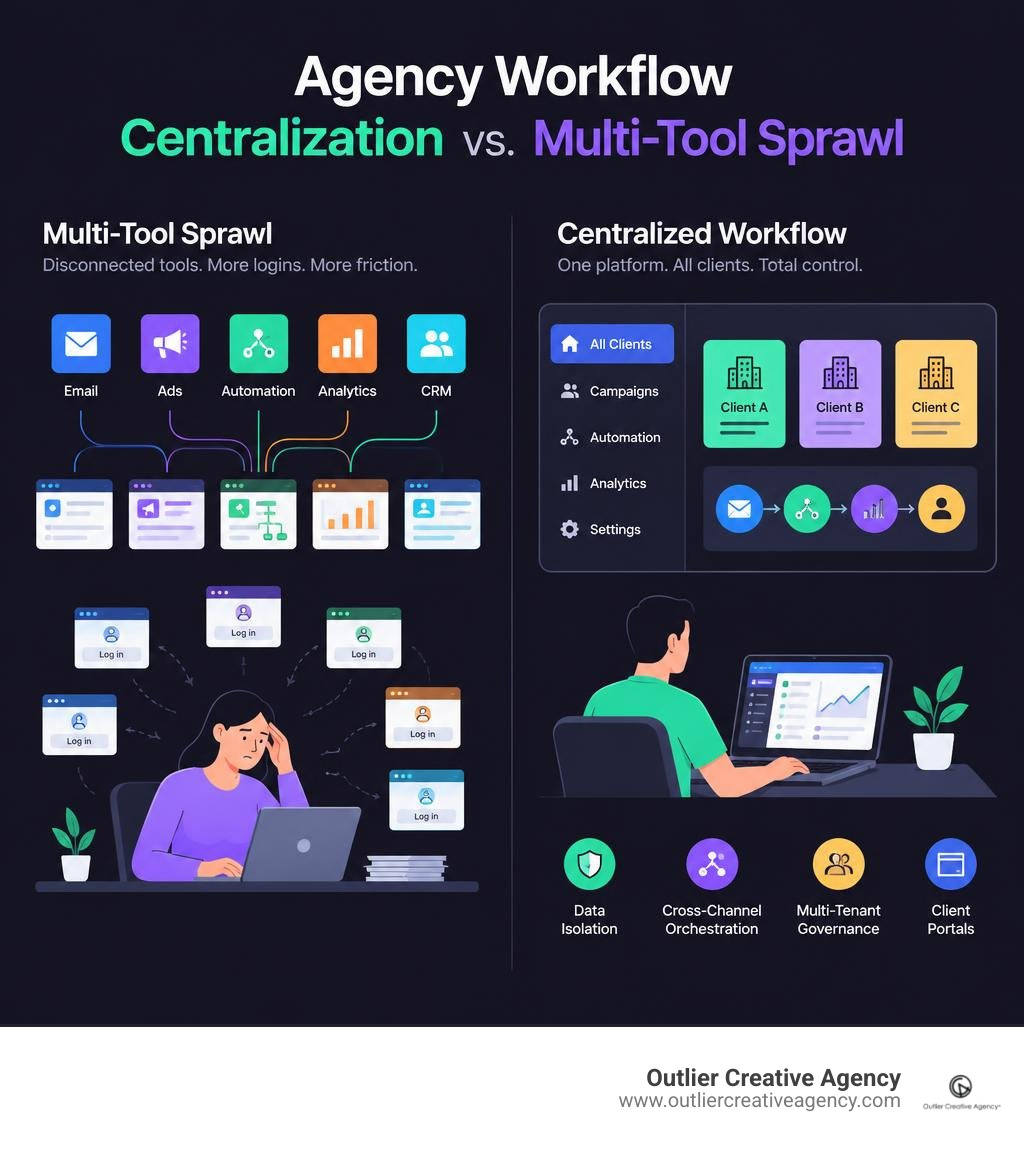
Managing marketing campaigns across multiple clients requires strict architectural separation and operational control. Standard marketing software is engineered for single-brand deployment, creating significant friction when applied across multiple client accounts. A dedicated marketing automation platform for agencies provides multi-tenant governance, data isolation, cross-channel workflow orchestration, and dedicated client portals.
When agencies manage campaigns without native multi-client structures, team members spend excessive time logging in and out of disconnected instances, manually syncing lead data, and risk cross-contaminating client records. Modern marketing automation software tools solve these operational bottlenecks by centralizing campaign execution within a unified administrative layer.
How Does Agency Automation Differ from Standard B2B Software?
Standard enterprise marketing tools assume that a single team manages one centralized database for one brand. In contrast, agency-focused systems rely on isolated sub-account architectures.
According to standard platform definitions, a foundational architecture must support distinct, customizable operational environments. For service agencies, these specialized platforms provide:
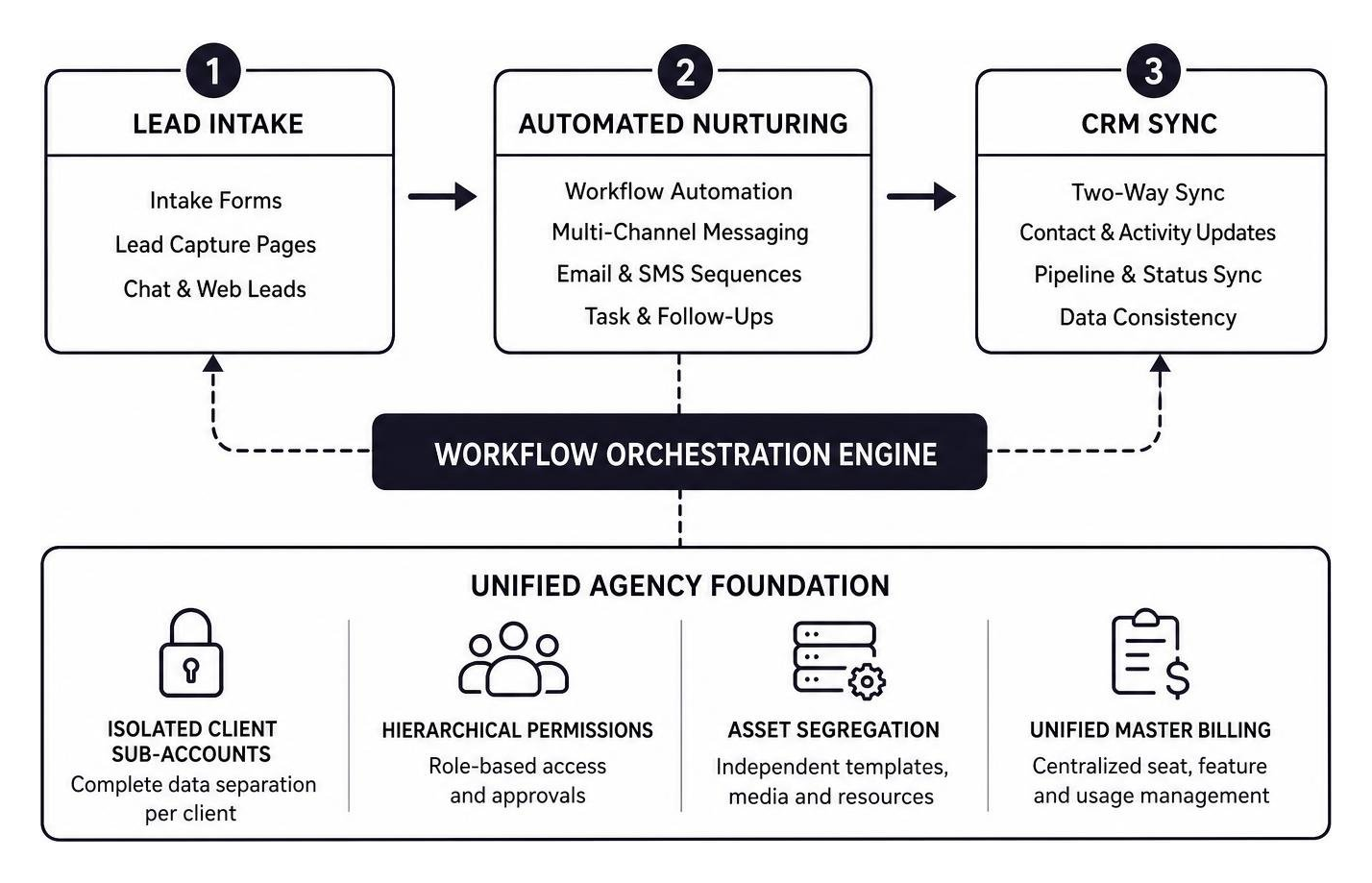
- Isolated Sub-Accounts: Complete segregation of contact records, lists, email sender reputations, and tracking pixels between different clients.
- Unified Master Billing: A centralized administrative console allowing the agency to control seat licensing, feature provisioning, and usage tiers across all accounts.
- Hierarchical Permissions: Granular access controls ensuring agency copywriters, media buyers, and client stakeholders only access authorized workspaces.
- Asset Segregation: Independent media libraries, brand guidelines, and automation templates that prevent cross-client data leaks.
For law firms operating under stringent state bar advertising regulations, this division is mandatory. Client confidentiality rules and legal ethics standards require that prospective client data collected via intake forms or lead capture pages remain strictly compartmentalized.
What Role Does Multi-Tenant Infrastructure Play in Client Security?
Data isolation across client accounts is a baseline operational and legal requirement. A multi-tenant infrastructure ensures that while the agency manages operations from a central dashboard, each client's database remains logically separated.
Leading platforms implement enterprise-grade security protocols, including AES-256 data encryption at rest and in transit, isolated database tables, comprehensive audit logs, and customizable approval gates.
In legal marketing, these approval gates protect practices against non-compliant messaging. For example, personal injury or criminal defense practices must ensure that case results or testimonials contain mandatory state-specific disclaimers before publication. Native agency workflow builders enforce these review steps, requiring attorney sign-off before automated sequences launch.
Which Architecture Best Fits Your Agency Workflow?
Selecting an operational architecture depends on how your team handles campaign deployment, lead nurturing, and client communications. A modern agency engine must combine CRM synchronization, multi-channel messaging, and unified communication inboxes into a single interface. Agencies adopting structured marketing automation growth systems eliminate context switching and streamline daily execution.
How Can Agencies Choose a Marketing Automation Platform Based on Core Features?
When evaluating platforms, focus on operational scalability and execution speed. Key capabilities include:
- Client Workspaces and Fast Onboarding: Rapid provisioning of sub-accounts using pre-configured industry templates, pipelines, and intake workflows.
- Multi-Channel Lead Routing: Unified management of SMS, email nurture sequences, website live chat, and inbound phone tracking.
- Advanced Lead Generation and CRM Sync: Seamless integration between landing pages, intake forms, and practice management CRMs. Structured marketing automation and lead generation workflows ensure leads route immediately to the appropriate intake team.
- Campaign Cloning and Snapshot Deployment: The ability to duplicate proven funnels, email sequences, and automation logic across new client accounts with a single click.
- API Connectivity and Custom Webhooks: Deep data integration with analytics suites, search engines, and specialized practice management tools.
How Do White-Labeling and Reseller Pricing Create New Revenue Streams?
White-labeling allows agencies to rebrand the entire platform interface—including custom CNAME domains (e.g., portal.yourfirm.com), branded mobile applications, custom color schemes, and system-generated notifications.
By white-labeling software, agencies transition from transactional service providers to comprehensive technology and marketing partners. Agencies evaluate various attorney marketing automation pricing models to establish high-margin recurring revenue:
- Markup Reselling: The agency purchases wholesale sub-accounts and bills clients a premium monthly technology fee.
- Bundled Retainers: Software costs are absorbed into comprehensive monthly retainers, increasing client stickiness and retention.
- Reseller Commissions: Partner commission structures provide percentage-based revenue shares on managed client accounts, creating ongoing monthly recurring revenue streams.
How Do AI Automation Agents Scale Client Deliverables in 2026?
In 2026, marketing automation has evolved from static, if-then logic trees into autonomous, multi-model AI agents. Rather than requiring manual step configuration for every task, modern systems leverage conversational AI agents capable of planning, executing, and optimizing client deliverables autonomously.
For an extensive look at how modern automation works across the marketing lifecycle, explore our marketing automation guide 2026.
How Can Agencies Scale Execution with an AI-Driven Marketing Automation Platform?
Modern AI agents execute tasks across search, social, and lead management channels:
- Speed-to-Lead Follow-Up: Research shows automated lead responses generated within 60 seconds drastically improve consultation booking rates. AI agents qualify incoming inquiries via conversational SMS or chat and schedule consultations directly onto attorney calendars.
- Autonomous Content Deployment: Advanced platforms leverage GEO Content Engines to research topics, generate structured articles complete with FAQ and Article schema markup, and trigger publishing across CMS environments.
- Social Scheduling and Workflow Optimization: Coupling natural language AI with multi-account marketing automation and social media workflows allows agencies to draft, review, and schedule monthly social calendars in minutes.
- Multi-Model Routing: Leading AI automation platforms route tasks across multiple AI model providers within a single execution waterfall, ensuring optimal output quality for copywriting, data analysis, and code generation.

How Can Agencies Automate Client Reporting and Pipeline Analytics?
Manual client reporting consumes dozens of unbillable agency hours each month. Dedicated agency automation engines connect directly to Google Analytics, Meta Ads, and call-tracking platforms to aggregate multi-channel data automatically.
These systems generate scheduled, white-labeled performance reports highlighting metrics that matter to managing partners: cost-per-lead, qualified intake calls, consultation booking rates, and projected case acquisition costs. Automated reporting eliminates manual data entry while providing law firm clients with transparent, verifiable ROI metrics.
How Do Unified Systems Compare to Disparate Multi-Tool Stacks?
Relying on separate, disconnected software tools creates friction, increases technical debt, and leads to workflow failures.
| Operational Factor | Unified Agency Platform | Disparate Multi-Tool Stack |
|---|---|---|
| Monthly Tech Cost | $197–$497 / month flat | $1,200–$2,800+ / month (20+ separate SaaS subscriptions) |
| Data Integrity | Native syncing; zero integration loss | Fragile third-party webhooks; frequent data synchronization errors |
| User Management | Single sign-on for all client portals | 15–20 logins per team member; complex password management |
| Client Experience | Centralized, branded portal with clear approval gates | Disjointed third-party links, confusing interfaces, fragmented reporting |
| Staff Training | One core operating system to master | High training overhead across multiple disconnected interfaces |
What Are the Primary Tool Consolidation Benefits?
Consolidating your agency stack yields immediate operational advantages:
- Reduced Software Overhead: Replacing separate subscriptions for email marketing, landing page builders, SMS gateways, scheduling tools, and pipeline management can save thousands of dollars annually.
- Decreased Context Switching: Team members execute campaigns, monitor inboxes, and update pipelines within a single dashboard rather than juggling dozens of browser tabs.
- Fewer Integration Failures: Native cross-channel automation removes reliance on fragile third-party webhooks that break whenever an external API updates.
- Streamlined Team Training: New hires master one consistent operating system, accelerating onboarding and reducing client delivery errors.
How Can Agencies Overcome Adoption Challenges and Migration Hurdles?
Migrating client data between platforms requires methodical change management:
- Establish Standardized Data Taxonomies: Clean and standardize contact tags, custom fields, and pipeline stages before importing databases.
- Execute Phased Client Rollouts: Migrate internal agency marketing and one pilot client first. Refine all automations and intake workflows before migrating remaining accounts.
- Draft Standard Operating Procedures (SOPs): Create internal workflow documentation and screen recordings detailing how your team builds campaigns, requests client approvals, and generates reports.
- Implement Pre-Flight Quality Assurance: Audit all webhooks, autoresponders, tracking pixels, and disclaimer elements prior to directing live advertising traffic into new funnels.
How Does Outlier Creative Agency Deliver High-Impact Campaign Automation?
At Outlier Creative Agency, we build high-performing marketing and automation engines designed exclusively for law firms across the nation, with dedicated offices in Los Angeles, California, and Austin, Texas. Our award-winning team specializes in designing data-driven strategies that expand caseloads, convert high-value inquiries, and maintain strict legal advertising compliance.
From sophisticated multi-channel intake funnels to specialized email marketing for attorneys, we ensure your firm captures, nurtures, and retains prospective clients efficiently.
If your law firm is ready to modernize its intake workflows, scale client acquisition, and implement compliant automation systems, contact Outlier Creative Agency today to book a consultation.
What Do Agencies Ask About Marketing Automation?
How Does an Agency Marketing Automation Platform Handle Separate Client Billing?
Agency platforms use centralized billing consoles that allow administrators to configure automated usage metering and client billing. Agencies can either pass software costs directly through to the client via integrated payment gateways or provision sub-accounts under a master agency plan. This structure enables agencies to bundle platform access into monthly retainers or apply a recurring software markup.
What Is the Difference Between Traditional Marketing Automation and an AI Automation Agent Platform?
Traditional marketing automation relies on deterministic, rule-based workflows ("if user clicks Link A, send Email B after two days"). In contrast, an AI automation agent platform uses natural language processing and autonomous decision-making to interpret context, draft original responses, enrich contact data, and resolve dynamic tasks across multiple software tools without requiring manual step-by-step logic.
Can an Agency Fully White-Label Client Dashboards and Outgoing Communications?
Yes. Dedicated agency automation engines allow complete white-label customization. Agencies can map custom CNAME records for branded client access, display custom logos and color palettes, route automated emails through dedicated domain servers, and configure verified business caller IDs for transactional SMS and voice notifications.
What Third-Party Integrations Are Vital for Multi-Client Marketing Systems?
A multi-client agency system requires robust integrations with core advertising platforms (Meta Ads, Google Ads), web analytics suites (Google Analytics 4), calendar and scheduling applications (Google Calendar, Outlook), communication channels (WhatsApp, Twilio, email servers), and industry-specific practice management CRMs. Native API connectivity ensures data flows reliably between ad clicks and signed client agreements.