

Master California attorney marketing rules with this guide to Chapter 7 compliance, advertising disclosures, and digital marketing regulations.
What Are the Core California Attorney Marketing Rules Under Chapter 7?
California attorney marketing rules are governed by the California Rules of Professional Conduct, Chapter 7, which prohibit false or misleading communications, require every advertisement to identify a responsible attorney and office address, mandate disclaimers on testimonials and past results, and restrict direct solicitation of prospective clients. These rules apply across all media, including websites, social media, and paid ads.
The foundation of legal promotion in the Golden State rests on the California Rules of Professional Conduct, specifically the framework laid out in Chapter 7. Information About Legal Services. California is home to nearly 40 million residents and represents the world's fourth-largest economy, contributing roughly 15% of the total United States GDP. With 4.3 million small businesses operating statewide and an exceptionally competitive legal marketplace across 483 incorporated cities, building an authoritative presence is essential. However, pursuing growth without strict adherence to State Bar regulations invites disciplinary exposure.
The State Bar of California regulates all communications regarding legal representation. Operating successfully within California attorney marketing requires understanding that ethical restrictions apply across traditional print, broadcast media, and every facet of digital campaigns.
How Does Rule 7.1 Regulate False or Misleading Communications?
The overarching principle governing all legal outreach is found in Rule 7.1 Communications Concerning a Lawyer’s Services. Under this rule, a lawyer shall not make a false or misleading communication about themselves or their services.
A communication is considered false or misleading if it:
- Contains a material misrepresentation of fact or law.
- Omits a fact necessary to make the statement, considered as a whole, not materially misleading.
- Leads a reasonable person to form an unjustified expectation about the results the lawyer can achieve.
A statement can be factually accurate in isolation yet still violate Rule 7.1 if it omits critical context. For instance, promoting a "$10 Million Settlement" without disclosing that the client's comparative fault significantly reduced the final payout or that the case presented extraordinary factual circumstances can mislead potential clients into forming unwarranted expectations.
Furthermore, guarantees or warranties regarding case outcomes are strictly prohibited. Fee transparency is equally vital: if a practice advertises a "no win, no fee" or contingency arrangement, it must explicitly disclose whether the client remains responsible for litigation costs and court filing fees if no recovery is obtained.
How Does Rule 7.2 Govern Advertising, Referral Fees, and Recordkeeping?
Under Rule 7.2, lawyers are permitted to market through any written, recorded, or electronic media, including public digital networks. However, the rule imposes clear structural requirements:
- Named Responsibility: Every advertisement must clearly identify the name and office address of at least one attorney or law firm responsible for its content.
- Referral Compensation Limits: Attorneys cannot pay, give, or promise anything of value to a person or entity for recommending their services. Permissible exceptions include paying the reasonable costs of advertising, paying the usual charges of a qualified lawyer referral service registered with the State Bar, and paying for a law practice under approved transition guidelines.
- Reciprocal Referral Agreements: Non-exclusive reciprocal referral arrangements with other lawyers or non-lawyer professionals are permitted, provided the client is fully informed of the existence and nature of the agreement.
- Record Retention: While historical versions of the rule required extensive multi-year logs, attorneys must comply with Business and Professions Code (BPC) § 6159.1, which requires law firms to retain true copies of all published advertisements for at least one year following their last dissemination date.
How Do California Rules Differ from ABA Model Rules?
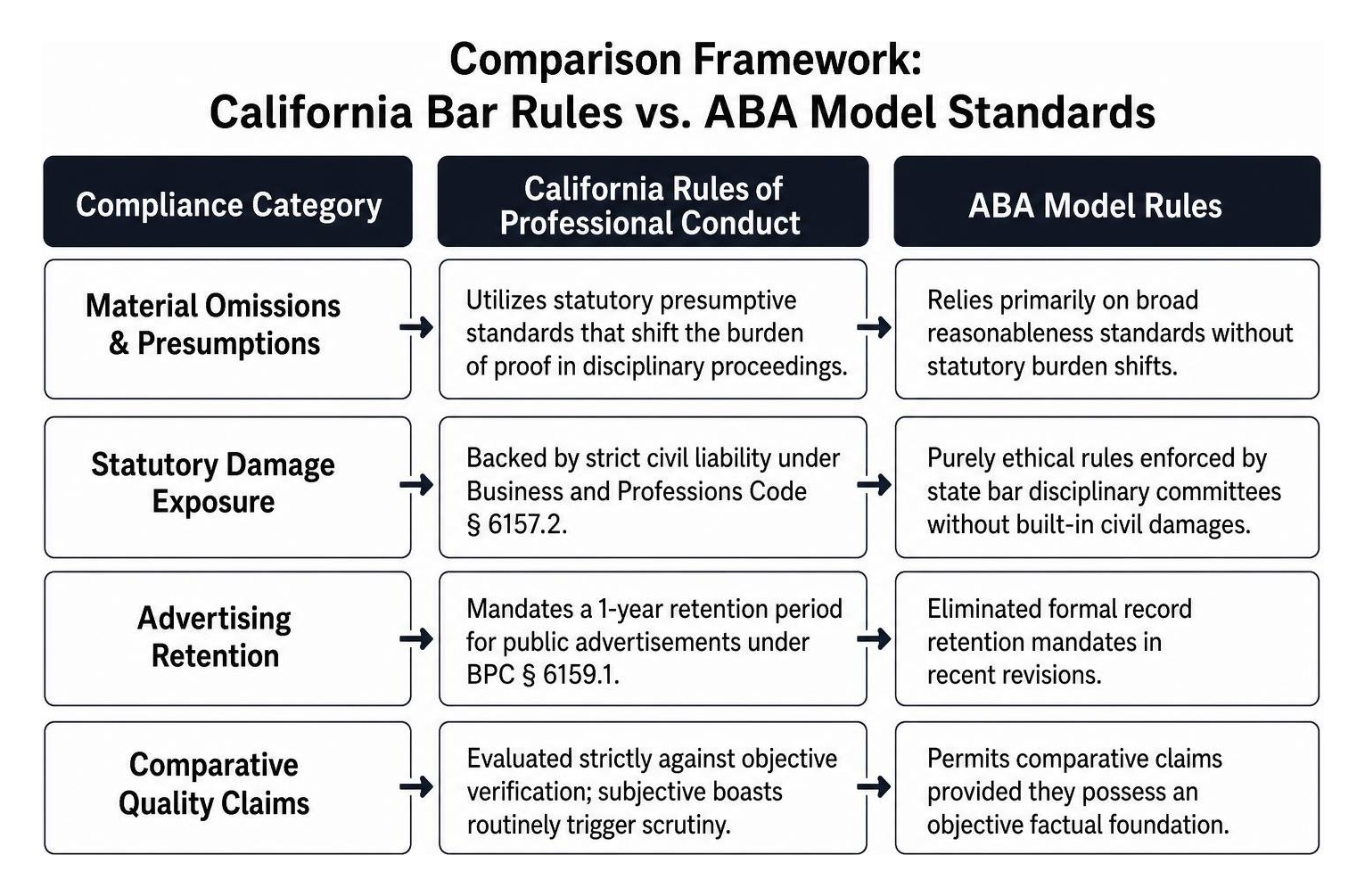
While California updated its Rules of Professional Conduct to align more closely with the ABA Model Rules, several distinct differences remain that practitioners must recognize.
| Compliance Category | California Rules of Professional Conduct | ABA Model Rules |
|---|---|---|
| Material Omissions & Presumptions | Utilizes statutory presumptive standards that shift the burden of proof in disciplinary proceedings. | Relies primarily on broad reasonableness standards without statutory burden shifts. |
| Statutory Damage Exposure | Backed by strict civil liability under Business and Professions Code § 6157.2. | Purely ethical rules enforced by state bar disciplinary committees without built-in civil damages. |
| Advertising Retention | Mandates a 1-year retention period for public advertisements under BPC § 6159.1. | Eliminated formal record retention mandates in recent revisions. |
| Comparative Quality Claims | Evaluated strictly against objective verification; subjective boasts routinely trigger scrutiny. | Permits comparative claims provided they possess an objective factual foundation. |
How Do Prohibited Solicitations and Targeted Direct Communications Work Under Rule 7.3?
Rule 7.3 sets clear boundaries on direct client acquisition. While general advertising targets the public at large, solicitation involves targeting a specific individual known to need legal services in a particular matter.
What Distinguishes Permissible Advertising from Prohibited Real-Time Solicitation?
California strictly prohibits in-person, live telephone, or real-time electronic contact when a significant motive is the lawyer's pecuniary gain.
- Prohibited Real-Time Contact: Uninvited phone calls, direct messaging via live chat software aimed at initiating immediate representation, or approaching accident victims at hospitals or collision scenes.
- Permissible Exceptions: Real-time communication is allowed if the prospective client is another lawyer, has a preexisting family or close personal relationship, or maintains a prior professional relationship with the attorney. Bona fide legal service plans are also permitted under specific conditions.
What Specific Labeling and Disclosure Standards Apply to Targeted Direct Outreach?
Written, recorded, or electronic communications directed to prospective clients known to be facing specific legal challenges—such as direct mail sent to homeowners facing foreclosure—are subject to strict formatting mandates:
- Clear Labeling: The word "Advertisement" or equivalent language must appear conspicuously on the outside of the envelope and at the beginning and end of any recorded or electronic transmission.
- Domestic Violence Restrictions: In family law and domestic violence matters, targeted solicitations face rigorous cooling-off periods and distribution restrictions to protect vulnerable individuals from coercive pressure.
What Are the Mandatory Disclosure Requirements for Testimonials, Specialization, and Firm Names?
Maintaining consumer transparency requires including visible, unambiguous disclaimers across all marketing collateral.
Mandatory Disclosures Checklist
- Conspicuous name and bona fide office location of the responsible attorney.
- Disclaimer that past results do not guarantee, warrant, or predict future case outcomes.
- Disclosure of client liability for litigation expenses in contingency fee promotions.
- Identification of dramatizations, simulated scenes, or actor portrayals.
- Clear statement of the certifying entity when claiming specialist status.
How Can Law Firms Ethically Use Client Testimonials and Past Case Results?
Client reviews and outcome summaries are powerful marketing assets, but they carry ethical risk under Rule 7.1. Because prospective clients may assume their case will yield identical results, testimonials must be accompanied by explicit disclaimers stating that past performance does not guarantee similar results.
If an advertisement features a paid endorsement or an actor playing the role of a client, the ad must disclose that it is a dramatization or paid testimonial. This aligns California Bar requirements with Federal Trade Commission (FTC) guidelines governing truth in advertising.
What Are the Restrictions on Certified Specialist Claims and Trade Names Under Rules 7.4 and 7.5?
Under Rule 7.4, an attorney may communicate their practice areas (e.g., stating that practice is limited to personal injury or estate planning). However, a lawyer cannot claim to be a "certified specialist" unless they have earned formal certification from the State Bar of California Board of Legal Specialization or an accredited entity, and the advertisement clearly identifies the certifying body.
Rule 7.5 governs law firm names and trade names. A firm name cannot be false or misleading. Trade names cannot imply an affiliation with a government agency (such as "California Department of Legal Defense") or suggest an organization of greater size or reach than actually exists.
How Do Statutory Advertising Regulations and Digital Compliance Intersect in California?
Digital campaigns must comply with both State Bar ethics rules and California statutory law.
How Do California Attorney Marketing Rules Apply to Websites, SEO, and Paid Ads?
Every digital asset functions as an official communication concerning legal services:
- Law Firm Websites: Website headers or footers should display the firm’s physical office address and the attorney responsible for the site.
- Organic Search Strategy: Implementing ethical SEO ensures metadata, title tags, and page content do not make deceptive promises to capture clicks. Highly competitive niches, such as California personal injury SEO, require rigorous adherence to disclaimer standards on high-ranking settlement archive pages.
- Digital Outreach: Our comprehensive approach to digital marketing for attorneys combines visibility with proactive compliance across web design, email, and content creation.
- Social Media Campaigns: Engaging in attorney social media marketing in California requires managing public comments and including necessary professional identity details on firm profiles.
- Paid Advertising: Utilizing structured law firm PPC services ensures ad copy adheres to space constraints without dropping necessary cost disclaimers. Deploying compliant PPC for attorneys requires dynamic landing pages that surface mandatory disclosures alongside conversion elements.
What Statutory Prohibitions and Civil Penalties Exist Under BPC Section 6157.2?
Beyond State Bar discipline, California Code, BPC 6157.2 outlines statutory advertising restrictions. Under this statute, legal advertisements cannot:
- Contain false, misleading, or deceptive statements regarding case results or potential recovery.
- Promise quick cash payouts or immediate settlement checks.
- Feature undisclosed celebrity endorsements or paid spokespersons without clear attribution.
- Reference industry awards that require paid membership fees or lack rigorous selection criteria.
Firms running competitive campaigns, such as California business litigation ads, must ensure every performance claim meets statutory standards. Advertisements must conspicuously display the responsible attorney's name and the city, town, or county of a bona fide office location.
Violations of BPC § 6157.2 carry civil liability, exposing non-compliant firms to statutory damages ranging from $5,000 to $100,000 per advertisement, alongside attorney fees and injunctive orders.
What Are the Penalties for Violating California Attorney Marketing Rules?
Non-compliance carries significant professional and financial risks:
- State Bar Discipline: Disciplinary actions range from private reprovals and public reprimands to license suspension or disbarment for egregious fraud.
- Civil Litigation: Aggrieved consumers or competitors can initiate civil actions seeking statutory fines and injunctive relief.
- Class Actions: Widespread deceptive digital campaigns can trigger broader legal challenges, including exposure to a California class action lawsuit alleging deceptive business practices.
Frequently Asked Questions About California Legal Advertising
Can California attorneys advertise on social media platforms without special disclosures?
No. Social media profiles and paid promotional posts must comply with Rules 7.1 and 7.2. Firm bios or profile landing pages must state the responsible attorney's name, office location, and relevant disclaimers regarding past results.
Is a disclaimer required for 'no win, no fee' statements in California lawyer ads?
Yes. If an advertisement states or implies that a client owes no fee without a financial recovery, Rule 7.1 requires the ad to clearly state whether the client remains liable for litigation costs and court fees incurred during the case.
How long must California law firms retain copies of their published advertisements?
Under California Business and Professions Code § 6159.1, law firms must retain true copies of all public advertisements—including digital ads, landing pages, and print media—for at least one year following the date of their last broadcast or publication.
What language access requirements apply to non-English legal advertisements in California?
With over 28% of California residents speaking Spanish (over 10.4 million people), multilingual campaigns are common across the state. Under California rules, if an advertisement is presented in a language other than English, the firm must be capable of providing representation in that language or clearly disclose the employment title of the non-lawyer personnel assisting with communication when advertising legal services.
Conclusion
Operating a law practice in California's dynamic legal market requires balancing impactful marketing with careful ethical compliance. From ensuring full context around case outcomes to implementing required disclaimers on digital assets, adhering to the State Bar Rules of Professional Conduct protects your firm's professional standing while building lasting trust with prospective clients.
At Outlier Creative Agency, we design high-performing marketing strategies built specifically for the legal sector. Whether you are refining your organic presence or managing targeted campaigns, our team delivers data-driven growth that stays fully compliant with California's legal advertising standards.
To learn more about optimizing your legal marketing campaigns, explore our approach to PPC advertising for law firms or book a consultation with our team today.