

Learn how a marketing automation white paper captures qualified leads for law firms, with key benchmarks and stats to boost ROI in 2026.
Why a Marketing Automation White Paper Matters for Law Firm Growth in 2026
A marketing automation white paper is a research-backed guide that explains a clear problem and a practical solution. For law firms in 2026, it can do two jobs at once: build trust with prospective clients or referral partners and capture high-intent leads through a useful content-for-contact-details exchange.
The benchmark case for using automation is strong:
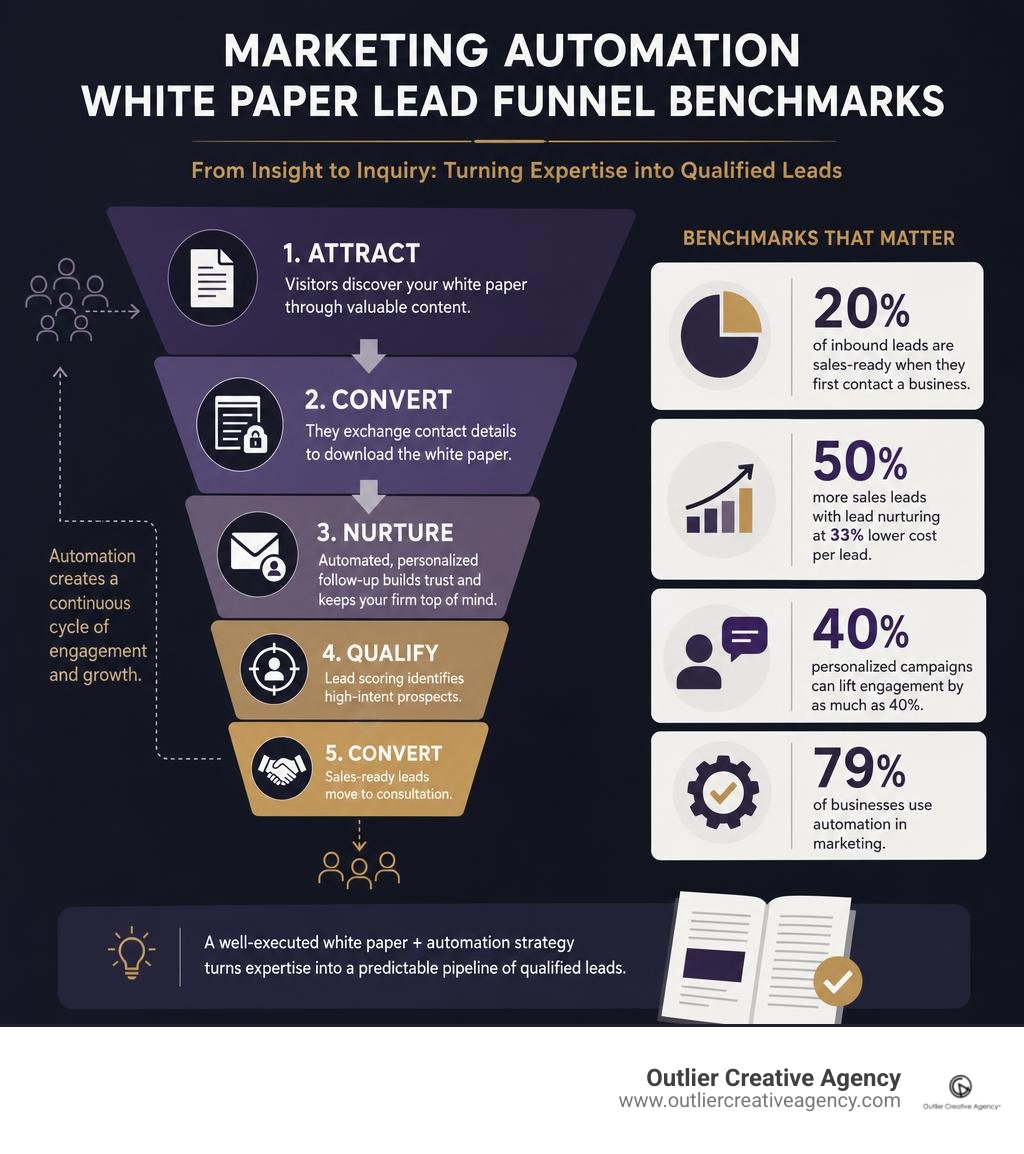
- Only 20% of inbound leads are sales-ready when they first contact a business.
- Lead nurturing can generate 50% more sales leads at a 33% lower cost per lead.
- Personalized campaigns can lift engagement by as much as 40%.
- 79% of businesses use automation in marketing, making it one of the most automated business functions.
For a managing partner or legal marketing director, the key is not simply publishing a PDF. Build a guide around a real client concern, such as what to do after a car accident, how to prepare for divorce, or how businesses can reduce employment-law risk. Then use a form, consent-based follow-up, lead scoring, and relevant email content to move readers toward a consultation without dumping every download into the same generic email list.
At Outlier Creative Agency (OCA), we work with legal experts to create clear, high-quality content that earns attention and drives qualified leads. In this guide, we will break down the marketing automation white paper terms, benchmarks, and practical systems law firms can use now to turn useful expertise into a more reliable client-acquisition process.
What Is a Marketing Automation White Paper and Why Does It Matter for Law Firms?
In the legal sector, client acquisition relies on building immediate credibility and trust. A white paper functions as an authoritative, comprehensive report that unpacks a complex legal or regulatory problem and provides an evidence-based roadmap for resolving it. Rather than acting as a promotional brochure, it demonstrates your firm's deep subject matter expertise.
When integrated into modern systems for marketing automation and lead generation, a white paper becomes the cornerstone of your client intake engine. In academic and institutional settings, scientific research on data modernization through automation demonstrates that structured digital workflows eliminate manual data collection bottlenecks while increasing response accuracy. For legal practices operating in competitive markets like Los Angeles and Austin, pairing authoritative long-form content with automated data capture bridges the gap between passive website visitors and qualified consultations.
Understanding the Role of a Marketing Automation White Paper in Inbound Strategy
Most people facing legal challenges do not immediately retain the first attorney they find. Whether a corporate general counsel is researching regulatory changes or an individual is navigating a catastrophic injury claim, prospects conduct extensive independent research before scheduling an intake call.
An inbound strategy powered by an authoritative white paper creates an equitable give-and-take scenario:
- Prospect Value: The prospective client receives a structured, educational breakdown of their issue, risk factors, and potential legal remedies.
- Law Firm Value: In exchange for the asset, the firm captures crucial lead metadata (name, verified email, organization size, and specific legal concerns).
- Intent Identification: Downloading a 15-page brief on commercial lease disputes signals explicit intent, allowing your automation platform to classify the prospect accurately rather than treating them like a casual blog reader.
White Papers vs. Case Studies, Ebooks, and Articles
Legal marketers often conflate different content assets. Selecting the right format depends on where the prospective client sits in their decision-making journey:
| Content Format | Average Length | Primary Strategic Purpose | Analytical Depth | Placement in Funnel |
|---|---|---|---|---|
| White Paper | 2,500–5,000+ words | In-depth problem analysis and systemic solutions | High; heavy reliance on empirical data, statutes, and analysis | Top to Middle of Funnel (Educational/Evaluation) |
| Ebook | 3,000+ words | Broad introductory overview of a wider topic | Moderate; visual, scannable, and conversational | Top of Funnel (Awareness) |
| Case Study | 500–1,500 words | Demonstrating past client outcomes and strategic victories | Practical; narrative-driven focus on specific results | Bottom of Funnel (Decision) |
| Blog Post / Article | 500–2,000 words | Answering specific, timely search queries and FAQs | Focused; addressing narrow questions quickly | Top of Funnel (Discovery/Organic Search) |
Key Marketing Automation Terms Every Legal Marketer Must Know
Implementing an automated intake and nurturing engine requires familiarity with the technical mechanisms that route leads. Deploying modern marketing automation software tools alongside frameworks like the Definitive Guide to Data-Driven Marketing allows firms to unify behavioral touchpoints and move away from disconnected spreadsheets.
Lead Scoring, Progressive Profiling, and Intent Triggers
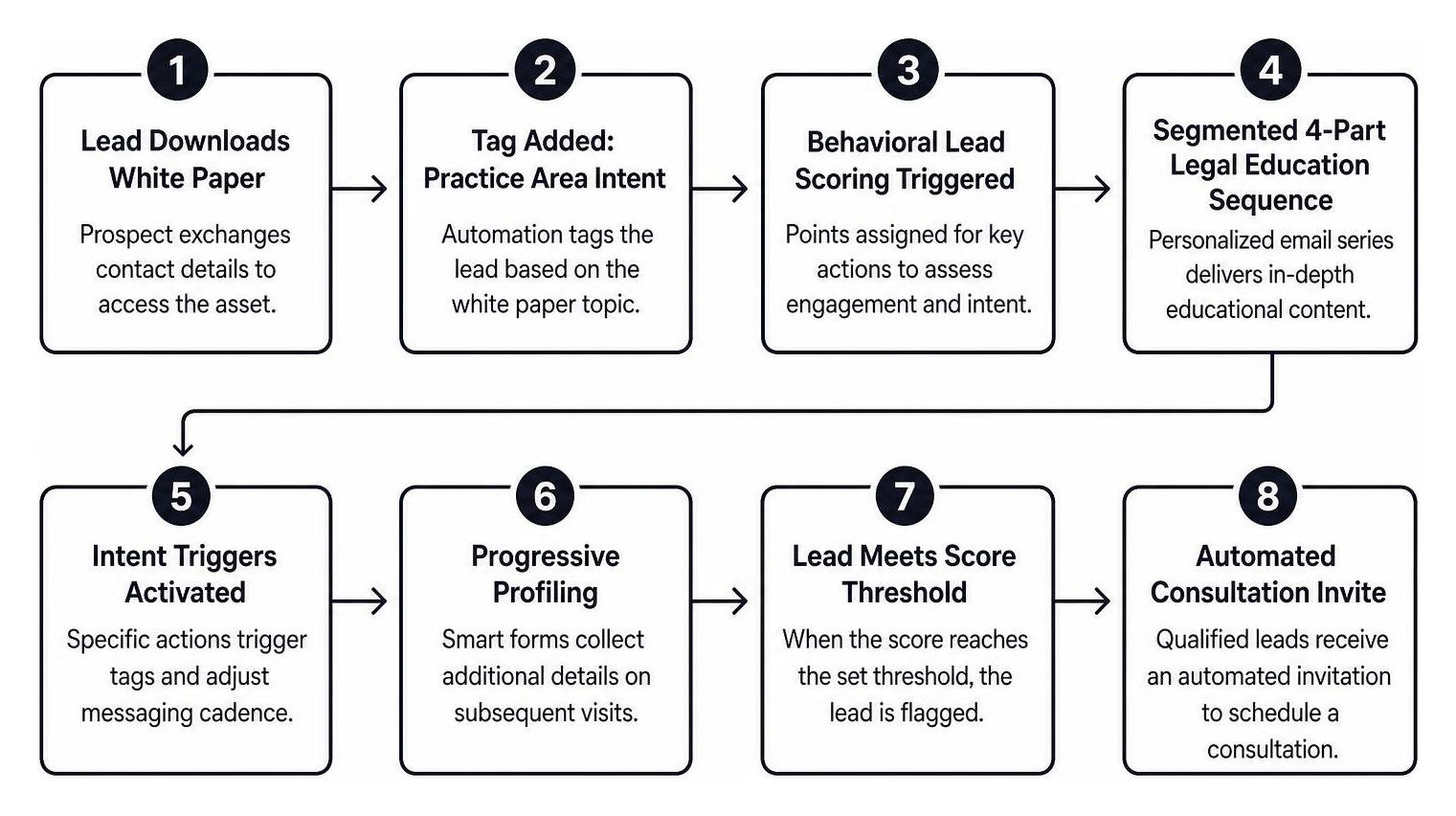
- Behavioral Lead Scoring: A programmatic methodology that assigns numeric values to prospect actions. For instance, downloading a white paper adds 15 points; visiting your attorney bio page adds 10 points; viewing your practice fee page adds 25 points. When a lead reaches a set threshold (e.g., 60 points), an alert notifies your intake team.
- Progressive Profiling: A smart-form technique that displays new fields on subsequent visits. Instead of asking a user for ten fields on their first white paper download, you ask for a name and email. When they return to download a secondary checklist, the form automatically asks for their company name, jurisdiction, or estimated case timeline.
- Intent Triggers: Automated conditional rules that fire based on real-time prospect interactions. If a subscriber opens your white paper follow-up email and clicks an internal link evaluating attorney marketing automation pricing, the platform immediately tags them as "High Consideration" and adjusts subsequent messaging cadence.
Dynamic Content, Journey Orchestration, and Closed-Loop Attribution
- Dynamic Content: Website copy, email sections, or document previews that adjust based on the recipient's saved attributes. A corporate litigation firm can display transactional corporate insights to enterprise executives while showing partnership dispute information to small business owners within the exact same automated email template.
- Journey Orchestration: Managing a multi-channel communication pathway across email, SMS, and retargeting based on real-time behavioral signals rather than rigid, calendar-based email blasts. Connecting these touchpoints through marketing automation big data ensures that prospective clients receive relevant information across every digital platform they use.
- Closed-Loop Attribution: Tracking a client journey from the initial organic search query or ad click that led to the white paper download, through every nurture email, all the way to a signed retainer agreement. This provides your managing partners with precise visibility into marketing return on investment.
Essential Marketing Automation Benchmarks and Statistics for Law Firms
Investing in advanced intake workflows requires clear data. As detailed in the Advanced Marketing Automation White Paper, organizations that connect analytics, lead scoring, and automated engagement consistently outperform peers who rely on unsegmented broadcast emails. Modern marketing automation tools turn raw data into predictable client conversion pipelines.

Conversion and Lead Nurturing Industry Benchmarks
- The 20% Sales-Readiness Rule: On average, only 20% of inbound leads are ready to retain a firm or make a purchasing decision upon first contact. The remaining 80% require structured education before scheduling an initial consultation.
- Nurturing Efficiency: Targeted lead nurturing produces 50% more sales-qualified leads while lowering the overall cost per lead by 33%.
- Departmental Automation Rates: Marketing departments lead enterprise automation adoption, with 79% of businesses employing automated marketing workflows across their operations.
- Executive Value Perception: 91% of marketing leaders identify automation platforms as a crucial driver of overall digital marketing success.
Personalization Impact and ROI Metrics
- Engagement Lift: Message personalization based on recipient behavior and practice area interest increases overall engagement rates by up to 40%.
- Behavioral Open Rates: Companies that segment and trigger email sends based on user behavior see up to a 350% increase in open rates and a 50% increase in conversion rates compared to static batch emails.
- Lead Scoring Revenue Growth: Organizations that deploy objective lead scoring achieve 28% better sales productivity and 33% higher revenue growth.
- Email Channel ROI: Over 60% of marketers confirm that automated email workflows generate measurable, positive ROI for their organizations.
How to Deploy Automated Content to Capture High-Value Retainers
Writing a high-impact white paper is only half the battle. To generate new caseloads, firms must distribute the asset strategically, capture qualified contact details, and execute an automated follow-up sequence that complies with legal advertising ethics.
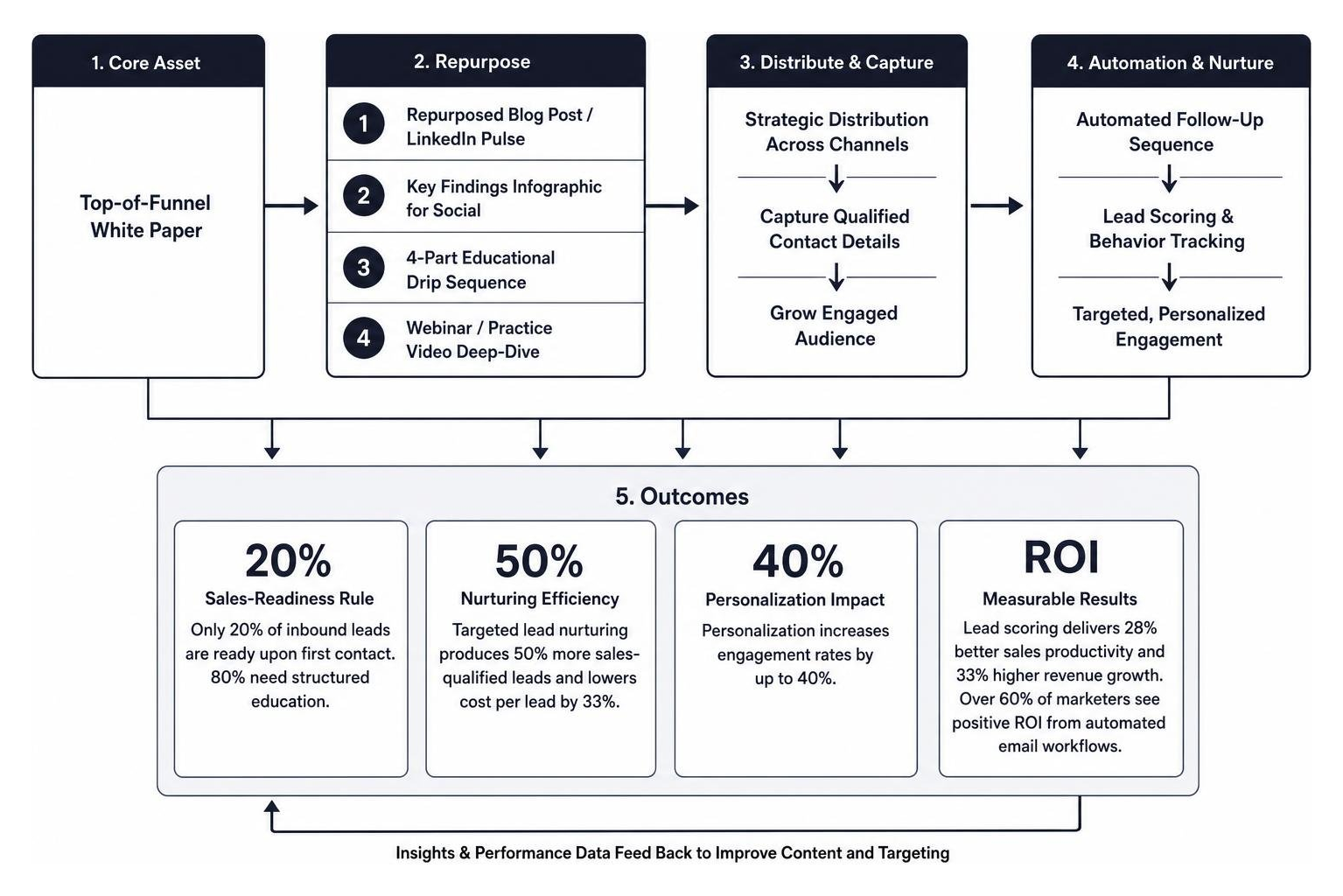
Connecting your long-form thought leadership with marketing automation and social media campaigns expands your organic reach while funneling prospects into an automated intake pipeline.
Gated vs. Ungated Strategy for a Marketing Automation White Paper
Marketers frequently debate whether content should sit behind a capture form:
- The Gated Approach: Requiring an email and name before download. This is ideal for high-intent, bottom-of-funnel topics where the asset delivers clear, actionable value (e.g., The 2026 Commercial Real Estate Risk Assessment Checklist).
- The Ungated Approach: Making the PDF freely available on your website with zero form fields. This maximizes reach, brand awareness, and SEO indexation, but prevents direct lead tracking and post-download email nurturing.
- The Hybrid Solution: Publishing the first 30% of the report directly on a public web page as an ungated executive summary with full SEO markup, while offering the complete analytical report, statutory citations, and workflow templates behind a concise capture form.
Multi-Channel Follow-Up and Drip Sequences
Once a prospective client downloads your white paper, dumping them into a generic, monthly firm newsletter leads to unsubscribes. Instead, trigger a dedicated four-part educational email sequence spaced across two weeks:
- Email 1 (Immediate Delivery): Deliver the direct PDF link with a personal welcome note highlighting two key takeaways from the report.
- Email 2 (Day 3 – Contextual Problem): Dive deeper into a specific challenge highlighted in Chapter 1 of the white paper, sharing a real-world scenario (without violating client confidentiality) illustrating the consequences of common mistakes.
- Email 3 (Day 7 – Strategic Framework): Break down practical steps the reader can take internally to mitigate legal risks or preserve evidence.
- Email 4 (Day 12 – The Low-Pressure Invitation): Invite the subscriber to schedule an introductory case evaluation or consultation if their legal matter requires direct representation.
For comprehensive strategies on structuring compliance-first legal messaging, explore our detailed Email Marketing Guide for Lawyers, or consult our specialized Email Marketing Guide for Shopify Lawyers if your firm handles e-commerce and digital commercial clients.
Frequently Asked Questions About Legal Marketing Automation
How does a white paper generate qualified leads for legal practices?
A white paper captures high-intent prospects by offering valuable, in-depth legal analysis in exchange for contact details. Readers who download technical legal guides are actively dealing with or anticipating legal challenges, making them more qualified than casual website visitors.
What is the difference between marketing automation software and a legal CRM?
Marketing automation software manages top- and middle-of-funnel interactions—such as website tracking, form fills, behavioral lead scoring, and automated email nurturing. A legal CRM (like Clio, Lead Docket, or Filevine) manages bottom-of-funnel operations, including active intake pipelines, conflict checks, retainer agreements, and case management.
How long does it take to see measurable ROI from marketing automation?
Most law firms observe pipeline growth within 60 to 90 days of deploying automated white paper funnels. Full revenue realization aligns with your practice area's average case lifecycle: transactional corporate retainers often close within weeks, whereas complex litigation or personal injury matters may take months from intake to final resolution.
How should law firms maintain legal compliance in automated email sequences?
Legal email sequences must comply with state bar advertising regulations and federal data privacy standards:
- Avoid making guarantees regarding case outcomes or past settlement values without required state bar disclaimers.
- Ensure clear "Attorney Advertising" notices are displayed prominently where mandated by local jurisdictions.
- Implement explicit double opt-in mechanisms and include a functional one-click unsubscribe link in compliance with the CAN-SPAM Act.
- Protect prospect data privacy under relevant state legislation such as the California Consumer Privacy Act (CCPA/CPRA).
Conclusion
A well-crafted white paper paired with an intelligent marketing automation workflow transforms your law firm's digital marketing from passive publishing into an active, predictable lead acquisition engine. By capturing prospects at the point of intent and delivering personalized, value-driven legal education, your practice builds trust before the first consultation even occurs.
At Outlier Creative Agency, we help law firms across the nation build award-winning, data-driven marketing systems that respect legal ethics while maximizing caseload growth. Explore our dedicated Services Email Marketing solutions to discover how we design tailored intake sequences for forward-thinking legal practices, or browse our latest Blog and industry Resources to scale your firm's authority.