

Navigate Google Ads restrictions with compliant digital marketing for personal injury lawyers, including retargeting workarounds and budget strategies.
Grow Personal Injury Cases Without Relying on Retargeting
To scale digital marketing for personal injury lawyers, start with high-intent Google Search Ads and local SEO. Send visitors to fast, clear pages about the cases you want to sign, then track each lead through intake to a signed case. Use cost per signed case, not just cost per lead, to decide where to spend more.
Personal injury ads need extra care. Google's personalized advertising policy limits targeting based on sensitive personal circumstances. Rather than building retargeting audiences around someone's injury, focus on what people search for, helpful content, and a strong follow-up process.
I'm Corey Larson. At Outlier Creative Agency, my work in digital marketing for personal injury lawyers spans legal video, social media, websites, and content built to help firms communicate clearly and earn new clients.
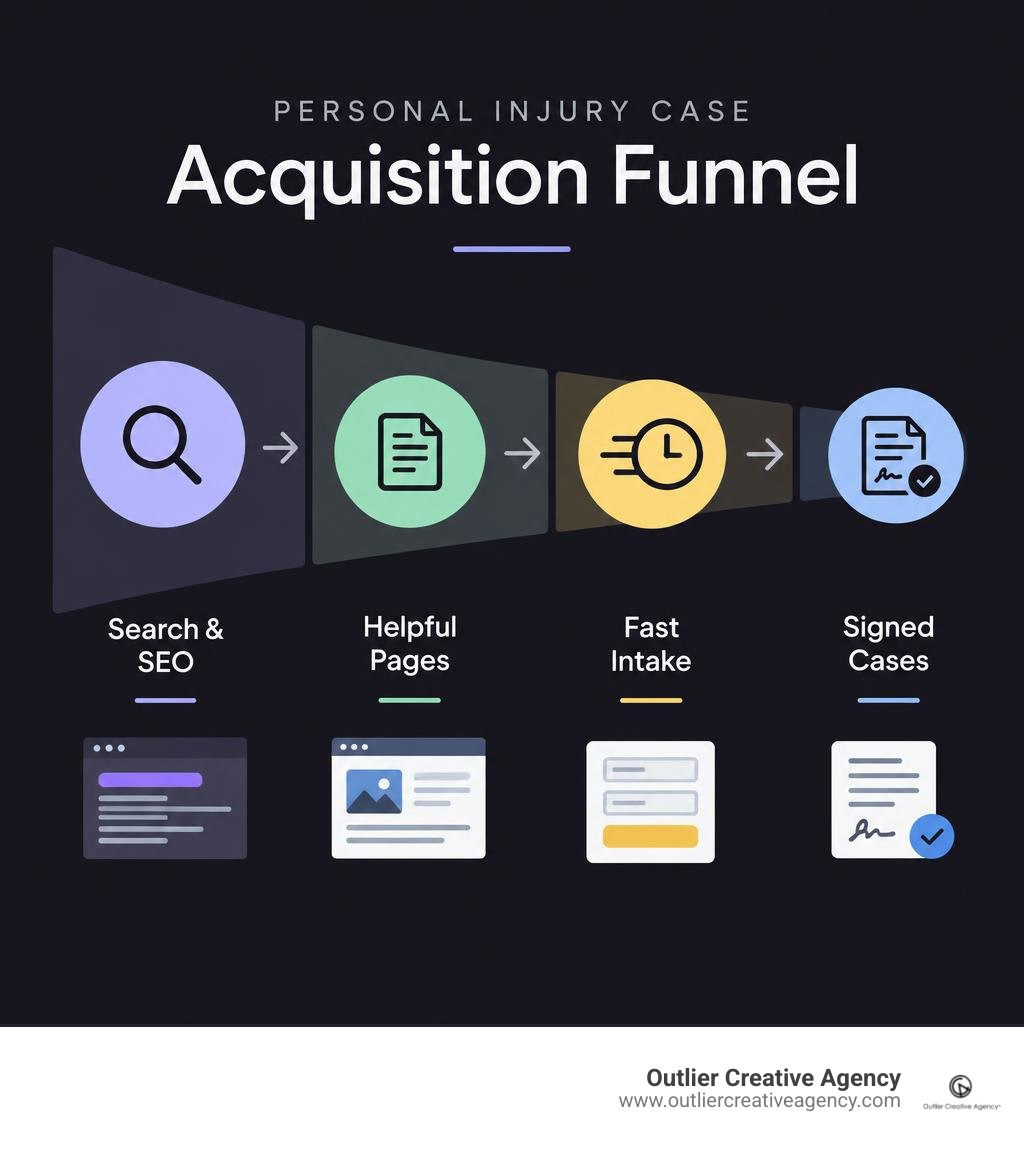
Core Pillars of Digital Marketing for Personal Injury Lawyers in 2026
Personal injury marketing demands an integrated system. Search engine algorithms evolve, but user intent remains urgent. Injured claimants search when they need immediate help, legal representation, and clarity. To build a robust caseload, firms must deploy a multi-channel framework combining paid search, organic authority, and conversion optimization.
| Marketing Channel | Primary Intent Level | Target CAC (Signed Case) | Time to Initial ROI | Primary Function |
|---|---|---|---|---|
| Local Services Ads (LSA) | Ultra-High (Immediate Need) | Moderate ($1,500 - $3,500) | 1 to 30 Days | Pay-per-lead direct phone calls |
| Google Search Ads (PPC) | High (Commercial & Active Search) | High ($2,000 - $5,000+) | 14 to 60 Days | Target specific high-value injury keywords |
| Organic Search (SEO) | High to Informational | Low to Moderate (Long-term) | 6 to 12 Months | Sustained organic case acquisition |
| Video & Brand Marketing | Mid to High (Trust & Validation) | Low (Blended) | 3 to 6 Months | Social proof, brand recall, conversion lift |
Our approach to personal injury marketing focuses on capturing direct demand while building a defensible online brand. Capturing high-intent search queries requires dominance across Google's traditional organic links and the local 3-pack.
Claiming and optimizing your Google Business Profile represents the bedrock of local discoverability. Complete every field, upload real office photography, and publish weekly updates. Ranking in the local map pack drives phone calls from prospects who want an attorney near them. You can examine practical tactics in our local SEO breakdown and our comprehensive personal injury SEO guide 2026.
Local Services Ads and High-Intent Google Search Campaigns
Google Local Services Ads place your practice at the very top of search engine results pages. Earning the Google Screened badge builds immediate credibility with potential clients. Unlike standard Pay-Per-Click advertising, LSA operates on a pay-per-lead model. You pay only for inbound phone calls and messages rather than simple clicks.
Managing your LSA campaign requires proactive dispute management. Invalid leads, wrong numbers, and calls outside your geographic area must be disputed promptly to recover ad spend. Maintain strict responsiveness metrics. Google rewards firms that answer calls immediately by showing their profiles more frequently.
Pairing LSAs with structured search campaigns captures prospects seeking specific counsel. Bidding on high-intent terms requires disciplined keyword grouping, strict negative keyword lists, and dedicated landing pages. Learn how to refine your campaign economics in our personal injury PPC complete guide 2026 and discover bid optimization techniques in our review of law firm adwords.
Aligning Paid Search and Digital Marketing for Personal Injury Lawyers
Paid search and organic search must reinforce each other. Paid campaigns deliver short-term lead volume and immediate case velocity. Organic campaigns build long-term authority and reduce blended acquisition costs over time.
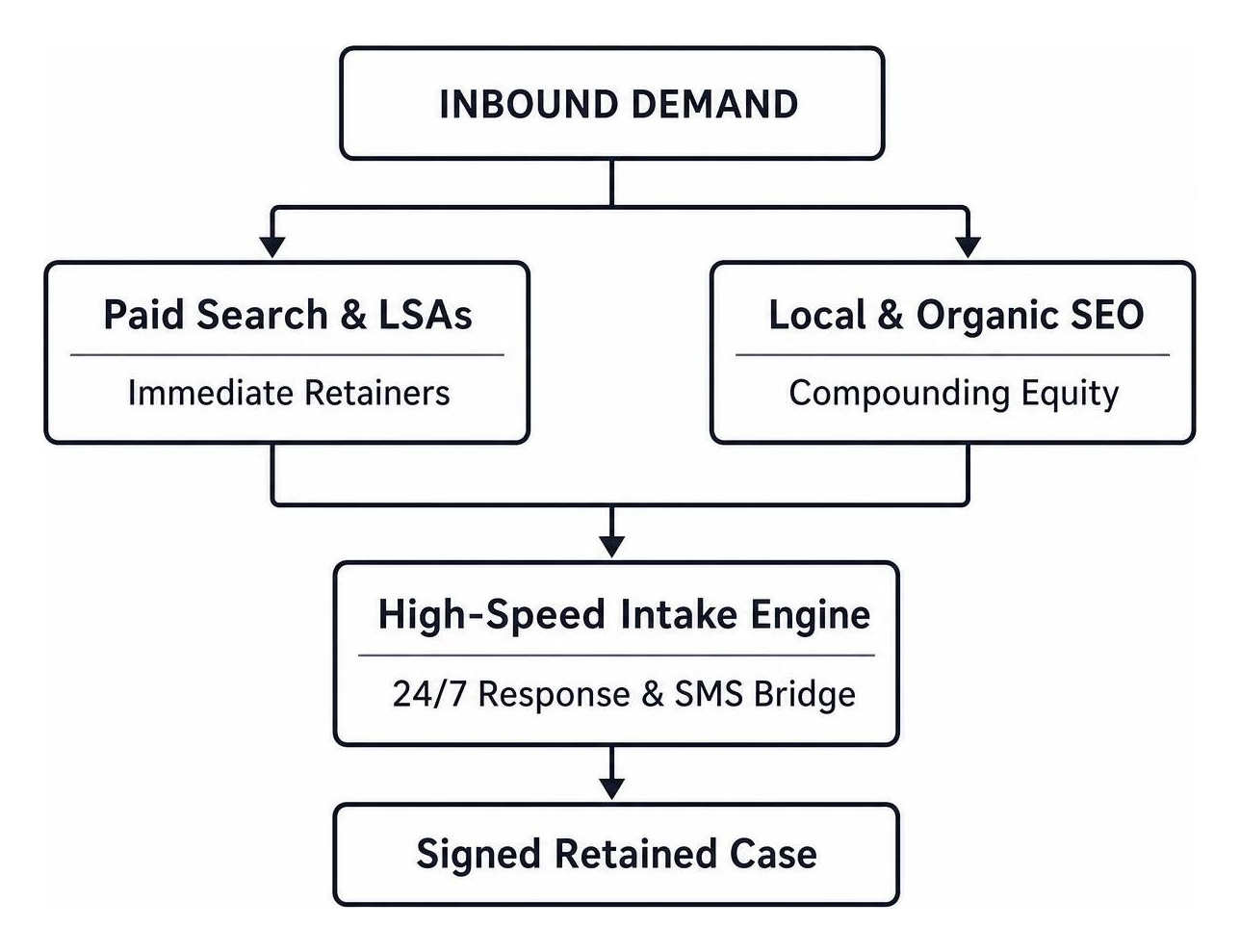
A data-backed SEO campaign captures prospective clients early in their decision-making process. By creating comprehensive content around specific injury symptoms, medical procedures, and recovery timelines, firms capture search traffic before a claimant contacts an insurer.
Targeting pre-injury and early recovery queries establishes credibility early. A searcher exploring post-concussion protocol after a motor vehicle accident needs immediate guidance. Supplying informative, helpful content positions your firm as the trusted authority when that reader decides to retain counsel. For systematic keyword discovery strategies, reference our guide on keyword research for law firms.
Navigating Google Ads Restrictions, Retargeting Rules, and Legal Compliance
Personal injury advertising faces stringent regulatory guardrails. Google's health in personalized advertising policies strictly prohibit retargeting users based on physical health conditions, bodily injuries, or medical treatments. Standard pixel-based remarketing that follows an injured claimant across the web with display banners can trigger immediate ad account suspension.
Firms must balance digital acquisition with State Bar advertising compliance. State bars in California and Texas enforce distinct guidelines regarding disclaimers, past settlement representations, client privacy, and non-guarantee statements. Misleading copy or improper fee disclosures put your firm's license at risk. Explore our breakdown of ethical SEO for sustainable compliance strategies.
Ensure your landing pages display the following elements to maintain total compliance:
- Clear attorney advertising disclaimers visible without scrolling.
- Explicit statements that past results do not guarantee future outcomes.
- Transparent fee structures, detailing contingency percentage terms and court cost responsibilities.
- Physical office addresses matching your registered State Bar profile.
Compliant Audience Building and Alternative Retargeting Strategies
Because direct health retargeting is restricted, personal injury practices must deploy alternative brand re-engagement models. Contextual display targeting lets your ads appear on relevant legal, automotive safety, and local news websites without tracking individual medical histories.
First-party data capture serves as your most resilient asset. When prospects download a free post-accident checklist or subscribe to a legal rights guide, your practice can engage them via automated email sequences. Build your automated client communication workflows using our email marketing guide for lawyers.
You can also use non-personalized video view engagement campaigns. When users watch your educational videos on YouTube or social platforms, you can serve general brand awareness ads to that viewership segment without violating sensitive personal data policies.
Video Content and Trust Building for Injured Claimants

Personal injury law is driven by trust and empathy. An injured claimant needs reassurance that their attorney cares about their recovery and possesses the trial strength to win. Video content delivers human connection faster than written text alone.
Firms that publish attorney bio videos, FAQs, and educational case breakdowns see increased dwell time on their websites. Video content humanizes the firm and provides visual reassurance to clients navigating complex trauma. Learn professional production techniques from our video production law firms guide 2026 and see how to showcase social proof with video testimonials for lawyers.
Budget Allocation and Tracking Cost Per Signed Case
Many personal injury firms evaluate marketing success by total lead volume. This metric creates a false sense of security. An agency can generate 200 cheap leads, but if only two sign retainers, your cost per acquisition skyrockets.
Data shows the average personal injury case resolution exceeds 11 months. Because revenue realization occurs months down the road, tracking cost per signed case (CPSC) is essential. Compare your metrics against our published law firm marketing benchmarks 2026 to ensure your media investment aligns with real industry performance.
Budget Allocation and Scaling Digital Marketing for Personal Injury Lawyers
A sustainable marketing budget matches your desired case mix and revenue targets. Catastrophic injury, commercial trucking, and traumatic brain injury claims warrant higher advertising acquisition budgets due to their substantial settlement values. Standard auto accident and premises liability claims require tight geographic targeting to maintain positive margins.
To learn more about firm growth frameworks, study our guide on how to market a law firm.
Plug leaks in your intake process before increasing ad spend. If inbound calls go to voicemail or forms sit uncontacted for hours, marketing dollars are wasted. Immediate intake response systems protect your investment and double your conversion rate.
Intake Automation, Reputation Management, and Referral Engines
Lead generation is only half the battle. Research reveals that just 21% of legal clients feel reassured that their legal team cares about their experience or asks for regular feedback. When clients feel neglected, online reviews suffer and referral opportunities disappear.
Improving client communication transforms your current caseload into an active referral engine. Automated text updates, milestone check-ins, and client portal integrations bridge the communication gap across the 11-month average case lifecycle. Evaluating an agency's ability to help you integrate these intake systems is covered in our breakdown on how to choose a personal injury marketing company.
Automated Review Generation and Local Authority
Online reviews represent the single most influential factor when consumers choose an attorney. Firms that implement automated satisfaction surveys and milestone review requests unlock dramatic growth. For instance, Pond Lehocky Giordano documented an 800% increase in 5-star Google reviews after deploying automated satisfaction surveys and improving client communication workflows.
Automate review requests when client sentiment peaks, such as immediately after a successful property damage resolution or upon settlement disbursement. Ensure your staff responds to every public review within 24 hours. Consistent, authentic responses signal professionalism to prospective clients and search engine algorithms.
Building Medical and Co-Counsel Referral Partnerships
A balanced case generation engine does not rely solely on paid media. Systematic referral marketing protects your firm from advertising market fluctuations. Establish structured outreach initiatives with local chiropractors, physical therapists, orthopedic surgeons, and non-competing legal practitioners.
Keep referral partners engaged with quarterly lunch meetings, co-branded educational safety webinars, and seamless co-counsel updates. Systematic relationship management yields consistent, pre-qualified personal injury cases at near-zero advertising cost.
Conclusion
Scaling a personal injury law firm in 2026 requires an end-to-end client acquisition system. By combining high-intent Google search ads, Local Services Ads, technical SEO, and rapid intake follow-up, your practice can secure high-value cases profitably.
Sustainable firm growth happens when marketing acquisition connects directly with modern intake systems and exceptional client communication.
At Outlier Creative Agency, we design compliant, high-performing growth systems tailored specifically for legal practices. If you want to audit your marketing economics, refine your paid search spend, or scale your signed caseload, explore our personal injury marketing solutions or book a strategy consultation with our team.
Frequently Asked Questions About Personal Injury Marketing
Why are Google Ads retargeting campaigns restricted for personal injury lawyers?
Google enforces strict personalized advertising policies regarding user health and sensitive personal circumstances. Because personal injury claims imply physical trauma, bodily damage, or medical care, serving personalized retargeting ads based on specific page visits is prohibited. Firms must use search ads, contextual display ads, and organic SEO to build visibility.
What is a good cost per signed case for a personal injury law firm?
Cost per signed case varies based on geographic competition and case type. For motor vehicle accidents in competitive markets like Los Angeles or Austin, target CPSC ranges between $1,500 and $3,500. For high-value claims such as commercial trucking, wrongful death, or severe traumatic brain injuries, an acquisition cost of $4,000 to $8,000 remains profitable relative to gross legal fees.
How long does it take for personal injury SEO to generate signed cases?
Personal injury SEO is a medium to long-term investment. Most firms see initial indexation and rank improvements in months 3 through 6. Consistent inbound phone calls and signed cases typically accelerate between months 6 and 12 as authority signals and local map pack rankings solidify. For example, a Philadelphia personal injury firm achieved a 10x increase in monthly organic leads and generated over $500,000 in case settlements within 8 months of comprehensive technical, local, and content SEO execution.
How can a personal injury firm scale signed cases without retargeting?
Focus on high-intent Google Search Ads, Local Services Ads, and local SEO. Send visitors to fast, clear pages about the cases you want to sign, then track each lead through intake to a signed case. Use cost per signed case, not just cost per lead, to decide where to spend more. Build first-party data capture through downloadable post-accident checklists and legal rights guides, then engage prospects through automated email sequences.
What role does intake speed play in personal injury marketing ROI?
Intake speed directly determines whether ad spend converts into signed cases. If inbound calls go to voicemail or forms sit uncontacted for hours, marketing dollars are wasted. Immediate intake response systems protect your investment and can double your conversion rate. Plug leaks in your intake process before increasing ad spend.