

Build a predictable client pipeline with modern online marketing for lawyers, from SEO and PPC to ethical compliance and ROI tracking.
How Online Marketing for Lawyers Builds a Client Pipeline
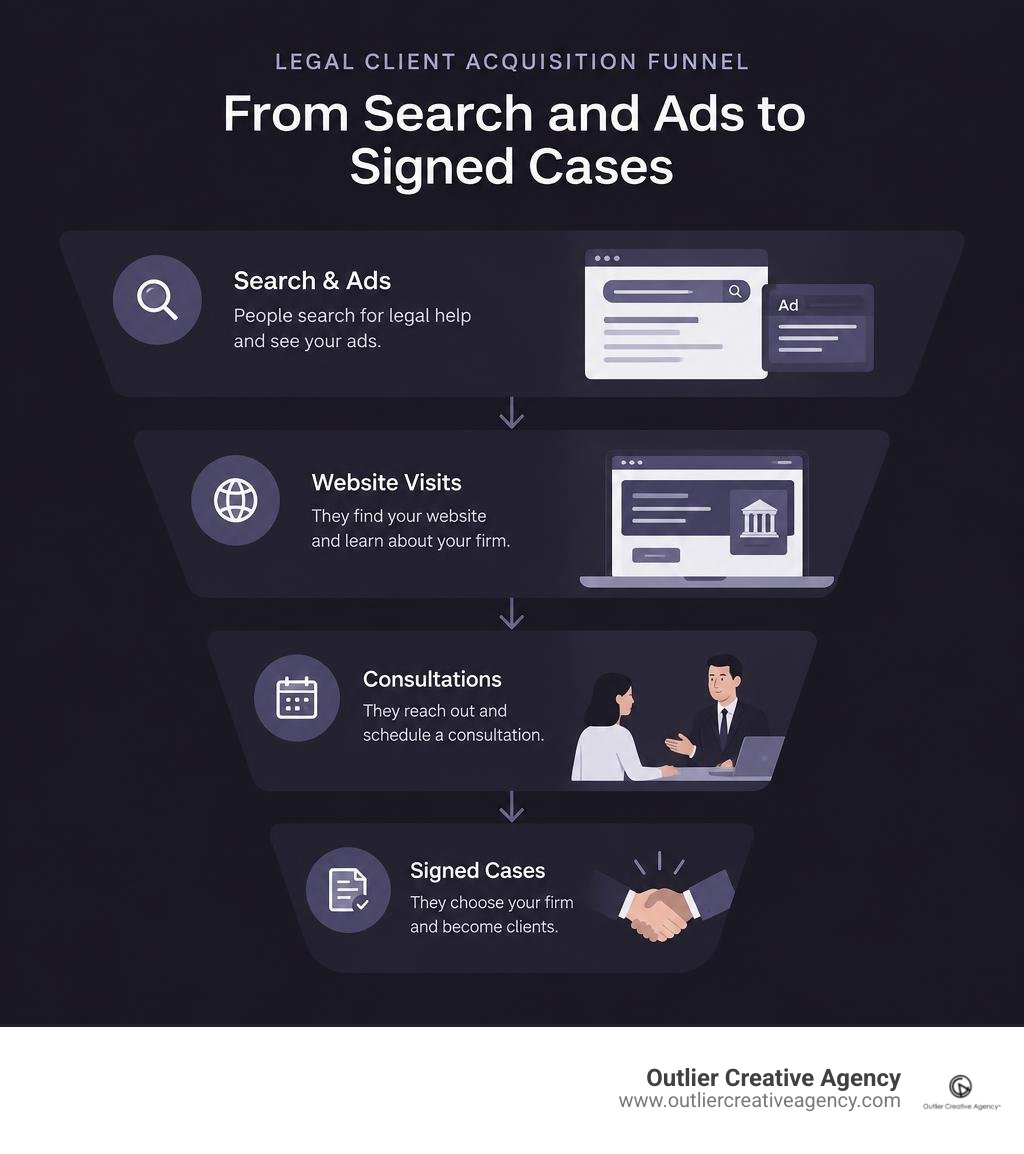
Online marketing for lawyers starts with a clear path from search to signed case. Build a fast website that makes it easy to contact your firm. Use local SEO to reach people looking for legal help, and targeted ads when you need leads sooner. Publish useful content, earn reviews, and track which inquiries become clients. Check every message against legal advertising rules before it goes live.
These channels work best together. A search result may bring someone to your site, but a clear practice page, credible reviews, and a simple intake process help turn that visit into a consultation.
I’m Corey Larson. At Outlier Creative Agency, I work with legal experts to create websites, video, social media, and content for online marketing for lawyers. Here’s how to put those pieces together.
5 Foundational Pillars of Online Marketing for Lawyers
Building a reliable client acquisition engine requires an integrated system. Relying solely on referrals creates revenue volatility. Today, 96% of consumers use search engines when looking for legal advice, and 81% research legal services online before making contact.
A complete strategy connects five operational pillars:
- High-converting website architecture
- Intent-driven organic search (SEO)
- High-yield paid advertising (PPC and LSAs)
- Active reputation management
- Compliance-first conversion systems
For practices in competitive sectors like personal injury marketing, these pillars turn casual web traffic into qualified caseloads.
Building High-Converting Law Firm Websites
Your website is the center of your marketing funnel. When a prospective client arrives, they are often in high-stress situations involving car accidents, workplace injuries, or contested divorces. Friction on your site drives them directly to a competitor.
Ensure your site meets these core technical requirements:
- Mobile responsiveness: Over 60% of legal searches originate on mobile devices.
- Page load speed: Pages must load in under 2.5 seconds to minimize bounce rates.
- Clear calls to action (CTAs): Direct phone numbers and consultation buttons must remain visible above the fold on all screen sizes.
- Streamlined intake forms: Keep initial forms short. Ask for essential contact details and brief incident descriptions.
- Integrated live chat: Provide 24/7 responsiveness to capture after-hours inquiries immediately.
Investing in professional web design services ensures your digital infrastructure converts visitors into qualified consultations.
Setting Up Multi-Channel Acquisition Funnels
A single touchpoint rarely secures a high-value case. Modern legal consumers follow the classic AIDA funnel (Awareness, Interest, Desire, Action) before signing a retainer.
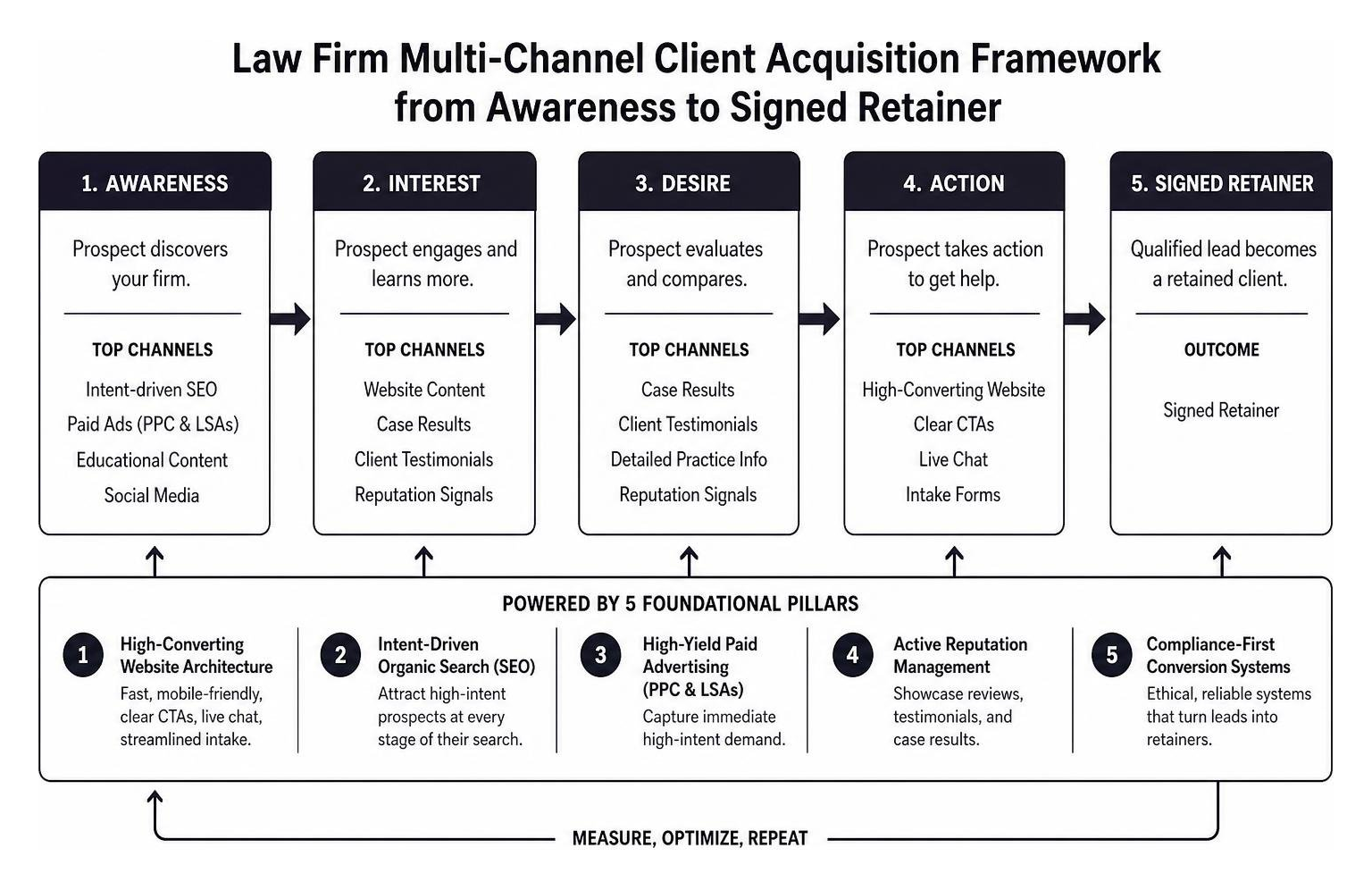
Top-of-funnel prospects might first discover your educational video about car accident settlement timelines. Mid-funnel prospects evaluate your case results and client testimonials. Bottom-of-funnel prospects search for direct legal representation.
Firms scaling their practices must coordinate multiple digital touchpoints to capture prospects at every stage of intent. Understanding how to market a law firm across touchpoints creates a sustainable pipeline.
Organic Search Strategies to Capture High-Intent Legal Leads
Google processes roughly 90% of global search traffic, making organic visibility vital. Only 2% to 3% of searchers click to the second page of Google, and the top organic result earns up to 35% more clicks than the tenth result.
Organic legal search requires topical depth, rigorous site architecture, and authoritative backlinks. Learn more about search architecture in this SEO for lawyers guide.
Our comprehensive SEO services focus on structuring practice area content hubs that establish clear topical authority.
Local Search Strategies in Online Marketing for Lawyers
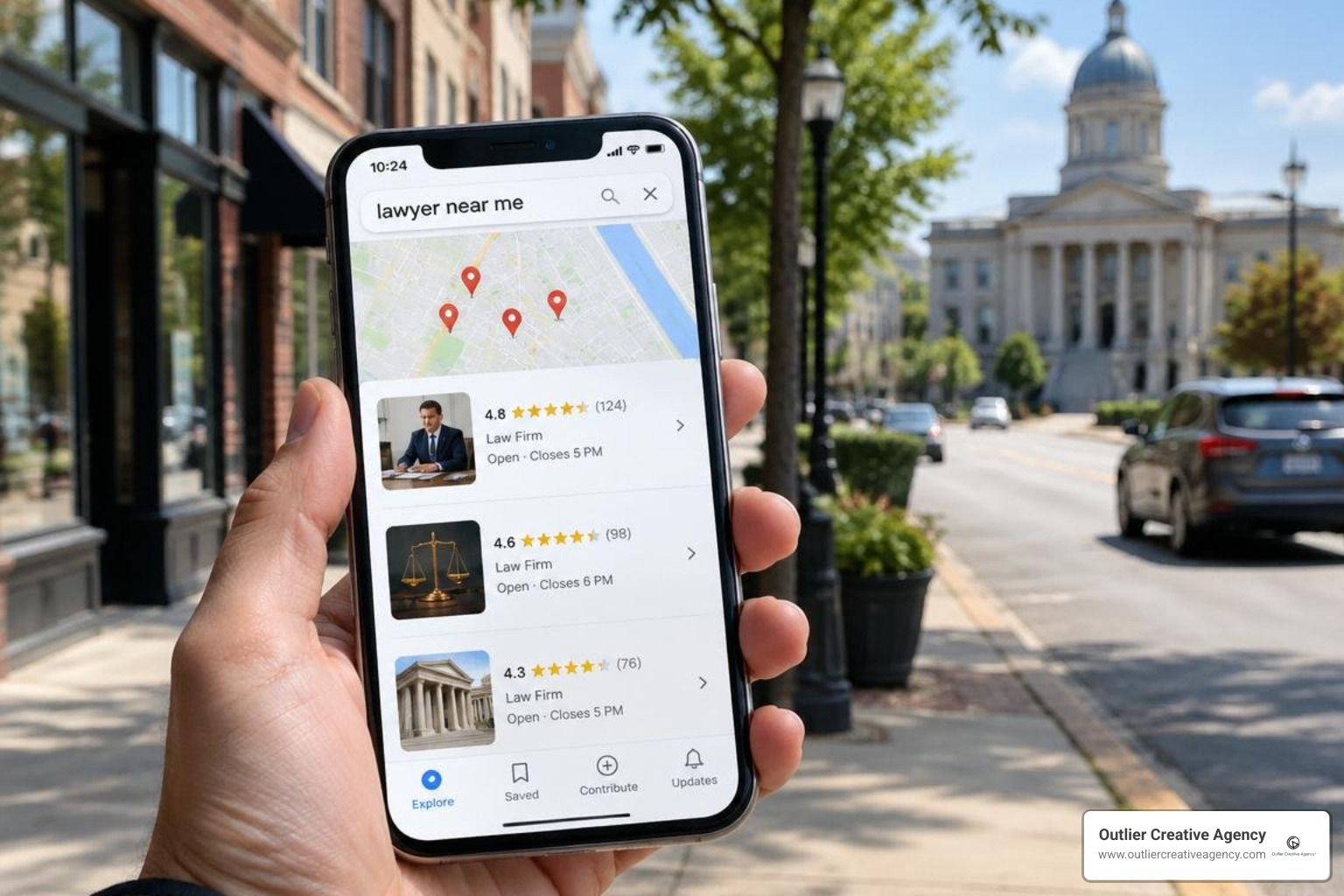
Between November 2020 and November 2025, searches for "attorney near me" surged by 81%. For searches with local intent, the Google Local 3-Pack appears above organic listings 93% of the time.
Appearing in the Local 3-Pack captures 44% of total search clicks, providing up to a 400% increase in views and a 100% lift in direct phone calls.
To dominate local search in major competitive markets:
- Maintain strict Name, Address, and Phone (NAP) consistency across all legal directories.
- Fully complete your Google Business Profile (GBP) categories, service areas, and operational hours.
- Generate regular client reviews and respond promptly to all feedback.
- Build localized landing pages targeting surrounding neighborhoods and municipalities.
Firms in competitive metropolitan markets can leverage targeted regional playbooks like Los Angeles SEO for lawyers or our dedicated law firm SEO agency Austin strategies to maximize local pack visibility.
Ethical AI Content and Online Marketing for Lawyers
Google evaluates legal websites under its strict "Your Money or Your Life" (YMYL) guidelines. Legal advice directly impacts a consumer's financial stability, freedom, and health. As a result, Google demands high Experience, Expertise, Authoritativeness, and Trustworthiness (E-E-A-T).
Firms can use AI tools ethically to draft outlines, generate structured FAQ schema, or create title tags. However, substantive legal content must involve licensed attorneys.
To maintain E-E-A-T standards:
- Feature detailed attorney author bios with bar admission numbers, credentials, and notable case histories.
- Ensure all statutory explanations are reviewed and signed off by qualified legal counsel.
- Avoid publishing generic, automated legal content that fails to address specific state statutes.
Learn how specialized practices maintain these quality signals in our guide to digital marketing for personal injury lawyers.
Paid Search and High-Yield Advertising for Legal Practices
Paid search provides immediate visibility for high-intent queries while organic search builds long-term authority. The legal industry achieves some of the highest conversion rates across Google Ads because paid search intercepts consumers at the exact moment legal help is required.

Discover additional practical steps in the American Bar Association guide on how to get clients as a lawyer.
Our managed PPC services focus on eliminating wasted spend to maximize your cost-per-acquisition.
Pay-Per-Click Strategies for High-Value Cases
Legal keywords are among the most expensive in Google Ads auctions. Broad keyword targeting quickly drains marketing budgets on unqualified clicks.
To maintain efficient cost-per-lead numbers:
- Use exact match and phrase match keyword targeting for high-intent terms like "truck accident lawyer."
- Build extensive negative keyword lists to exclude terms like "pro bono," "salary," or "law school."
- Implement dayparting to run ads only during hours when intake staff can immediately answer calls.
- Route ad clicks to dedicated landing pages featuring distinct phone numbers and clear consultation forms.
Review proven ad models in our breakdown of law firm advertising strategies.
Local Services Ads and Google Screened Badges
Google Local Services Ads (LSAs) appear at the absolute top of the search engine results page, above traditional paid ads and organic results.
LSAs operate on a pay-per-lead model rather than pay-per-click. Law firms pay only when a prospective client calls or messages directly through the ad. Earning the green "Google Screened" badge requires passing state bar license verifications and background checks. This badge establishes immediate trust and drives high-intent phone calls directly to your intake team.
Authority Building Through Social Media, Email, and Reputation Management
Converting prospective clients requires social proof. Research shows 82% of consumers who contact an attorney after finding them online review ratings before making contact.
Explore broader firm development techniques in this law firm marketing guide.
Our integrated social media services humanize your firm while maintaining strict legal compliance.
Review Acquisition and Reputation Management
Client reviews provide the social proof needed to turn search impressions into consultations.
Systematize review collection with these steps:
- Automate SMS and email review requests immediately following a successful settlement or case resolution.
- Provide a direct link to your Google Business Profile to eliminate friction.
- Maintain active profiles on authoritative legal directories such as Avvo, Justia, and Martindale-Hubbell.
- Respond professionally to all reviews. Thank positive reviewers and address critical feedback without disclosing confidential case details.
Webinar Marketing and Automated Email Sequences
Webinars serve as effective mid-funnel lead generation tools for complex practice areas like estate planning, business litigation, and employment law.
Hosting an educational session on statutory updates or common claim mistakes positions your firm as an authority. After the session, use segmented email campaigns based on attendee engagement. Send follow-up case studies, downloadable legal checklists, and simple calendar booking links.
Scale your nurture sequences with dedicated email marketing services.
Navigating Legal Ethics and Advertising Compliance
Legal marketing requires strict adherence to regulatory rules. Violations lead to bar sanctions, financial penalties, and reputational damage. Review essential legal requirements through this overview of internet advertising and marketing law.
| Marketing Channel | Governing Regulations | Primary Compliance Requirements |
|---|---|---|
| SMS / Direct Messaging | TCPA, FCC Guidelines | Prior express written consent, clear opt-out mechanisms. |
| Email Campaigns | CAN-SPAM Act | Conspicuous unsubscribe links, physical postal address, accurate headers. |
| Search & Social Ads | State Bar Ethics Rules | Mandatory advertising disclaimers, no misleading guarantees. |
| Website & Landing Pages | State Bar Rules, FTC | Prominent "Past results do not guarantee future outcomes" disclaimers. |
Federal Regulations: TCPA, CAN-SPAM, and Data Privacy
Direct digital marketing channels carry federal compliance obligations:
- Telephone Consumer Protection Act (TCPA): Automated text messages and telemarketing require documented, express written consent. Non-compliance results in statutory penalties per violation.
- CAN-SPAM Act: Commercial marketing emails must include an accurate physical postal address and a functional one-click unsubscribe mechanism.
- Data Privacy Policies: Law firm websites must feature clear privacy policies outlining data collection, storage, and retention practices to protect client confidentiality.
State Bar Advertising Rules and Disclaimers
State bar associations enforce distinct advertising ethics rules.
Common ethical requirements include:
- Past results disclaimers: Conspicuously state that prior case outcomes do not guarantee similar results in future matters.
- Specialization rules: Avoid terms like "expert" or "specialist" unless officially certified by your state bar board of legal specialization.
- Actor and dramatization notices: Disclose any use of paid actors or simulated scenes in video and social advertisements.
For specific regional requirements, consult our California attorney marketing guide.
Tracking Performance and Legal Marketing Return on Investment
Marketing without detailed tracking wastes capital. Modern firms must evaluate campaign performance based on signed retainers and acquisition cost rather than vanity metrics.
Review complete benchmarking frameworks in our lawyer marketing guide.
Essential Metrics for Modern Law Firms
Track these core metrics monthly to gauge campaign performance:
- Cost Per Qualified Lead (CPQL): The total marketing spend divided by the number of vetted potential clients.
- Intake Conversion Rate: The percentage of inbound calls and form submissions that convert into scheduled consultations.
- Client Acquisition Cost (CAC): Total marketing and intake expenditures divided by the number of signed retainers.
- Average Case Value: The gross fee generated per signed case compared across marketing channels.
Marketing Analytics and Legal CRM Tools
Connect your marketing channels to a legal customer relationship management (CRM) platform like Law Ruler, Lead Docket, or Clio Grow. Use dynamic call tracking tools like CallRail to attribute every phone call and web form directly to its original keyword, ad campaign, or local directory.
Integrating CRM automation allows your partners to identify exactly which channels yield high-value retainers and reallocate marketing budgets accordingly.
Build a Predictable Legal Client Pipeline with Outlier Creative Agency
Building a predictable, scalable client pipeline requires moving away from fragmented marketing tactics. Combining technical web architecture, local map dominance, disciplined paid search, and strict ethical compliance creates an asset that consistently generates high-value caseloads.
Outlier Creative Agency provides specialized, end-to-end growth strategies designed exclusively for ambitious legal practices nationwide. If you are ready to expand your market footprint and build a data-driven acquisition engine, explore our tailored legal marketing solutions and reach out to schedule an introductory consultation with our team.
Frequently Asked Questions About Legal Digital Marketing
How long does it take for legal SEO to generate signed cases?
On average, a comprehensive legal SEO campaign begins delivering measurable organic visibility, phone calls, and signed cases within 3 to 6 months. In competitive metro areas and practice areas like personal injury, establishing top-tier map pack dominance often requires 6 to 12 months of consistent optimization.
Should a law firm prioritize SEO or PPC advertising first?
If your firm needs immediate consultation volume, paid search (PPC and Local Services Ads) delivers near-instant lead flow. However, PPC costs cease generating returns the moment ad spend stops. The most resilient law firms deploy a hybrid approach, using PPC for immediate cases while building compounding organic authority through SEO.
How can law firms track marketing ROI without tracking non-billable hours?
Implement a legal CRM paired with dynamic call tracking numbers. This infrastructure tags every inbound lead with its exact marketing source, calculates total cost per acquisition, and tracks final case revenue when settlements or judgments clear.
Who can help my firm put these strategies into practice?
Outlier Creative Agency works exclusively with law firms to build these integrated acquisition systems, from website architecture to compliant paid campaigns. If you would like a second opinion on your current marketing mix, consider scheduling a consultation with our team to discuss your firm's goals.
Related serviceMarketing for law firms